Why Is It Called Pismo Beach? A Chumash Word for Tar
Pismo comes from pismu', the Obispeño Chumash word for tar, according to a 1975 study cited in a city report. The name passed to Rancho El Pismo and to the town of El Pismo laid out in 1886. Pismo became Pismo Beach in 1923, a change made for promotion.
Pismo Beach, California, takes its name from pismu’, a Chumash word for tar, by way of Rancho El Pismo; the word Beach was added in 1923. A 1914 book guessed fish and a 1916 one gave up before a 1975 study tied it to tar.
Why is it called Pismo Beach?
Start with the ground. An environmental report for the City of Pismo Beach on Price Canyon says people dug bituminous sandstone out of this area from roughly 1880 to 1930 and shipped it out for asphalt paving. The same report gives the name: “The name Pismo is derived from the Obispeño word pismu’ meaning tar.” It credits that to a 1975 work by Applegate, page 38.
The report adds that the name “may have been the name of a village located in Price Canyon,” then hedges: other evidence suggests the canyon fell under a village called Chiliquini. So the word is pinned down better than the spot.
The city’s police department tells it more simply in its own history page: the Chumash “referred to Pismo as a place to find ‘pismu’, or tar, which later evolved into the name of this coastal community.”
What does Pismo mean? The fish theory
If you’ve heard that Pismo means place of fish, that idea goes back to 1914. That year Nellie Van de Grift Sanchez wrote in Spanish and Indian Place Names of California that Pismo was “an Indian word said to mean ‘place of fish’, but this definition is not based upon scientific authority.” She flagged it herself, so it’s a curiosity rather than a rival.
Two years later, A. L. Kroeber wouldn’t guess at all. “Pismo, in San Luis Obispo County, is of unknown origin,” he wrote in 1916. “The place was in Chumash Indian territory, and the name sounds like good Chumash.”
Pismo Beach history: a rancho, El Pizmo and the word Beach
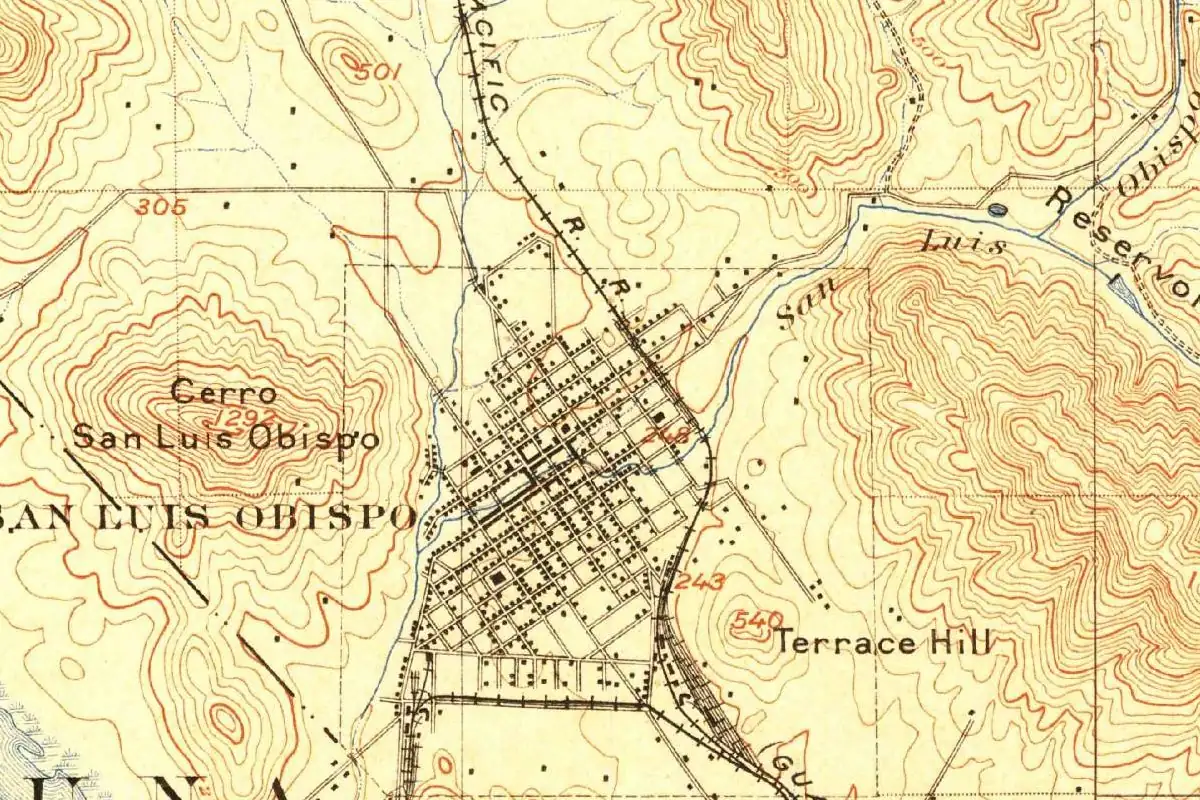
Pismo Beach sits in California’s San Luis Obispo County, which shares its name with the old mission town of San Luis Obispo. The name Pismo traveled through a ranch. The police history says a ranch of about 7,000 acres (2,833 ha) was granted to José Ortega in 1846 and sold to Isaac J. Sparks, and that John M. Price bought the property, “known as Rancho El Pismo,” in 1848. The city’s Price Canyon report dates it later: Price’s “deed for one half of the Pismo Rancho was dated 1852.” The police history makes him alcalde in 1848, a post the history describes as part judge and part peace officer, and Price Canyon still carries his name.
Price had a town called “El Pismo” subdivided in 1886, the same history says, and a year later it was recorded as the “Town of El Pizmo.” Federal name records still carry El Pizmo among the city’s alternate spellings. The Southern Pacific reached Pismo in 1895 and brought tourists in by train. The city itself gives 1891 as its founding year.
Then came the rebranding. “The name of the community was changed from Pismo to Pismo Beach in 1923,” the police history says, adding that the new word on the post office name “was surely done for its promotional value.” The next year, the town dedicated a new pier for visitors.
Pismo wasn’t the only town to add the word. In Florida, Vero became Vero Beach in 1925, and a city survey there says local leaders added the word to promote growth and tourism. Delray Beach, Florida, got its “Beach” through a union of two towns in 1927.
The city that came and went
Becoming a city took several tries. The police history says voters turned down incorporation in 1926 and 1935, then approved it by seven votes, 205 to 198, and Pismo Beach became a city on January 11, 1939. It didn’t last. In an election on February 27, 1940, residents voted 259 to 251 to disincorporate. The city came back for good on April 25, 1946, after a vote of 245 to 216.
Pismo on the 1897 map
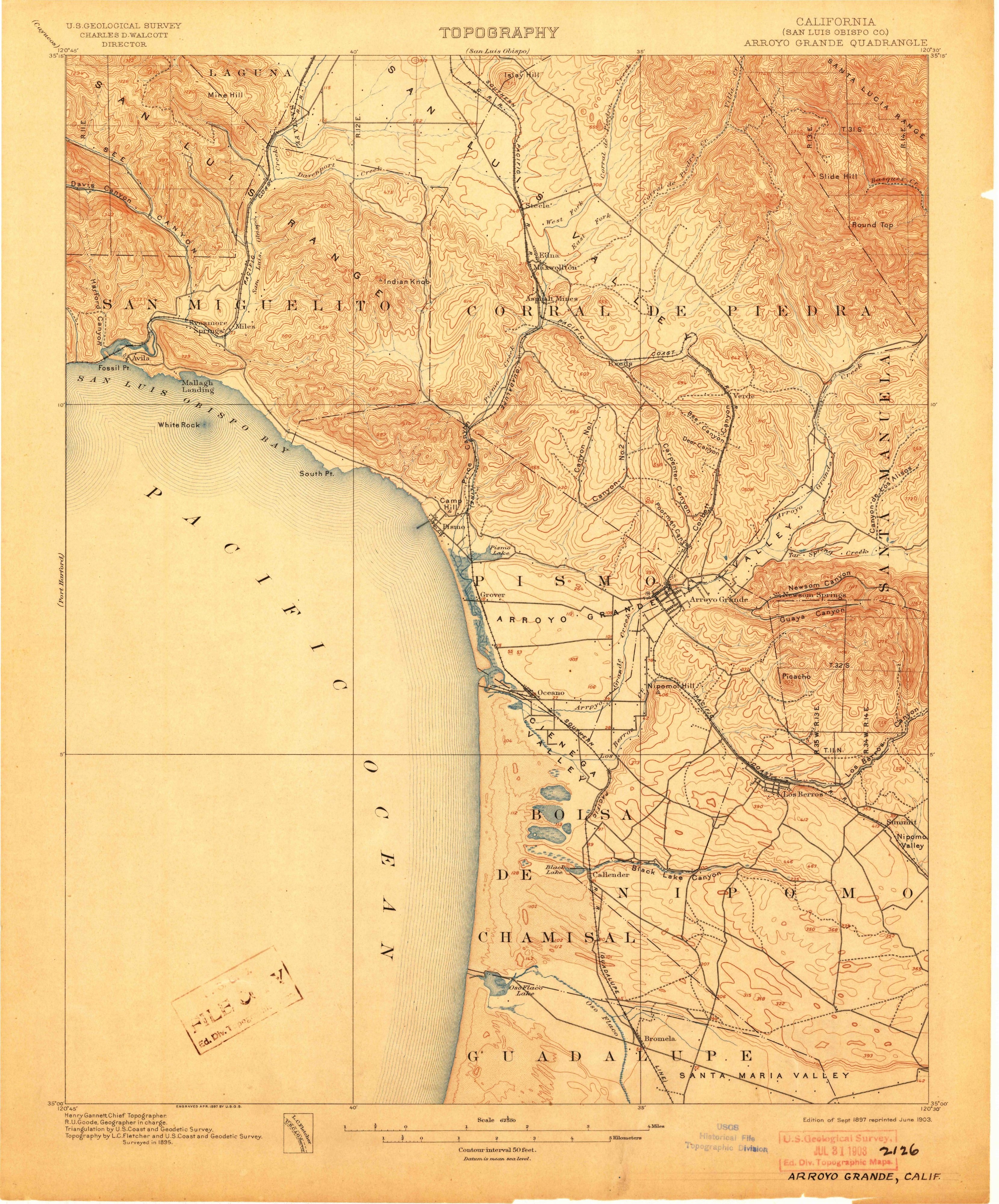
The map at the top was cropped from the Arroyo Grande quadrangle, at 1:62,500, from the U.S. Geological Survey. The margin lists Charles D. Walcott as director and Henry Gannett as chief topographer, credits the topography to L. C. Fletcher and the Coast and Geodetic Survey, and reads “Surveyed in 1895” and “Engraved Apr. 1897.” This copy is a reprint: a line in the bottom margin reads “Edition of Sept 1897 reprinted June 1903,” and a Survey stamp on it is dated July 31, 1903.
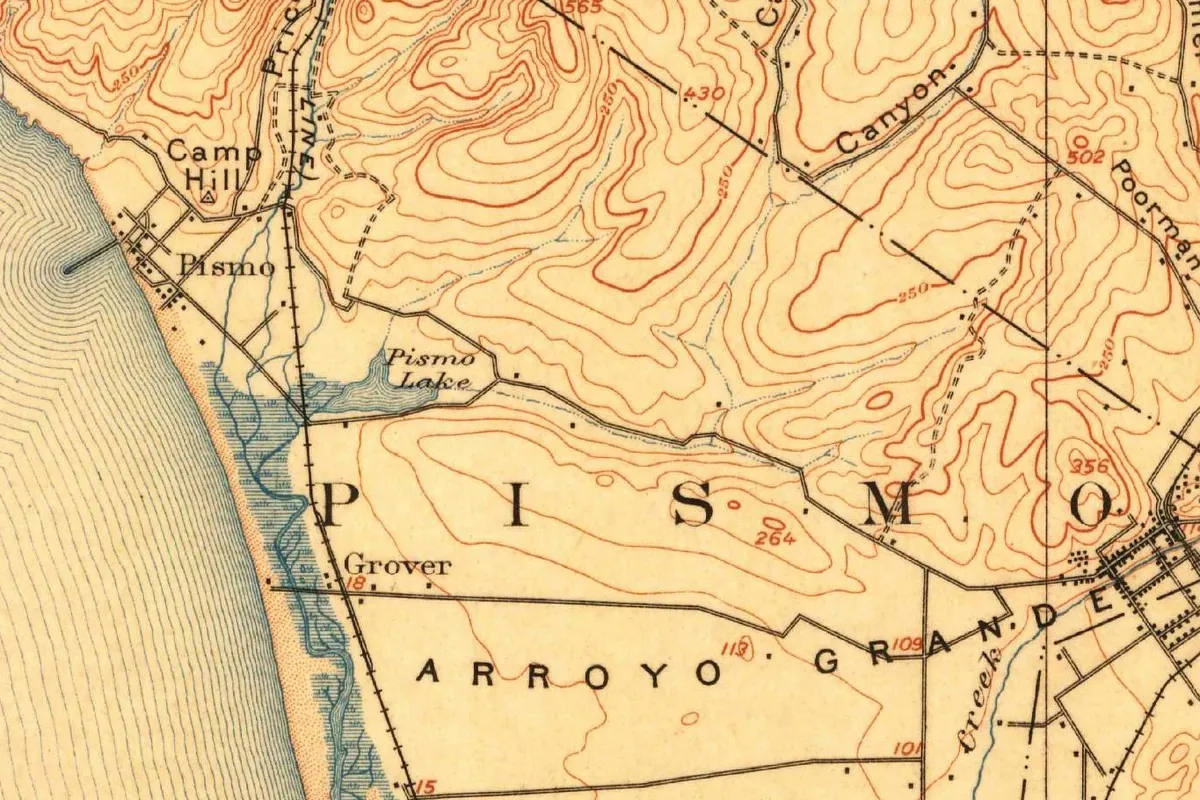
Look closely and you’ll see the town lettered Pismo in small type on the shore, with a line running straight out into the water. South of Pismo Lake, the letters P I S M O are spread in big type across the flat land, and Arroyo Grande is spaced out the same way below them, running toward a town grid at the right edge. Grover, Camp Hill and a railroad line are there too.
Quick answers
What does Pismo mean?
Tar. A 1975 work cited by the city traces Pismo to pismu’, the Obispeño word for tar, and bituminous sandstone was mined in the area for paving.
Does Pismo mean “place of fish”?
Probably not. Nellie Sanchez printed that meaning in 1914 but warned it had no scientific basis.
When did Pismo become Pismo Beach?
In 1923, according to the police department’s history, which says the new name was for promotion.
Key dates
- 1846A ranch of 7,000 acres here is granted to José Ortega, the police history says.
- 1848The police history has Rancho El Pismo sold to John M. Price; a city report dates his deed for half the rancho to 1852.
- 1886Price has the town of El Pismo subdivided; a year later it's recorded as the Town of El Pizmo.
- 1895The Southern Pacific reaches Pismo, bringing tourists by train.
- 1897The Arroyo Grande quadrangle, surveyed in 1895, labels Pismo on the coast.
- 1914Nellie Sanchez prints the "place of fish" meaning, with a warning that it has no scientific basis.
- 1916A. L. Kroeber calls the name of unknown origin but likely Chumash.
- 1923Pismo becomes Pismo Beach.
- 1939Pismo Beach incorporates on January 11, then votes to disincorporate in February 1940.
- 1946The city incorporates again on April 25.
Things to do in Pismo Beach, California
Pismo Pier
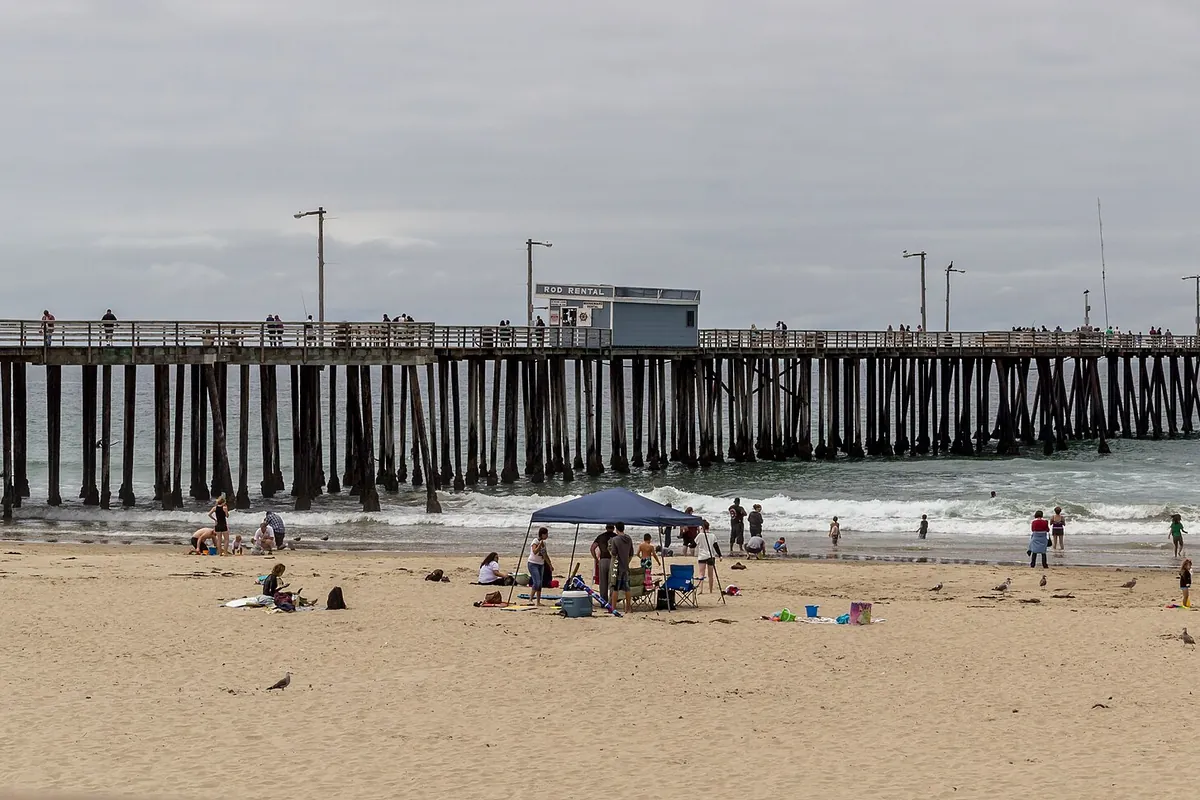
The town's 1,200-foot (366 m) pier, which the city recommends for walking, fishing, sightseeing and watching the sun go down over the Pacific.
Dinosaur Caves Park
An 11-acre (4.5 ha) city park on the bluffs above the ocean, named for a concrete brontosaurus a shop owner started building in the 1940s to pull drivers into his sea-cave attraction, the Caves of Mystery.
Pismo State Beach
A Central Coast state beach where you can camp, take a hike, swim or fish from the surf.
Pismo State Beach Monarch Butterfly Grove
A protected grove of tall eucalyptus and Monterey cypress where western monarch butterflies gather to spend the winter, one of the largest such sites in the state.
Getting there
Open Pismo Beach in Google Maps
Opens in a new tab. The pin is the center of Pismo Beach in the USGS place-name record.
The closest airports, Amtrak stations and intercity bus stops, measured in a straight line from the center of Pismo Beach.
Airports
- San Luis Obispo County Regional (SBP) 7 mi 11 km
- Santa Maria Public/Capt G Allan Hancock Field (SMX) 20 mi 32 km
- Hollywood Burbank (BUR) 145 mi 234 km
Amtrak trains
- Grover Beach station (GVB) 2 mi 3 km
- San Luis Obispo station (SLO) 9 mi 15 km
Intercity buses
- Amtrak Chartered Vehicle Amtrak Connecting Service · Grover Beach Amtrak 2 mi 3 km
- FlixBus San Luis Obispo Santa Barbara Avenue 9 mi 14 km
- CLAS Amtrak Connecting Service · San Luis Obispo 9 mi 15 km
Distances are as the crow flies, not by road. We don't list schedules or fares because they change; check with the airline, Amtrak or the bus company before you go. Official data (FAA commercial service airports (2025), FAA airport locations, Amtrak stations and Intercity Bus Atlas) from the FAA and the U.S. Bureau of Transportation Statistics, checked Nov 18, 2026.
Sponsored
Staying in Pismo Beach?
Compare hotels in Pismo Beach, California, on Expedia.
See hotels in Pismo BeachWe may earn a commission if you buy through this link. It never changes what we write. Read our affiliate disclosure
Historical Sources & References
- City of Pismo Beach, Price Canyon EIR, sections IV-C and IV-E. Pismo from the Obispeño pismu’, “tar” (citing Applegate, 1975), the possible village in Price Canyon and Chiliquini (citing Gibson, 1983), and Price’s 1852 deed (p. IV-E4); the mining of bituminous sandstone from about 1880 to 1930 (p. IV-C4).
- City of Pismo Beach Police Department, “Department History” (Gary Hoving, 2003). Pismu and the Chumash; the grants of 1846 and 1848; John M. Price; El Pismo and El Pizmo; the railroad in 1895; the name change of 1923; the incorporation votes of 1939, 1940 and 1946.
- A. L. Kroeber, California Place Names of Indian Origin (1916), p. 55. “Of unknown origin” but “good Chumash.” Checked against the page image.
- Nellie Van de Grift Sanchez, Spanish and Indian Place Names of California (1914), p. 128. “Place of fish,” with her own caveat. Checked against the page image.
- City of Pismo Beach, “Living & Visiting” and Dinosaur Caves Park; California State Parks, Pismo State Beach and the Monarch Butterfly Grove. The founding year of 1891 and the details in the things-to-do list.
- U.S. Geological Survey, GNIS feature 1652776. Pismo Beach’s federal record, listing El Pizmo and Pismo as variants.
- Arroyo Grande quadrangle, surveyed 1895, edition of September 1897, reprinted June 1903. The sheet the map at the top was cropped from.
Sponsored
Put this 1897 map on your wall
The Geological Survey's Arroyo Grande sheet, surveyed in 1895 and shown here in a June 1903 reprint, with Little Pismo on the shore, is in the public domain. Download the full-size scan for free, then have it printed on canvas with CanvasOnTheCheap.
Print a map on canvasDownload the full-size mapWe may earn a commission if you buy through this link. It never changes what we write. Read our affiliate disclosure
Spot something wrong, or know more? Tell us here. You can also email us or use our contact page. Corrections are noted here with their date, never made silently.