Santa Maria, California, Was Central City Until 1882
Santa Maria, California, was laid out in 1874 and 1875 as Central City. Its post office kept the older name Santa Maria, borrowed from the valley and river. In 1882 the town took that name too, and the local historical society says mail for Central City kept ending up in Central City, Colorado.
A town with somebody else’s post office
For its first few years Santa Maria, California, was a town called Central City, and its post office was already named Santa Maria. The town caught up with its mail in 1882, when Central City became Santa Maria for good. So the name didn’t come from the founders. It came from the valley, by way of the post office.
The town started at a crossroads of four farms. The Santa Maria Valley Historical Society says Rudolph Cook, John Thornburgh, Isaac Fesler and Isaac Miller each held a quarter section of land, and in 1874 they gave strips where their properties met and laid out Central City. The map was recorded at the county seat on April 12, 1875. That corner is now Broadway and Main Street.
“Its official title remained unchanged”
A Thompson & West history of the county, printed in 1883, explains the mix-up better than anybody since. Mail for the area, it says, had been handled at Dana’s place on the Nipomo ranch under the name Santa Maria. When the office moved into the new town, the name came with it:
“The post-office for this vicinity had been kept at Dana’s place on the Nipoma Ranch, and known as the Santa Maria office. Though transferred to Central City at this time, its official title remained unchanged.”
So for several years you could live in Central City and get your letters at the Santa Maria post office. The same 1883 book still calls the town Central City from start to finish, which tells you the old name hung on in print for a while.
The mail that went to Colorado
The change came in 1882. The historical society ties it to the narrow-gauge Pacific Coast Railroad, which reached town that spring, and to a practical problem: mail meant for the township “had a way of showing up in Central City, Colorado.” Its timeline puts the last spike of the line from San Luis Obispo on April 15, 1882, the first issue of the Santa Maria Times on April 22, and the name change that same April.
The old book backs up the newspaper date. It says the Times “came into existence April 22, 1882,” and by 1891 another county history was writing “the town of Central City (now Santa Maria).” The Colorado mail story comes from the historical society, though. We haven’t found it in a source from the 1880s, so take it as the local explanation rather than something on paper from the time.
Where the valley got the name
Santa Maria is Spanish for Saint Mary, and that’s where things get less tidy. Nellie Van de Grift Sanchez, writing about California place names in 1914, said the name was given “in honor of the mother of Christ” and left it there. An 1891 county history by Yda Addis Storke told it another way:
“This valley was named from an Indian called Santa Maria, and the title at first related to but a small part of it, but it was later extended to the whole valley and stream.”
Neither book says who the man was, when the name first showed up, or how either writer knew. On the order of things, though, the record is clearer. Storke says the name started on a small piece of land and spread to the whole valley and stream, and the 1883 history shows a Santa Maria post office at Dana’s place on the Nipomo ranch before Central City existed. Both point the same way: the name was on the land first, and the town borrowed it.
A city of the sixth class
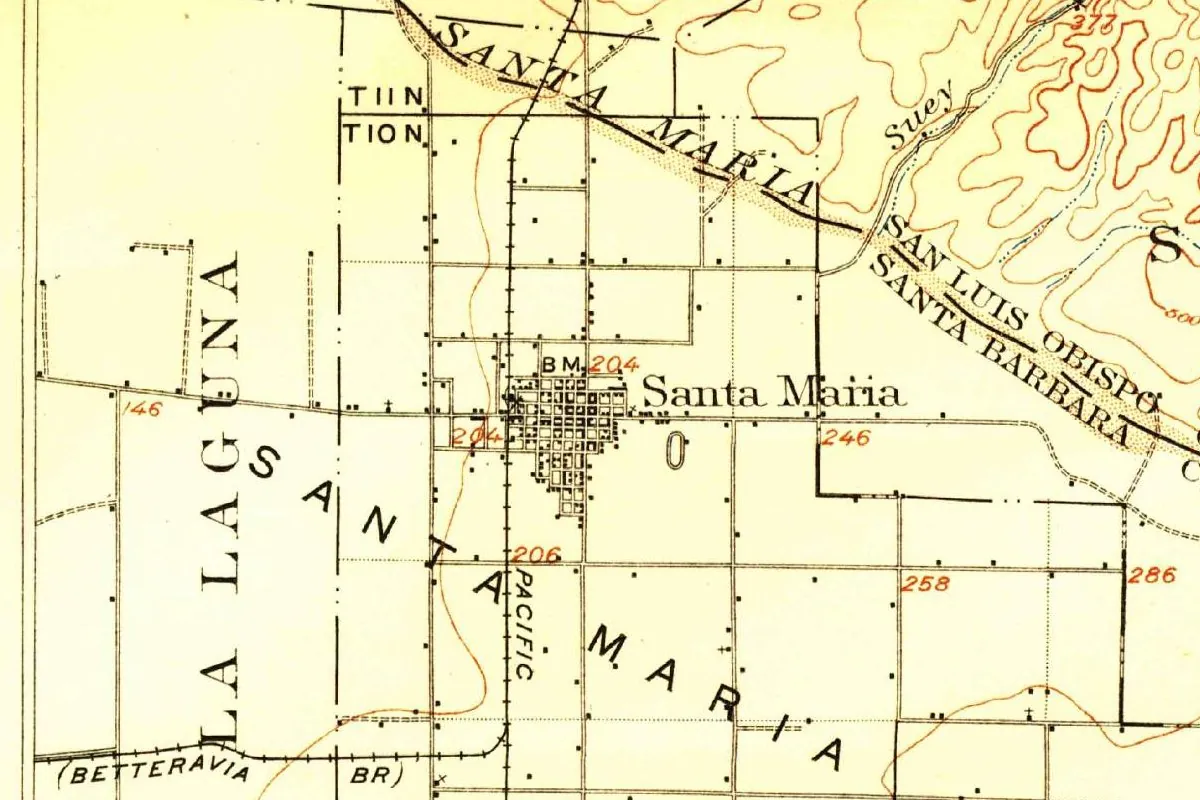
Santa Maria was incorporated on September 12, 1905, as a city of the sixth class, according to the historical society. By then Central City was a memory, though the society still describes the old townsite lingering under the busy streets. If you look at the 1905 government map at the top of this page, you’ll see the name three times: on the town, across the valley and on the river along the county line. That’s the whole story in one picture. The town was the last of the three to be called Santa Maria.
Quick answers
What was Santa Maria, California, called before?
Central City. The townsite was laid out in 1874 and 1875 under that name and became Santa Maria in 1882.
Why did Central City change its name?
The Santa Maria Valley Historical Society says mail for the town kept going to Central City, Colorado. The post office in town had already been called Santa Maria since before the townsite existed.
Who was Santa Maria named after?
Nobody agrees on a person. Sanchez wrote in 1914 that the name honors the mother of Christ, while an 1891 county history said the valley was named for an Indian called Santa Maria.
When was Santa Maria founded?
Central City was surveyed in 1874 and its map recorded on April 12, 1875. It took the name Santa Maria in 1882 and was incorporated on September 12, 1905.
Key dates
- 1874Rudolph Cook, John Thornburgh, Isaac Fesler and Isaac Miller give land where their claims meet, and the Central City townsite is surveyed.
- 1875April 12: the Central City map is recorded at the county seat. The Santa Maria post office moves into the new town.
- 1882April: the railroad from San Luis Obispo arrives, the Santa Maria Times begins on April 22, and Central City becomes Santa Maria.
- 1891A county history says the valley was named for an Indian called Santa Maria.
- 1905September 12: Santa Maria is incorporated as a city of the sixth class.
Getting there
Open Santa Maria in Google Maps
Opens in a new tab. The pin is the center of Santa Maria in the USGS place-name record.
The closest airports, Amtrak stations and intercity bus stops, measured in a straight line from the center of Santa Maria.
Airports
- Santa Maria Public/Capt G Allan Hancock Field (SMX) 4 mi 6 km
- San Luis Obispo County Regional (SBP) 23 mi 37 km
- Hollywood Burbank (BUR) 129 mi 208 km
Amtrak trains
- Guadalupe station (GUA) 8 mi 13 km
- Grover Beach station (GVB) 16 mi 26 km
Intercity buses
- Amtrak Chartered Vehicle Amtrak Connecting Service · Santa Maria Amtrak Bus Stop 1 mi 2 km
- FlixBus San Luis Obispo Santa Barbara Avenue 25 mi 41 km
- CLAS Amtrak Connecting Service · San Luis Obispo 26 mi 41 km
Distances are as the crow flies, not by road. We don't list schedules or fares because they change; check with the airline, Amtrak or the bus company before you go. Official data (FAA commercial service airports (2025), FAA airport locations, Amtrak stations and Intercity Bus Atlas) from the FAA and the U.S. Bureau of Transportation Statistics, checked Nov 13, 2026.
Sponsored
Staying in Santa Maria?
Compare hotels in Santa Maria, California, on Expedia.
See hotels in Santa MariaWe may earn a commission if you buy through this link. It never changes what we write. Read our affiliate disclosure
Historical Sources & References
- Jesse D. Mason, History of Santa Barbara County, California (Thompson & West, 1883), pp. 314, 318. Central City laid out in 1875 on land from Thornburgh, Cook, Miller and Fesler; the quoted passage on the Santa Maria post office at Dana’s place on the Nipomo ranch (p. 314); the Santa Maria Times from April 22, 1882 (p. 318).
- Yda Addis Storke, A Memorial and Biographical History of the Counties of Santa Barbara, San Luis Obispo and Ventura (1891), pp. 112-113. The quoted passage on the valley “named from an Indian called Santa Maria,” a name that first covered a small part of the valley and later the whole valley and stream (p. 112) and “the town of Central City (now Santa Maria)” (p. 113).
- Nellie Van de Grift Sanchez, Spanish and Indian Place Names of California (1914), p. 110. Santa Maria, “St. Mary,” named “in honor of the mother of Christ.”
- Santa Maria Valley Historical Society Museum, “About”. The four quarter sections, the 1874 survey and the map recorded April 12, 1875, the railroad and the name change in 1882, the mail that went to Central City, Colorado, and incorporation on September 12, 1905.
- Santa Maria Valley Historical Society Museum, “Timeline”. The last spike on April 15, 1882, the first Santa Maria Times on April 22, 1882, and “April 1882 Central City became Santa Maria.”
- GNIS feature 1652791 (U.S. Geological Survey). A federal record that files the city under Santa Barbara County; we used its latitude and longitude for the map.
- U.S. Geological Survey, Lompoc sheet (1905). The source of the map at the top of this page.
Spot something wrong, or know more? Tell us here. You can also email us or use our contact page. Corrections are noted here with their date, never made silently.