Placerville, California: From Hangtown to a Name for Gold
Placerville takes its name from placer gold, the kind found mixed with sand and washed out with water. The camp was known as Old Dry Diggings, then Hangtown after hangings in 1849. The city says Placerville was suggested as early as 1850 and became official with incorporation in 1854.
Placerville, California, was called Old Dry Diggings and then Hangtown before it settled on a name for placer gold, which became official in 1854. The old nicknames didn’t go away quietly. Thirty years later, a county history said Hangtown was still “not seldom used.”
Old Dry Diggings
The camp started with a lucky find by a ranch hand. Paolo Sioli’s Historical Souvenir of El Dorado County, published in Oakland in 1883, quotes Judge Grimshaw of Daylor’s ranch in Sacramento County. In the summer of 1848, Grimshaw says, William Daylor, Jared Sheldon and Perry McCoon were mining on Weber Creek with a crew of Indian workers. One morning their vaquero reported “some new dry diggings” and showed off gold he’d picked up.
The ranchers didn’t think the new spot was worth moving camp for, so they sent prospectors there instead. Grimshaw says the place “up to January, 1849, went by the name of the ‘old dry diggings.’” E. N. Strout, “for long years a citizen of El Dorado county” in Sioli’s words, puts it the same way: “In 1848 and the early part of 1849, Placerville and surroundings were known as ‘Old Dry Diggings.’”
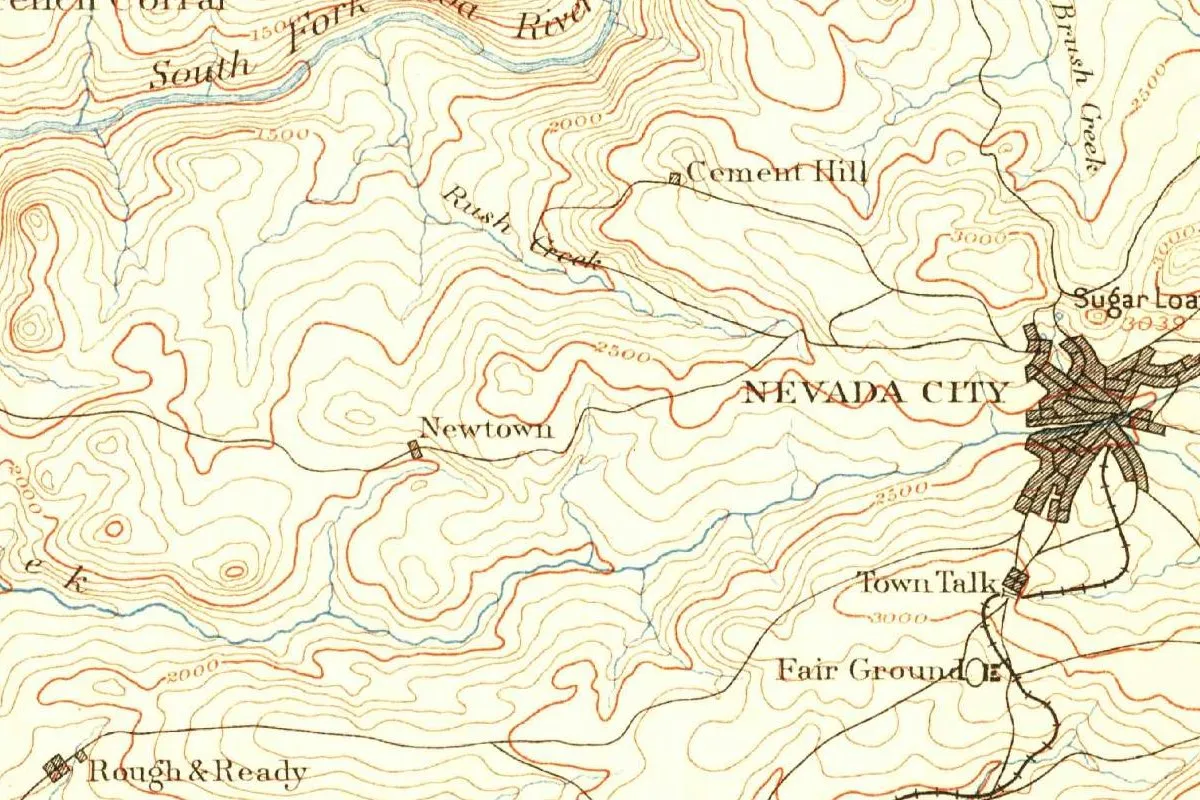
The City of Placerville explains the name. “It was called Dry Diggins,” the city says, “because the miners had to cart the dry soil down to the running water to wash out the gold.” Nevada City went through a similar stage: one of its early names was Deer Creek Dry Diggings.
Three stories behind Hangtown
The second name is the one people remember. Sioli says Hangtown was known “by all miners of California up to this day,” and he didn’t try to pick one account of how it started. “We have got before us three different statements,” he wrote, and “we think it is the best to make space here for all three of them.”
Grimshaw’s version begins with a robbery over a poker game in January 1849. Three men were caught, tried by the miners and flogged. When two of them later threatened the men who’d judged them, a meeting was called, and the two were “hung on the leaning oak tree in the hay yard below Elstner’s El Dorado Saloon.” Grimshaw ends it this way: “For many years the camp went by the name of Hangtown, to distinguish it from other dry diggings.”
Strout tells a different story, about a gang called the “Owls” who robbed a French trader’s post. In his account, the robbers were caught, tried and executed under “a white oak tree of gigantic size” on the south bank of Hangtown Creek, at what’s now the northwest corner of Main and Coloma streets, on February 12, 1849. By 1883, Strout said, George G. Blanchard’s brick building covered the stump of the tree, so if you walk to that corner today, you’re at the spot his account names.
The third version Sioli prints puts the same corner and the same year on a different case: two Frenchmen and a Spaniard, hanged by a mob in 1849 after an officer recognized two of them as wanted for murder elsewhere.
The city’s history tells its own version, with three men accused early in 1849 and hanged from a giant white oak at a hay yard near the center of town, and it doesn’t choose among Sioli’s. It adds that “Old Dry Diggins soon became known as Hangtown due to several other hangings.”
Why placer
The new name described the gold, not the hangings. When Henry Gannett explained the city’s name for the Geological Survey in 1905, he started with Spanish: “From the Spanish plaza, meaning ‘place;’ in mining districts, a place where surface deposition is washed for valuable minerals.”
The Survey’s own “EarthWord” feature, from 2017, defines placers as deposits “in which grains of a valuable mineral like gold … are mixed with sand deposited by a river or glacier.” It traces the word a step further than Gannett did: “Placer is an Americanization of the Catalan word placel, which itself came from the Spanish word plaza, meaning ‘open space.’”
So you get a town named for a way of finding gold, the same kind of naming that gave Lead, South Dakota, a miners’ word for a vein of ore. In Colorado, a placer gold find in January 1859 is where the story of Idaho Springs starts.
Placerville becomes official
Nobody on record claims credit for the new name. The City of Placerville says only that “Placerville had been suggested as early as 1850,” and that “it became official when the city was incorporated in 1854.” It adds that there had been “agitation for a less morbid name.”
Sioli gives the paperwork. Placerville was incorporated under an act passed by both houses of the California legislature and “approved May 13, 1854, John Bigler Governor.” At the first municipal election, on June 5, 1854, Alexander Hunter was elected mayor. The city says the county seat moved to Placerville in 1857.
Even so, the old name hung on. Sioli wrote that Hangtown was “not seldom used even now after about thirty years,” and that it was “known by all miners of California.”
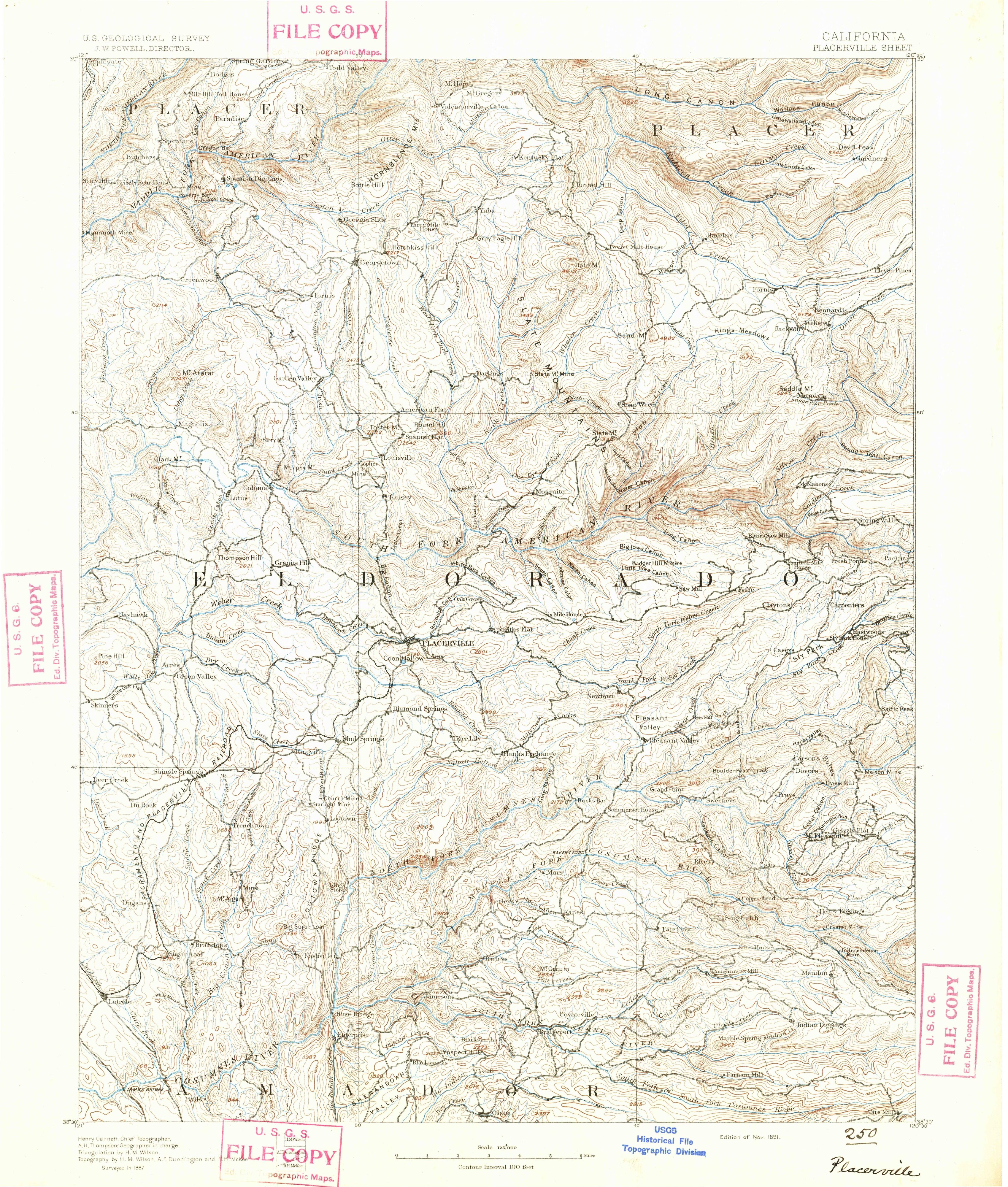
Placerville on the 1891 map
The map at the top of this page is the Geological Survey’s Placerville sheet at 1:125,000, in its “Edition of Nov. 1891.” The margin lists Henry Gannett as chief topographer, A. H. Thompson as geographer in charge, and topography by H. M. Wilson, A. F. Dunnington and R. H. McKee, “Surveyed in 1887.” On the full sheet, Placerville sits left of center, a little below the middle, just under the spaced-out letters of EL DORADO.
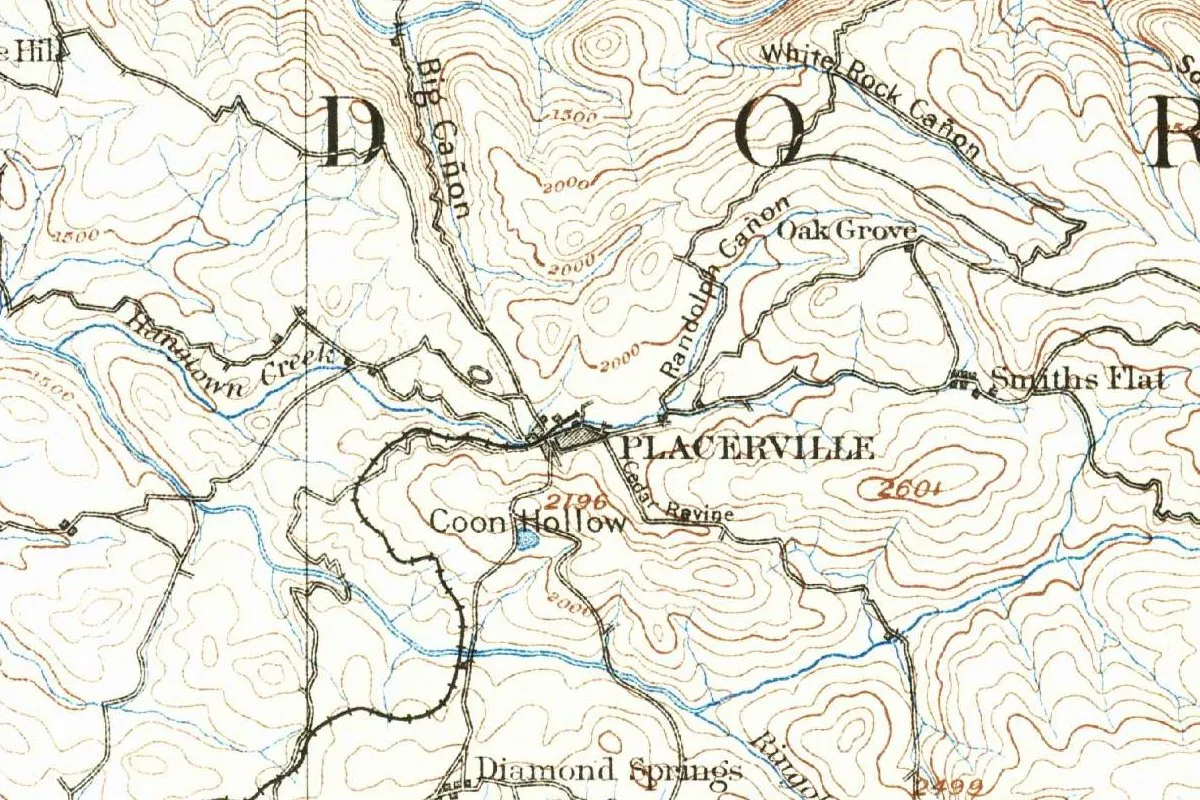
In this detail, PLACERVILLE is lettered beside a small dark block of town, and Hangtown Creek still carries the old name west of town. Coon Hollow and Cedar Ravine sit just south of town, with Diamond Springs at the bottom. The contour lines are drawn every 100 feet (30 m).
Quick answers
Why was Placerville called Hangtown?
Hangings in 1849. Sioli’s 1883 history gives three different accounts of who was hanged and why, and the city says the camp “soon became known as Hangtown due to several other hangings.”
What does placer mean?
It’s a deposit where gold is mixed with sand and washed out with water. Gannett traced the word to the Spanish plaza, and a 2017 USGS feature to the Catalan placel.
When did Hangtown become Placerville?
In 1854, when the city was incorporated, according to the City of Placerville. The name had been suggested as early as 1850.
Key dates
- 1848A vaquero working for Daylor, Sheldon and McCoon finds new dry diggings near Weber Creek, in Judge Grimshaw's account.
- 1849Hangings at the Old Dry Diggings give the camp the name Hangtown; E. N. Strout dates one of them to February 12.
- 1850The name Placerville has been suggested by this year, according to the City of Placerville.
- 1854An act approved May 13 incorporates the city of Placerville; the first municipal election is held on June 5.
- 1857The county seat moves to Placerville.
- 1891The Geological Survey issues its Placerville sheet, surveyed in 1887.
Things to do in Placerville, California
Gold Bug Park & Mine
A park built around a hard-rock gold mine, where you can explore the underground mine on a self-guided audio tour. There's also a museum of rocks, minerals and mining tools.
Fountain & Tallman Museum
The El Dorado County Historical Society's museum in the building of John Fountain and Benjamin Tallman's Soda Works, from about 1852. The society calls it the oldest extant building on Placerville's Main Street.
El Dorado County Historical Museum
The county's history museum, run by the El Dorado County Library and open since 1974.
Marshall Gold Discovery State Historic Park
The park at Coloma, on Highway 49 between Placerville and Auburn, where James Marshall found gold in 1848. It has a replica of the sawmill and more than 20 historic buildings.
Getting there
Open Placerville in Google Maps
Opens in a new tab. The pin is the center of Placerville in the USGS place-name record.
The closest airports, Amtrak stations and intercity bus stops, measured in a straight line from the center of Placerville.
Airports
- Sacramento International (SMF) 43 mi 69 km
- Stockton Metro (SCK) 62 mi 101 km
Amtrak trains
- Auburn station (ARN) 19 mi 31 km
- Rocklin station (RLN) 24 mi 39 km
Intercity buses
- Amtrak Chartered Vehicle Amtrak Connecting Service · Auburn Amtrak 19 mi 31 km
- AVLN Amtrak Connecting Service · Auburn Amtrak 19 mi 31 km
- Greyhound Roseville Bus Stop 26 mi 42 km
Distances are as the crow flies, not by road. We don't list schedules or fares because they change; check with the airline, Amtrak or the bus company before you go. Official data (FAA commercial service airports (2025), FAA airport locations, Amtrak stations and Intercity Bus Atlas) from the FAA and the U.S. Bureau of Transportation Statistics, checked Nov 18, 2026.
Sponsored
Staying in Placerville?
Compare hotels in Placerville, California, on Expedia.
See hotels in PlacervilleWe may earn a commission if you buy through this link. It never changes what we write. Read our affiliate disclosure
Historical Sources & References
- Paolo Sioli, Historical Souvenir of El Dorado County, California (1883), pp. 207-209. The act of May 13, 1854, Old Dry Diggings, and the three accounts of Hangtown from Judge Grimshaw, E. N. Strout and a third writer. Checked against the page images.
- City of Placerville, “Placerville City History”. Dry Diggins, Hangtown, the name suggested in 1850 and made official in 1854, and the county seat in 1857.
- Henry Gannett, The Origin of Certain Place Names in the United States (1905), p. 247. “From the Spanish plaza, meaning ‘place.’”
- U.S. Geological Survey, “EarthWord—Placer” (2017). What a placer is, and the word’s path from plaza through Catalan placel.
- Gold Bug Park & Mine, Fountain & Tallman Museum, El Dorado County Historical Museum and Marshall Gold Discovery State Historic Park. The places listed above.
- Placerville’s GNIS entry, feature 277577 (U.S. Geological Survey). The city’s listing as a populated place in El Dorado County, with its coordinates.
- U.S. Geological Survey, Placerville sheet (November 1891). The 1:125,000 sheet the map at the top was cropped from.
Sponsored
Put this 1891 map on your wall
The Geological Survey's 1891 Placerville sheet, surveyed in 1887, where Hangtown Creek still carries the town's old name, is in the public domain. Download the full-size scan for free, then have it printed on canvas with CanvasOnTheCheap.
Print a map on canvasDownload the full-size mapWe may earn a commission if you buy through this link. It never changes what we write. Read our affiliate disclosure
Spot something wrong, or know more? Tell us here. You can also email us or use our contact page. Corrections are noted here with their date, never made silently.