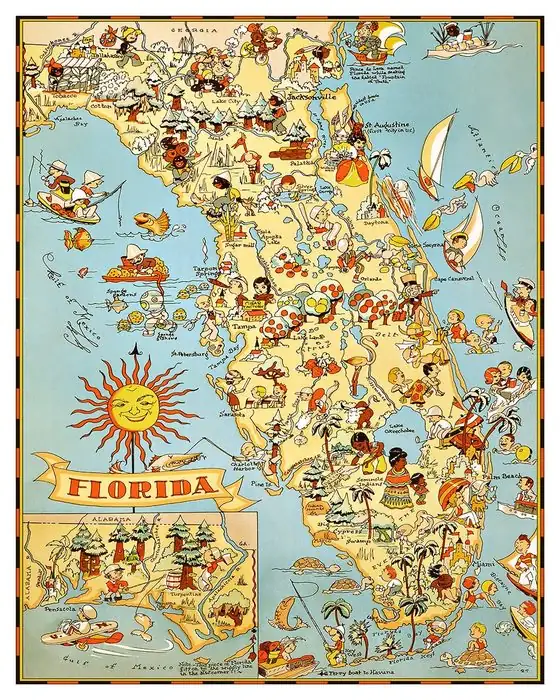
Why Is It Called Palm Beach? A Shipwreck's Coconuts
Palm Beach is named for the coconut groves that settlers planted from the cargo of the Providencia, a ship that ran aground in January 1878 with about 20,000 coconuts. The town says the trees weren't native. When a post office opened in 1887, a winter visitor named Gus Ganford gets the credit for proposing the name.
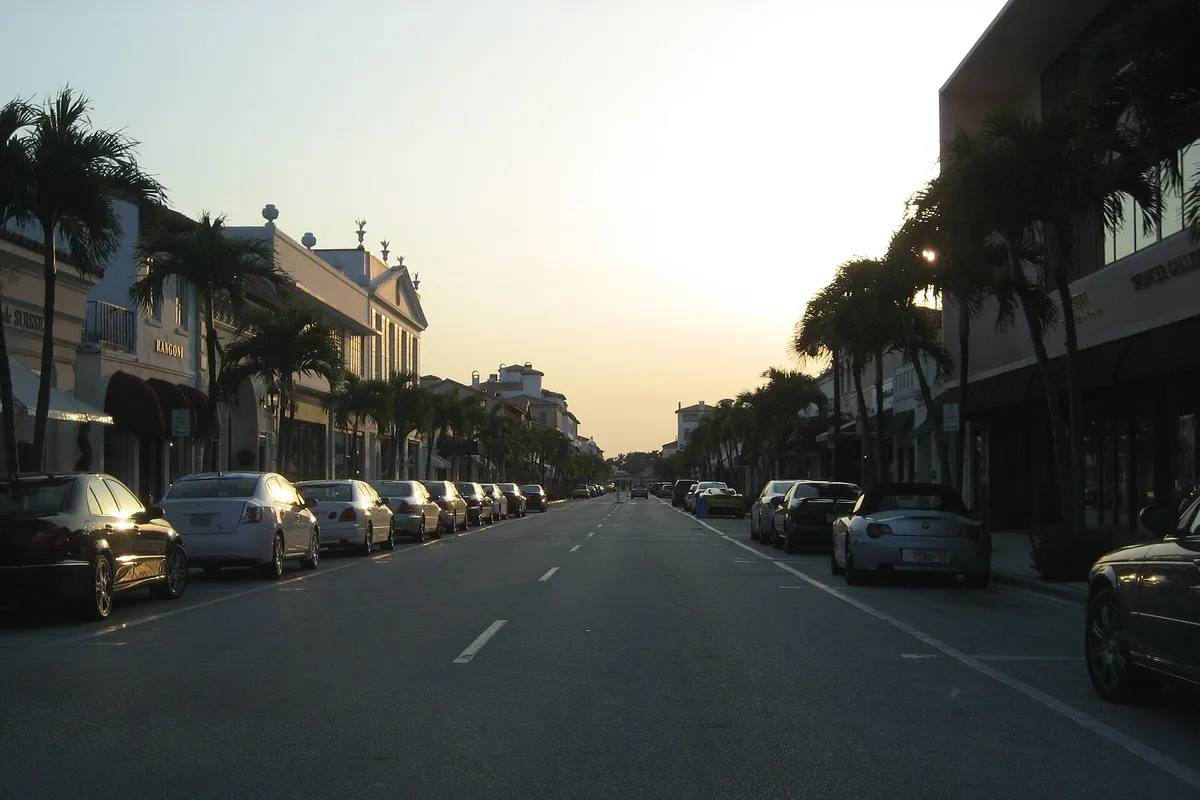
Palm Beach, Florida, is named for coconut palms that settlers planted after the Providencia ran aground in 1878, and those palms weren’t even native there. So the name of one of the country’s best-known resort towns started as salvage from a wreck.
Why is it called Palm Beach, Florida?
When the first homesteaders came, the island had no name of its own that stuck. The Town of Palm Beach says the whole district went by “Lake Worth,” after Maj. Gen. William Jenkins Worth, an officer of the Second Seminole War, and that the first permanent pioneers arrived in 1872. The Historical Society of Palm Beach County adds an earlier name. A post office called Tustenegee ran at what is now the center of Palm Beach for most of 1877 to 1879, and at least one map from 1878 labels the island Tustenegee, which the society calls “a Seminole name.” It doesn’t say what the word means, and neither will we.
The name that won came from the beach itself, or rather from what grew on it. The town credits the story to “early settler accounts,” and the historical society tells it the same way, as you’ll see below. The trees in the name were planted, not found.
On January 9, 1878, according to the historical society, a barque called the Providencia went aground off the island with logs, hides and 20,000 coconuts. The town says the ship was carrying them from Havana to Barcelona. Two settlers took the cargo as salvage and sold the nuts to their neighbors for two and a half cents apiece, and the neighbors put them in the ground, hoping coconuts would become a money crop. The town is blunt that coconuts “were not native to South Florida.”
The society’s verdict is that the groves gave their name to the island, to the county and, later, to several towns, West Palm Beach among them. A Florida House resolution for the town’s centennial in 2011 told the story the same way. None of the sources we read reproduces a document from 1878 itself, though. What we have are later histories built on what the pioneers remembered.
The words themselves were chosen in 1887, for the mail. In January of that year, the historical society says, the brothers Edmund M. and John Brelsford applied for a post office called Palm City, only to learn the name had gone a month earlier to an office near Fernandina. “Gus Ganford, a winter visitor from Philadelphia, is credited with suggesting the name Palm Beach,” the society writes, and the name was officially recorded that October. The Brelsfords kept the post office in their store on the lake, near where the Flagler Museum stands today.
Palm trees put their name on other towns, too, in different ways. In California, Palm Springs is named partly for a fan palm that the Agua Caliente Band of Cahuilla Indians calls native to the place. And Palm Beach isn’t the only town whose story opens with a wreck: Mendocino, California, got its start after a ship was wrecked in 1851 or 1852 near Point Cabrillo and its salvagers brought back news of the redwoods, though the town’s name comes from a cape. Closer to home, Palm Bay went by Tillman, the name of its post office, until people there sought a change in 1924.
Palm Beach history
Tourists followed the coconuts. The town dates the Coconut Grove House, the island’s first hotel, to 1880. The pioneer era, it says, ended in 1894, when Henry M. Flagler opened his Royal Poinciana Hotel, which the town calls the largest wooden building in the world, and his Florida East Coast Railroad arrived two years later. His Palm Beach Inn on the ocean got a new name because, the town says, guests kept writing in for rooms “down by the breakers.” The Breakers burned in 1903 and again in 1925, and was rebuilt each time.
The town itself is younger than its hotels. In January 1911, the historical society says, residents found out that West Palm Beach, across the lake, meant to annex the island in that year’s legislative session. They quietly hired a Miami lawyer to draw up the papers. On the night of April 17, 1911, 35 men met (women couldn’t vote yet, the town points out) at the Palm Beach Hotel and voted to incorporate, making Palm Beach the county’s second municipality. Elisha N. Dimick became the first mayor.
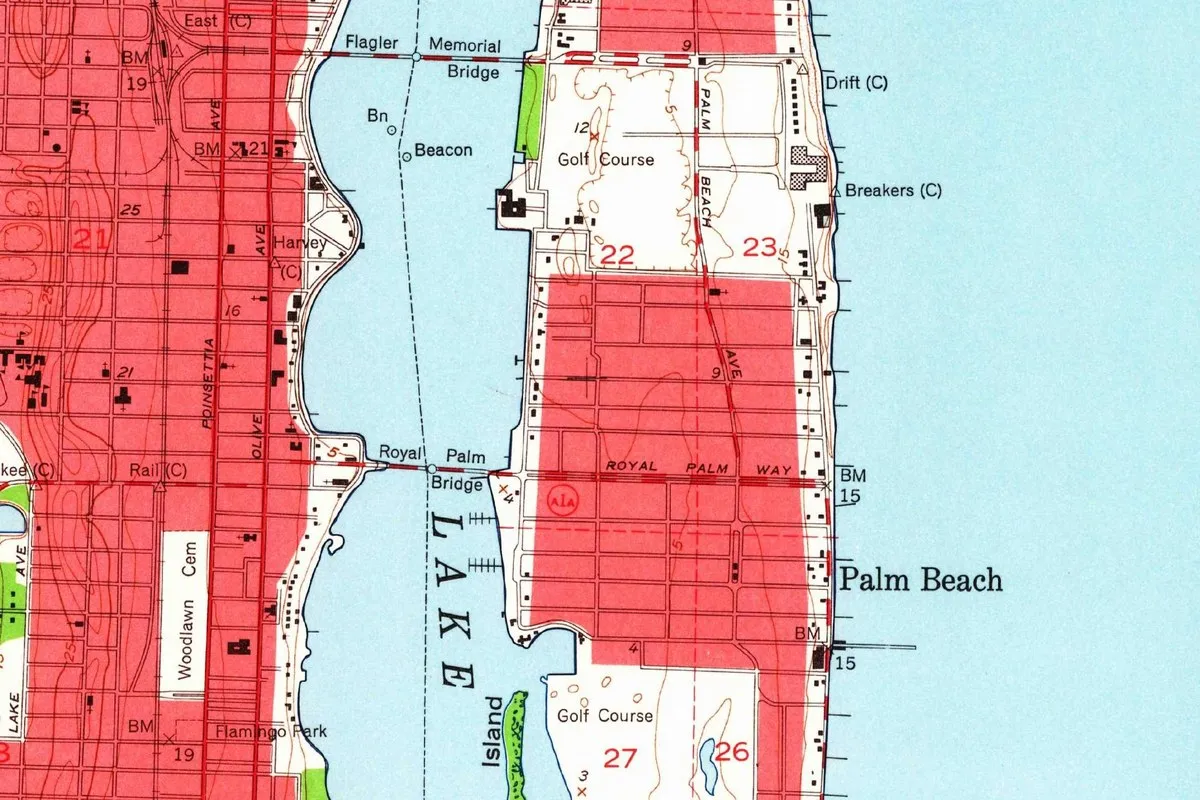
Palm Beach on the 1946 map
The Palm Beach quadrangle of 1946 was mapped by the U.S. Coast and Geodetic Survey and published by the Geological Survey, from aerial photographs taken in 1942 and 1945 and checked in the field in 1946. Our copy is a later printing, with a road legend dated 1964 and a file stamp of May 22, 1964. The pink tint, the margin explains, marks areas where only landmark buildings are shown, which is why most of the island looks like solid blocks. In the crop you can follow Royal Palm Way across the island to the Royal Palm Bridge over the lake, with the Flagler Memorial Bridge to the north. “Breakers (C)” by the beach is one of the Coast and Geodetic Survey’s control points, which the margin marks with a C.
Quick answers
Are coconut palms native to Palm Beach, Florida?
No, according to the town, which says the coconuts from the Providencia “were not native to South Florida.” Settlers planted them after the 1878 wreck.
Who named Palm Beach, Florida?
The Historical Society of Palm Beach County says a winter visitor from Philadelphia, Gus Ganford, gets the credit for proposing the name when the post office was set up in 1887.
When was Palm Beach, Florida, incorporated?
On April 17, 1911, when residents voted to form a town ahead of an expected annexation attempt by West Palm Beach.
Key dates
- 1877A post office called Tustenegee opens at what is now the center of Palm Beach.
- 1878The Providencia runs aground on January 9, and settlers plant its coconuts.
- 1887The name Palm Beach is officially recorded for a post office in October.
- 1894Henry Flagler's Royal Poinciana Hotel opens.
- 1911Voters meet on April 17 and make Palm Beach a town.
Things to do in Palm Beach, Florida
Flagler Museum
Whitehall, the Gilded Age mansion Henry Flagler finished in 1902 and now a National Historic Landmark. Visitors walk its rooms at their own pace and see exhibitions that change during the year.
Pan's Garden
A half-acre (0.2 ha) garden planted only with Florida's native trees, shrubs, grasses and wildflowers, opened by the Preservation Foundation of Palm Beach in 1994 as the state's first all-native botanical garden. Its name comes from Frederick MacMonnies's 1890 bronze of Pan at the entrance pool.
Worth Avenue
The town's famous shopping street, which took off after about 1923, growing, its association says, as an offshoot of the Everglades Club that Addison Mizner built in 1918.
The Society of the Four Arts
A nonprofit cultural center founded in 1936 and one of the oldest in Palm Beach, with art exhibitions, talks by well-known speakers, concerts and films, plus two libraries.
Getting there
Open Palm Beach in Google Maps
Opens in a new tab. The pin is the center of Palm Beach in the USGS place-name record.
The closest airports, Amtrak stations and intercity bus stops, measured in a straight line from the center of Palm Beach.
Airports
- President Donald J Trump International (DJT) West Palm Beach 4 mi 6 km
- Fort Lauderdale/Hollywood International (FLL) 44 mi 71 km
Amtrak trains
- West Palm Beach station (WPB) 2 mi 3 km
- Delray Beach station (DLB) 18 mi 29 km
Intercity buses
- FlixBus West Palm Beach South Tamarind Avenue 2 mi 3 km
- Greyhound Boynton Beach Tri Rail Station 11 mi 17 km
Distances are as the crow flies, not by road. We don't list schedules or fares because they change; check with the airline, Amtrak or the bus company before you go. Official data (FAA commercial service airports (2025), FAA airport locations, Amtrak stations and Intercity Bus Atlas) from the FAA and the U.S. Bureau of Transportation Statistics, checked Nov 21, 2026.
Sponsored
Staying in Palm Beach?
Compare hotels in Palm Beach, Florida, on Expedia.
See hotels in Palm BeachWe may earn a commission if you buy through this link. It never changes what we write. Read our affiliate disclosure
Historical Sources & References
- Town of Palm Beach, “History of Palm Beach”. Lake Worth as the district’s name, the Providencia and its coconuts, the Coconut Grove House, Flagler’s hotels and the 1911 vote.
- Historical Society of Palm Beach County, “Pioneer Era”. The wreck of January 9, 1878, the 20,000 coconuts and the names that came from the groves.
- Historical Society of Palm Beach County, “Palm Beach”. Tustenegee, the Palm City application, Gus Ganford and the October 1887 post office, and the annexation scare of 1911.
- Florida House of Representatives, HR 9047 (2011). The centennial resolution’s version of the naming story.
- U.S. Geological Survey, GNIS feature 288390. Palm Beach in Palm Beach County.
- Palm Beach quadrangle, 1946. The sheet the map at the top was cropped from.
Spot something wrong, or know more? Tell us here. You can also email us or use our contact page. Corrections are noted here with their date, never made silently.