Macon, Georgia: Named for a North Carolina Senator
Nathaniel Macon, a North Carolina congressman and U.S. senator, is the namesake. An 1879 history says Georgia's legislature, in the December 1822 act organizing Bibb County, had commissioners lay out a town to be called Macon on the Ocmulgee River. George White's 1849 survey of the state's counties names the senator as the man it honors.
“A town to be called Macon”
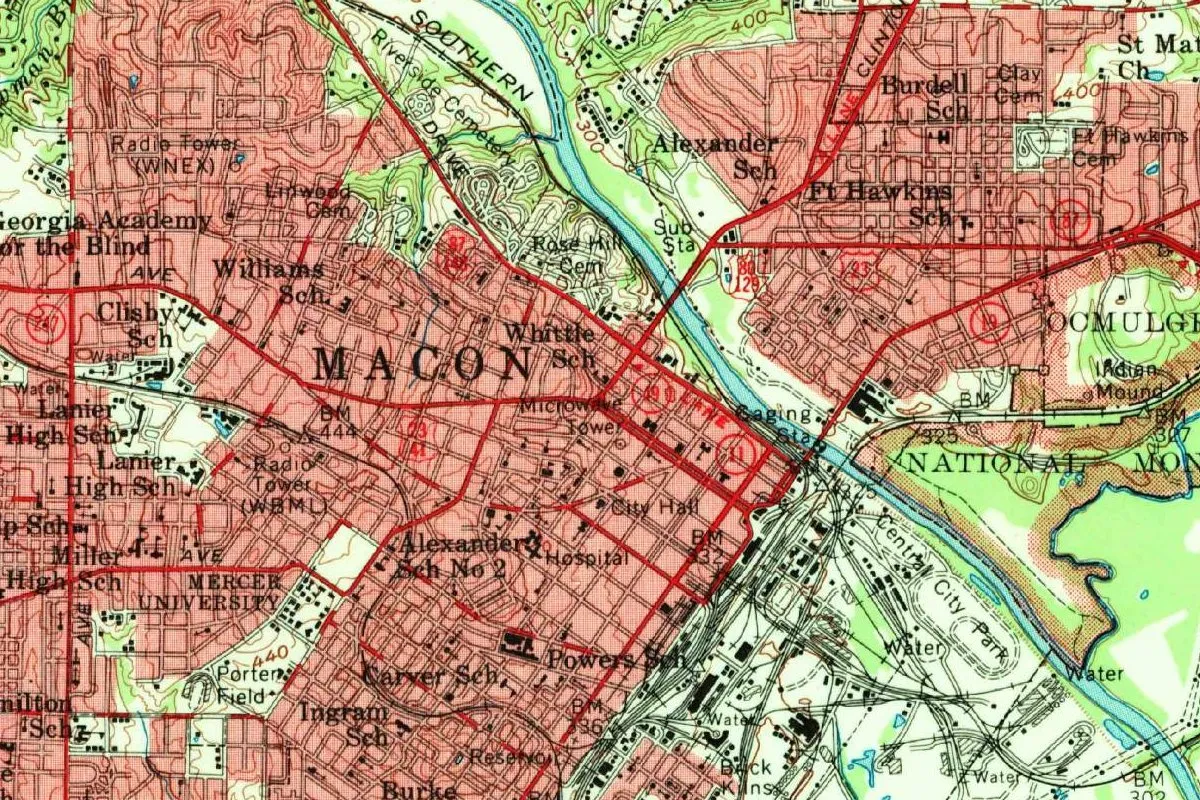
In December 1822, Georgia lawmakers ordered a town laid out on the Ocmulgee River to be called Macon, after North Carolina’s Nathaniel Macon. The name came with the paperwork: the same law that organized Bibb County set aside the spot and told the commissioners what to call it.
John C. Butler, whose Historical Record of Macon and Central Georgia came out in 1879, lays out the order of things. The state had set aside a reserve of land on the west bank, across from the old Fort Hawkins tract, and in December 1822 the legislature, “in connection with the act to establish the county of Bibb, authorized the commissioners to lay off the plan for a town to be called MACON.” The capitals are Butler’s.
A surveyor named James Webb drew the grid early in 1823. Butler says there wasn’t a single frame building inside it yet, just a log inn and a ferryman’s cabin. Lots went up for auction on March 7 and 8, 1823, and on December 8 of that year an act to incorporate the town of Macon passed both houses of the legislature.
The man on the map
Butler doesn’t say who suggested the name, and the older accounts don’t either. They agree on who it honors. George White, who toured Georgia county by county for his 1849 Statistics of the State of Georgia, put it in the first line about the town:
“Macon, named after the Hon. Nathaniel Macon of North Carolina, is the seat of justice. Few places have advanced with more rapidity.”
That’s on page 108, under Bibb County. Twenty-six years after the lot sale, White didn’t think you needed more than a line on the senator.
Nathaniel Macon was born in Warren County, North Carolina, in 1757, according to Butler. He was studying at Princeton when the Revolution started, served as a private, and refused pay, promotion and a pension. He sat in Congress from 1791 to 1815 and was Speaker of the House from 1801 to 1806. Butler also passes along that Thomas Jefferson called him “the last of the Romans.” When he died in 1837, he’d asked for a plain coffin, paid for before the funeral, and a pile of field stones for a monument.
You’ll see slightly different dates for his Senate years depending on the book. Butler has him serving from 1816 to 1828. Henry Gannett’s 1905 bulletin on American place names says 1816 to 1826, and it lists Macon counties and towns in Alabama, Illinois, Mississippi, Missouri, North Carolina and Tennessee named for the same man, along with Georgia’s city and county.
Two Carolina names, one river
Macon wasn’t the first name on this stretch of the Ocmulgee. Butler quotes the naturalist William Bartram on the “Ocmulgee Fields,” ancient Indian fields on the river’s east bank, and says Fort Hawkins was later built on them. The fort the Americans built there in 1806 took a North Carolina name too.
Fort Hawkins stood on the east bank. The 1906 Cyclopedia of Georgia says it was built in 1806, and Butler says it “was named in honor of Hon. Benjamin Hawkins, a United States Senator from the State of North Carolina.” Hawkins had also served as a federal commissioner negotiating treaties with the Creeks. A trading settlement grew up around the fort. Butler writes that it was called Fort Hawkins until about 1821, when the name Newtown was adopted.
So when the new town went up on the west bank, the neighbors across the river were living under one North Carolina senator’s name while the newcomers took another’s. The two places didn’t stay apart for long. After the Fort Hawkins land was sold in 1828, Butler says, Newtown was taken into the town of Macon in 1829. The New Georgia Encyclopedia sums up where that left the city: a fall-line town in Georgia, at the point where the Ocmulgee stops being navigable.
The Ocmulgee still runs between the two halves: one laid out under the name of a senator from Warren County, the other grown up around a fort named for another Carolina senator.
Quick answers
Which Macon is the city named for?
Nathaniel Macon of North Carolina. George White’s 1849 Statistics of the State of Georgia says the town was “named after the Hon. Nathaniel Macon of North Carolina,” and Gannett’s 1905 bulletin calls him a U.S. senator from that state.
Was Macon ever called Fort Hawkins or Newtown?
No, not the town on the west bank. Fort Hawkins and Newtown were the settlement on the east side of the Ocmulgee; Butler says Newtown was incorporated into Macon in 1829.
When did Macon get its name?
In December 1822. Butler’s 1879 history says the act that organized Bibb County authorized commissioners to lay out “a town to be called MACON,” and the town was incorporated on December 8, 1823.
Key dates
- 1806Fort Hawkins goes up on the east side of the Ocmulgee. The 1906 Cyclopedia of Georgia dates it to this year.
- 1821About this year, Butler says, the settlement around the fort stopped being called Fort Hawkins and took the name Newtown.
- 1822December: the act organizing Bibb County has commissioners lay off a town to be called Macon on the west side of the river.
- 1823Surveyor James Webb lays out the grid; the first lots are auctioned on March 7 and 8.
- 1823December 8: an act to incorporate the town of Macon passes both houses of the Georgia legislature.
- 1829Newtown, on the Fort Hawkins side of the river, is taken into the town of Macon.
Getting there
Open Macon in Google Maps
Opens in a new tab. The pin is the center of Macon in the USGS place-name record.
The closest airports, Amtrak stations and intercity bus stops, measured in a straight line from the center of Macon.
Airports
- Middle Georgia Regional (MCN) Macon 10 mi 17 km
- Hartsfield/Jackson Atlanta International (ATL) 72 mi 115 km
Amtrak trains
- Atlanta station (ATL) 79 mi 128 km
Intercity buses
- FlixBus Macon Bus Station under 1 mi 1 km
- Greyhound Warner Robins Bus Stop 15 mi 24 km
Distances are as the crow flies, not by road. We don't list schedules or fares because they change; check with the airline, Amtrak or the bus company before you go. Official data (FAA commercial service airports (2025), FAA airport locations, Amtrak stations and Intercity Bus Atlas) from the FAA and the U.S. Bureau of Transportation Statistics, checked Nov 13, 2026.
Sponsored
Staying in Macon?
Compare hotels in Macon, Georgia, on Expedia.
See hotels in MaconWe may earn a commission if you buy through this link. It never changes what we write. Read our affiliate disclosure
Sponsored
Want the spooky side of Macon?
The name has its story above. For the ghost stories, US Ghost Adventures runs walking ghost tours in Macon.
See ghost tours in MaconWe may earn a commission if you book through this link. It never changes what we write. Read our affiliate disclosure
Historical Sources & References
- John C. Butler, Historical Record of Macon and Central Georgia (1879), pp. 43-44, 53, 71, 73-74, 78-80, 110-111. Bartram’s description of the Ocmulgee Fields (pp. 43-44); Fort Hawkins built on those fields (p. 53); Fort Hawkins named for Benjamin Hawkins (p. 71); the settlement called Fort Hawkins until about 1821, then Newtown, and Newtown taken into Macon in 1829 (pp. 73-74); the December 1822 act and the town “to be called MACON,” James Webb’s survey and the lot sale of March 7-8, 1823 (pp. 78-79); the incorporation act of December 8, 1823 (p. 80); Nathaniel Macon’s life, Jefferson’s “last of the Romans” and his Senate years (pp. 110-111).
- George White, Statistics of the State of Georgia (1849), p. 108. The quoted line naming Nathaniel Macon of North Carolina as the town’s namesake, and the first lot sale in 1823.
- Henry Gannett, The Origin of Certain Place Names in the United States (USGS, 1905), p. 195. Macon in Bibb County and the other Macon counties and towns named for Nathaniel Macon, senator from North Carolina, with his Senate years given as 1816-1826.
- Allen D. Candler and Clement A. Evans, eds., Georgia (Cyclopedia of Georgia), vol. 2 (1906), pp. 511-512. Fort Hawkins built in 1806, the name Newtown from about 1821, the 1822 commissioners and the naming for Nathaniel Macon.
- New Georgia Encyclopedia, “Macon”. Named for North Carolina statesman and senator Nathaniel Macon; fall-line location at the head of navigation; incorporation on December 8, 1823.
- GNIS feature 332301 (U.S. Geological Survey). Macon’s official spelling and its Bibb County listing, plus the coordinates used to pick the 1956 sheet.
- U.S. Geological Survey, Macon sheet (1956). The 1956 quadrangle cropped for the view of Macon astride the Ocmulgee.
Spot something wrong, or know more? Tell us here. You can also email us or use our contact page. Corrections are noted here with their date, never made silently.