San Diego Names: La Jolla, Coronado, Del Mar and More
San Diego place names are mostly Spanish, from saints and simple descriptions of the land, with a few Native words and some promoters’ inventions. Del Mar just means “of the sea,” Coronado probably goes back to four martyred saints, and nobody is sure what La Jolla means.
Planning a trip? Here’s where the names on your map came from. The Spanish ones are usually plain descriptions: a hill, a box canyon, a pretty view. A few are older Native names, and others came from the men who bought land and laid out towns on it.
Where San Diego got its name
The bay had a different name first. Juan Rodríguez Cabrillo called it San Miguel, and William Smythe’s 1908 history of the city quotes his description of “a land-locked and very good harbor.” Sanchez says that in 1602 Sebastián Vizcaíno “changed the name from San Miguel to San Diego.” Our San Diego article tells that story, including whether the name came from his flagship, the saint’s feast day or both.
The bay and Point Loma
Point Loma
Point Loma is “hill point.” Nellie Van de Grift Sanchez, in her 1922 book on California place names, explains that loma means “hill,” and Point Loma, at the very end of the peninsula that encloses San Diego Bay, is a high promontory.
Ballast Point
Ballast Point used to be named for its rocks. Smythe says a fort was planned on “what is now known as Ballast Point, then called Point Guijarros (cobblestones).” Plans for a ten-gun battery there were drawn in 1795, and the work took five years or more. The old name doesn’t explain the new one, and Smythe doesn’t either.
La Playa
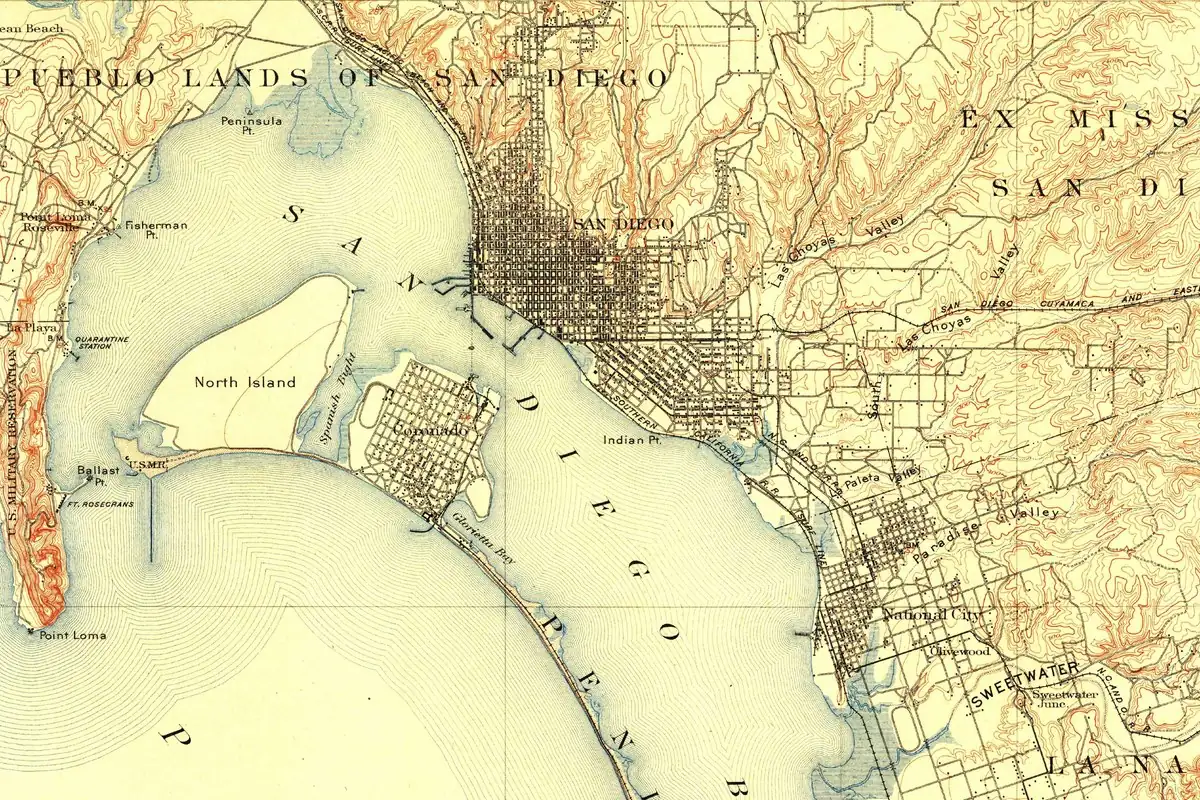
La Playa simply means “the beach.” Smythe says that was the name of the shore nearest the old anchorage, where Boston trading firms put up big warehouses to store cattle hides. The warehouses were framed in Boston and named after the ships. You’ll find La Playa on the 1904 map at the top of this page, on the bay side of Point Loma.
Roseville
Roseville, just north of La Playa, was founded by Louis Rose. Smythe says Rose bought land there, partly from Governor Robinson and partly from the city, and laid out the town. He was once offered $100,000 for the townsite and turned it down, sure it would be the site of the future city.
Coronado
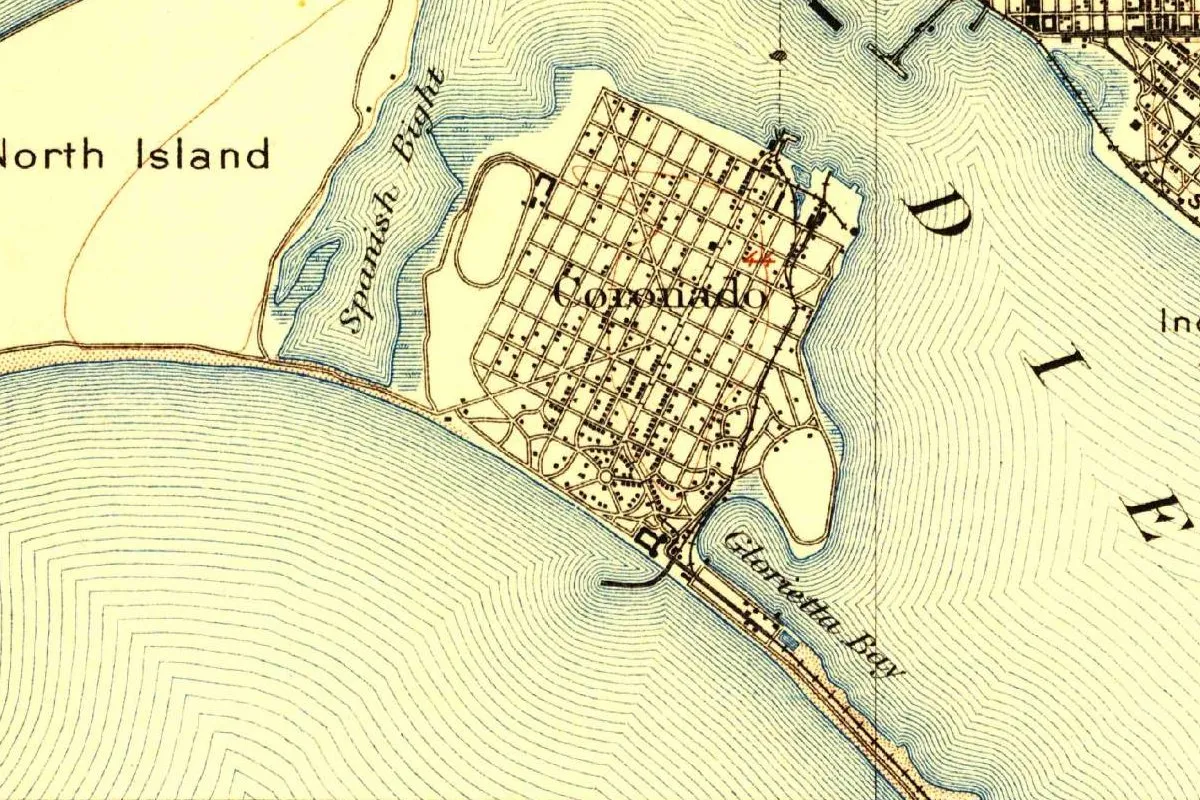
Coronado most likely goes back to four saints, not to the famous explorer. Sanchez says the name of Coronado Beach, the long spit of land that forms the outer shore of the harbor, “is said to have been suggested by the Coronado Islands near it.” Those islands, she says, were not named for Francisco Vásquez de Coronado, “as many have supposed, but for Los Quatro Martires Coronados (the four crowned martyrs),” whose feast falls on November 8. The name was shortened to Coronados, and its likeness to the explorer’s name “led to some confusion.”
Downtown and Old Town
Old Town
Old Town is where the name San Diego was first used for a town. Sanchez says Father Junípero Serra founded the first California mission at San Diego in 1769, and “the name was originally applied to the ‘Old Town,’ some distance from the present city.” Smythe explains why it was there: the presidio stood on the hill above the river, where it could be defended, and “Old Town grew up upon the flat below Presidio Hill.”
New Town, or Davis’s Folly
The first try at a city on the bay got a nickname. Smythe says that on March 18, 1850, William Heath Davis and his partners were granted land on the bay for a new town. Smythe gives credit for picking the spot to Andrew B. Gray, a surveyor who was one of the partners. They talked the Army’s quartermaster into reloading the materials for a new government building, already landed at La Playa, and bringing them across the bay instead. By April 1853, Smythe says, the new town “had begun to dwindle.”
Lieutenant Derby, who arrived in August 1853 and was “famous as ‘John Phoenix,’” Smythe says, wrote down his first impressions:
“The three villages then, which go to make up the great city of San Diego, are the Playa, Old Town, and New Town, or ‘Davis’s Folly.’”
Note the nickname. Smythe says the new town was “frequently called ‘Davis’s Folly,’” and Derby used it only three years after Davis and his partners got their land.
Horton’s Addition and Horton Plaza
Today’s downtown is mostly Alonzo Horton’s. Smythe says that at a city land sale on May 10, 1867, Horton bought six 160-acre lots, 960 acres in all, for $265, a little over 27 cents an acre. The new district came to be called Horton’s Addition. Smythe tells how Old Town merchants followed: E. W. Morse sold his Old Town stock in June 1869 and moved to Horton’s Addition, “much to the disgust of his old neighbors.” Horton kept a half block in front of the Horton House open “as a breathing space for his guests,” Smythe says. He later gave it to the city, and it was officially named Horton Plaza.
The coast
La Jolla
Nobody knows for sure what La Jolla means. Sanchez calls it “a word of doubtful origin.” Some people, she says, think it means “a pool,” some think it comes from hoya, a hollow surrounded by hills, and some think it may be a corruption of joya, “a jewel.” Another idea was that the place was named for caves there with pools in them. Sanchez’s verdict: “until some further information turns up this name must remain among the unsolved problems.” She adds that it might not be Spanish at all, but a Native word that got bent into something that sounded Spanish.
Torrey Pines
Torrey Pines is named for a teacher from New York. Smythe says Dr. J. L. Le Conte found the trees in 1850, while he was staying in San Diego. He and the naturalist Dr. C. C. Parry named them for their teacher, Dr. John Torrey, of New York, by calling the tree Pinus Torreyana. Smythe wrote that the tree grew in only two places in the world, here and on Santa Rosa Island. In 1900 the city set aside 369 acres on the bluffs to protect it, about four miles (6 km) south of Del Mar.
Del Mar
Del Mar means “of the sea.” Sanchez translates it as “of or on the sea” and places it on the shore about eighteen miles (29 km) north of San Diego. In her list of names at the back of the book, she marks it “Modern.”
Encinitas
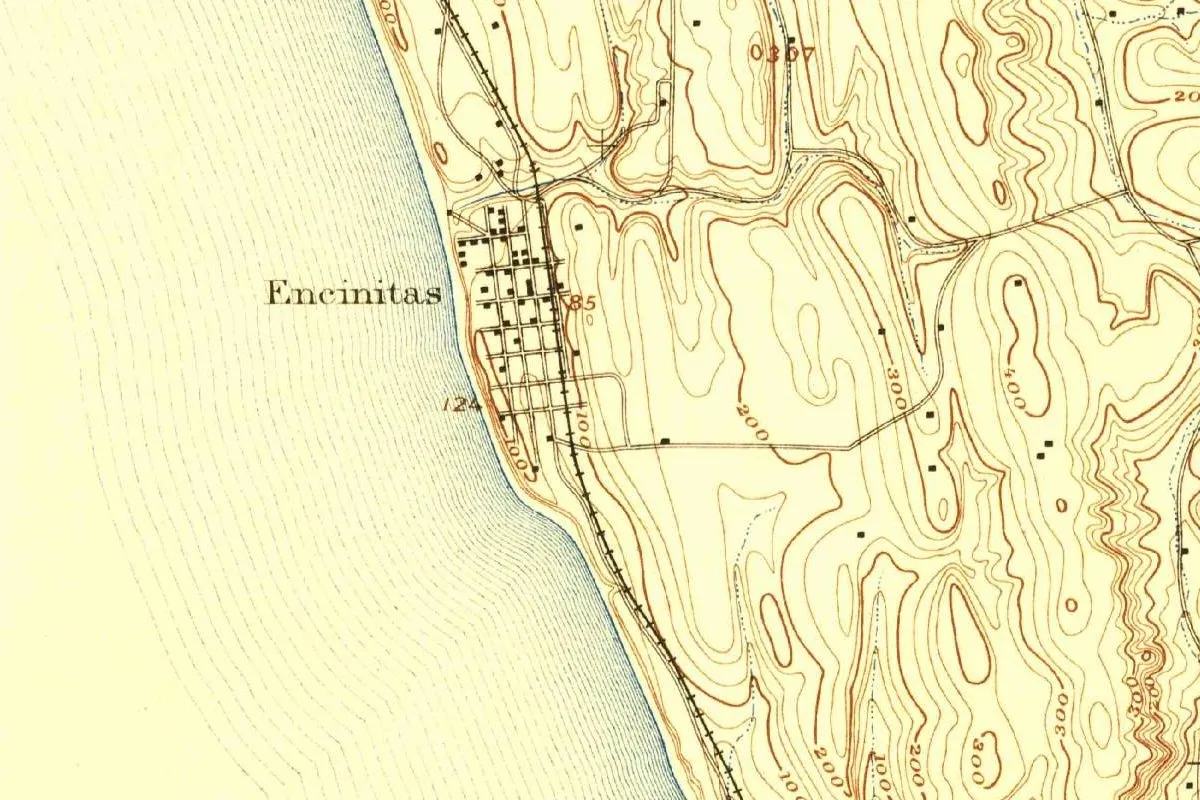
Encinitas means “little oaks,” Sanchez says. She puts it on the coast about twenty miles (32 km) northwest of San Diego.
Around the county
Chula Vista
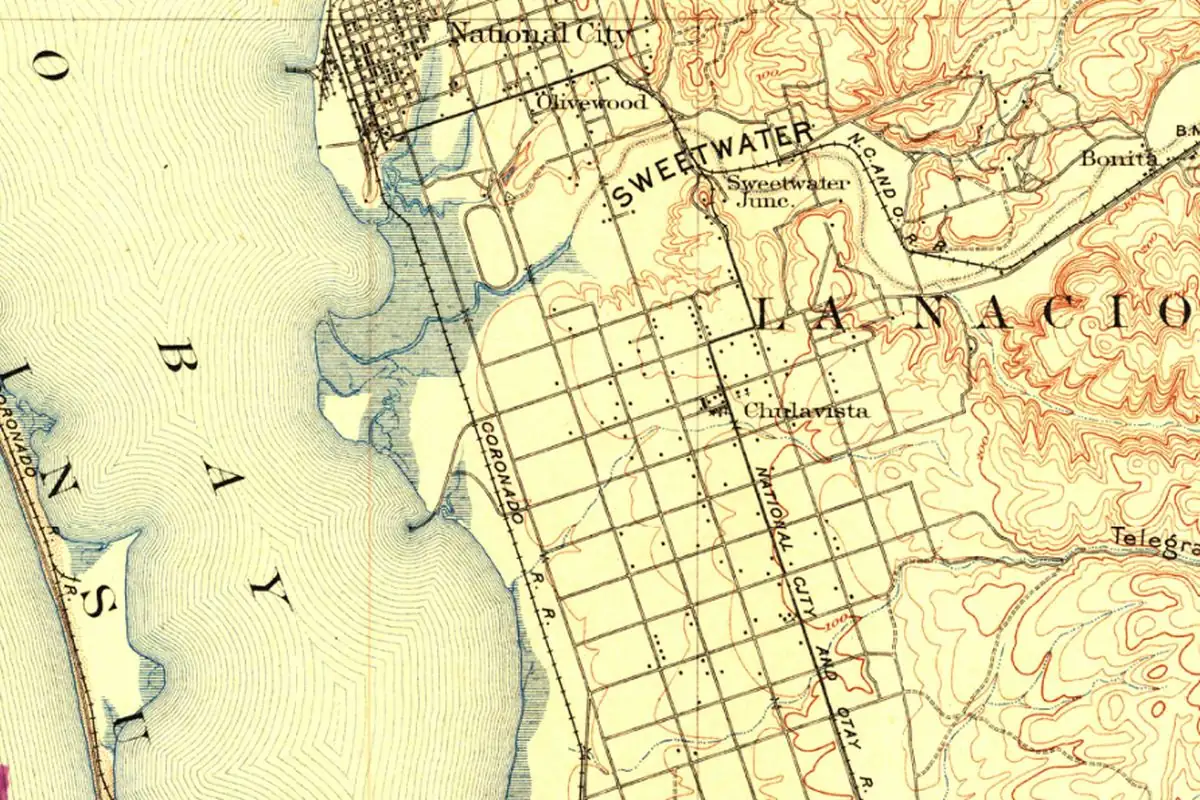
Chula Vista means “pretty view.” Sanchez says chula is a word of Mexican origin meaning pretty, graceful, attractive. She quotes Charles B. Turrill: “This name was probably first used by the promoters during the boom of 1887.”
Linda Vista
Linda Vista also means a pretty view: “charming or pretty view,” in Sanchez’s words. In her day it was a place ten or twelve miles (16 to 19 km) due north of San Diego.
El Cajon
El Cajon is “the box.” Sanchez says the place, about twelve miles (19 km) northeast of San Diego, “perhaps received its name” from the Spanish habit of calling a deep canyon with high, box-like walls un cajón, a box.
La Mesa
La Mesa means “the table,” which Sanchez says was used very commonly for a high, flat tableland. She notes it was sometimes printed on maps as one word, Lamesa.
Escondido
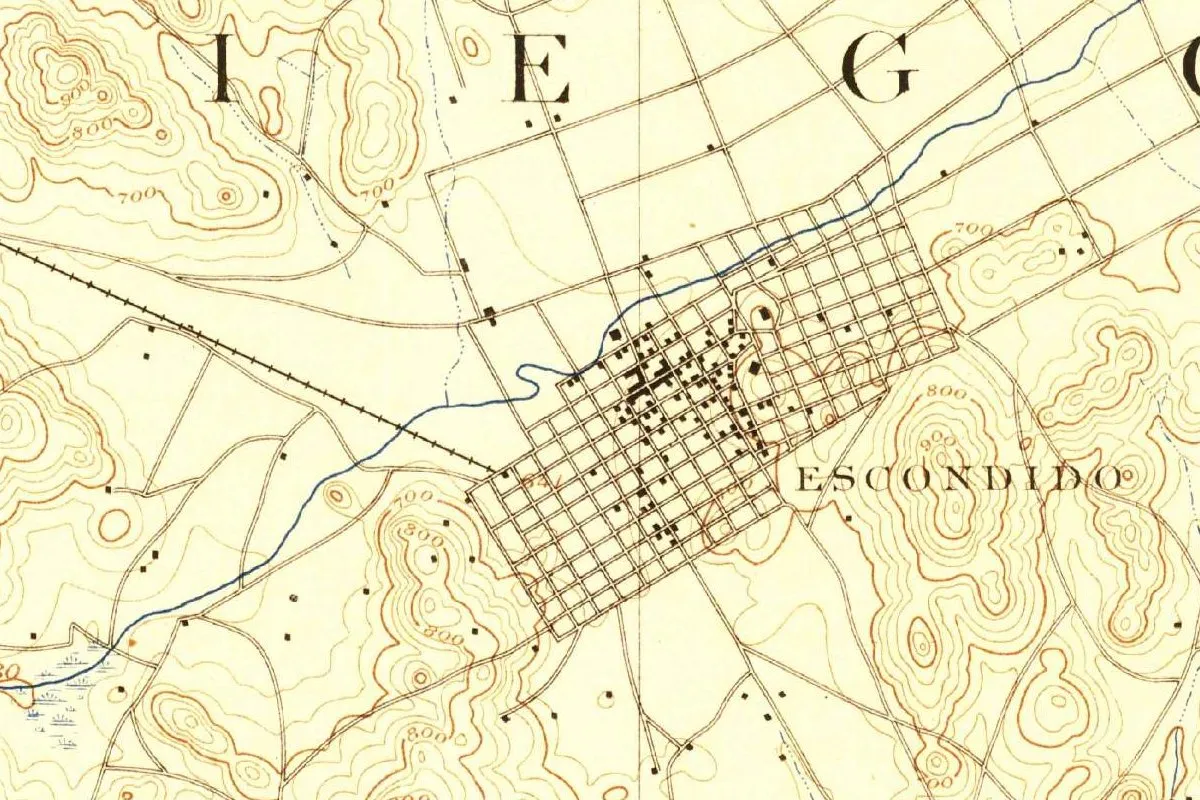
Escondido means “hidden.” Sanchez says “it is said” the place, about fifteen miles (24 km) from the coast, got the name because of where it sits in its valley. She also mentions another place the Spanish called Escondido because the water they were looking for was hard to find, and says this one may have been named the same way.
Otay
Otay is a Native name. A. L. Kroeber, in a 1916 University of California study, wrote that it comes from a word in the language he called Diegueño, meaning “brushy.” Sanchez repeats that and adds that Otay was the name of a former Native village near San Diego.
Cuyamaca
The Cuyamaca Mountains have a Native name too. Kroeber says the Indians he called the Diegueño named them that, and that ekwi-amak is “rain-above.” Sanchez gives T. T. Waterman’s version, “rain yonder,” and says the popular translation “woman’s breast” “is probably not based on fact.”
Descanso
Descanso means “rest.” Sanchez says a government surveying party called it that because they stopped there each day to rest.
Dulzura
Dulzura, a few miles north of the Mexican border, means “sweetness,” and Sanchez couldn’t figure out why: “What there was of ‘sweetness’ in the history of this desolate mining camp can not be discovered.”
Names we’re still checking
You might be wondering about the Gaslamp Quarter, Balboa Park, Hillcrest, Pacific Beach, Ocean Beach, Mission Bay, Mission Valley, North Island and the Hotel del Coronado. We haven’t yet found an old source we can show you that says how those names ended up on the map. Until we do, they stay off this page.
Quick answers
What does La Jolla mean?
Nobody knows for sure. Sanchez (1922) lists “a pool,” a hollow among hills (hoya) and “a jewel” (joya) as guesses, and says the name “must remain among the unsolved problems.”
What does Del Mar mean?
“Of the sea,” or “of or on the sea,” as Sanchez put it.
Is Coronado named after the explorer?
No, according to Sanchez. Coronado Beach is said to be named for the Coronado Islands, and the islands were named for “the four crowned martyrs,” not for Francisco Vásquez de Coronado.
What does Chula Vista mean?
“Pretty view.” Sanchez says chula means pretty, graceful or attractive.
Key dates
- 1769Father Junípero Serra founds the first California mission at San Diego. The name San Diego first belongs to the settlement later called Old Town.
- 1795Plans are drawn for a ten-gun battery on Point Guijarros, the point now called Ballast Point.
- 1850March 18: William Heath Davis and his partners get the land for a new town on the bay, later nicknamed Davis's Folly.
- 1850Dr. J. L. Le Conte finds the rare pines on the coast that he and Dr. C. C. Parry name for John Torrey.
- 1867May 10: Alonzo E. Horton buys 960 acres of city land at auction for $265, the start of Horton's Addition.
- 1887The year of the land boom, when, according to one account, promoters probably first used the name Chula Vista.
- 1900The city sets aside 369 acres on the coastal bluffs to protect the Torrey pines.
Sponsored
Planning a trip to San Diego?
Compare hotels in San Diego on Expedia.
See hotels in San DiegoWe may earn a commission if you buy through this link. It never changes what we write. Read our affiliate disclosure
Sponsored
Read up before your trip
Browse digital travel magazines on Magzter.
Browse travel magazinesWe may earn a commission if you buy through this link. It never changes what we write. Read our affiliate disclosure
Historical Sources & References
- Nellie Van de Grift Sanchez, Spanish and Indian Place Names of California (1922). Vizcaíno changes San Miguel to San Diego in 1602 (p. 28); the mission and Old Town (p. 32); Coronado Beach and the four crowned martyrs (p. 34); El Cajon (p. 43); Chula Vista and Turrill’s note on the 1887 boom (p. 44); Cuyamaca, Descanso, Dulzura, Encinitas and Escondido (pp. 45-46); La Jolla (p. 46); Linda Vista, Point Loma, Del Mar and La Mesa (pp. 47-48); Del Mar marked “Modern” (p. 377); Otay (p. 407).
- A. L. Kroeber, California Place Names of Indian Origin (1916). Cuyamaca (p. 41); Otay (p. 53).
- William E. Smythe, History of San Diego, 1542-1908 (1908). Cabrillo’s San Miguel (p. 28); Point Guijarros, now Ballast Point (p. 85); La Playa and the hide houses, and Derby’s arrival in August 1853 (pp. 102-103); “Davis’s Folly” (p. 108); Derby’s three villages (p. 243); the new town dwindles, and E. W. Morse moves to Horton’s Addition (p. 282); Louis Rose and Roseville (pp. 287, 709); Old Town below Presidio Hill, Gray’s choice of the site and the new town of 1850 (pp. 316-317); Horton’s purchase (p. 349); Horton Plaza and the Torrey pines (pp. 622-623).
- U.S. Geological Survey, San Diego sheet (1904). The map at the top of this page, with Point Loma, La Playa, Roseville, Ballast Point and Coronado labeled.
Sponsored
Live in the San Diego area with kids?
GetOut sells a yearly membership for family attractions around San Diego. Check which places are included before you buy, and keep in mind it renews automatically every year unless you turn renewal off in your account.
See GetOut San DiegoWe may earn a commission if you buy through this link. It never changes what we write. Read our affiliate disclosure
Spot something wrong, or know more? Tell us here. You can also email us or use our contact page. Corrections are noted here with their date, never made silently.