Seattle Names: Puget Sound, Ballard, Alki and More
Seattle place names come from British and American naval explorers, the town’s founders and the people who platted the land, plus a few older Native words. Puget Sound is named for a British lieutenant, Ballard for the captain who managed the company that laid it out, and Alki started out as part of the name “New York-Alki.”
Planning a trip? Here’s where the names on your map came from. A lot of them were handed out from ships, by a British captain in 1792, an American naval expedition in 1841 and the U.S. Coast Survey in the 1850s. The rest came from the settlers who landed in 1851 and the people who laid out the neighborhoods after them.
Where Seattle got its name
The city is named for Chief Seattle, a leader who was a friend of the first settlers. The name went on the first town plat in 1853, and the spelling took a while to settle down. Our Seattle article tells that story, with the old spellings and what the founders themselves wrote.
Seattle also picked up a nickname early. Edmond Meany, in his 1923 book on Washington place names, quotes Frederic James Grant’s 1891 history: in the summer of 1883, two Northern Pacific visitors, General Sprague and John Muir, “addressed Seattle as the Queen City of the Sound.”
The water
Puget Sound
Puget Sound is named for Peter Puget, a lieutenant on Capt. George Vancouver’s British expedition. In May 1792, with the ships anchored near Restoration Point, across the water from today’s Seattle, Vancouver sent Puget and a Mr. Whidbey off in small boats to explore the waters to the south. They set out on May 19, and by May 29 both search parties were back. Vancouver wrote, in the words Meany printed:
“Thus by our joint efforts, we had completely explored every turning of this extensive inlet; and to commemorate Mr. Puget’s exertions, the south extremity of it I named Puget’s Sound.”
So the first Puget Sound was only the far southern end, the bays and inlets south of today’s Tacoma and The Narrows. Meany calls it “a name much extended beyond its original application.” Today it covers the whole inland sea, Seattle included.
Elliott Bay
Seattle’s harbor is named for a chaplain. Meany says the Wilkes Expedition, an American naval survey, explored the bay in 1841 and named it for the Rev. J. L. Elliott, the expedition’s chaplain. Clarence Bagley’s 1916 history of Seattle says he was chaplain of the Vincennes, one of the expedition’s ships. For years the government charts called it Duwamish Bay instead.
Lake Washington and Lake Union
Both lakes were named at an 1854 gathering of pioneers. Grant’s 1891 history says that up to 1854 they had no names but “tenas chuck” and “hias chuck,” which he translates as little water and big water. Other names were tried: Isaac Ebey called the big lake “Lake Geneva” in 1851, and a railroad survey map showed “Lake Dwamish.” Then, in 1854, Thomas Mercer suggested Washington for the big lake, “after the father of his country,” Meany writes, and Union for the small one, because one day it would join the big lake to Puget Sound. Meany puts the naming at a pioneer picnic, and Grant at a public meeting. Meany says that idea was already around in 1854, and the canal that finally did it was celebrated on July 4, 1917.
Salmon Bay and Shilshole
Salmon Bay was named for salmon that may not have been there. Arthur Denny, one of the founders, wrote in 1908 that some of the early settlers thought the bay “must be a great resort for salmon in their season and therefore named it Salmon Bay, but time proved it not to be a very appropriate name.” Meany says Denny knew the bay as Shilshole in December 1852, and that the older name, Shul-shale, belonged to a Native group that lived on the bay, according to a writer named J. A. Costello.
Smith Cove
Smith Cove is named for a doctor. Meany says it honors Dr. Henry A. Smith, the pioneer who settled there in 1853. The Wilkes Expedition had called it Quartermaster Cove.
The neighborhoods
Alki
Alki was the first try at a city, and its name was a joke about the future. Meany says the Denny party, 12 adults and 12 children, landed on the point on November 13, 1851. The settlers “called the place ‘New York,’” and when it grew slowly they added a hyphen and the jargon word Alki, which he translates as “by and bye.” New York-Alki was supposed to become the big city of the Pacific Coast. Denny himself remembered it a little differently: the Terrys, “being New Yorkers, first named the place New York, but afterwards changed it to Alki,” which he says means “by and by,” “before long.” A footnote in Grant’s 1891 history, quoting the historian Bancroft, gives “in the future” or “by and by.”
When most of the settlers moved across Elliott Bay to start Seattle, the ones who stayed dropped “New York,” and Alki Point kept the rest. Before any of that, the Wilkes Expedition had called it Point Roberts. Meany wasn’t sure which Roberts that meant: four men by that name sailed with the expedition, and he thought it might even be the diplomat Edward Roberts. Bagley says it was armorer Humphrey Roberts.
Ballard
Ballard is named for Capt. W. R. Ballard. Meany quotes a local man, R. W. Grover, who said the land was first platted on July 17, 1882, as Farmdale Homestead by John Leary, Thomas Burke and W. R. Ballard. In 1888 it became Gilman Park, with Captain Ballard as the active manager. In 1889 the Seattle, Lake Shore & Eastern built a spur line out to it, and the line’s manager, a Mr. Jennings, needed a name for the station at the end. He “decided to honor Captain Ballard and the new station was called Ballard.” The name Gilman Park dropped out of use almost at once. In November 1890, at a public meeting, Grover himself moved that Gilman Park be known as Ballard, and that’s when steps were taken to change the legal name.
Belltown
Belltown grew up on William N. Bell’s land. Meany says it developed on the donation claim of Bell, “one of the original founders of the city.”
Queen Anne
Queen Anne Hill is named for a house style. Meany says that around 1880 several Seattle families built homes “in the then prevailing Queen Anne style of architecture,” and the Rev. Daniel Bagley jokingly asked people if they were “going out to Queen Anne Town.” The name stuck to the hill, Meany adds, “causing wonderment to new-comers.”
Magnolia
Magnolia may have been named by mistake. Meany says Capt. George Davidson of the U.S. Coast Survey named Magnolia Bluff in 1856, but “no magnolia trees are native there.” There were plenty of madrones and ceanothus, and those “may have been mistaken for magnolias.”
Georgetown
Georgetown is named for a son. Meany says the landowner, Julius Horton, platted the town in 1890 and named it for his son, George M. Horton.
Ravenna
Ravenna Park is named for a city in Italy. Meany says it was named after Ravenna, Italy, “famed for its trees,” and that after former President Roosevelt died, the name was changed to Roosevelt Park. That’s what Meany reported in 1923.
West Point
West Point, the tip of land with the lighthouse at the north end of Elliott Bay, was named by the Wilkes Expedition in 1841, “evidently for the direction in which it lies,” Meany says.
Fauntleroy
Fauntleroy, on the west side of the city, has a love story behind it. Meany says George Davidson of the Coast Survey named Fauntleroy Cove in 1857 for the survey brig E. H. Fauntleroy. Davidson had named the brig for Robert Henry Fauntleroy, whose daughter Ellinor became Mrs. Davidson in 1858. The same year he named the cove, Davidson also named three Olympic peaks that are “in plain view” from Seattle, Meany says: Mount Ellinor for his sweetheart, Mount Constance for her sister, and The Brothers for her two brothers.
Downtown
Yesler Way and the “Skid Road”
Yesler Way used to be Mill Street. Denny wrote that the settlers moved their boundary “north to what is now the south line of Mill Street” to make room for one more claim, and a footnote in his book adds: Yesler Way. Meany explains the old name: “The road leading from his mill became Mill Street, later changed to Yesler Way.” That mill was Henry Yesler’s, and Grant’s 1891 history says the most important building in the village “was Yesler’s sawmill at the foot of Mill street. In more senses than one it was the life of the place.” Henry Yesler had come up from Portland in October 1852 looking for a mill site, Bagley says, and he got a strip of waterfront where two other men’s claims met.
You may have heard that this street was the first “Skid Road,” and that “Skid Row” comes from it. Here’s what our sources do say. Bagley describes how a skid road worked in the early logging days: once a big tree was down, “a skid road was then built from the spar to the water and the first journey of the stick of timber was commenced.” What none of the old books we read says is that Mill Street was called the Skid Road, or that the phrase Skid Row started here. Until we find that in a source we can show you, we’re not going to tell it as fact.
Pioneer Place
The spot where Yesler built his mill is the old heart of town. Bagley says the point where the claims of Boren and Maynard joined was “now Pioneer Place.” Grant, in 1891, called Pioneer Place “the real business center of the city,” a five-sided space where four streets met: Commercial, Yesler Avenue, James and Front. Why it was called Pioneer, neither book says.
Mercer Street
Mercer Street marks an old property line. Bagley says Thomas Mercer, the same man who named the lakes, took up a land claim that ran to Lake Union, and “what is now known as Mercer Street was the dividing line between his claim and that of D. T. Denny.”
Around the city
Mount Rainier
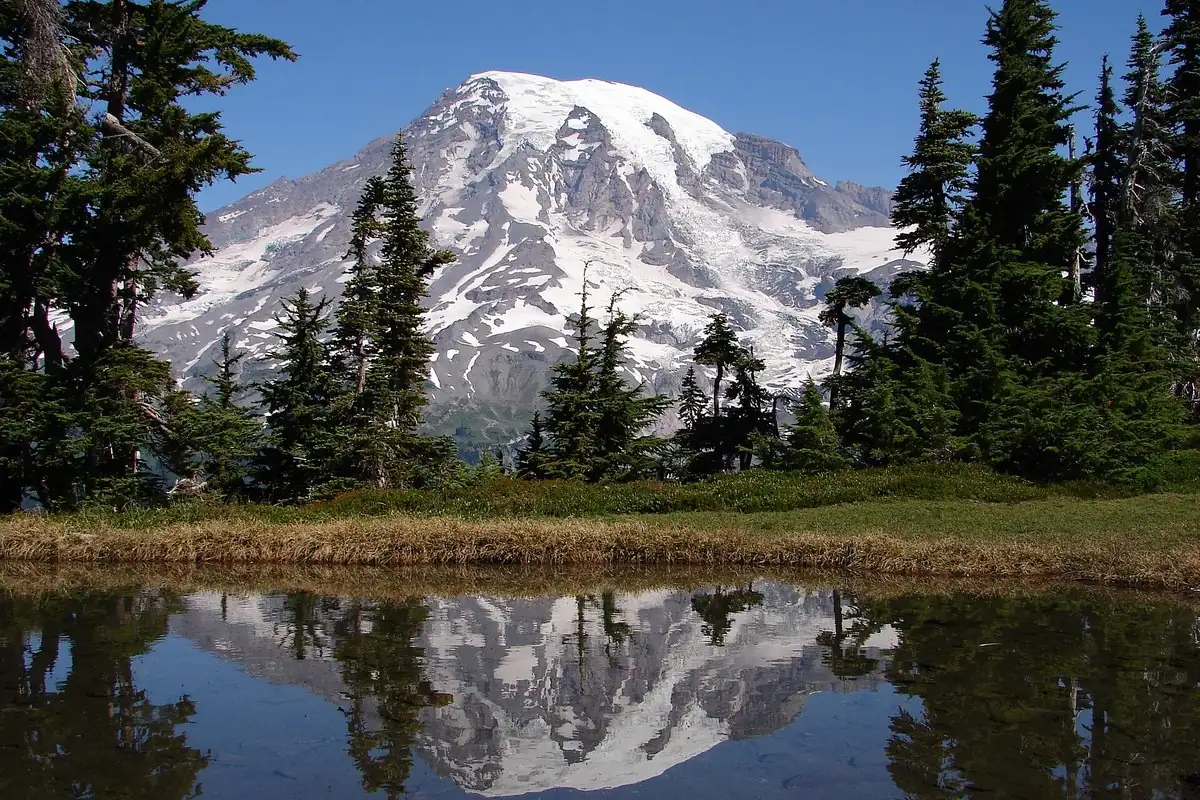
Mount Rainier is named for a British admiral. Meany says Vancouver sighted the mountain on May 8, 1792, and named it for Rear Admiral Peter Rainier of the British Navy. Meany adds that in 1853 the writer Theodore Winthrop declared the Native name of the mountain to be “Tacoma,” and said it was a general word for all snow peaks. Our Tacoma article tells how a city ended up with that name, and why it’s still argued over.
Duwamish
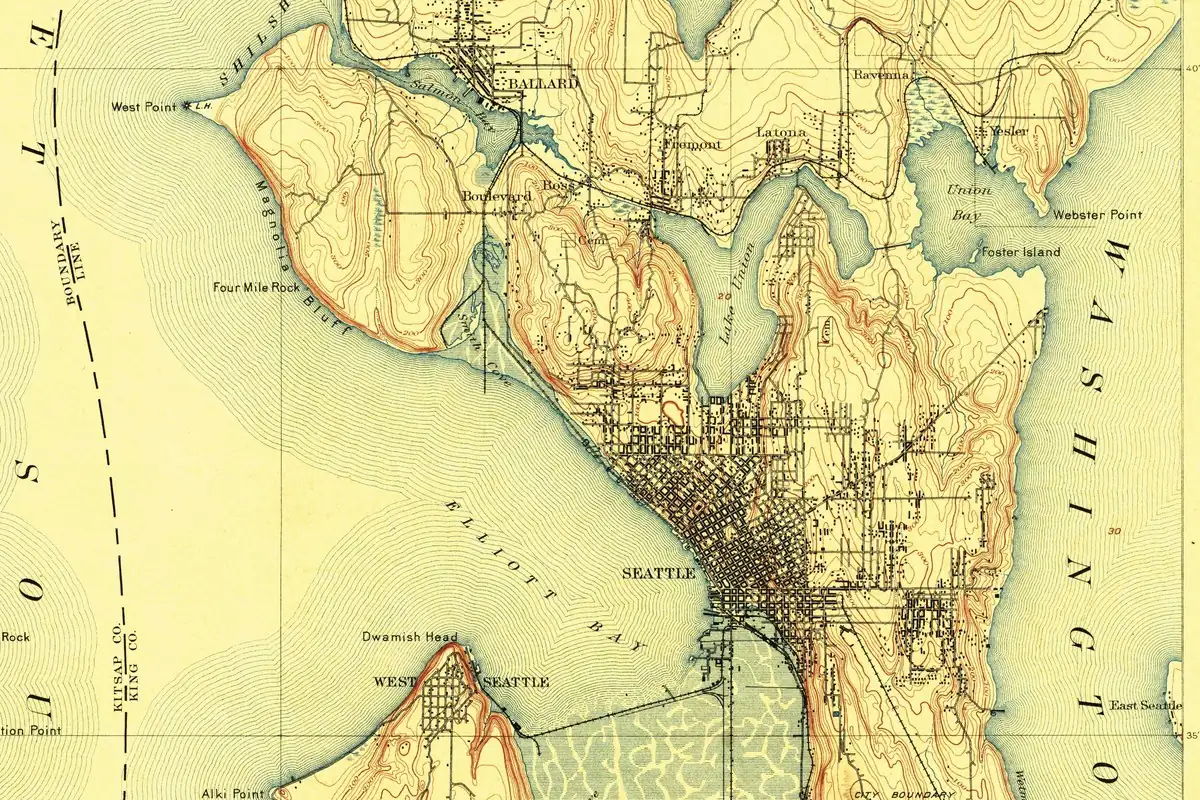
Duwamish is a tribal name. Meany says the U.S. Coast Survey named Duwamish Head, the bluff where West Seattle sits, in 1856. He quotes Denny as saying the right spelling was “Dewampsh,” and the missionary Myron Eells as saying it’s the name of a tribe and means “the people living on the river.” That’s Eells’s translation, and we pass it on as his. The 1894 map at the top of this page spells it Dwamish Head.
Mercer Island
Mercer Island is named for Asa Shinn Mercer. Meany says it honors Mercer, “who once owned land there.”
Bainbridge Island
Bainbridge Island, across the sound from downtown, is named for a naval hero. Meany says the Wilkes Expedition named it in 1841 for Capt. William Bainbridge, “hero of the Constitution in the Java action.” Bagley calls him a hero of the War of 1812.
Vashon Island
Vashon Island was named on May 29, 1792, Meany says, by Vancouver himself, after his friend Capt. James Vashon of the British Navy.
Restoration Point
Restoration Point, at the southeast end of Bainbridge Island, is where Vancouver’s ships anchored. He named it for “Restoration Day,” May 25, 1660, when the Stuart kings got the English crown back, Meany says. Vancouver had first called it Village Point because of a Native camp nearby.
Kirkland and Renton
Kirkland is named for Peter Kirk, an English iron maker. Meany says Kirk founded the town in 1886 and hoped to build steelworks there. Renton was first known as Black River Bridge, and its name honors Capt. William Renton of the Port Blakely Mill Company.
Names we’re still checking
You might be wondering about the Space Needle, Capitol Hill, Fremont, Pike Place, Pioneer Square, Green Lake and Skid Row. Meany mentions Fremont and Green Lake, but he doesn’t say where their names came from, and we haven’t yet found a source we can show you for the others. Until we do, they stay off this page.
Quick answers
Who is Puget Sound named after?
Peter Puget, a lieutenant with George Vancouver’s British expedition. Vancouver named the far southern end of the sound for him in May 1792, “to commemorate Mr. Puget’s exertions.”
Why is it called Ballard?
It’s named for Capt. W. R. Ballard, who managed the company that laid it out. In 1889 the railroad named its new station for him. The old name, Gilman Park, faded fast, and in November 1890 steps were taken to make Ballard the legal name.
What does Alki mean?
Meany translates it as “by and bye,” Denny as “by and by” or “before long,” and a footnote in Grant’s history, quoting Bancroft, as “in the future” or “by and by.” The settlers first called the place New York, then New York-Alki, meaning it would be a big city someday.
Why is it called Magnolia if there are no magnolias?
Meany says George Davidson named Magnolia Bluff in 1856. No magnolias grow there naturally, but madrones and ceanothus were plentiful and “may have been mistaken for magnolias.”
Key dates
- 1792May 8: George Vancouver sights the mountain and names it for Rear Admiral Peter Rainier.
- 1792May 19 to 29: Peter Puget and Mr. Whidbey explore the inlet to the south, and Vancouver names its far end Puget's Sound.
- 1841The Wilkes Expedition charts the area and names Elliott Bay, Bainbridge Island, West Point and Point Roberts, today's Alki Point.
- 1851November 13: the Denny party lands at the point they will call New York, and later Alki.
- 1854At a pioneer picnic, Thomas Mercer suggests the names Lake Washington and Lake Union.
- 1856George Davidson of the U.S. Coast Survey names Magnolia Bluff. The Coast Survey names Duwamish Head the same year.
- 1882July 17: the land that becomes Ballard is platted as Farmdale Homestead.
- 1889A railroad station at the end of a new spur line is named Ballard, after Capt. W. R. Ballard.
- 1890Julius Horton plats Georgetown, named for his son. In November, a public meeting takes steps to change Gilman Park's legal name to Ballard.
Sponsored
Planning a trip to Seattle?
Compare hotels in Seattle on Expedia.
See hotels in SeattleWe may earn a commission if you buy through this link. It never changes what we write. Read our affiliate disclosure
Sponsored
Read up before your trip
Browse digital travel magazines on Magzter.
Browse travel magazinesWe may earn a commission if you buy through this link. It never changes what we write. Read our affiliate disclosure
Historical Sources & References
- Edmond S. Meany, Origin of Washington Geographic Names (1923). Alki Point, Point Roberts and New York-Alki (p. 4); Bainbridge Island (p. 12); Ballard, quoting R. W. Grover (p. 13); Belltown (p. 17); Duwamish Head and the Duwamish River (p. 74); Elliott Bay (p. 78); Fauntleroy Cove and the Olympic peaks (pp. 83-84); Georgetown (p. 96); Green Lake (p. 103); Kirkland (p. 131); Lake Union, Lake Washington and the canal (pp. 140-141); Magnolia Bluff (p. 157); Mercer Island (p. 165); Mount Rainier and Winthrop’s “Tacoma” (p. 177); Puget Sound and Vancouver’s words (p. 234); Queen Anne Hill (p. 237); Ravenna Park (p. 241); Renton and Restoration Point (p. 243); Salmon Bay and Shilshole (p. 253); Chief Seattle, the 1853 plat and Mill Street, later Yesler Way (p. 262); the Queen City and Fremont (p. 264); Smith Cove (p. 277); Vashon Island (p. 326); West Point (p. 342).
- Clarence B. Bagley, History of Seattle, vol. 1 (1916). Wilkes’s Point Roberts for Humphrey Roberts and Elliott Bay for the chaplain of the Vincennes (p. 13); Yesler’s arrival and Pioneer Place (p. 25); Mercer Street (p. 27); the lakes, quoting Grant (p. 41); the skid road (p. 229).
- Frederic James Grant, History of Seattle, Washington (1891). Mill Street, now Yesler Avenue, and a footnote quoting Bancroft on Alki, “in the future” or “by and by” (p. 70); Yesler’s sawmill at the foot of Mill Street (p. 82); “tenas chuck” and “hias chuck” and the naming of the lakes (p. 85); Pioneer Place (p. 381).
- Arthur A. Denny, Pioneer Days on Puget Sound (1908). New York changed to Alki (p. 33); Mill Street, footnoted as Yesler Way (p. 38); Salmon Bay (p. 52).
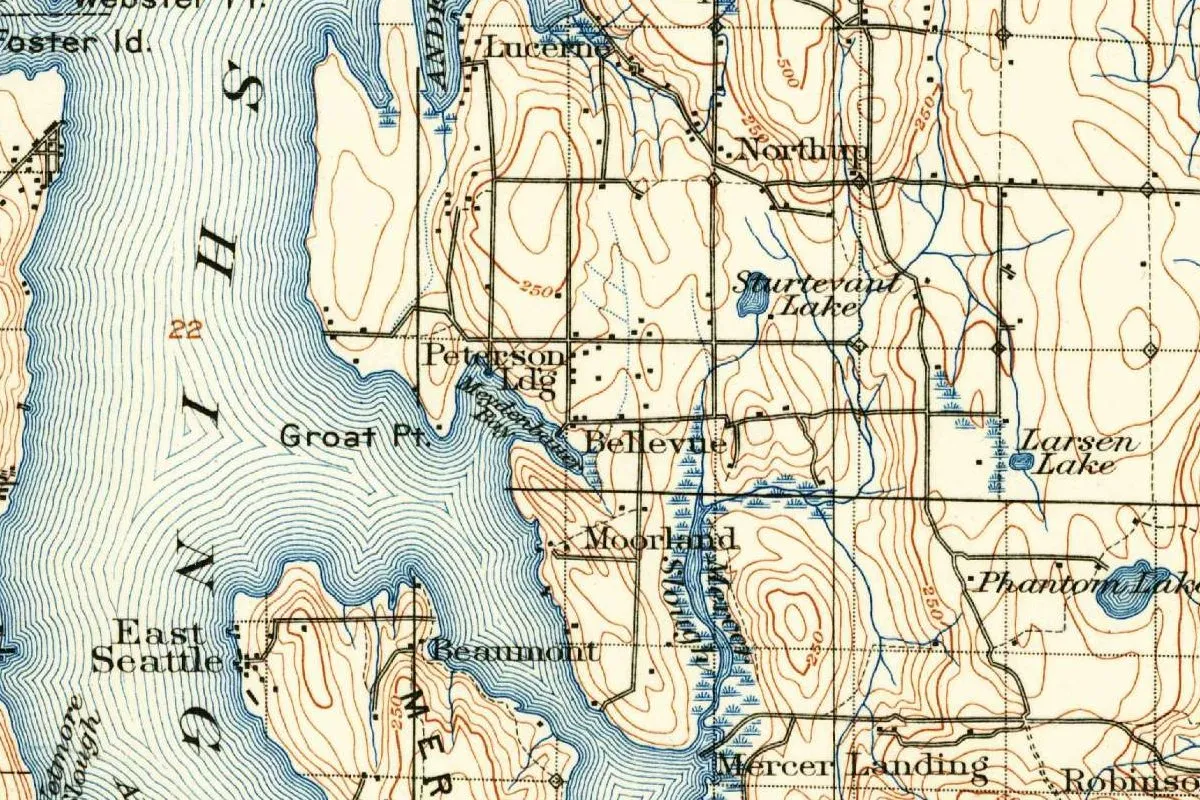
- U.S. Geological Survey, Seattle sheet (1894). The map at the top of this page, with Ballard, Salmon Bay, Magnolia Bluff, Dwamish Head and Alki Point labeled.
Sponsored
Live in the Seattle area with kids?
GetOut sells a yearly membership for family attractions around Seattle and the rest of Washington state. Check which places are included before you buy, and keep in mind it renews automatically every year unless you turn renewal off in your account.
See GetOut WashingtonWe may earn a commission if you buy through this link. It never changes what we write. Read our affiliate disclosure
Spot something wrong, or know more? Tell us here. You can also email us or use our contact page. Corrections are noted here with their date, never made silently.