How Aurora, Illinois Got Its Name From the Dawn
Aurora is the Latin word for dawn. When the Fox River settlement known as McCarty's Mills got its post office in 1837, some settlers wanted to name it for the Potawatomi chief Waubonsie. E. D. Terry suggested Aurora instead, Homer's "rosy-fingered" goddess, a Kane County history of 1878 says, and his name was adopted.
When Aurora, Illinois, got its post office in 1837, settler E. D. Terry suggested the name of the dawn goddess over that of the old chief Waubonsie. Before that, people on this stretch of the Fox River had called the place after the brothers who ran its mills.
McCarty’s Mills on the Fox
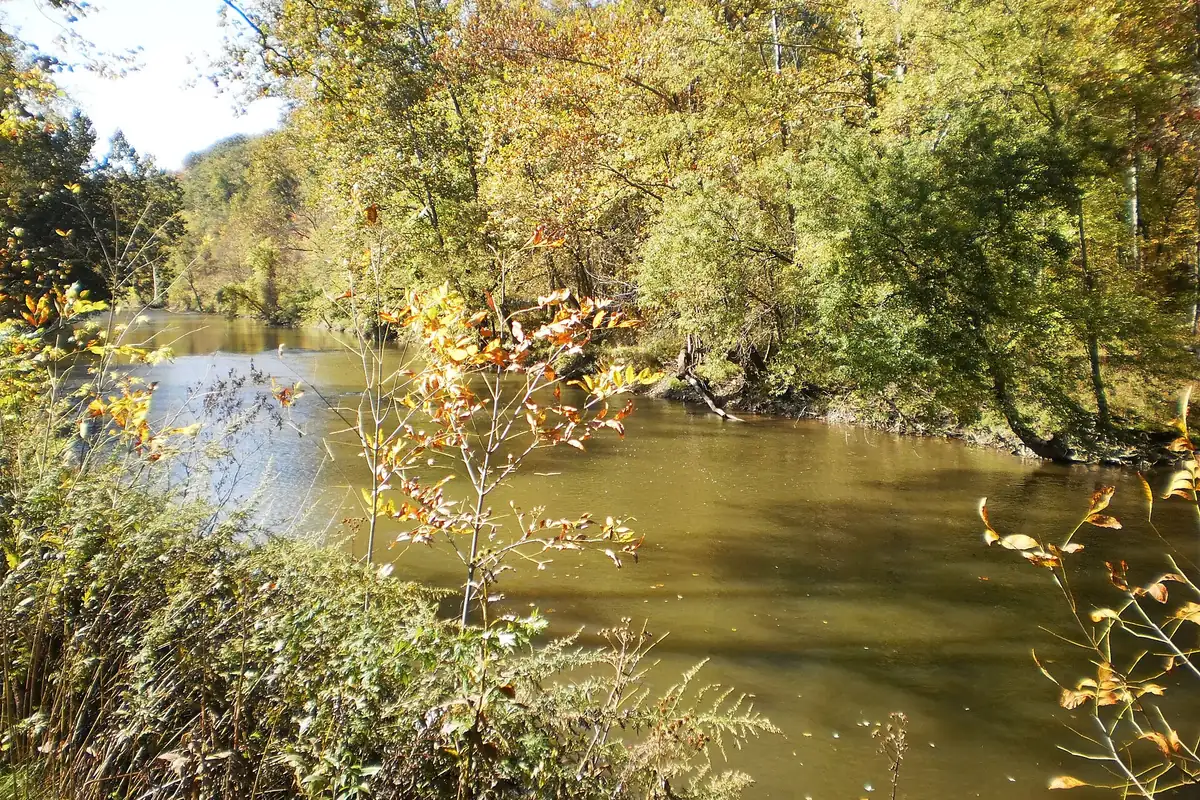
The town started with a dam. According to Joslyn’s History of Kane County (1908), the McCarty brothers, Joseph and Samuel, built a log cabin, dammed the river in the summer and fall of 1834 and raised a sawmill, a job that took a dozen men three days. The City of Aurora says Joseph McCarty built the first campfire in April 1834 on the island that’s now downtown.
The place already had a name. The 1908 history puts it this way: “Before the arrival of the McCartys the Indian name of the place was ‘Waubonsie,’ in honor of the chief of that name,” whose home was north of the mill on the west side of the river. Then, in 1835, it says, “the place became known among the whites as McCarty’s Mills.” Samuel McCarty laid out the first streets and lots and, the book notes, “always insisted on calling himself ‘The founder of Aurora.’”
A post office needs a name
What changed the name was the mail. The Past and Present of Kane County, published in 1878, says Samuel McCarty staked a road to the settlement in 1836 and talked the mail contractor into using it. A man named Burr Winton, who was living in McCarty’s house, took over the job of boarding the drivers. Then the settlers wanted a post office of their own. At a meeting in November 1836, with R. C. Horr in the chair, they backed Winton as postmaster and sent off a petition. He took charge of the office in March 1837.
The petition needed a name, and the 1878 book says that wasn’t easy. Some of the settlers wanted to honor “the friendly old Chief of the Pottawattomies” by calling it Waubansie, and there were other ideas too. Then:
“…Mr. E. D. Terry having suggested Aurora, Homer’s ‘rosy-fingered’ goddess received the honor, and the village as euphonious and classic a name as could have been conferred upon it.”
The 1908 history tells it more plainly: “Several Indian names were suggested, but finally E. D. Terry suggested the classic name Aurora, which was adopted.” Terry wasn’t a stranger to the place. The 1908 history lists him among the newcomers of 1835, and the 1878 book says he and Richard Terry put up a hotel there in the fall of 1836.
One small wrinkle, if you like that kind of thing: Homer wrote in Greek, but Aurora is a Latin word. Henry Gannett’s 1905 federal list of place names says the many American towns called Aurora are “named from the Latin word, meaning ‘morning,’ ‘dawn,’ ‘east.’” The City of Aurora keeps it simple: the village “became Aurora, goddess of the dawn.”
The other stories
You’ll also hear the choice explained in other ways. A 2012 article from the Aurora Historical Society, printed in the Daily Herald, says Waubonsie was the favorite but that Illinois already had a post office by that name. It also passes along two theories: “Some say it is a transplanted place name from New York state,” and others that Aurora was meant as “a translation of Waubonsie’s name.” The article gives that name’s meaning as “break of day” or “early dawn,” but it doesn’t say where that translation comes from, and we couldn’t find a language source that confirms it. Neither of the old county histories mentions either theory. They both give the name to Terry and his classical goddess.
The same article dates Winton’s appointment as postmaster to March 2, 1837. The 1878 book only says March.
Two Auroras, then one
For a while there were two towns. The 1908 history says the “town of West Aurora” was incorporated separately in 1854, with its own trustees, and that there was “some rivalry between the two towns, as well as some jealousy, and hard feelings.” In 1857, it says, the people of both agreed “to bury the hatchet and unite to become the city of Aurora.” The name had crossed the river.
It also traveled west. Aurora, Nebraska, got its name because settler David Stone suggested it “as a compliment to his wife who was a native of Aurora, Illinois,” according to Lilian Fitzpatrick’s 1925 book on Nebraska place names. That story is told in full on our page for Aurora, Nebraska. So a goddess from Homer, picked for a post office in Illinois, ended up on a county seat on the Nebraska prairie, by way of a wife’s hometown.
Quick answers
Who named Aurora, Illinois?
E. D. Terry, one of the early settlers. Kane County histories from 1878 and 1908 both say he suggested Aurora when the settlement got its post office.
What was Aurora, Illinois, called before?
McCarty’s Mills, after the McCarty brothers’ mills on the Fox River. The 1908 county history also says the place had been called Waubonsie, for the Potawatomi chief, before the McCartys came.
Is Aurora named after Chief Waubonsie?
No. Some settlers wanted to name the post office for him, but Terry’s suggestion, Aurora, won out. A modern article repeats the idea that Aurora translates the chief’s name, but it gives no source for that meaning.
When did Aurora get its name?
In 1837, when the post office opened with Burr Winton as postmaster. The 1878 history says March; the Aurora Historical Society gives March 2.
Key dates
- 1834The McCartys dam the Fox River and put up a sawmill; the city dates Joseph McCarty's first campfire on the island to April.
- 1835The settlement becomes known among the whites as McCarty's Mills, according to a 1908 county history.
- 1836November: a meeting of settlers backs Burr Winton as postmaster and sends off a petition for a post office.
- 1837March: Winton takes charge of the new post office, named Aurora at E. D. Terry's suggestion.
- 1857Aurora and the separate town of West Aurora agree to unite as the city of Aurora.
Getting there
Open Aurora in Google Maps
Opens in a new tab. The pin is the center of Aurora in the USGS place-name record.
The closest airports, Amtrak stations and intercity bus stops, measured in a straight line from the center of Aurora.
Airports
- Chicago O'Hare International (ORD) 26 mi 42 km
- Chicago Midway International (MDW) 29 mi 47 km
Amtrak trains
- Naperville station (NPV) 9 mi 15 km
- Plano station (PLO) 13 mi 21 km
Intercity buses
- Greyhound Naperville Route 59 Metra Station 6 mi 9 km
- Van Galder (Coach USA) O'Hare International Airport - Terminal 2 Departures 26 mi 42 km
- Wisconsin Coach Lines O'Hare International Airport - Terminal 2 Departures 26 mi 42 km
Distances are as the crow flies, not by road. We don't list schedules or fares because they change; check with the airline, Amtrak or the bus company before you go. Official data (FAA commercial service airports (2025), FAA airport locations, Amtrak stations and Intercity Bus Atlas) from the FAA and the U.S. Bureau of Transportation Statistics, checked Nov 13, 2026.
Sponsored
Staying in Aurora?
Compare hotels in Aurora, Illinois, on Expedia.
See hotels in AuroraWe may earn a commission if you buy through this link. It never changes what we write. Read our affiliate disclosure
Sponsored
Want the spooky side of Aurora?
The name has its story above. For the ghost stories, US Ghost Adventures runs walking ghost tours in Aurora.
See ghost tours in AuroraWe may earn a commission if you book through this link. It never changes what we write. Read our affiliate disclosure
Historical Sources & References
- The Past and Present of Kane County, Illinois (1878), pp. 282-283. McCarty’s road, Burr Winton, the meeting of November 1836, the post office of March 1837, the push to call it Waubansie, and Terry’s suggestion of “Homer’s ‘rosy-fingered’ goddess.”
- Henry Gannett, The Origin of Certain Place Names in the United States (1905), p. 33. Aurora, a name used “in many other places,” “named from the Latin word, meaning ‘morning,’ ‘dawn,’ ‘east.’”
- Joseph and Frank W. Joslyn, History of Kane County, Ill., vol. 1 (1908), pp. 543-544 and 548. The McCartys’ dam and sawmill of 1834, the earlier name Waubonsie, McCarty’s Mills from 1835, E. D. Terry’s “classic name Aurora,” and the union of Aurora and West Aurora in 1857.
- Lilian Linder Fitzpatrick, Nebraska Place-Names (1925), p. 71. Aurora, Nebraska, suggested by David Stone for his wife, “a native of Aurora, Illinois.”
- City of Aurora, “About Our City”. Joseph McCarty’s campfire of April 1834, McCarty mills, and the village that “became Aurora, goddess of the dawn” in 1837.
- Aurora Historical Society, “A look at how Aurora emerged in the 1830s,” Daily Herald (2012). Waubonsie already in use for another Illinois post office, the New York and translation theories, and Winton’s appointment on March 2, 1837.
- GNIS feature 403732 (U.S. Geological Survey). Aurora’s listing number, kept with Kane County.
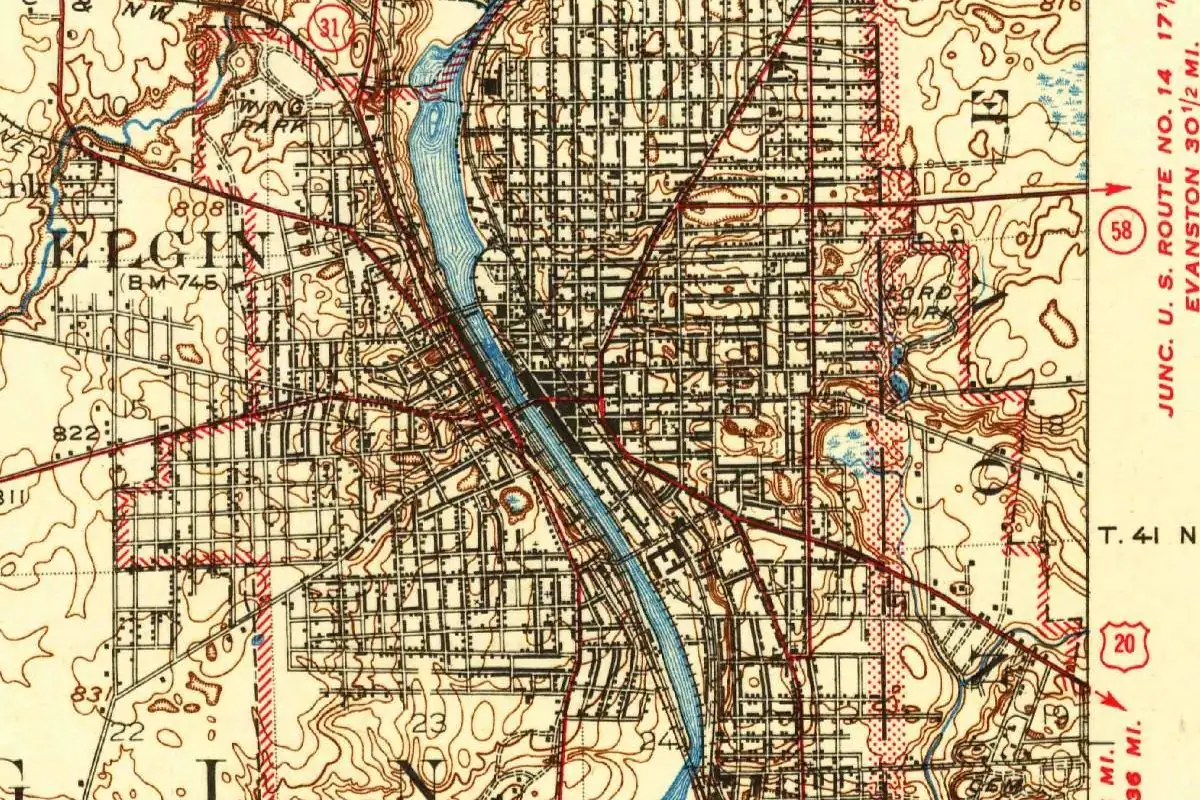
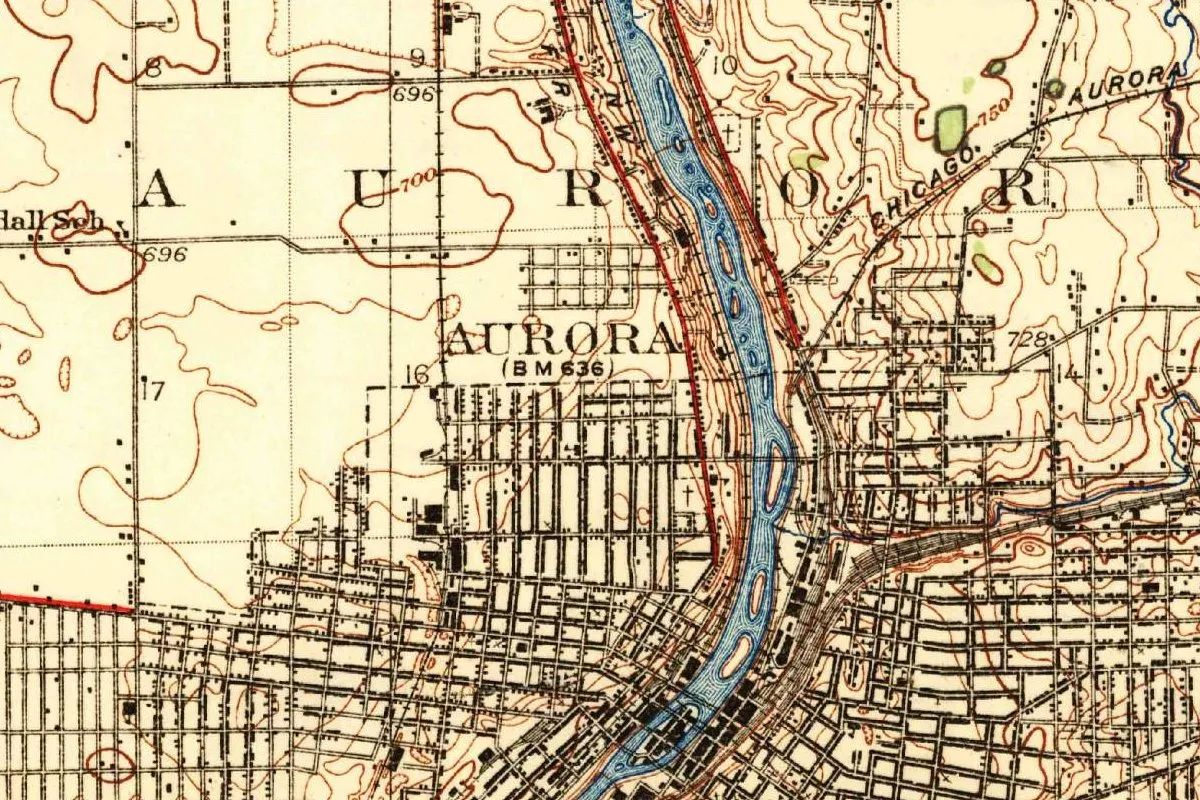
- U.S. Geological Survey, Geneva sheet (1932). A 1:62,500 sheet from a 1929 survey, with Aurora’s streets running down to the Fox River and its islands.
Spot something wrong, or know more? Tell us here. You can also email us or use our contact page. Corrections are noted here with their date, never made silently.