Naperville, Illinois: How Naper's Settlement Got a New Name
Naperville carries the name of Joseph Naper, a former Lake Erie steamer captain who settled on the DuPage River in 1831. An 1857 county history says the spot was then known as Naper's Settlement, and an 1882 history says it became Naperville when his town plat, dated February 14, 1842, was drawn.
A sailor on the DuPage
Before it was Naperville, the spot on the DuPage River where Lake Erie steamer captain Joseph Naper settled in 1831 went by Naper’s Settlement. The town’s later name kept the captain and dropped the settlement.
The “Captain” in front of his name wasn’t a courtesy. Rufus Blanchard’s 1882 History of Du Page County says Naper started out as a cabin boy on a Lake Erie steamer and worked his way up until he was captain of one that ran between Buffalo and Detroit from 1828 to 1830. His younger brother John also commanded sailing ships on the lake. Then the two of them headed west together, carrying the ironwork for a sawmill and a stock of goods to trade.
The first county history, written by C. W. Richmond and H. F. Vallette in 1857, picks up the story from there. Joseph Naper had looked over the land in February 1831. In July his family arrived from Ohio along with John’s. He built a cabin near where his flour mill later stood, plus a trading house, and traded with the settlers and with the Indians, who the book says “were quite numerous here at that time.” More families kept arriving, and by the end of spring 1832 the place had about 180 people.
“Then known as”
The 1857 history puts the first name of the place in one short line:
“The locality was then known as ‘Naper’s Settlement.’”
That’s on page 7, right after the list of families. Blanchard used the same kind of phrase in 1882, calling it “the Naper settlement.” Neither county history describes a vote on the name; both just report what people called the place.
Henry Gannett’s federal bulletin on place names put it just as plainly in 1905: Naperville, in DuPage County, was “named for Joseph Naper, its founder.”
So when did it become Naperville?
This is where the two county histories don’t line up, which matters if you’re the kind of person who likes one tidy date.
Blanchard’s 1882 book says Joseph Naper surveyed and laid out the town in streets, that his plat “bears date of February 14, 1842,” and that “henceforward the name of the place was Naperville, instead of the Naper settlement.” A plat, by the way, is the surveyed map that divides land into streets and lots.
The 1857 history tells it differently. It says “the original town plat was laid out in the year 1835, by Capt. Naper,” covering about 80 acres. And the records it reprints already use the new name before 1842: settlers met “at Naperville” on September 29 and October 28, 1839, to protect their land claims. So the name Naperville was clearly in use by 1839, even if a dated plat from 1842 is what Blanchard pointed to.
Neither version changes whose name it is. They just disagree on when the paperwork caught up with what people were already saying.
The founder stayed on
Naper didn’t name the place and leave. According to Blanchard, the Illinois legislature passed an act approved on February 7, 1857, to incorporate the village of Naperville, and when the first election was held on May 4 of that year, the voters picked Joseph Naper as president.
The 1857 history also gives you a sense of how busy the young town felt. The road through the village was the main route between Chicago and Galena, and the authors pass along a story that at a very early date Naperville was bigger than Chicago, since Chicago had one log house and Naperville had two. They tell it with an “it is said,” so take it as the boast it sounds like.
What’s easier to check is the ending: a captain who’d spent his early years on Lake Erie ended up with an Illinois town named for him, and then got elected to run it.
Quick answers
Who was Naperville named after?
Joseph Naper, who settled on the DuPage River in 1831. Gannett’s 1905 bulletin calls him the town’s founder, and Blanchard’s 1882 history says he had been a steamer captain on Lake Erie.
What was Naperville called before?
Naper’s Settlement. The 1857 county history says the place “was then known as” that in the early 1830s, and Blanchard’s 1882 history calls it “the Naper settlement.”
When did Naper’s Settlement become Naperville?
The sources differ. Blanchard dates the change to Naper’s plat of February 14, 1842; the 1857 history dates the first plat to 1835 and prints 1839 meeting records already held “at Naperville.”
Key dates
- 1831Joseph Naper visits the DuPage in February and brings his family from Ohio in July, with his brother John's family.
- 1832By the end of spring the settlement has about 180 people. The 1857 history says it was then known as Naper's Settlement.
- 1835The 1857 history dates Captain Naper's original town plat, about 80 acres, to this year.
- 1839Settlers' meetings on September 29 and October 28 are recorded as held at Naperville.
- 1842February 14: the date on Joseph Naper's plat, according to the 1882 history, which says the name Naperville dates from it.
- 1857February 7: an act incorporates the village of Naperville. On May 4, Joseph Naper is elected its first president.
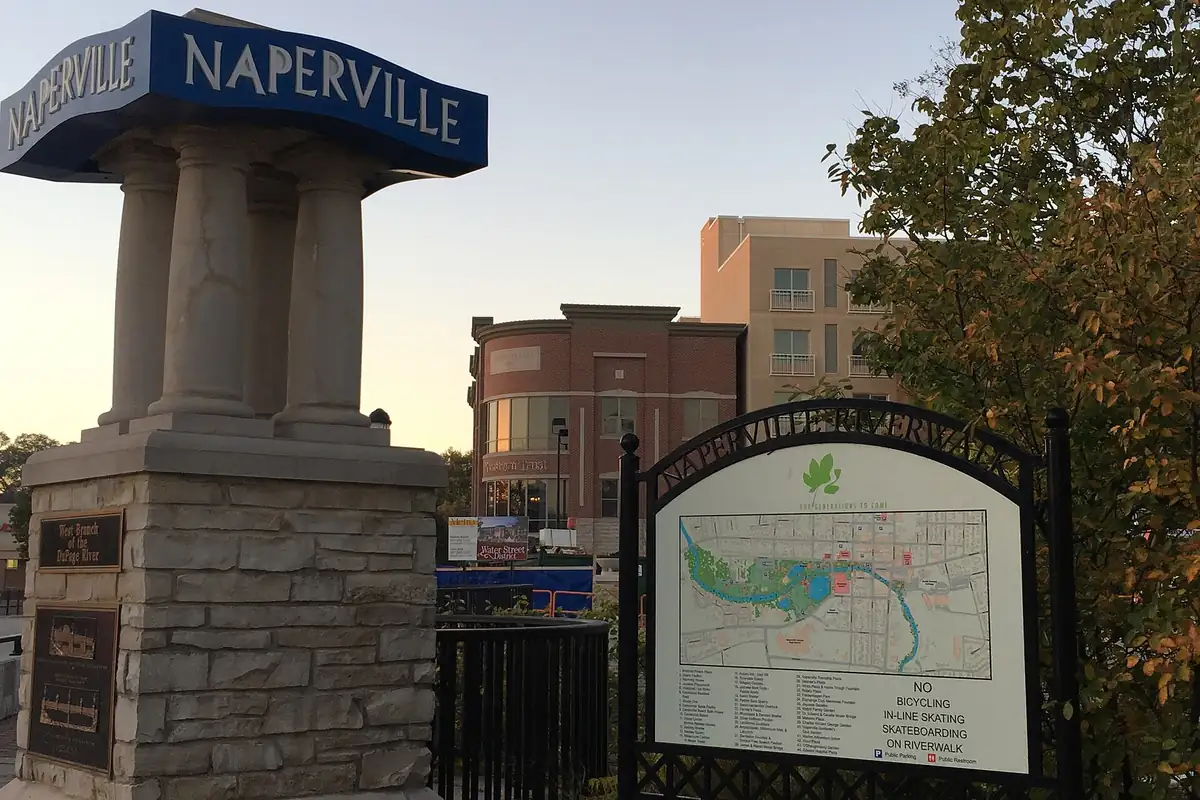
Getting there
Open Naperville in Google Maps
Opens in a new tab. The pin is the center of Naperville in the USGS place-name record.
The closest airports, Amtrak stations and intercity bus stops, measured in a straight line from the center of Naperville.
Airports
- Chicago O'Hare International (ORD) 18 mi 29 km
- Chicago Midway International (MDW) 20 mi 33 km
Amtrak trains
- Naperville station (NPV) under 1 mi 0.7 km
- La Grange station (LAG) 14 mi 23 km
Intercity buses
- Greyhound Naperville Route 59 Metra Station 3 mi 5 km
- Wisconsin Coach Lines O'Hare International Airport - Terminal 2 Departures 18 mi 29 km
- Van Galder (Coach USA) O'Hare International Airport - Terminal 2 Departures 18 mi 29 km
Distances are as the crow flies, not by road. We don't list schedules or fares because they change; check with the airline, Amtrak or the bus company before you go. Official data (FAA commercial service airports (2025), FAA airport locations, Amtrak stations and Intercity Bus Atlas) from the FAA and the U.S. Bureau of Transportation Statistics, checked Nov 13, 2026.
Sponsored
Staying in Naperville?
Compare hotels in Naperville, Illinois, on Expedia.
See hotels in NapervilleWe may earn a commission if you buy through this link. It never changes what we write. Read our affiliate disclosure
Sponsored
Want the spooky side of Naperville?
The name has its story above. For the ghost stories, US Ghost Adventures runs walking ghost tours in Naperville.
See ghost tours in NapervilleWe may earn a commission if you book through this link. It never changes what we write. Read our affiliate disclosure
Historical Sources & References
- C. W. Richmond and H. F. Vallette, A History of the County of Du Page, Illinois (1857), pp. 7, 46 and 90. The Napers’ arrival from Ohio in July 1831, the trading house, about 180 settlers by spring 1832 and the line saying the place “was then known as” Naper’s Settlement (p. 7); the claim society meetings held at Naperville on September 29 and October 28, 1839 (p. 46); the 1835 town plat of about 80 acres, the Chicago-Galena road and the “two log houses” story (p. 90).
- Rufus Blanchard, History of Du Page County, Illinois (1882), pp. 30-31, 215-216. Joseph Naper’s years as a cabin boy and steamer captain on Lake Erie (pp. 30-31), and the brothers bringing sawmill ironwork and trade goods (p. 31); his plat dated February 14, 1842, after which the place was Naperville “instead of the Naper settlement,” the 1857 incorporation act and Naper’s election as village president (pp. 215-216).
- Henry Gannett, The Origin of Certain Place Names in the United States (USGS, 1905), p. 220. Naperville “named for Joseph Naper, its founder.”
- GNIS feature 421954 (U.S. Geological Survey). The spelling Naperville and its DuPage County location, as recorded in the federal names database.
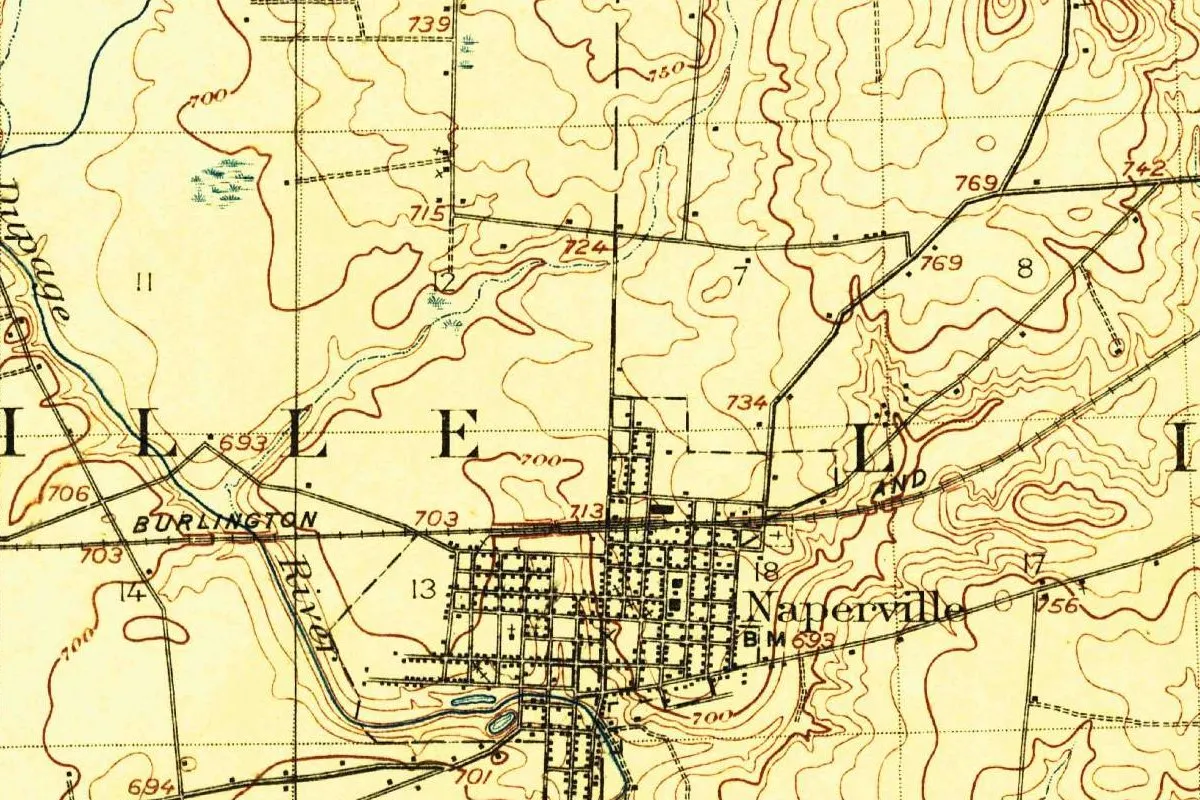
- U.S. Geological Survey, Wheaton sheet (1908). Source sheet for the 1908 map detail showing the Naperville street grid by the river.
Spot something wrong, or know more? Tell us here. You can also email us or use our contact page. Corrections are noted here with their date, never made silently.