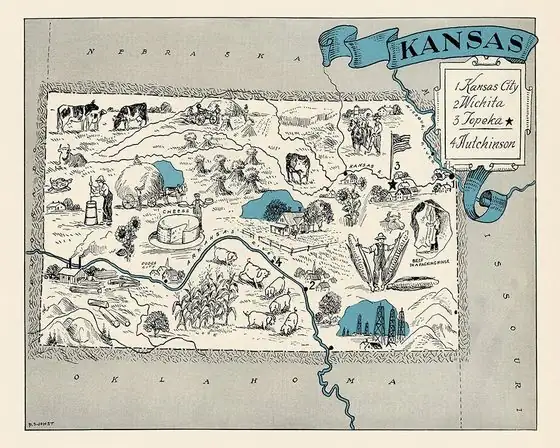
Olathe, Kansas: Two Stories Behind a Shawnee Word
Olathe comes from a Shawnee word that Dr. John T. Barton, who laid out the town in 1857, understood to mean "beautiful." A 1915 county history prints two versions: a Shawnee chain carrier named Dave Daugherty exclaimed it at the site, or, in Barton's own 1888 telling, chief Joseph Parks supplied it.
A doctor, a prairie and a borrowed word
Dr. John T. Barton named Olathe, Kansas, in 1857 with a Shawnee word he was told meant “beautiful,” but the old accounts disagree on who gave it to him. Everyone agrees on the doctor, the year and the meaning he took from it. Who actually said the word first is where the stories split.
Barton knew the Shawnee well. Ed Blair’s History of Johnson County, Kansas, published in 1915, describes him as a Virginian with a Philadelphia medical degree who had come west in 1850 and become physician to the Shawnees at Chillicothe, about 3 miles (5 km) west of today’s Shawnee, Kansas. In 1856 and 1857 the Shawnees were choosing their individual allotments of land. With what the book calls “certain inside information” from Lot Coffman, the man in charge of the allotting, Barton rode to the geographic center of Johnson County and claimed two quarter sections for a town.
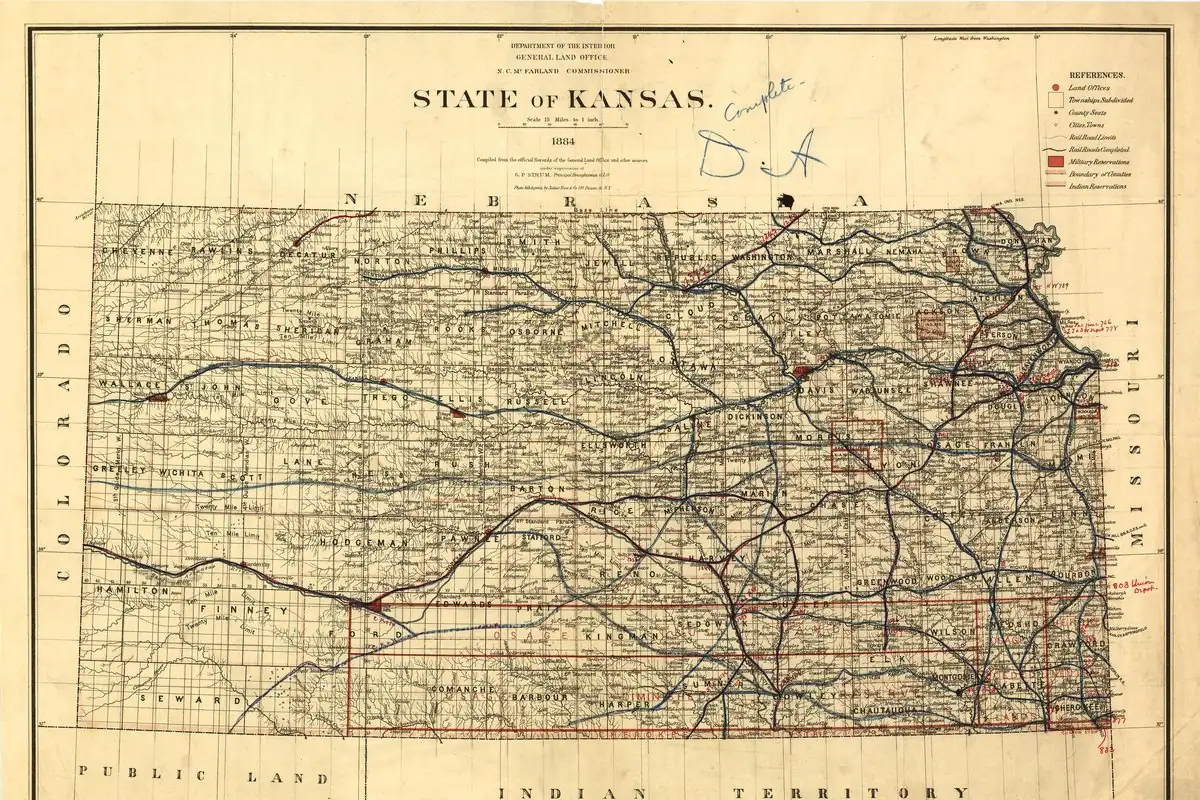
That location was the point. The Olathe Historical Society says Barton and his partners picked the center of the county, crossed by Mill Creek and the Santa Fe Trail. John W. Giffin, writing in the same 1915 book, says Barton wanted a town there “for the purposes of a county seat.” It worked: when the county-seat question came to a vote, the book says, the Shawnees were declared legal voters “for this occasion” and voted almost solidly for Olathe.
The chain carrier on the hill
Blair’s book doesn’t settle on one naming story. It prints two, written by different people, about 25 pages apart.
The first comes from John W. Giffin’s chapter, “The First Twenty Years.” In his telling, a surveyor named Bradford laid out the town in the last week of February and the first week of March 1857, and a Shawnee man named Dave Daugherty came along as chain carrier and, if needed, interpreter. When the party reached the top of a hill and Barton pointed out the future county seat, Giffin says Daugherty “exclaimed in Shawnee, ‘O lathe,’ which in the Indian language means beautiful.” Barton “then and there” declared that would be the name.
The 1912 Kansas: A Cyclopedia of State History tells the same scene in shorter form, without naming the man: a Shawnee Indian with Barton’s party saw the site and “exclaimed ‘O-la-the!’ the Indian word for beautiful.”
Barton’s own version
The second story is the one Barton told himself. It’s in an address by S. T. Seaton, dated 1906 and reprinted in the same county history. Here there’s no hilltop shout. Barton saw the site “carpeted with a profusion of wild verbenas and other prairie flowers,” couldn’t get the word “beautiful” out of his head, and decided an English word wouldn’t do for a town in the wild West. Back at Chillicothe, he went looking for a Shawnee one.
“And meeting Capt. Joseph Parks, head chief of the Shawnees, he said: ‘Captain, what in the Shawnee language would you call two quarters of land, all covered with wild flowers? In English we would say it was beautiful.’ Parks replied: ‘We would say it was “Olathe,”’ …”
Seaton adds that Parks gave it “the Indian pronunciation Olaythe, with an explosive accent on the last syllable,” and that the official interpreter told Barton the same word, suggesting the accent go on the second syllable for English speakers. “This is Barton’s own story as related by him in 1888,” Seaton writes. So the town’s founder remembered asking a chief, not hearing a chain carrier, and he remembered it more than 30 years after the fact.
What “beautiful” rests on
Both versions land on the same meaning, and so do the outside sources. When Henry Gannett catalogued the country’s place names for the Geological Survey in 1905, he described Olathe as “An Indian word of the Shawnee dialect meaning ‘beautiful.’” The Olathe Historical Society calls it “a Shawnee word understood to mean ‘beautiful.’”
Notice what all of those are, though. They’re town histories, a cyclopedia and a government list, and the 1915 book traces both of its stories back to Barton’s circle. None of the sources here is a Shawnee dictionary or a statement from the Shawnee people themselves. So the safe way to put it is the historical society’s way: it’s the meaning the founders were given and the town has used ever since. If you want a linguist’s answer, you’ll have to look past these pages.
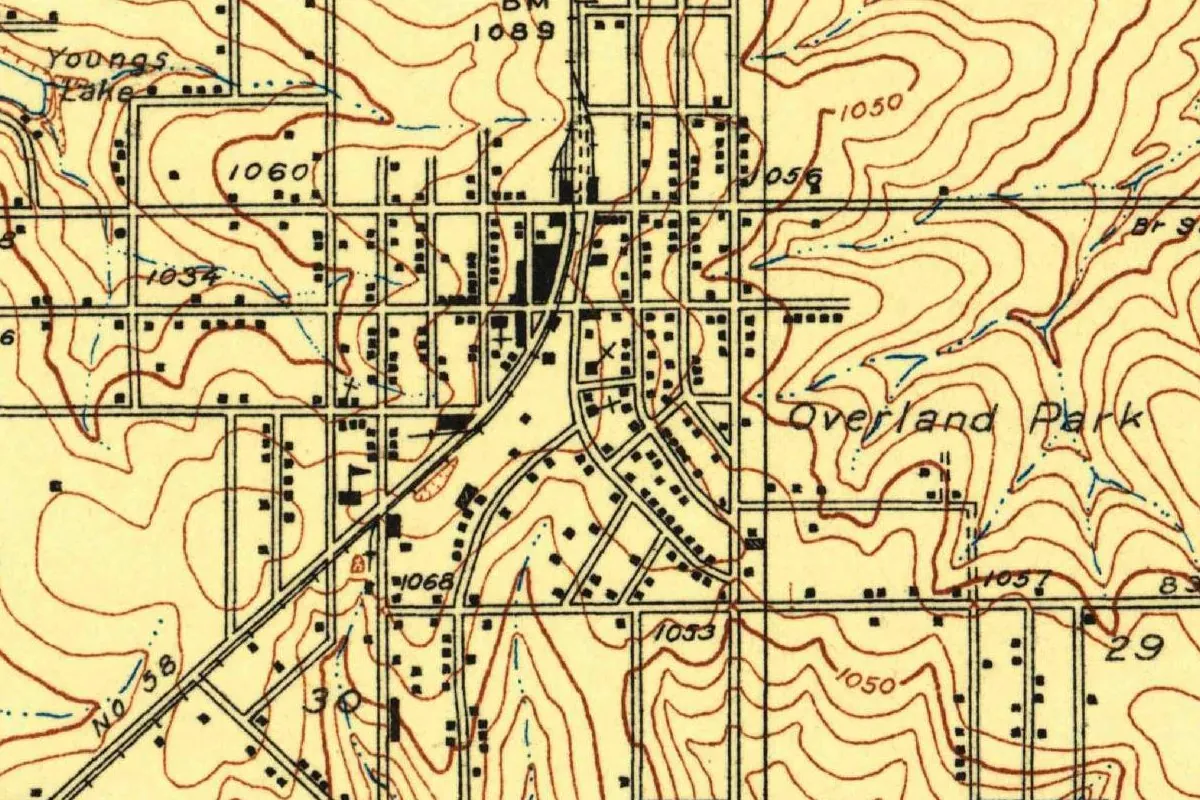
You’ll also see different founding dates depending on which part of the book you read. Giffin dates the act creating the Olathe Town Company to February 20, 1857. Seaton says another territorial act incorporated the town on February 11, 1858, and that Barton entered the town site at the Lecompton land office on May 17, 1858. Blair’s book has a chapter on Overland Park, too, which grew up decades later in the same county.
The prairie Barton saw is long gone under the streets of a county seat in eastern Kansas. The word he borrowed for it stuck, and whichever version you believe, it came to him from a Shawnee speaker in 1857.
Quick answers
What does the name Olathe mean?
“Beautiful,” according to the early accounts. A 1905 federal place-name list calls it a Shawnee word meaning “beautiful,” and the Olathe Historical Society says it’s “understood to mean” that. None of the sources cited here is a Shawnee-language dictionary.
Who named Olathe, Kansas?
Dr. John T. Barton, who laid out the town in 1857. The disagreement is over who gave him the word: a Shawnee chain carrier, Dave Daugherty, in one 1915 account, or Shawnee chief Joseph Parks in Barton’s own 1888 telling.
How do you pronounce Olathe?
Barton’s story says Parks pronounced it “Olaythe,” with an explosive accent on the last syllable, and the interpreter advised putting the accent on the second syllable in English. That’s the only pronunciation guide in these sources.
Was Olathe founded in 1857?
Yes, the site was picked and surveyed in 1857, and John W. Giffin dates the town company’s act to February 20 of that year. Another territorial act incorporated the town on February 11, 1858.
Key dates
- 1857February 20: the territorial legislature approves the act creating the Olathe Town Company, according to John W. Giffin.
- 1857Spring: Dr. John T. Barton picks two quarter sections near the center of Johnson County and gives the town a Shawnee name.
- 1858February 11: another territorial act incorporates the town; on May 17 Barton enters the town site at the Lecompton land office.
- 1888Barton tells his own version of the naming, later printed in a 1915 county history.
- 1905A Geological Survey bulletin on place names describes Olathe as "An Indian word of the Shawnee dialect meaning 'beautiful.'"
Getting there
Open Olathe in Google Maps
Opens in a new tab. The pin is the center of Olathe in the USGS place-name record.
The closest airports, Amtrak stations and intercity bus stops, measured in a straight line from the center of Olathe.
Airports
- Kansas City International (MCI) 29 mi 47 km
- Manhattan Regional (MHK) 101 mi 163 km
Amtrak trains
- Kansas City station (KCY) 19 mi 30 km
- Lawrence station (LRC) 23 mi 37 km
Intercity buses
- Greyhound Kansas City 47Th St Transit Center 18 mi 28 km
- Jefferson Lines Kansas City 20 mi 33 km
- FlixBus Kansas City Bus Station 20 mi 33 km
Distances are as the crow flies, not by road. We don't list schedules or fares because they change; check with the airline, Amtrak or the bus company before you go. Official data (FAA commercial service airports (2025), FAA airport locations, Amtrak stations and Intercity Bus Atlas) from the FAA and the U.S. Bureau of Transportation Statistics, checked Nov 13, 2026.
Sponsored
Staying in Olathe?
Compare hotels in Olathe, Kansas, on Expedia.
See hotels in OlatheWe may earn a commission if you buy through this link. It never changes what we write. Read our affiliate disclosure
Historical Sources & References
- Ed Blair, History of Johnson County, Kansas (1915), pp. 86, 111-113, 120. John W. Giffin’s “The First Twenty Years”: the town company act of February 20, 1857, Barton’s plan for a county seat, Bradford’s survey and Dave Daugherty’s “O lathe” (p. 86). S. T. Seaton’s “Fifty Years of Olathe” (1906): Barton’s background, the Shawnee allotments and Lot Coffman, the verbenas, the question to Joseph Parks, “Olaythe” and the accent, “Barton’s own story as related by him in 1888,” the incorporation of February 11, 1858, and the entry of May 17, 1858 (pp. 111-113). The Shawnee vote for the county seat (p. 120). Also online: p. 86.
- Henry Gannett, The Origin of Certain Place Names in the United States (USGS, 1905), p. 230. “An Indian word of the Shawnee dialect meaning ‘beautiful.’”
- Frank W. Blackmar, ed., Kansas: A Cyclopedia of State History, vol. 2 (1912), p. 386. The unnamed Shawnee man in Barton’s party who “exclaimed ‘O-la-the!’ the Indian word for beautiful.”
- Olathe Historical Society, “Early History to the 1860s”. The site at the center of the county on Mill Creek and the Santa Fe Trail, and “a Shawnee word understood to mean ‘beautiful.’”
- GNIS feature 479198 (U.S. Geological Survey). Olathe’s place-name entry, Johnson County, Kansas.
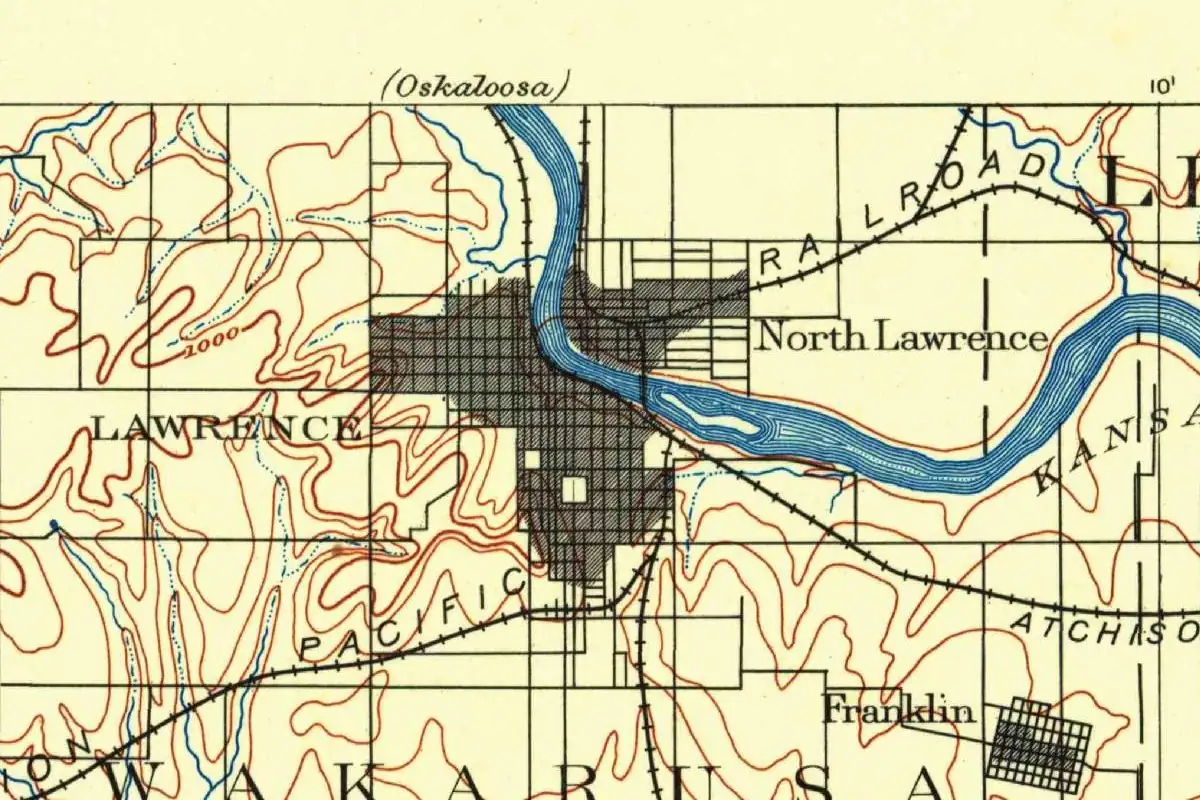
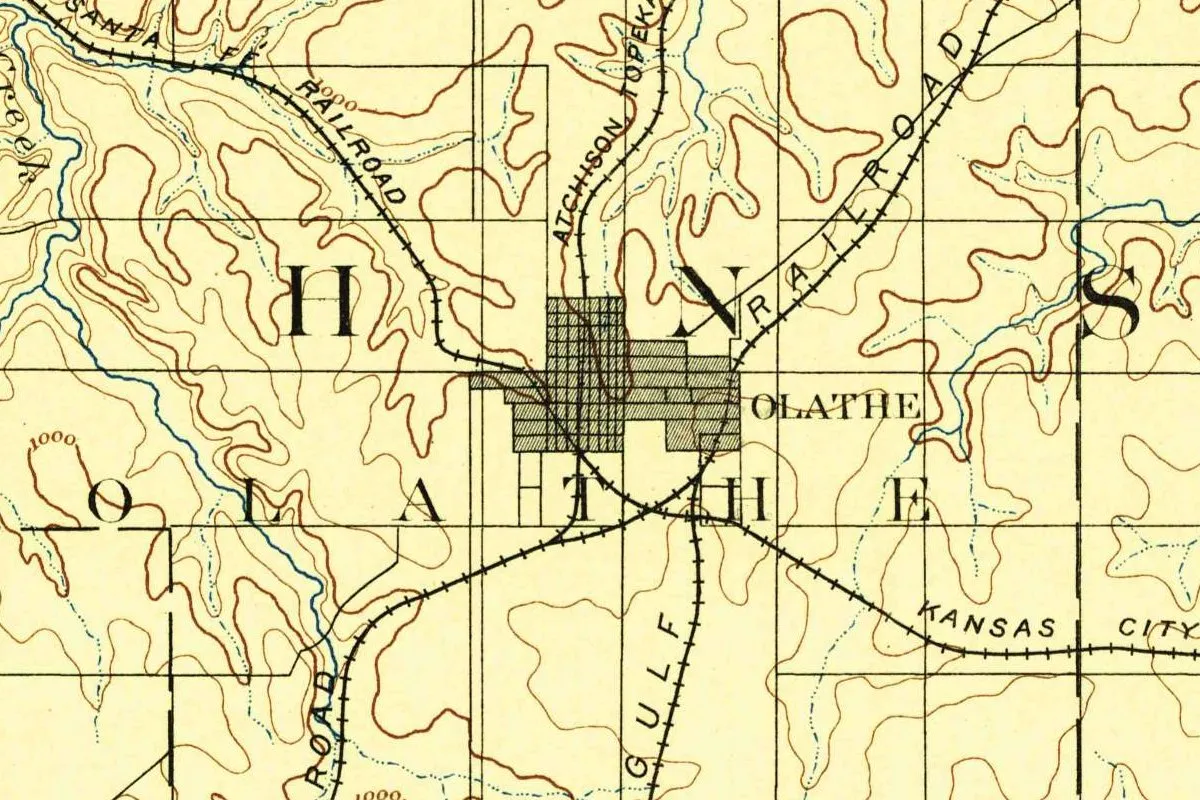
- U.S. Geological Survey, Olathe sheet (1887). Source of the 1887 map image above.
Spot something wrong, or know more? Tell us here. You can also email us or use our contact page. Corrections are noted here with their date, never made silently.