Branson, Missouri: The Town That Was Lucia for a While
Branson is named for Reuben S. Branson, who ran a general store in Taney County and became the first postmaster of the Branson post office, appointed in 1882. The post office was renamed Lucia in the early 1900s, then changed back; a 1933 place-name study blamed a local dislike of the Branson family.
Lucia, for a few years
For a few years after 1900, the post office at Branson, Missouri, went by Lucia, and a 1933 study blamed a local dislike of the Bransons. The name itself is no mystery: it comes from Reuben S. Branson, the storekeeper who ran the first post office. The mystery is why the town lost it for a while and then took it back.
The White River Valley Historical Society, the Taney County history group, keeps a list of the county’s post offices, drawn mainly from Elmo Ingenthron’s book The Land of Taney. Its entry starts simply: “Branson— named after first postmaster, Reuben S. Branson.”
A store seven miles above Forsyth
Reuben Branson got a biographical sketch in a big regional history published in 1894, A Reminiscent History of the Ozark Region. It says he was born in Gasconade County, Missouri, in 1853, taught school for a while, and married Mary T. Cooper. After a few months in the drug business in Greene County, he brought his stock of goods down to Taney County.
The book puts it this way:
“…located about seven miles above Forsyth, where he established a general store, and the same year also established Branson postoffice, of which he was postmaster for some time.”
Seven miles is about 11 km, up the White River from the county seat. And that’s how the name began: a man, a store and a post office that carried his name. The historical society’s list gives the date of his appointment as postmaster, June 13, 1882, and says the office started out at the mouth of Bull Creek, near Hensley’s Ferry, before moving to the mouth of Roark Creek.
The 1894 book thought well of him. It opens his sketch by calling him “the ex-county clerk and recorder of Taney County” and a man who’d “achieved eminence solely by excellence of character.” It says he was elected county assessor in 1884, then served four years as county and circuit clerk and recorder. After that came a year running the Forsyth distillery, a year of milling and a boarding house, and by 1893 he was living in Oliver Township.
Then the town became Lucia
Here’s where it gets interesting. The historical society’s postal list records the change in plain dates: “Name changed to Lucia 2 May 1901. Changed back to Branson 11 Jun 1904.”
Margaret E. Bell’s 1933 master’s thesis on place names in southwest Missouri, now part of the State Historical Society of Missouri’s place-name collection, tells the same story with a reason attached. Her entry for Lucia, as the State Historical Society summarizes it, says the post office was named after the wife of E. P. Brice, the postmaster, and that the name Branson “was changed to Lucia in 1902 because of the widespread dislike for Rube Branson and his family, reputed Bald-Knobbers.” Then, the entry adds, “in 1908 the old name Branson was resumed.”
That’s a long way from “excellence of character.” Bell got her information from local people, and she names them: T. P. Wright, W. R. Adams and Chas. Groom. So the reason is what neighbors were still saying about the family some 30 years later, not a line from a postal order.
What “Bald-Knobbers” meant here
The label wasn’t a compliment. Historian Lynn Morrow, writing in the State Historical Society’s Missouri Encyclopedia, describes the Baldknobbers as vigilantes in Taney County, a vigilance committee whose image, he writes, “is often exaggerated and partly fabricated.” Bell’s informants called the Bransons “reputed” members, and that’s as far as the record goes. Neither the 1894 book nor the postal list says anything about it.
Two sets of dates
You’ll notice the dates don’t line up. The postal list, based on Ingenthron, has Lucia from 1901 to 1904. Bell’s thesis has it from 1902 to 1908, and dates the naming for R. S. Branson to 1881 rather than 1882. Bell also names E. P. Brice as the postmaster behind the name Lucia, but the historical society’s list of postmasters for those years runs from William M. Hawkins, appointed in 1886, straight to William R. Cox, appointed the day the name changed back in 1904.
The result is a clear origin and a messy middle. Everybody agrees the town is named for Reuben S. Branson and his post office. The Lucia years happened, but exactly when, and exactly why, depends on whether you trust the postal dates or the memories Bell collected.
The name sticks
By the time Branson was incorporated, the old name was back for good. Discover Branson’s history puts the incorporation at April 1, 1912, and says the whole business section burned that August and was rebuilt. The Powersite Dam, built across the White River in 1912 and 1913, created Lake Taneycomo, and Harold Bell Wright’s 1907 novel The Shepherd of the Hills had already started bringing visitors to these hills.
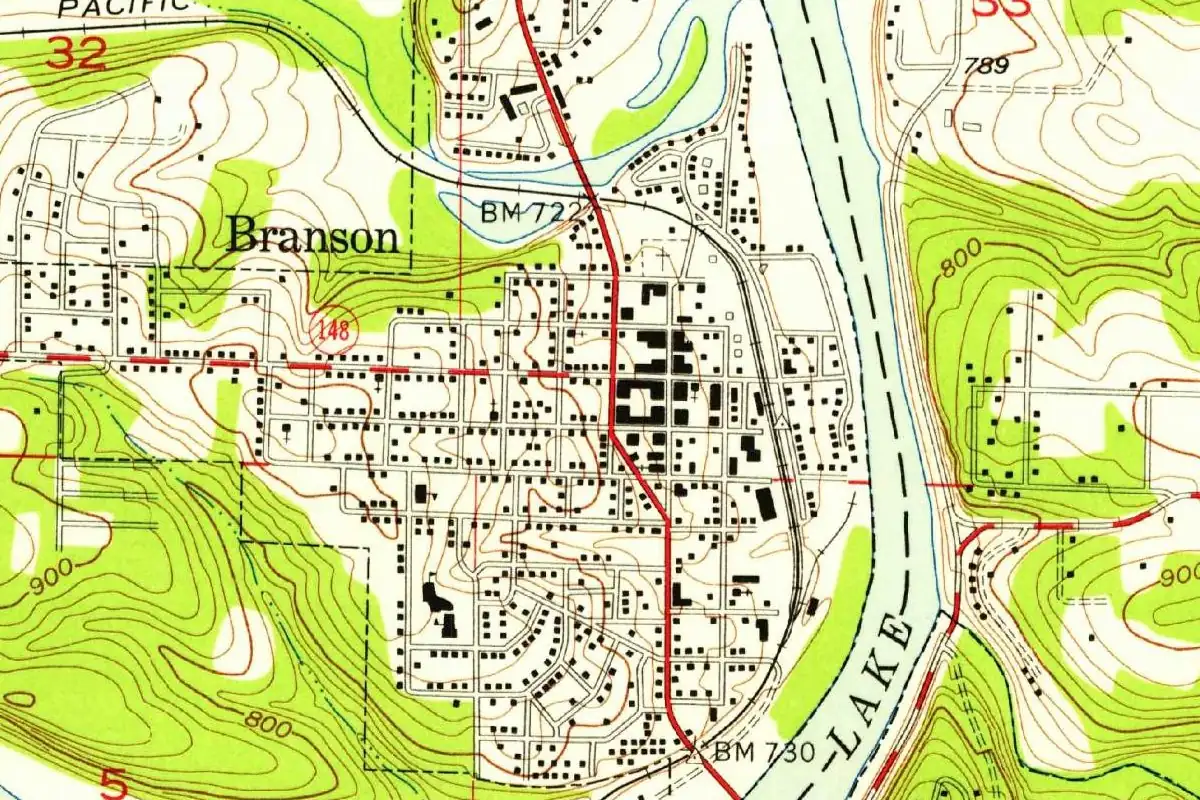
By 1956, when the Geological Survey mapped it at a large scale, Branson sat pressed up against that lake, with its streets climbing the hillside and the railroad curving along above. Visitors kept coming; Discover Branson says the old winding road from Springfield was eventually blasted straighter and 35 miles (56 km) shorter.
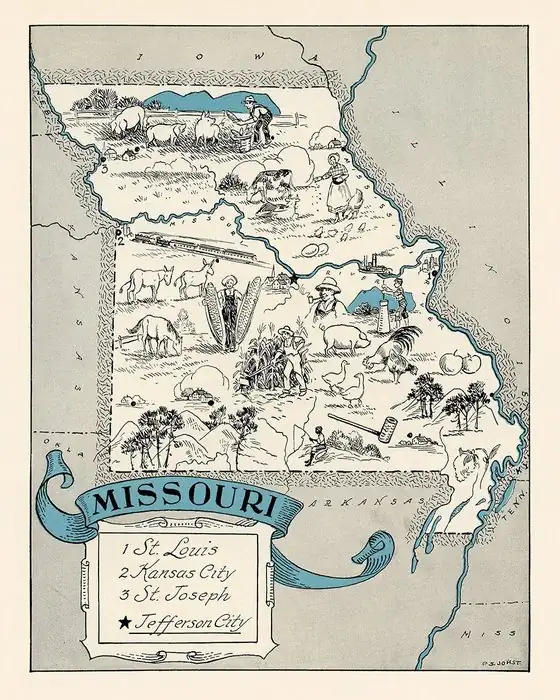
Branson isn’t the only Missouri town tied to an early postmaster. Kirksville carries the name of a tavern keeper who was “generally conceded” to have been its first. But Branson tried another name for a few years and then went back. You’ll find it on the map of Missouri under the storekeeper’s name, Lucia long forgotten.
Quick answers
Who is Branson, Missouri, named after?
Reuben S. Branson, a storekeeper who set up the Branson post office and was its first postmaster, appointed in 1882, according to the White River Valley Historical Society.
Was Branson ever called Lucia?
Yes. The post office was renamed Lucia in the early 1900s and later changed back. The postal list gives 1901 to 1904; a 1933 thesis gave 1902 to 1908.
Why was Branson renamed Lucia?
The State Historical Society’s summary of Margaret E. Bell’s 1933 place-name thesis says it was “because of the widespread dislike for Rube Branson and his family,” and that Lucia was the postmaster’s wife. That explanation came from local informants, not from a postal record.
Key dates
- 1882Reuben S. Branson is appointed postmaster on June 13, at the post office named for him.
- 1901On May 2, by the postal record, the post office's name is changed to Lucia.
- 1904On June 11 the name goes back to Branson.
- 1907Harold Bell Wright publishes The Shepherd of the Hills, set in the hills around Branson.
- 1912Branson is incorporated on April 1. In August, fire destroys the business district, which is rebuilt.
Things to do in Branson, Missouri
Branson Centennial Museum
A history museum run by the White River Valley Historical Society at 120 South Commercial Street in historic downtown Branson, opened for the city's centennial in 2012, with rotating exhibits through the year.
The Shepherd of the Hills
The historic homestead where the outdoor drama of Harold Bell Wright's 1907 novel about life in the Ozark Mountains is staged, along with seasonal events and a holiday drive-through light trail.
Branson Scenic Railway
Excursions in vintage passenger cars from the heart of Branson through tunnels, over trestles and into Ozark wilderness that's still home to wildlife and the ruins of long-ago communities.
Table Rock State Park
A Missouri state park on Table Rock Lake near Branson, with a marina, paved and mountain biking trails, lakeshore campsites, yurts and picnic areas.
Getting there
Open Branson in Google Maps
Opens in a new tab. The pin is the center of Branson in the USGS place-name record.
The closest airports, Amtrak stations and intercity bus stops, measured in a straight line from the center of Branson.
Airports
- Springfield-Branson Ntl (SGF) 43 mi 69 km
- Northwest Arkansas Ntl (XNA) Bentonville 65 mi 105 km
Intercity buses
- Jefferson Lines Branson / Hollister 2 mi 3 km
- Greyhound Springfield Cu Transit Center 39 mi 63 km
Distances are as the crow flies, not by road. We don't list schedules or fares because they change; check with the airline, Amtrak or the bus company before you go. Official data (FAA commercial service airports (2025), FAA airport locations, Amtrak stations and Intercity Bus Atlas) from the FAA and the U.S. Bureau of Transportation Statistics, checked Nov 14, 2026.
Sponsored
Staying in Branson?
Compare hotels in Branson, Missouri, on Expedia.
See hotels in BransonWe may earn a commission if you buy through this link. It never changes what we write. Read our affiliate disclosure
Sponsored
Want the spooky side of Branson?
The name has its story above. For the ghost stories, US Ghost Adventures runs walking ghost tours in Branson.
See ghost tours in BransonWe may earn a commission if you book through this link. It never changes what we write. Read our affiliate disclosure
Historical Sources & References
- White River Valley Historical Society, “Taney County Post Offices”. “Named after first postmaster, Reuben S. Branson”; the moves from Bull Creek to Roark Creek; Branson’s appointment on June 13, 1882; the change to Lucia on May 2, 1901, and back on June 11, 1904; the postmasters Hawkins and Cox. Based mainly on Elmo Ingenthron’s The Land of Taney.
- Margaret E. Bell, “Place Names in the Southwest Border Counties of Missouri” (1933), via State Historical Society of Missouri. Branson named for R. S. Branson, first postmaster, “in 1881”; Lucia named for the wife of E. P. Brice; the change “because of the widespread dislike for Rube Branson and his family, reputed Bald-Knobbers”; the name resumed in 1908; the informants.
- A Reminiscent History of the Ozark Region (Goodspeed, 1894), pp. 300-301. Reuben S. Branson’s biography: born in 1853; the store “about seven miles above Forsyth” and the Branson post office (p. 301); assessor and county clerk; “excellence of character” (p. 300).
- Lynn Morrow, “Nathaniel N. Kinney,” Missouri Encyclopedia. The Baldknobber vigilantes of Taney County and their “often exaggerated and partly fabricated” image.
- Discover Branson, “Branson History”. The store and post office of 1882; The Shepherd of the Hills (1907); incorporation on April 1, 1912; the August 1912 fire; Powersite Dam and Lake Taneycomo; the shorter road from Springfield. A tourism site, used only for these points.
- White River Valley Historical Society, Branson Centennial Museum. Branson’s incorporation in 1912 and the museum’s opening for the centennial.
- GNIS feature 739970 (U.S. Geological Survey). The national gazetteer entry for Branson, a populated place in Taney County.
- U.S. Geological Survey, Branson sheet (1956). The 1:24,000 sheet used for the lakeside view of Branson above.
Spot something wrong, or know more? Tell us here. You can also email us or use our contact page. Corrections are noted here with their date, never made silently.