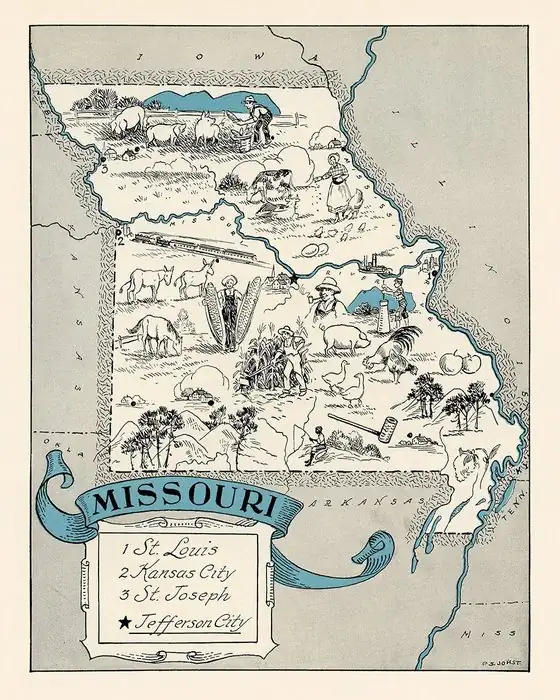
Joplin, Missouri: Named for a Preacher's Creek
Joplin, Missouri, got its name secondhand. The city is named for Joplin Creek, and the creek was named for the Rev. Harris G. Joplin, a Methodist preacher who built a log cabin by a spring there around 1840. He left in the 1840s and died in 1847, more than 20 years before anyone laid out a town in his name.
The preacher and his spring
The fullest account is in The History of Jasper County, Missouri, published in 1883. Its writer says Harris G. Joplin was born in Tennessee about 1810, was ordained there and moved to Greene County, Missouri. In 1840 he came to this part of Jasper County, built a large log cabin, improved a farm of about 80 acres and organized a Methodist congregation that met in his home.
He didn’t stay long. Money trouble, the book says, forced him to sell out, and in the fall of 1844 he went back to Greene County, where he preached until his death in 1847. What he left behind was a name on a stream:
“Near the log-cabin of the Rev. Mr. Joplin was a spring, the source of the little run which now divides East Joplin and empties into Joplin Creek proper. This little stream was originally Joplin Creek, the larger one subsequently taking its name. The city took her name from the creek.”
The writer was careful to add that “every effort has been made to get at the exact facts.” Joel T. Livingston’s 1912 History of Jasper County tells it the same way with slightly different dates: Joplin came in 1839, held services at his cabin until 1845, and the creek “took its name because its headwaters ran through the reverend gentleman’s farm.” Henry Gannett’s 1905 book on American place names sums it up: Joplin was “named from Joplin Creek, which was named for Rev. H. G. Joplin, who lived on its banks.”
So if you guessed the ragtime composer Scott Joplin, that’s not where the city’s name comes from. Every source we read traces it to the preacher.
Two mining camps on one creek
For decades the settlement had a different name. The 1941 WPA guide to Missouri says John C. Cox, a Tennessean who settled nearby in 1838, ran a store with the area’s first post office in it, called Blytheville “in honor of Billy Blythe, a wealthy and popular Cherokee who lived on Shoal Creek.”
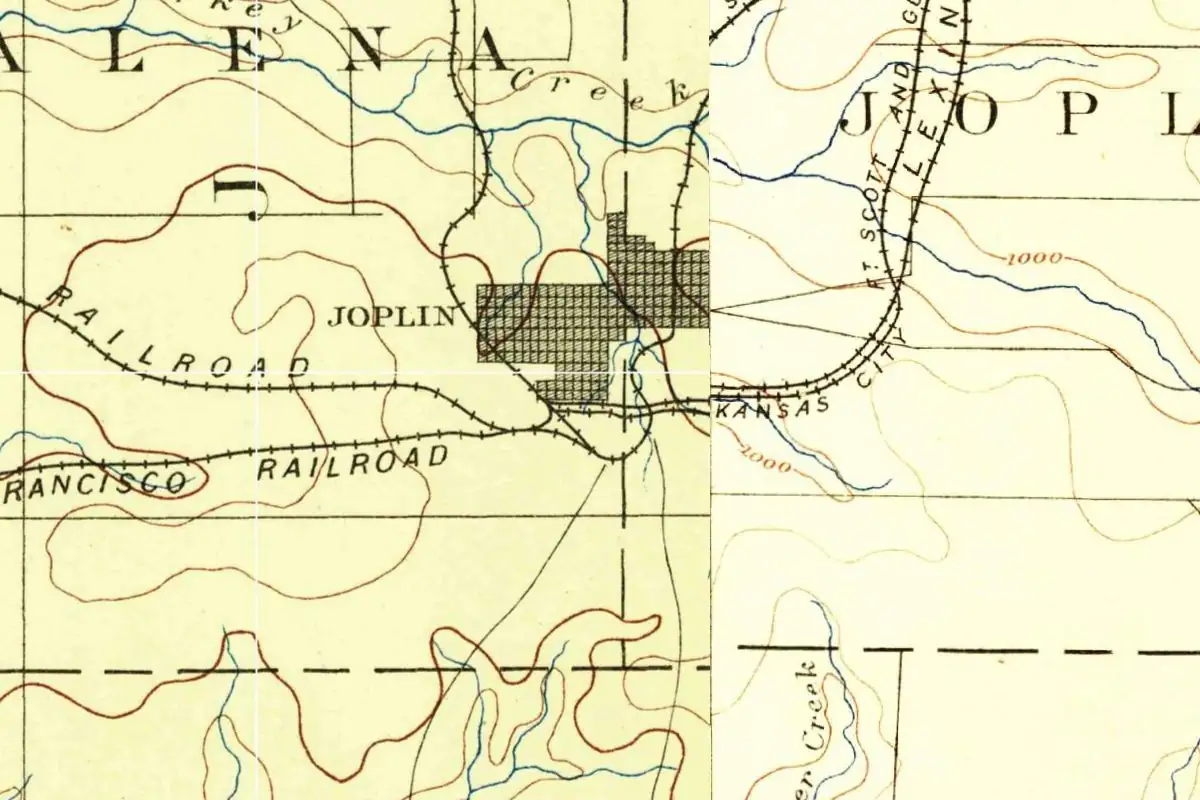
Lead changed everything. When the mining rush hit around 1870, Cox, who owned much of the land, laid out a town and, the WPA guide says, named it Joplin City “in honor of his old friend, the Methodist minister.” The 1883 history says “the county records bear date of July 28, 1871.” That same month, Davis & Murphy laid out a rival town called Murphysburg on the west side of the creek. On the 1886 Geological Survey map at the top of this page, you can see the result: one dense block of streets where several railroads come together, with Joplin Creek running through the middle.
Union City, briefly
The two camps tried to merge in 1872, under a neutral name. Their petition to the county court, the 1883 history says, asked for a town called Union City, and the court granted it on March 14, 1872. The Union City post office replaced the old Blytheville office that April.
The name didn’t last. Residents who didn’t like the merger fought it in court, and the town’s leaders asked the state legislature for a charter instead. On March 23, 1873, it passed a bill granting a charter to the “city of Joplin,” and the preacher’s name was back for good. The WPA guide says Joplin Creek still divided the city into East Town and West Town, “once rival mining camps.”
Joplin on Route 66
Joplin is also the last Missouri city on the WPA’s Route 66 tour. The guide’s Tour 5 follows US 66 from St. Louis through Rolla, Springfield and Joplin and on to Galena, Kansas, just across the state line, where the road’s short Kansas stretch begins. For the other stops, see our Route 66 towns collection, which includes Springfield to the east.
Quick answers
Who was Joplin, Missouri, named after?
The Rev. Harris G. Joplin, a Methodist minister who lived there around 1840. The city is named for Joplin Creek, and the creek was named for him because his cabin stood by its source.
Is Joplin, Missouri, named after Scott Joplin?
No. The 1883 county history, Gannett’s 1905 book and the 1941 WPA guide all trace the name to the Rev. Harris G. Joplin, by way of Joplin Creek.
When was Joplin, Missouri, founded?
John C. Cox laid out the town in July 1871, and the county records are dated July 28, 1871. Joplin got its city charter on March 23, 1873.
What was Joplin, Missouri, called before?
The first post office there was called Blytheville. In 1872 and 1873, after Joplin and Murphysburg merged, the combined town was briefly called Union City.
Key dates
- 1840The Rev. Harris G. Joplin builds a log cabin near a spring and holds Methodist services there (1883 county history; a 1912 history says 1839).
- 1844Joplin goes back to Greene County, Missouri. He dies there in 1847.
- 1871July: John C. Cox lays out the town of Joplin, and Davis & Murphy lay out Murphysburg across the creek.
- 1872March 14: The county court incorporates the two camps as one town called Union City.
- 1873March 23: The legislature passes a bill granting a charter to the "city of Joplin."
- 1941The WPA guide to Missouri follows US 66 through Joplin on its way to Galena, Kansas.
Getting there
Open Joplin in Google Maps
Opens in a new tab. The pin is the center of Joplin in the USGS place-name record.
The closest airports, Amtrak stations and intercity bus stops, measured in a straight line from the center of Joplin.
Airports
- Joplin Regional (JLN) 5 mi 8 km
- Northwest Arkansas Ntl (XNA) Bentonville 57 mi 91 km
Intercity buses
- Jefferson Lines Joplin (Road Ranger) 6 mi 10 km
Distances are as the crow flies, not by road. We don't list schedules or fares because they change; check with the airline, Amtrak or the bus company before you go. Official data (FAA commercial service airports (2025), FAA airport locations, Amtrak stations and Intercity Bus Atlas) from the FAA and the U.S. Bureau of Transportation Statistics, checked Nov 10, 2026.
Sponsored
Staying in Joplin?
Compare hotels in Joplin, Missouri, on Expedia.
See hotels in JoplinWe may earn a commission if you buy through this link. It never changes what we write. Read our affiliate disclosure
Historical Sources & References
- The History of Jasper County, Missouri (1883), pp. 389-398. “The reverend gentleman from whom the city undoubtedly gained its name. Rev. Harris G. Joplin was a native of Tennessee, born about the year 1810”; his arrival in 1840, return to Greene County in the fall of 1844 and death in 1847; the spring and “The city took her name from the creek”; Cox’s town, “The county records bear date of July 28, 1871”; Murphysburg; the Union City petition granted March 14, 1872; the charter for the “city of Joplin” passed March 23, 1873.
- Joel T. Livingston, A History of Jasper County, Missouri, and Its People, vol. 1 (1912), p. 143. Harris Joplin’s arrival in 1839, services at his cabin until 1845, and Joplin Creek, “which took its name because its headwaters ran through the reverend gentleman’s farm.”
- Henry Gannett, The Origin of Certain Place Names in the United States (1905), p. 171. “Joplin; city in Jasper County, Missouri, named from Joplin Creek, which was named for Rev. H. G. Joplin, who lived on its banks.”
- Writers’ Program, Missouri: A Guide to the “Show Me” State (1941). pp. 233-236: Cox’s settlement in 1838, the Reverend Joplin’s cabin “near a spring which still flows,” the Blytheville post office named for Billy Blythe, and East Town and West Town. Tour 5 follows US 66 through Joplin to Galena, Kansas.
- U.S. Geological Survey, Joplin sheet (1886) and Carthage sheet (1886). The two maps joined at the top of this page.
- GNIS feature 729911, Joplin (U.S. Geological Survey). The official name and coordinates of the city.
Sponsored
Gear up for your next road trip
Explore rooftop tents, vehicle awnings and outdoor gear from TOPOAK Overland.
Shop TOPOAK overlanding gearWe may earn a commission if you buy through this link. It never changes what we write. Read our affiliate disclosure
Spot something wrong, or know more? Tell us here. You can also email us or use our contact page. Corrections are noted here with their date, never made silently.