Lake Lure, North Carolina: Dr. Morse's Lure, or His Wife's?
Lake Lure is named after the lake at its center, made by damming the Rocky Broad River in 1925-1927. The Town of Lake Lure says the name has always been credited to Elizabeth Morse, wife of the developer, Dr. Lucius B. Morse, but that he was already using Lure to advertise Chimney Rock before the lake.
Lake Lure, North Carolina, got its name from the lake Dr. Lucius Morse built in the 1920s, and Lure was in his advertising before the lake project began. Who first put “Lake” and “Lure” together is the part the town itself is careful about.
Why is it called Lake Lure, North Carolina?
The town is named after its lake, which was a developer’s project. The Town of Lake Lure’s history page, “Lake Lure Yesterday & Today,” says the idea of a resort here belonged to Dr. Lucius B. Morse, who came to the gorge for his health and dreamed up the lake and the resort while at Chimney Rock early in the 1900s. His company, Chimney Rock Mountains, Inc., planned to build its resort around a lake made by damming the Rocky Broad River at a spot called Tumbling Shoals.
The same page gives the naming story and then qualifies it: “Though the name ‘Lake Lure’ has always been attributed to Dr. Morse’s wife Elizabeth, Dr. Morse was using the name ‘Lure’ in his Chimney Rock promotional materials before the lake project began.” The town’s “Discover” page is shorter: it says the lake “was named Lake Lure by Dr. Morse’s wife, Elizabeth Parkinson.”
The Morse family’s papers at UNC Asheville back up the early use of the word. The library’s finding aid lists a brochure titled “The Lure,” dated 1920, among the Chimney Rock materials. The town doesn’t hide what the word means, either: “As the name implies,” its boating page says, Lake Lure does “‘lure’ many people to enjoy its unique beauty.”
Lake Lure, NC history
Morse first saw Chimney Rock as a visitor. The state’s essay for highway marker O-82 says the physician had moved to Hendersonville to ease his tuberculosis, and was too weak to climb the rock, so he paid a man a quarter for a donkey ride to the summit. He and his brothers bought the rock in 1902. The town names the brothers as Hiram and Asahel, gives the seller as Jerome Freeman and the price as $5,000, and says the company later built its holdings up to 8,000 acres (3,240 ha).
Dam construction started in 1925, directed by Mees & Mees, engineers from Charlotte. The resort borrowed $1,000,000 from the Bird Mortgage Company, based in Asheville, the town says, and the power company borrowed $550,000 more for the dam. The dam was finished in September 1926, the lake was full in 1927, and the town was incorporated that same year. The power plant started selling electricity in 1928.
The timing was bad. On October 24, 1929, both mortgage holders foreclosed, and the resort plan stopped. The lake stayed with the power company’s successors until the town bought it, a purchase completed on July 26, 1965. Chimney Rock stayed in the Morse family until 2007, when the state bought it for a park, according to the O-82 essay.
The North Carolina Gazetteer gives slightly different dates: it has the town established in 1925 and incorporated in 1927, and that the lake was formed in 1928.
Two resort towns in other states are also named for their lakes. Lake Geneva, Wisconsin, got its name after the surveyor John Brink renamed the lake, finding the older name, Big Foot, too ugly. At Lake Placid, New York, the village is named for its lake, and who first called that water placid is unknown.
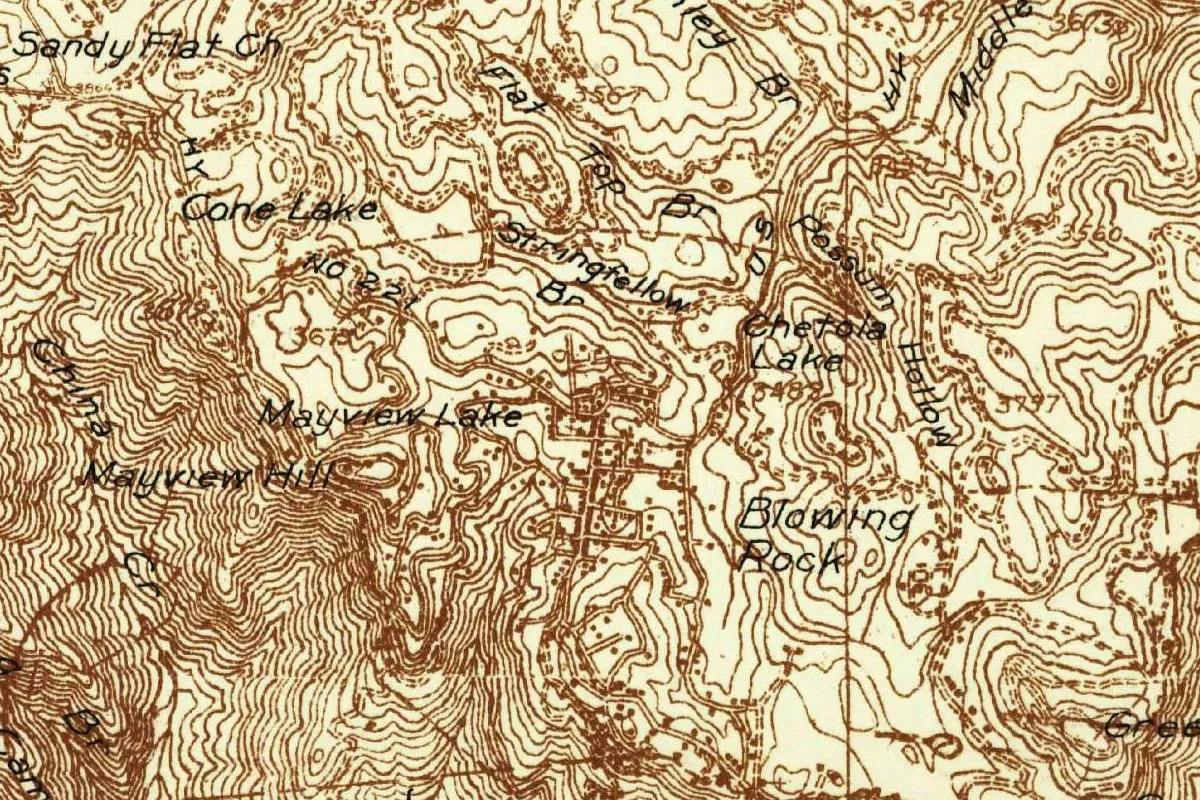
Lake Lure on the 1959 map
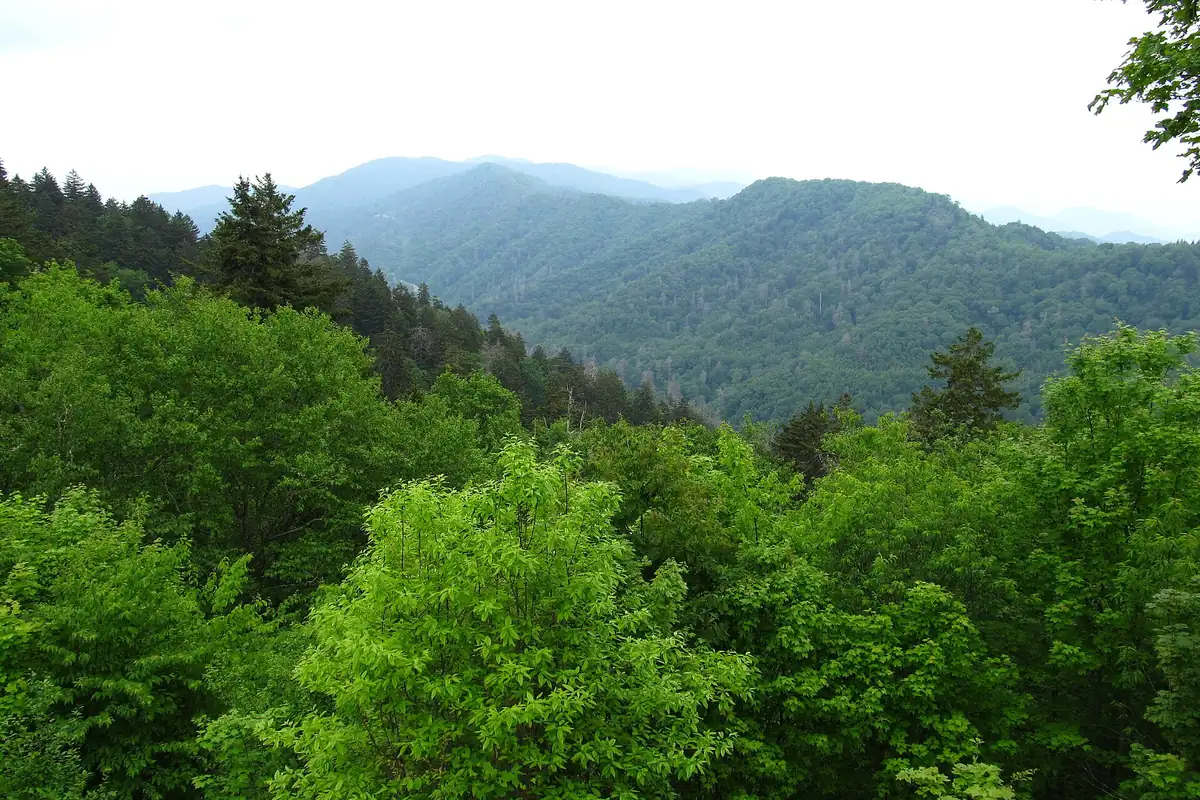
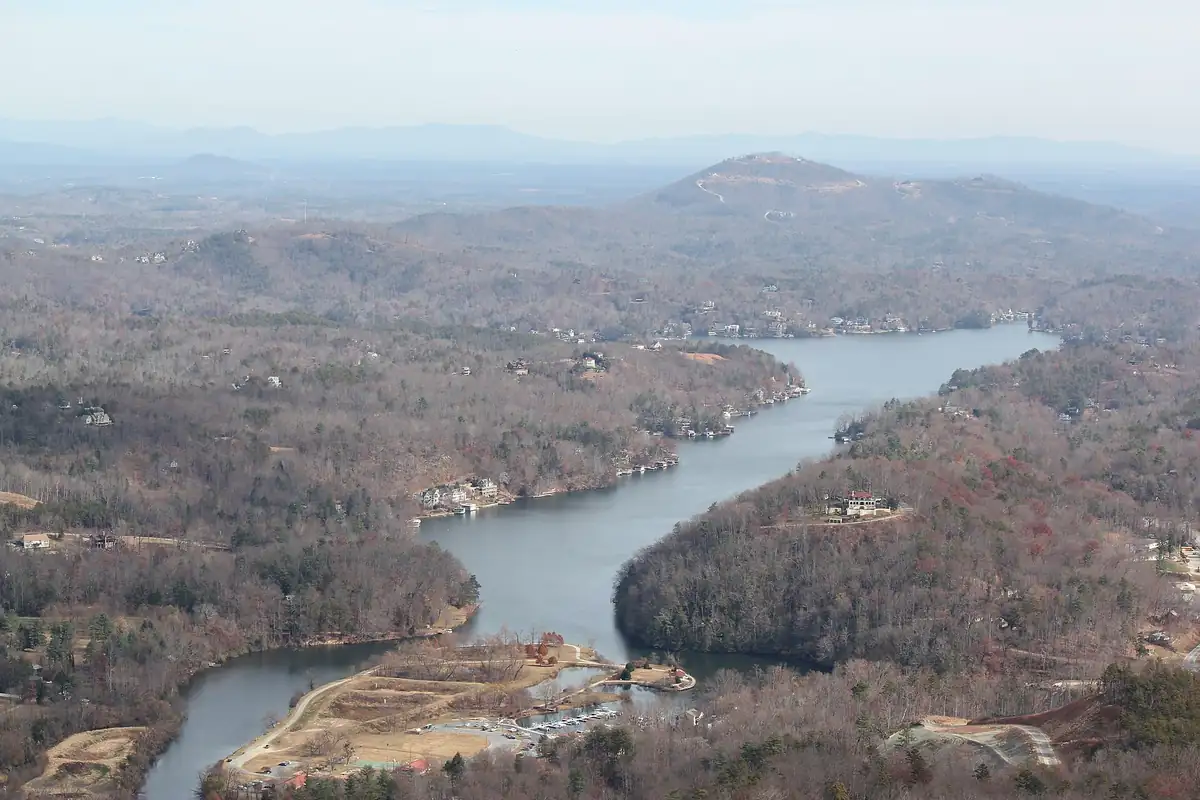
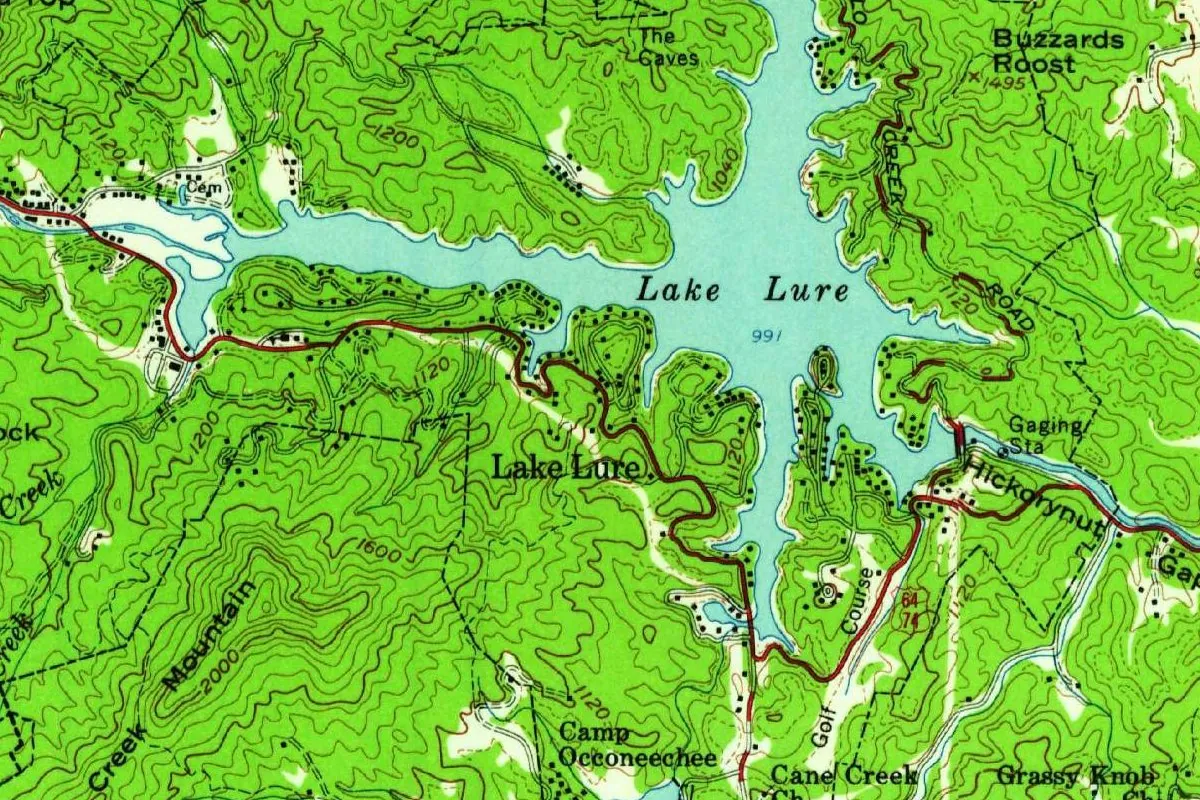
The map at the top comes from the Geological Survey’s Lake Lure quadrangle, a 1:62,500 sheet dated 1959, based on 1955 aerial photographs and field-checked in 1959; this copy was printed in 1960. Lake Lure spreads across the middle, its water level marked 991 feet, with houses lined up along the shore road and the town’s name printed on the land to the south. Buzzards Roost is at the upper right and Hickorynut Gap at the right, where the river flows out. The photo below looks down on the lake from Chimney Rock.
Quick answers
Who named Lake Lure, North Carolina?
Elizabeth Morse, wife of the developer Dr. Lucius B. Morse, is usually credited. The Town of Lake Lure adds that Morse had already been using the word Lure in his Chimney Rock advertising before the lake was planned.
Is Lake Lure, North Carolina, a man-made lake?
Yes. Morse’s company dammed the Rocky Broad River starting in 1925, and the lake was full by 1927, the town says.
When did Lake Lure, North Carolina, become a town?
In 1927, the same year the lake filled. The town bought the lake itself in 1965.
Key dates
- 1902Dr. Lucius B. Morse and his brothers buy Chimney Rock for $5,000.
- 1920A Chimney Rock brochure titled "The Lure" is printed, according to the Morse family papers at UNC Asheville.
- 1925Work begins on a dam across the Rocky Broad River, under the Charlotte engineers Mees & Mees.
- 1926September: The dam is finished and the lake begins to fill.
- 1927The lake reaches full pool, and the Town of Lake Lure is incorporated.
- 1929October 24: The resort's two mortgage holders foreclose.
- 1965July 26: The Town of Lake Lure completes its purchase of the lake.
Things to do in Lake Lure, North Carolina
Paddling on Lake Lure
Kayaks, canoes and stand-up paddleboards have needed no town permit since 2024, when Lake Lure changed its lake rules. Motorboats still need one, and the town publishes a boaters' guide and map.
Dittmer-Watts Nature Trail
A town trail system with 3.3 miles (5.3 km) of trails, benches along the way and a covered picnic area, at 271 NC 9. Dogs are welcome on a leash.
Buffalo Creek Park
A town park at 2191 Buffalo Creek Road whose loop trail reopened in August 2026 after trail work by volunteers and the town's public works crew, with banked turns for mountain bikes and views of Lake Lure, Bald Mountain Lake and Youngs Mountain.
Rumbling Bald Access, Chimney Rock State Park
The free side of Chimney Rock State Park, at 827 Boys Camp Road in Lake Lure, which the state calls "a more rugged backcountry experience," with rock climbing, picnicking and 1.5 miles (2.4 km) of hiking.
Getting there
Open Lake Lure in Google Maps
Opens in a new tab. The pin is the center of Lake Lure in the USGS place-name record.
The closest airports, Amtrak stations and intercity bus stops, measured in a straight line from the center of Lake Lure.
Airports
- Asheville Regional (AVL) 19 mi 31 km
- Greenville Spartanburg International (GSP) Greer 37 mi 59 km
- Charlotte/Douglas International (CLT) 72 mi 116 km
Amtrak trains
- Spartanburg station (SPB) 36 mi 58 km
- Greenville station (GRV) 41 mi 66 km
Intercity buses
- Sunway Charters Forest City 21 mi 33 km
- Greyhound Asheville Asheland Ave 23 mi 37 km
- FlixBus Spartanburg 35 mi 56 km
Distances are as the crow flies, not by road. We don't list schedules or fares because they change; check with the airline, Amtrak or the bus company before you go. Official data (FAA commercial service airports (2025), FAA airport locations, Amtrak stations and Intercity Bus Atlas) from the FAA and the U.S. Bureau of Transportation Statistics, checked Nov 27, 2026.
Sponsored
Staying in Lake Lure?
Compare hotels in Lake Lure, North Carolina, on Expedia.
See hotels in Lake LureWe may earn a commission if you buy through this link. It never changes what we write. Read our affiliate disclosure
Historical Sources & References
- Town of Lake Lure, “Lake Lure Yesterday & Today”. Morse’s plan, the name and its qualification, the 1902 purchase, the dam of 1925-1926, the incorporation of 1927, the foreclosures of 1929 and the town’s purchase of 1965.
- Town of Lake Lure, “Discover the Town of Lake Lure”. The lake named by Elizabeth Parkinson.
- Town of Lake Lure, “Getting Out On Lake Lure”. “As the name implies,” and the lake rules in the things-to-do list.
- N.C. Department of Natural and Cultural Resources, “Chimney Rock, O-82”. Morse in Hendersonville, the donkey ride, the purchase of 1902 and the state park of 2007.
- The North Carolina Gazetteer, “Lake Lure” (town) and (lake), via NCpedia. Established 1925, incorporated 1927, and the lake formed in 1928.
- UNC Asheville, Morse Family Chimney Rock Park Collection. The 1920 brochure “The Lure.”
- Dittmer-Watts Nature Trail, Buffalo Creek Park and Chimney Rock State Park. The details in the things-to-do list.
- GNIS feature 1021079 (U.S. Geological Survey). Lake Lure in Rutherford County, with the coordinates for this page.
- U.S. Geological Survey, Lake Lure quadrangle (1959). The sheet the map at the top was cropped from.
Spot something wrong, or know more? Tell us here. You can also email us or use our contact page. Corrections are noted here with their date, never made silently.