Lake Geneva, Wisconsin: How Big Foot Lake Became Geneva
Lake Geneva takes its name from the lake beside it. The city says government surveyor John Brink named the lake in 1835 after Geneva, New York. In an 1899 interview, Brink said the Indians called it Big Foot, and that he changed the name because the lake was too beautiful for it. He was born near Geneva.
Lake Geneva, Wisconsin, carries the name of its lake, which surveyor John Brink renamed for Geneva, New York, because Big Foot seemed too ugly a name. That’s how Brink himself told it, at 88, to a Milwaukee newspaper. The city’s history tells the same story more briefly: Brink, “a government surveyor,” named the lake in 1835 “after the lake in his home in Geneva, New York.”
The surveyor who didn’t like “Big Foot”
The Crystal Lake Historical Society, in Illinois, keeps a transcription of an 1899 Milwaukee Sentinel interview with Brink. “I first saw Lake Geneva in 1833,” he said. In 1835 he was running township lines, and his instructions were to “preserve all the Indian names.” The Indians called the lake “Big Foot,” he said, and he wasn’t sure whether the name came from the lake itself or from the Winnebago chief of that name, though he leaned toward the shape of the lake.
He didn’t keep it. Brink told the paper that the chief clerk at the surveyor general’s office in Cincinnati asked him what right he’d had to change the name. “None whatever,” he answered. Why do it, then? “Because it was too beautiful a sheet of water to be called such an ugly name.” And why Geneva? “Because I was born eight miles north of Geneva at the foot of Seneca Lake, New York, and I thought it a beautiful and appropriate name for that lovely sheet of water in those Wisconsin woods.” The clerk, Brink said, had been raised near there too, and told him “we’ll let it go on the records as Lake Geneva.”
It’s Brink’s memory, more than 60 years later, so you should take the dialogue as his telling. The historical society gives his birthplace as Phelps, in Ontario County, New York. The Wisconsin Historical Society’s note on the name, which spells him “John Brek,” says the lake reminded him of Seneca Lake near Geneva.
Big Foot, the lake and the chief
Brink wasn’t the only one who thought the old name was about a foot. Increase A. Lapham, in his 1844 description of Wisconsin, wrote that Geneva lake “was formerly called Big foot lake, from some fancied resemblance of its form to that of the human foot.” He added that “Fontana is at the head of this lake, and Geneva is at the foot.” So in 1844 the village was simply Geneva. The county’s post office list on the page before still had one called Bigfoot.
The city’s history ties the name to people instead. It says Big Foot and the local Potawatomi were evicted in 1836, and it gives another Native name for the lake, Kish-Way-Kee-Tow, “meaning clear water.” That translation is the city’s, and none of the other sources here repeats it.
Henry Gannett gave a slightly different reason for the Geneva part. He wrote in 1905 that the city was “so named because of the resemblance in its geographical situation to Geneva, New York.”
Mills, lots and the Newport of the West
Brink’s claim, the city says, was to the waterfall power and the land at the White River outlet of the lake. In 1836 Christopher Payne, from Belvidere, Illinois, made a rival claim and built the first log cabin. Grist and sawmills followed, the town was surveyed and laid out in 1837, and land sales were confirmed in 1839.
Most of the settlers came from New England and New York, the city says, by the Erie Canal and the Great Lakes, landing at Southport, which is now Kenosha, or at Milwaukee. After the Civil War, wealthy Chicago families built mansions on the shore, and the town became known as “the Newport (RI) of the West.” The Chicago Fire of 1871, the city says, sent many of those families to their summer homes on the lake while Chicago was rebuilt.
Brink covered a lot of ground. The historical society’s transcription has him staking out 40 acres (about 16 ha) for a village at Dubuque in 1833. He also served as county surveyor of McHenry County, Illinois, and died in 1904.
A Gannett map, printed in 1955
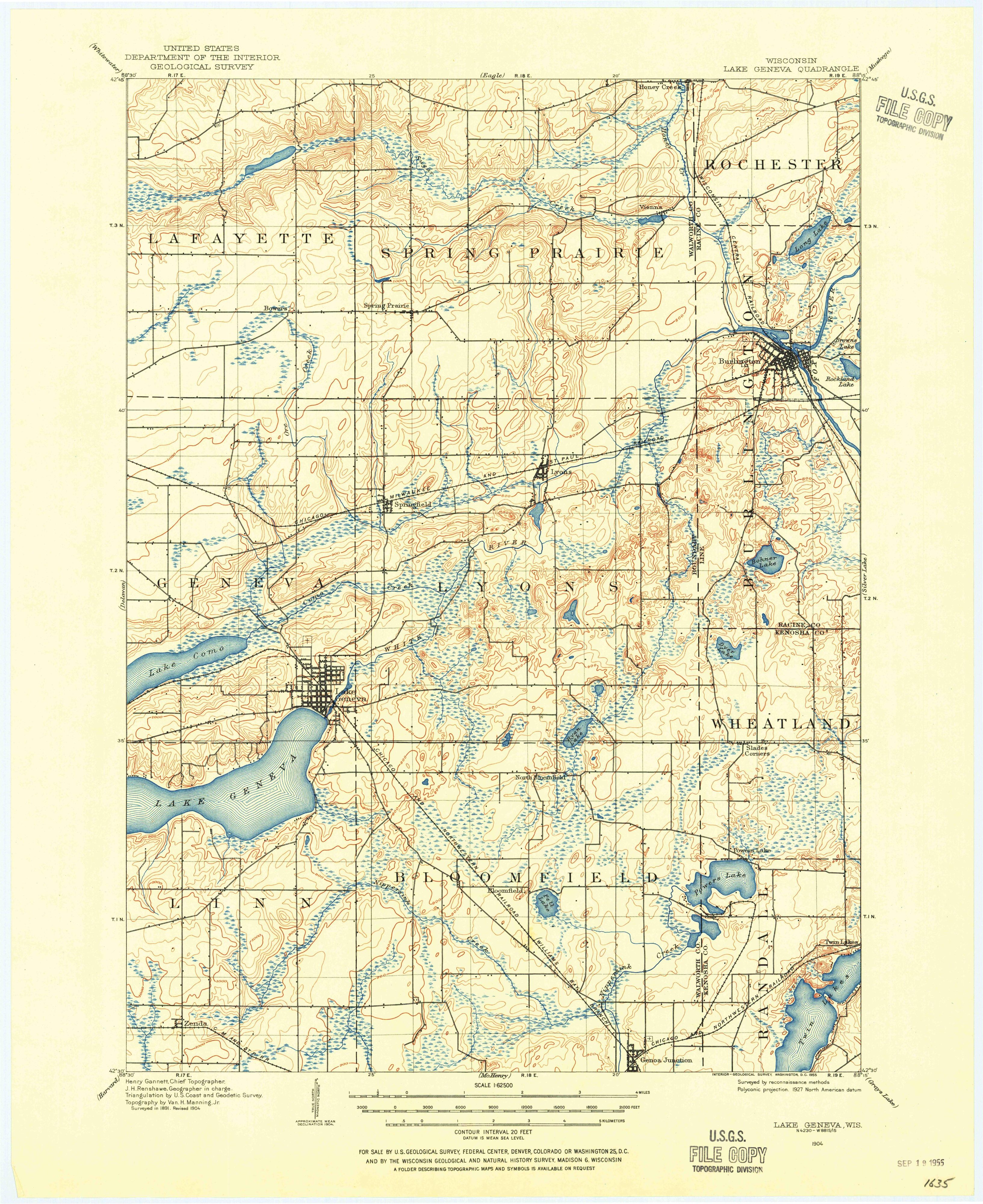
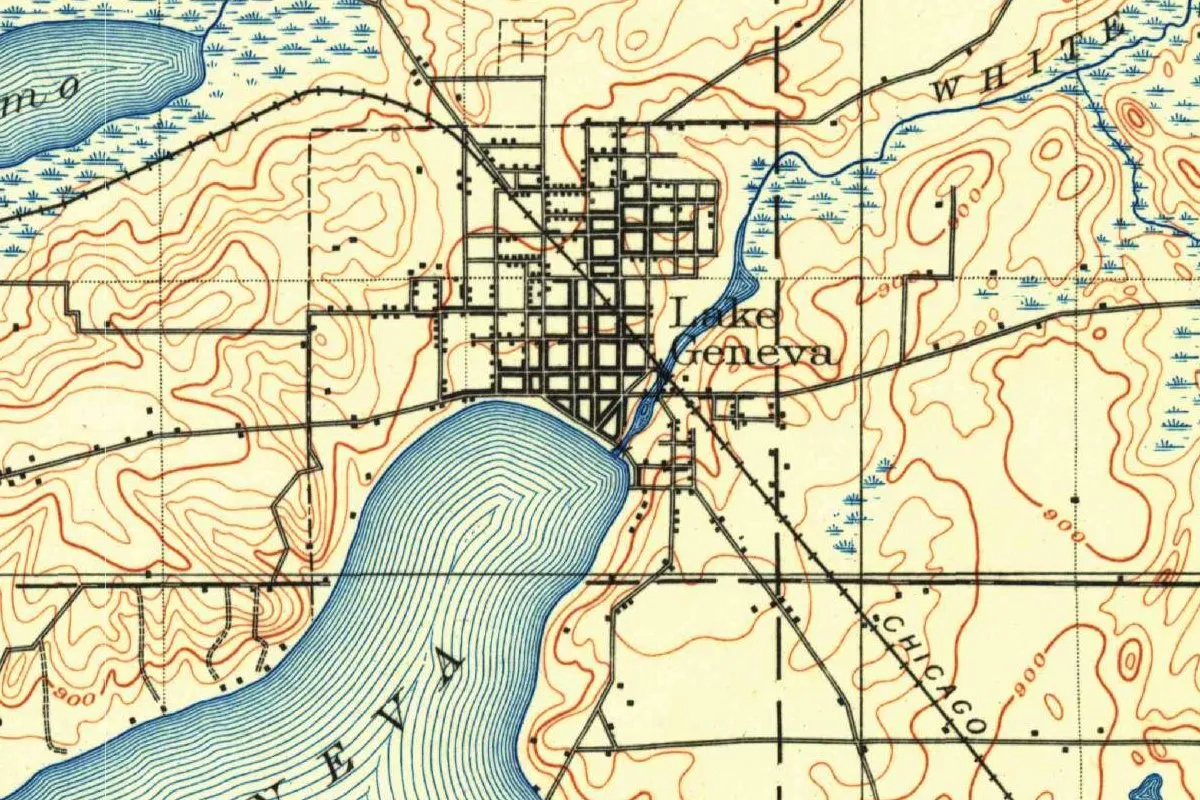
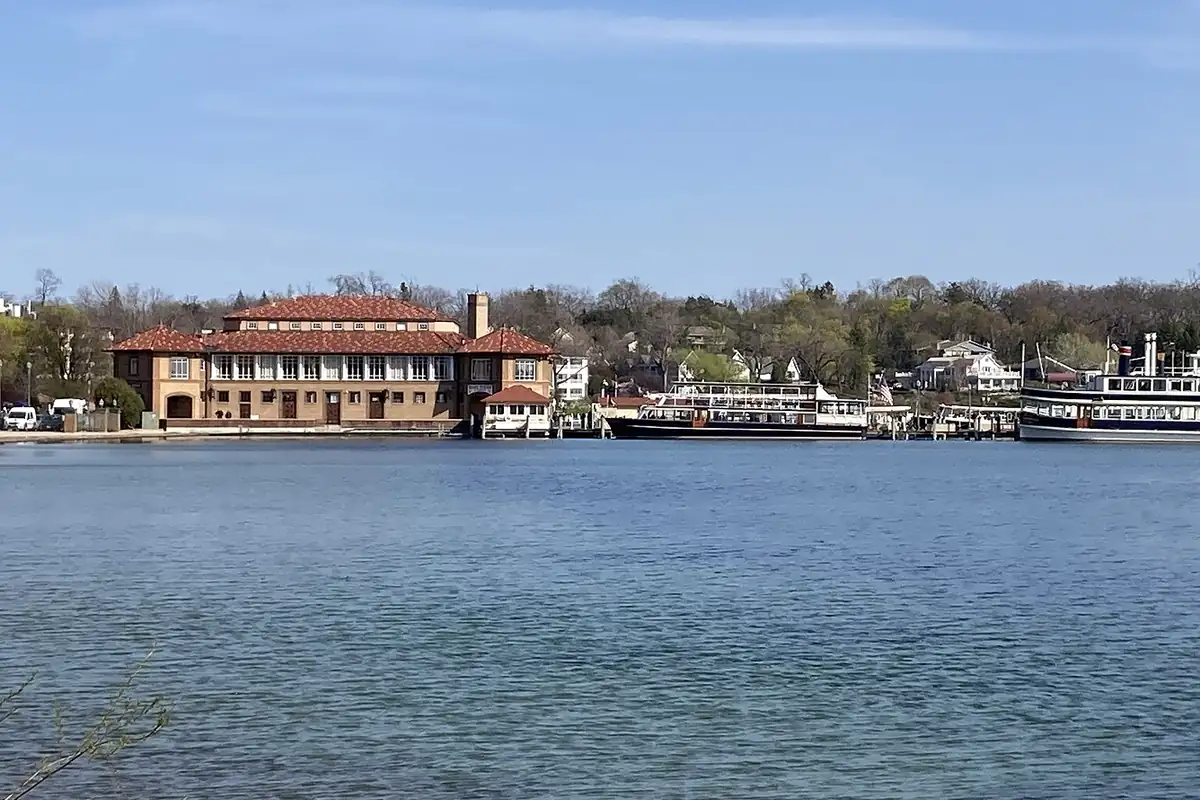
The map at the top of this page is the Geological Survey’s Lake Geneva quadrangle. Its margin names Henry Gannett as chief topographer, the same Gannett who later explained the name, and says the area was “surveyed in 1891” and “revised 1904.” The copy shown here was printed in 1955. The town’s grid sits right at the outlet, with the stream heading off toward the White River and a railroad marked Chicago cutting across. The photo below shows the Riviera and the tour boats on the lakefront.
If you like towns that carry the name of the lake beside them, Lake Placid, New York, is another one, though nobody knows who named its lake.
Quick answers
Why is it called Lake Geneva?
Because of the lake. Surveyor John Brink named the lake in 1835 after Geneva, New York, according to the city, and the town carries the lake’s name. Brink said in 1899 that he’d been born near Geneva, at the foot of Seneca Lake.
What was Lake Geneva called before?
Big Foot. Brink said the Indians called it that, and Increase Lapham wrote in 1844 that it “was formerly called Big foot lake.” The city’s history also gives Kish-Way-Kee-Tow, which it translates as “clear water.”
Is the town of Lake Geneva named after Geneva, Switzerland?
These sources don’t mention Switzerland. Brink named the lake for Geneva, New York, and Gannett also pointed to Geneva, New York.
Key dates
- 1833John Brink first sees the lake, he said in 1899.
- 1835Brink, running survey lines, names the lake for Geneva, New York, and claims the water power at the outlet.
- 1836Christopher Payne of Belvidere, Illinois, makes a rival claim and builds the first log cabin.
- 1837The town is surveyed and laid out.
- 1844Increase Lapham describes Geneva lake, formerly Big foot lake, with a place called Geneva at its foot.
- 1871After the Chicago Fire, many Chicago families move to their summer homes on the lake.
Things to do in Lake Geneva, Wisconsin
Big Foot Beach State Park
A state park on the shore of the lake with 5 miles (8 km) of hiking trails, a family campground, a swimming beach, and picnic and playground areas.
Geneva Lake Museum
A local history museum with a brick-paved Main Street of yesteryear lined with homes and businesses from 1830 to 1980, plus exhibits on Yerkes Observatory, a one-room schoolhouse, old maps and a Native American dwelling.
Black Point Estate & Gardens
A lakeshore estate run by the Wisconsin Historical Society. You get there by boat with the Lake Geneva Cruise Line from the Riviera Docks at 812 Wrigley Drive, since there's no parking at the estate.
Riviera Beach
The city beach on Wrigley Drive, steps from the Geneva Lake Path, the library, the Riviera Ballroom and the downtown business district.
Getting there
Open Lake Geneva in Google Maps
Opens in a new tab. The pin is the center of Lake Geneva in the USGS place-name record.
The closest airports, Amtrak stations and intercity bus stops, measured in a straight line from the center of Lake Geneva.
Airports
- General Mitchell International (MKE) Milwaukee 37 mi 59 km
- Chicago/Rockford International (RFD) 44 mi 70 km
Amtrak trains
- Sturtevant station (SVT) 28 mi 45 km
- Milwaukee Airport-Trains station (MKA) 35 mi 57 km
Intercity buses
- Wisconsin Coach Lines Kenosha Brat Stop 24 mi 39 km
- FlixBus Janesville Janesville Park and Ride 28 mi 46 km
- Van Galder (Coach USA) 15766 Manchester Rd - McDonalds/FasMart Lot 29 mi 47 km
Distances are as the crow flies, not by road. We don't list schedules or fares because they change; check with the airline, Amtrak or the bus company before you go. Official data (FAA commercial service airports (2025), FAA airport locations, Amtrak stations and Intercity Bus Atlas) from the FAA and the U.S. Bureau of Transportation Statistics, checked Nov 17, 2026.
Sponsored
Staying in Lake Geneva?
Compare hotels in Lake Geneva, Wisconsin, on Expedia.
See hotels in Lake GenevaWe may earn a commission if you buy through this link. It never changes what we write. Read our affiliate disclosure
Historical Sources & References
- City of Lake Geneva, “History”. Brink’s claim and naming in 1835, Kish-Way-Kee-Tow, the eviction of 1836, Payne’s cabin, the survey of 1837, the land sales of 1839, the settlers who landed at Southport (Kenosha) and the “Newport (RI) of the West.”
- Crystal Lake Historical Society, “John Brink”. Brink’s birth in Phelps, New York, in 1811, his death in 1904, and the transcribed 1899 Milwaukee Sentinel interview: Big Foot, the clerk in Cincinnati, Seneca Lake and the 40 acres (about 16 ha) at Dubuque.
- Wisconsin Historical Society, “Lake Geneva, Walworth Co.”. The lake “named by John Brek,” and the resemblance to Seneca Lake near Geneva.
- Increase A. Lapham, A Geographical and Topographical Description of Wisconsin (1844), pp. 171-172. “Formerly called Big foot lake,” Geneva at the foot of the lake, and the Bigfoot post office. Checked against the page images.
- Henry Gannett, The Origin of Certain Place Names in the United States, 2nd ed. (1905), p. 179. The resemblance “in its geographical situation to Geneva, New York.” Checked against the page image.
- Big Foot Beach State Park; Geneva Lake Museum; Black Point Estate; Riviera Beach. The details in the things-to-do list, including the 5 miles (8 km) of trails at Big Foot Beach.
- GNIS feature 1581223 (U.S. Geological Survey). Lake Geneva in the federal place-name database, in Walworth County, with its coordinates.
- U.S. Geological Survey, Lake Geneva quadrangle (1904, printed 1955). The 1:62,500 sheet the map at the top was cropped from, with Gannett in the margin, contour lines of 900 feet (274 m), and the 1955 printing date.
Sponsored
Put this 1904 map on your wall
The Geological Survey's 1904 Lake Geneva sheet (a 1955 printing) is in the public domain. Download the full-size scan for free, then have it printed on canvas with CanvasOnTheCheap.
Print a map on canvasDownload the full-size mapWe may earn a commission if you buy through this link. It never changes what we write. Read our affiliate disclosure
Spot something wrong, or know more? Tell us here. You can also email us or use our contact page. Corrections are noted here with their date, never made silently.