Lake Placid, New York: A Lake Name Older Than the Village
The village carries the name of the lake beside it. The historian Mary MacKenzie wrote that Lake Placid was the only water name on surveyor Stephen Thorn's 1804 map of North Elba that survives, and that who christened it will probably never be known. The Lake Placid Shore Owners' Association dates its first map appearance to 1840.
Lake Placid, New York, borrowed its name from a lake that a historian found on an 1804 survey map, and nobody knows who first called the water placid. The village itself didn’t exist as a village until 1900. By then, the lake’s name had been on paper for decades, and it’s the one that stuck.
The only name Thorn’s map kept
Mary MacKenzie, whose history of North Elba and Lake Placid was published by the Lake Placid Public Library, starts with a survey. Stephen Thorn came up from Albany in the summers of 1804 and 1805 to lay out lots, and his 1804 map of North Elba, she wrote, “has an intriguing tale to tell.”
“With the exception of Lake Placid, every stream, pond, and lake, and even the islands of Lake Placid, bear different names than they have today,” MacKenzie wrote. Then she drew the line: “Whether Thorn himself, or the pioneers before him, christened the waters of North Elba will probably never be discovered. In any case, only one appellation, Lake Placid, survives.”
So you won’t find a story here about who looked at the water and called it placid. MacKenzie didn’t have one, and neither do the other sources.
1804 or 1840
Not everyone gives the same date. The Lake Placid Shore Owners’ Association says “Placid Lake was first identified on a map in 1840.” It adds that the form Placid Lake “is still used today when it is necessary to differentiate the Lake from the Village of Lake Placid.” The two sit side by side: the village’s center is on Mirror Lake, and an 1885 county history puts a ridge of land between Mirror Lake and Lake Placid.
H. P. Smith’s History of Essex County, published in 1885, describes the lake as “one of the most important heads of the Ausable river” and says that, although it’s only a little way from Mirror lake, it’s “effectually separated from the latter by a ridge of land passing between the two.” The same book already had a post office called Lake Placid, with Frank B. Stickney as postmaster.
The village sits on Mirror Lake
The lake in the center of the village, as the Visitors Bureau puts it, is Mirror Lake, not Lake Placid. MacKenzie wrote that it was “poetically, but aptly, christened Mirror Lake in the early 1870s” by Miss Mary Monell, and that for seventy years and more before that it was Bennet’s Pond, “and was so designated on early maps of the region.”
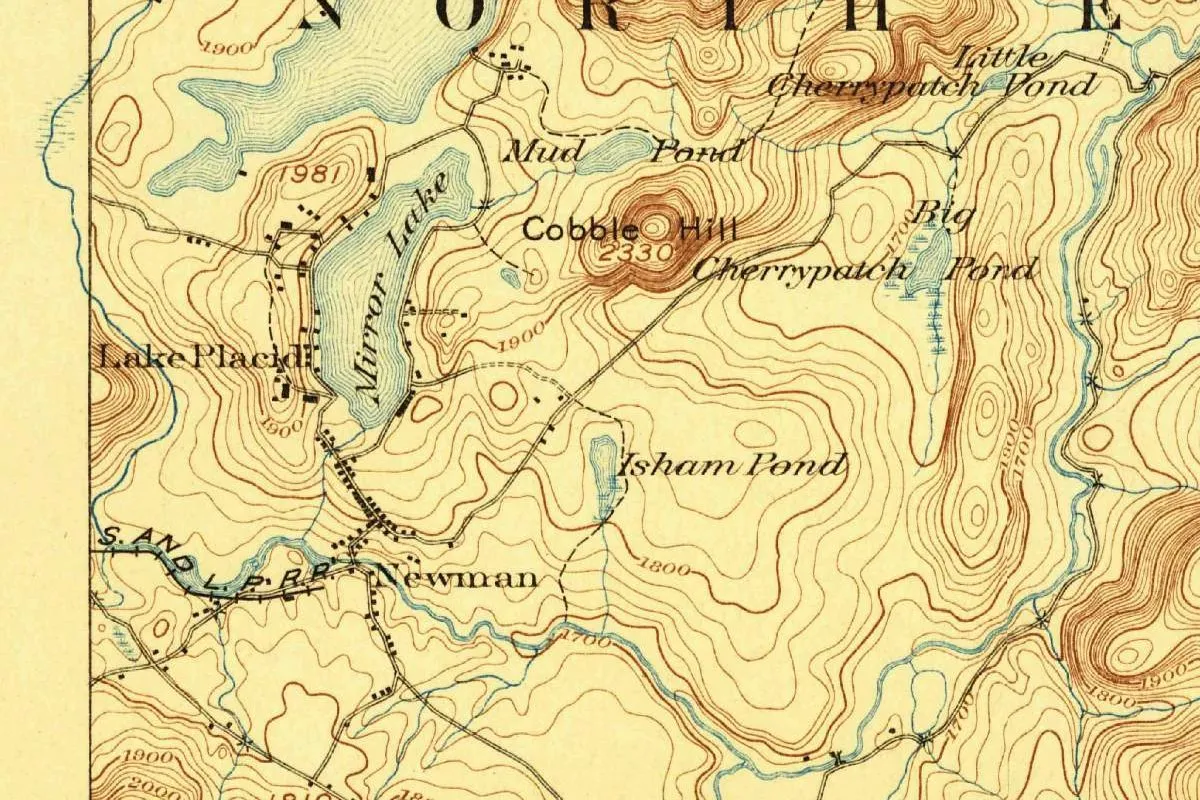
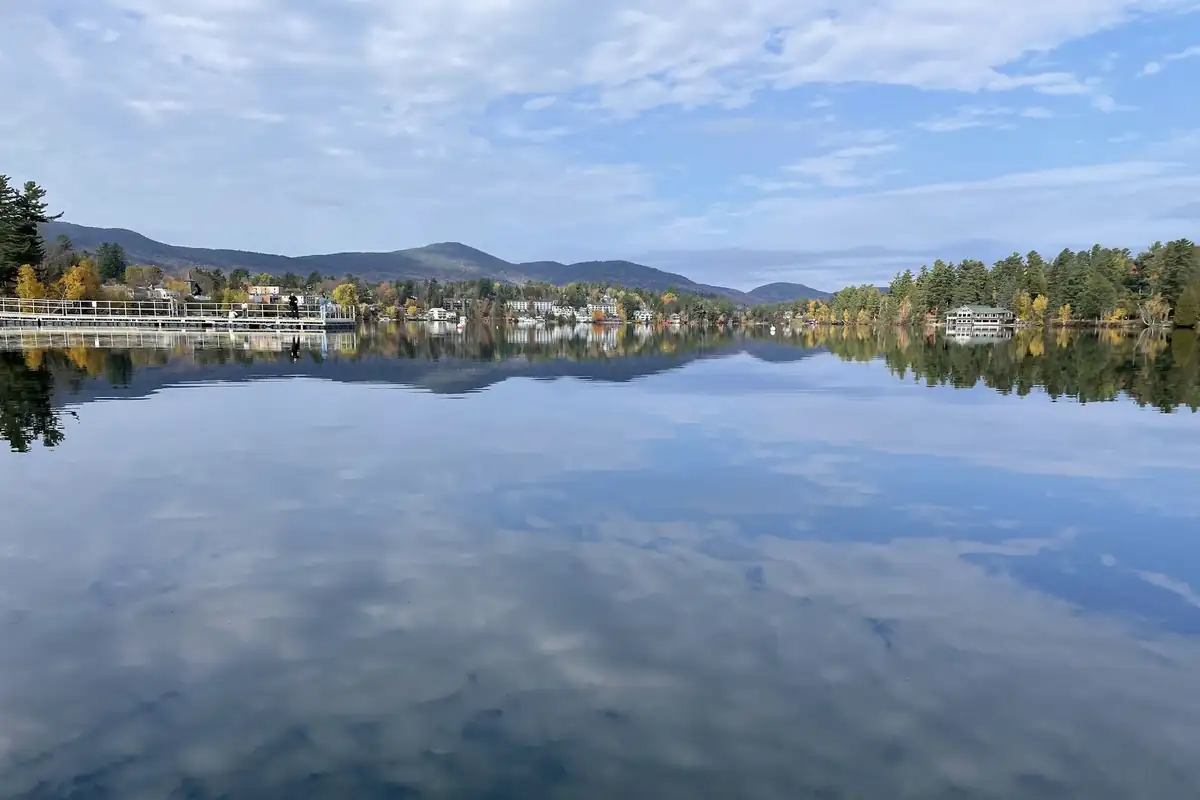
On the map at the top of this page, the village label sits on the west shore of Mirror Lake, with part of a larger lake off to the upper left. The photo below looks up Mirror Lake from its south end toward the village.
A sheet from 1896, and a second Lake Placid
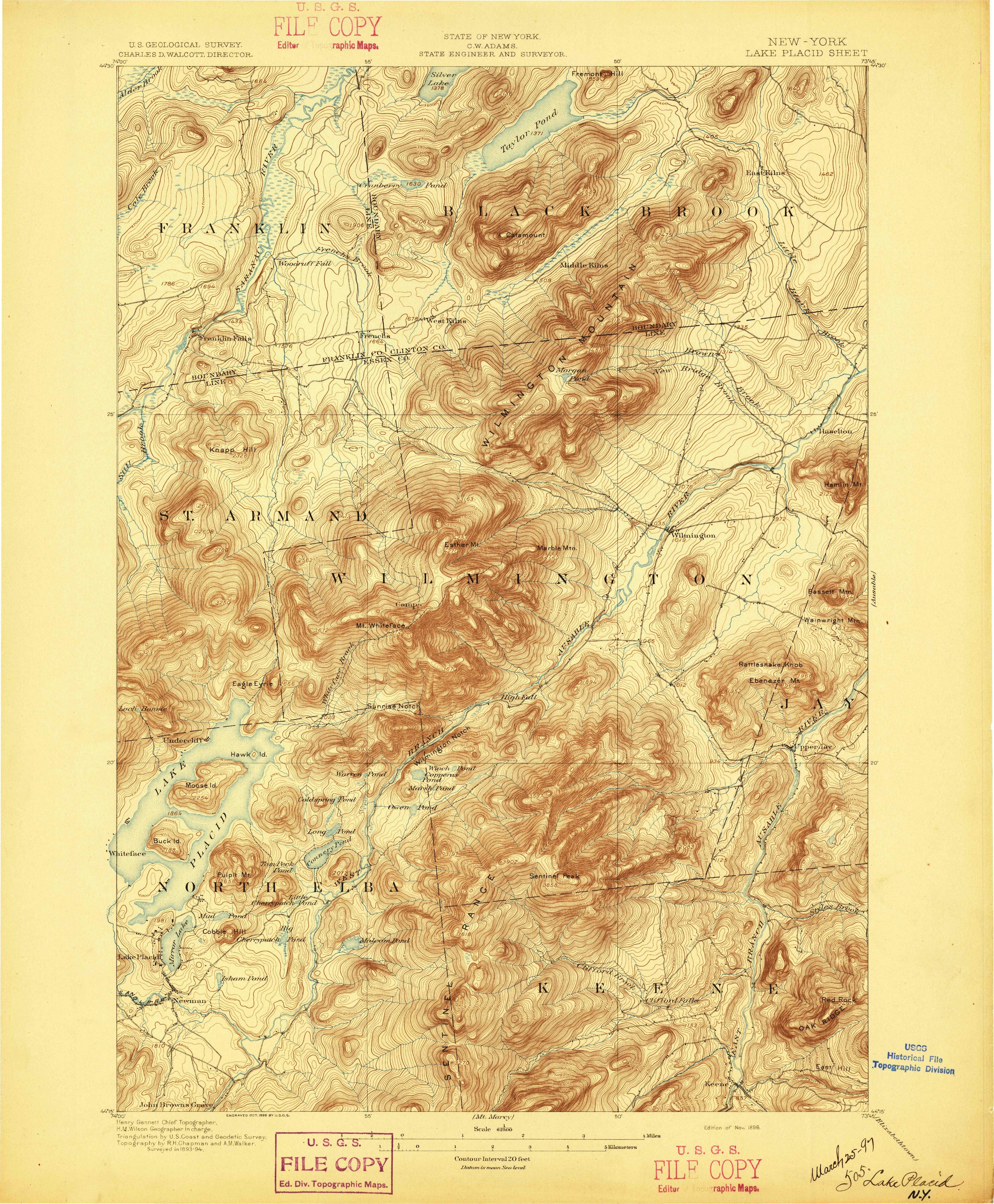
The map is the Geological Survey’s Lake Placid sheet, made with the State of New York. Its margin names Henry Gannett as chief topographer and H. M. Wilson as geographer in charge, says the area was “surveyed in 1893-94,” and gives the engraving date as October 1896 and the edition as November 1896. This copy is that original edition, a file copy, not a later reprint. Elsewhere on the full sheet, outside this detail, it marks “John Browns Grave.”
The Olympics didn’t name the place. The Winter Games came in 1932 and again in 1980, long after the name was set. The 1932 Games even turn up in the story of Sun Valley, Idaho, where the city says alpine skiing had picked up momentum after Lake Placid.
The name did travel, though. Melvil Dewey, who founded the Lake Placid Club across Mirror Lake from Main Street in 1895, set up a second club in Florida in 1926, at Lake Stearns, and the Visitors Bureau says he “convinced town leaders to change the town’s name to Lake Placid.” If you’re interested in towns that took their names from the lake next door, Lake Geneva, Wisconsin, is one where the surveyor who named the lake told his own story.
Quick answers
Why is it called Lake Placid?
The village carries the name of the lake. Mary MacKenzie wrote that the lake already had the name on Stephen Thorn’s 1804 map of North Elba, and that who christened it will probably never be known.
Is the village of Lake Placid on Lake Placid?
Its center isn’t. The center is on Mirror Lake, according to the Visitors Bureau, and Smith’s 1885 history says Lake Placid is separated from Mirror lake by a ridge of land. MacKenzie wrote that Mirror Lake was Bennet’s Pond until the early 1870s. The Lake Placid Shore Owners’ Association uses the name Placid Lake to tell the lake apart from the village.
Was Lake Placid named for the Olympics?
No. The name was in use long before the Winter Games of 1932 and 1980. An 1885 county history already lists a post office called Lake Placid.
Key dates
- 1804Surveyor Stephen Thorn maps North Elba. Lake Placid is the one water name on his map that survives, according to Mary MacKenzie.
- 1840Placid Lake is first identified on a map, according to the Lake Placid Shore Owners' Association.
- 1895Melvil Dewey founds the Lake Placid Club across Mirror Lake from Main Street.
- 1900The village of Lake Placid is created.
- 1926Dewey founds a second club at Lake Stearns, Florida, and persuades that town to change its name to Lake Placid.
- 1932Lake Placid hosts the Olympic Winter Games, and hosts them again in 1980.
Things to do in Lake Placid, New York
Mirror Lake
The 128-acre (52 ha), one-mile-long (1.6 km) lake in the middle of the village, open to canoes, kayaks and paddleboards but not gas motors, with a flat 2.7-mile (4.3 km) loop around it.
Lake Placid Olympic Museum
A museum of the village's Olympic history inside the Olympic Center, next to the site of the Miracle on Ice, with multimedia exhibits.
John Brown Farm State Historic Site
The home and grave of the abolitionist John Brown, at 115 John Brown Road. He was buried in front of his house on December 8, 1859, and the remains of several of his followers were moved there in 1899.
The History Museum
The Lake Placid-North Elba Historical Society's museum, which has been in the village's historic train station since 1967.
Getting there
Open Lake Placid in Google Maps
Opens in a new tab. The pin is the center of Lake Placid in the USGS place-name record.
The closest airports, Amtrak stations and intercity bus stops, measured in a straight line from the center of Lake Placid.
Airports
- Plattsburgh International (PBG) 36 mi 58 km
- Patrick Leahy Burlington International (BTV) 43 mi 69 km
Amtrak trains
- Westport station (WSP) 27 mi 43 km
- Port Henry station (POH) 31 mi 49 km
Intercity buses
- Adirondack Trailways Trailways · Lake Placid 2 mi 3 km
- Vermont Translines State of VT Park and Ride 37 mi 59 km
- FlixBus Plattsburgh 37 mi 60 km
Distances are as the crow flies, not by road. We don't list schedules or fares because they change; check with the airline, Amtrak or the bus company before you go. Official data (FAA commercial service airports (2025), FAA airport locations, Amtrak stations and Intercity Bus Atlas) from the FAA and the U.S. Bureau of Transportation Statistics, checked Nov 17, 2026.
Sponsored
Staying in Lake Placid?
Compare hotels in Lake Placid, New York, on Expedia.
See hotels in Lake PlacidWe may earn a commission if you buy through this link. It never changes what we write. Read our affiliate disclosure
Sponsored
Want the spooky side of Lake Placid?
The name has its story above. For the ghost stories, US Ghost Adventures runs walking ghost tours in Lake Placid.
See ghost tours in Lake PlacidWe may earn a commission if you book through this link. It never changes what we write. Read our affiliate disclosure
Historical Sources & References
- Mary MacKenzie, The Plains of Abraham: A History of North Elba and Lake Placid. Stephen Thorn’s surveys of 1804 and 1805, the one name that survives from his map, Mirror Lake’s naming in the early 1870s, Bennet’s Pond, and the village of 1900. Read in the reproduction of the Lake Placid Public Library edition that its editor, Lee Manchester, posted on SlideShare.
- Lake Placid Shore Owners’ Association, “History”. Placid Lake first identified on a map in 1840, and the use of Placid Lake to tell the lake from the village.
- H. P. Smith, ed., History of Essex County (1885), pp. 661 and 667. The lake as a head of the Ausable, the ridge between it and Mirror lake, and Frank B. Stickney as postmaster at Lake Placid. Checked against the page images.
- Lake Placid Visitors Bureau, “Melvil Dewey”. The Lake Placid Club of 1895, the Florida club of 1926 and the renaming of Lake Stearns, and the Games of 1932 and 1980.
- Mirror Lake; Lake Placid Olympic Museum; John Brown Farm State Historic Site; The History Museum. The details in the things-to-do list, including Mirror Lake’s 128 acres (52 ha) and its 2.7-mile (4.3 km) loop.
- GNIS feature 954931 (U.S. Geological Survey). The village as a populated place in Essex County, located by coordinates.
- U.S. Geological Survey, Lake Placid sheet (1896). The 1:62,500 edition of November 1896 the map at the top was cropped from, with Cobble Hill at 2,330 feet (710 m).
Sponsored
Put this 1896 map on your wall
The Geological Survey's 1896 Lake Placid sheet is in the public domain. Download the full-size scan for free, then have it printed on canvas with CanvasOnTheCheap.
Print a map on canvasDownload the full-size mapWe may earn a commission if you buy through this link. It never changes what we write. Read our affiliate disclosure
Spot something wrong, or know more? Tell us here. You can also email us or use our contact page. Corrections are noted here with their date, never made silently.