Sandusky, Ohio: Cold Water, Clear Water or a Trader?
Sandusky is named for its bay and river, from an Indian word whose meaning is disputed. Butterfield (1873) gives Wyandot words for "clear water," "at the cold water" or "water within water-pools"; Gannett (1905) gives "there is pure water here" or "large pools of water." Aldrich (1889) doubts a claim that a trader named Sodowsky gave the name.
Sandusky, Ohio, took its name from the bay, and the old books can’t agree whether the word means clear water, cold water or pools of water. Two county histories also take on a story that it’s a trader’s family name, and both turn it down.
Three Wyandot words for water
The fullest list comes from Consul W. Butterfield, who wrote an 1873 history of Colonel William Crawford’s 1782 campaign against the towns on the Sandusky River. The name, he says, is the Sandusquet of the old French traders and voyagers, and the Wyandots had more than one form of it: Sah-un-dus-kee, “clear water,” or San-doos-tee, “at the cold water,” for “the clear, cold water of the springs near the south shore of Sandusky Bay.” Or, he adds, it may have come from Sa-undustee, “water within water-pools,” which he also calls a Wyandot word. Then he quotes a line, without saying whose it is:
“The latter signification is peculiarly applicable to Sandusky Bay and the extensive marshes on its borders, which are intersected, in many directions, by pools and channels of open water.”
Butterfield leaves all three on the table. The quoted line only says the third one fits the marshes.
Henry Gannett files the Ohio city, county and river under one heading in his 1905 USGS bulletin and offers his own versions. It says the name was “Derived from the Indian outsandouke, ‘there is pure water here,’ or from sa-anduste, ‘large pools of water.’” Then: “Another authority gives the meaning as ‘cold spring.’” Gannett doesn’t say which Indian language, and he doesn’t choose.
What the Wyandots told Harrison, and what Walker said
H. L. Peeke’s 1925 Centennial History of Erie County adds two Wyandot accounts. The first is a tradition that “aged Wyandot warriors” told General Harrison. In it, their tribes, fighting the Senecas centuries earlier, landed at the Maumee and worked east along the lake shore, naming bays and rivers as they went. At Cold Creek, where it enters the bay, they were so taken with “the springs of clear cold water” that they camped there, and called the bay and river Sandusky, “meaning in their language ‘At the Cold Water.’” Peeke calls it “A very probable account.”
The second comes from William Walker, whom Peeke calls the principal chief of the Wyandots at Upper Sandusky. In a conversation with John M. James at Columbus in 1835, which Peeke takes from Butterfield, Walker said the word meant “at the coldwater” and should be pronounced San-doos-tee.
Peeke also points to two old maps: one published in Amsterdam in 1720 shows “a water called Lac Sandouske” inside today’s Erie County, and Henry Popple’s 1733 map from London calls the bay “Lake Sandoski.” If you’ve wondered how far back the name goes, that’s how far Peeke takes it.
The trader who didn’t name it
There’s a rival story, and Peeke says there have been many claims like it. Lewis Cass Aldrich’s 1889 History of Erie County gives it: a writer named Anton Eickhoff claimed that “a German Polander, by name Sodowsky,” set up a trading post “before 1728” on the lake shore where Sandusky stands, and that the town got its name from him. Aldrich’s verdict is that the trading post “is not sufficiently substantiated,” and that the naming claim “is disputed by the noted historian George Bancroft, and others.”
Peeke went further. In 1922 he wrote to a Judge J. M. Sandusky in Missouri, a descendant of the trader Jacob Sodowsky, to ask about the family name. The judge wrote back that there was “a tradition in the family that Sandusky Bay derived its name from him,” and then added: “I think, however, the name Sandusky Bay is of Indian origin.”
Sandusky City, Portland and the City of Sandusky
The bay had its name long before the town did, and the town took a few tries to settle on the same one.
The Erie County Historical Society says Zalmon Wildman, of Connecticut, platted “Sandusky City” in 1816 in Portland Township, on the south shore of Sandusky Bay, on the site once occupied by the Indian chief Ogontz. Aldrich adds that Wildman’s first town “has generally been known as Portland, but which he gave the name of Sandusky city.”
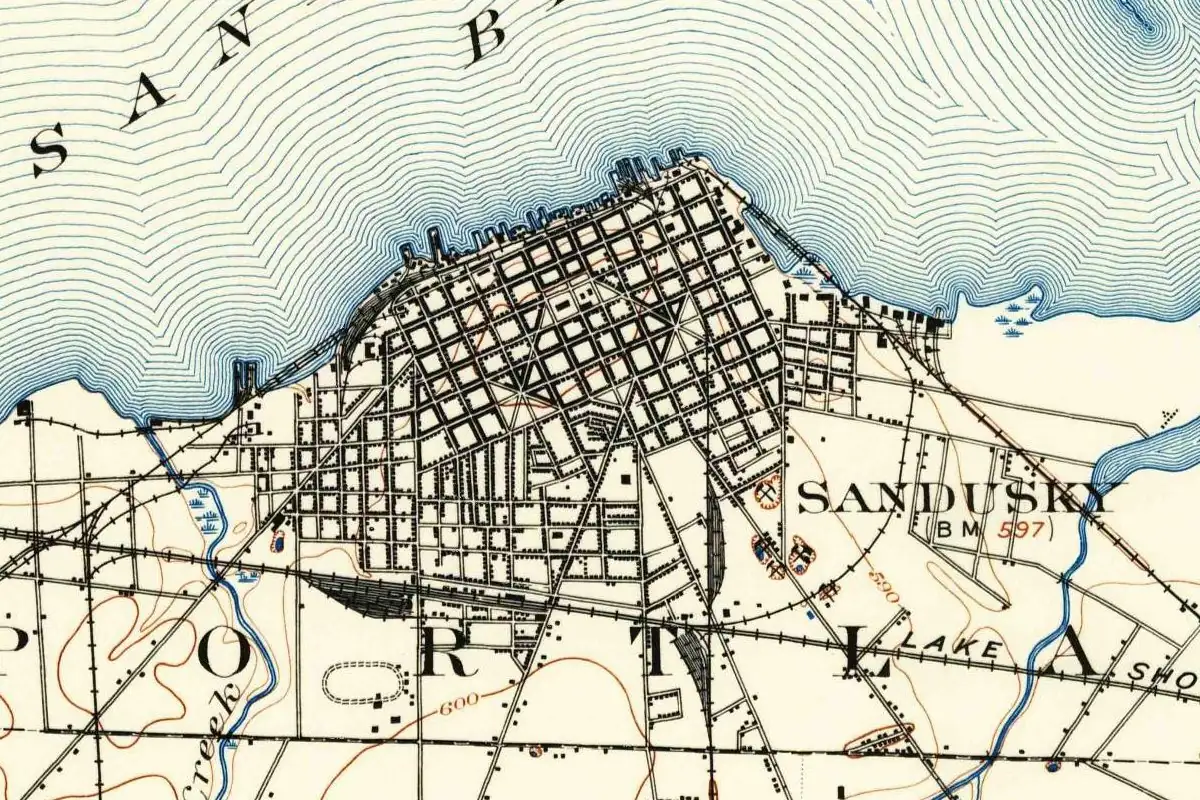
The next year, the society says, Colonel James Kilbourne, the founder of Worthington, Ohio, met Wildman and Isaac Mills in New York City. The two had conflicting claims to land in Portland Township. Kilbourne worked out a compromise, with a bigger town on the site, and suggested it be named the “City of Sandusky.” His son Hector Kilbourne surveyed and platted it in 1818. Hector was a Freemason, and the society says he laid the square and compass of the Masonic emblem over the town’s rectangular grid, “which continues to confuse travelers to this day.” You can see those diagonal streets slicing across the grid on the 1904 map at the top of this page.
The new name didn’t stick right away. People “often referred to” the place as Portland, Ogontz Place or Sandusky City, the society says, “which was a source of confusion during the city’s early years.” The legislature cleared that up on February 14, 1824. Aldrich quotes the act incorporating the town, which was “henceforth to be known and distinguished by the name of Sandusky.” By then, he says, it had something like 300 people.
Down the river and along the lake
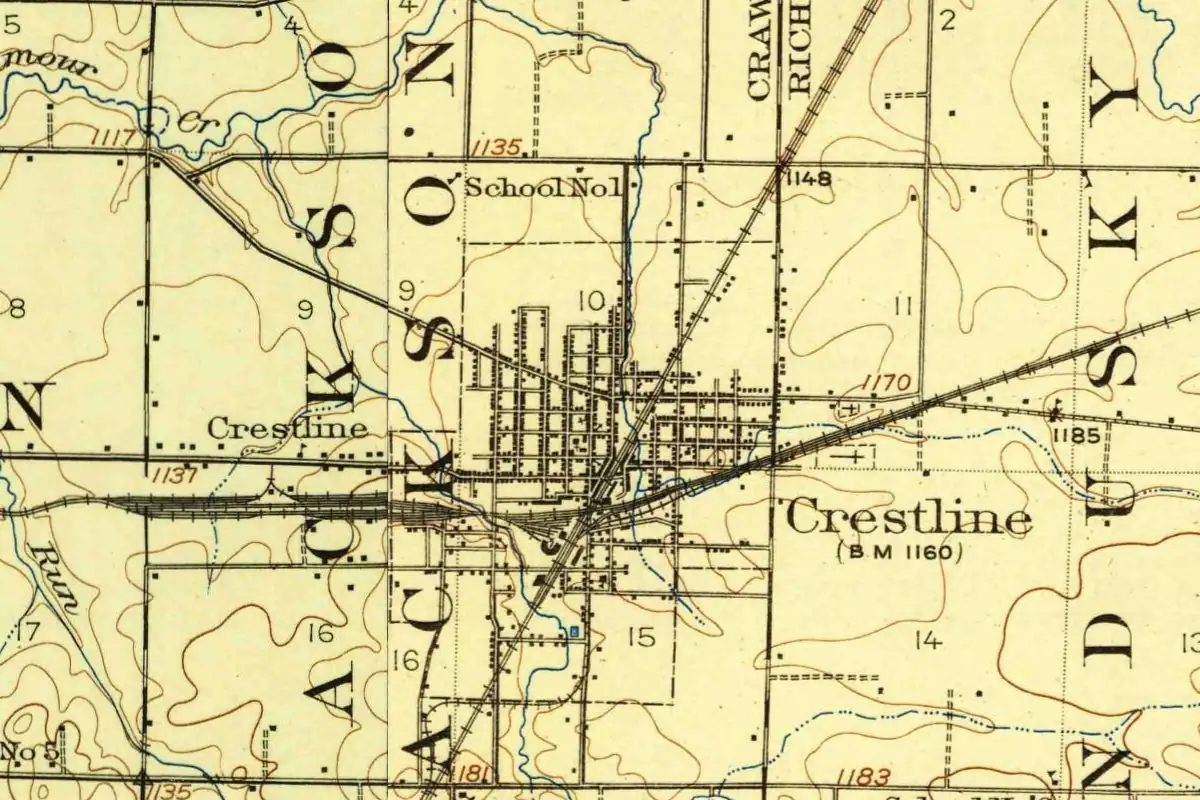
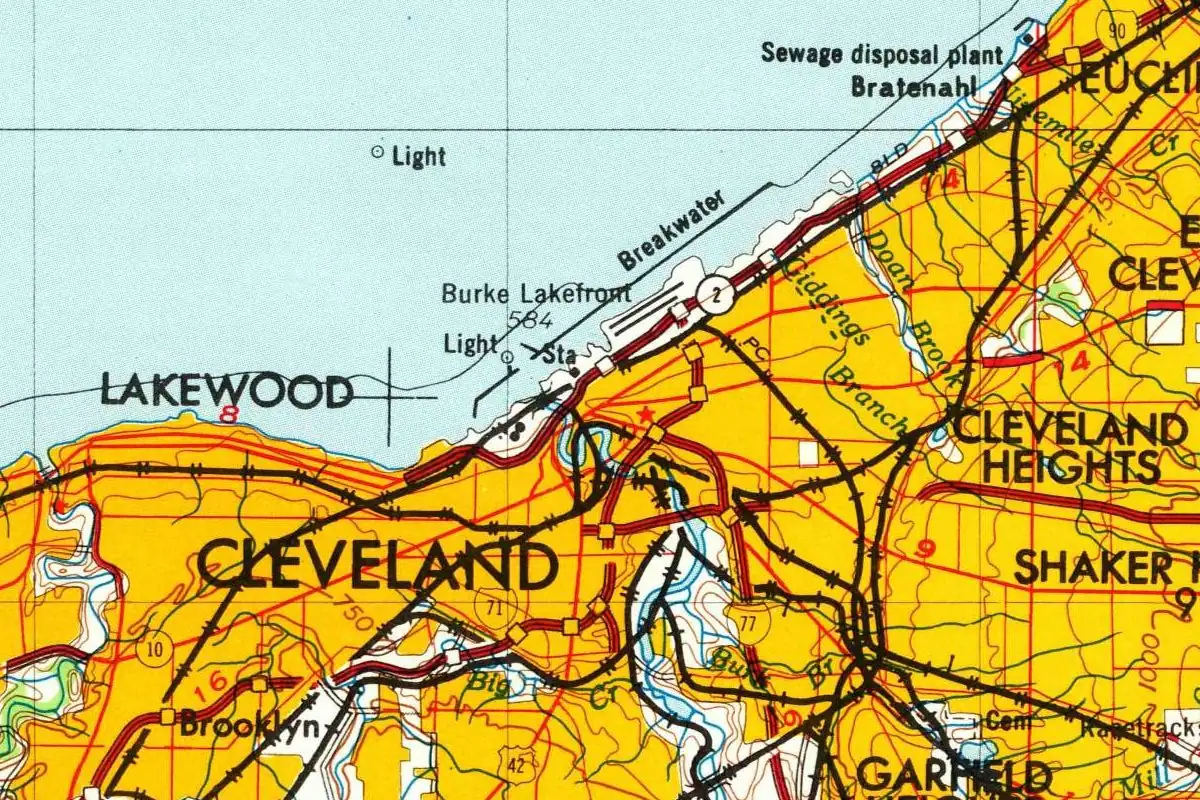
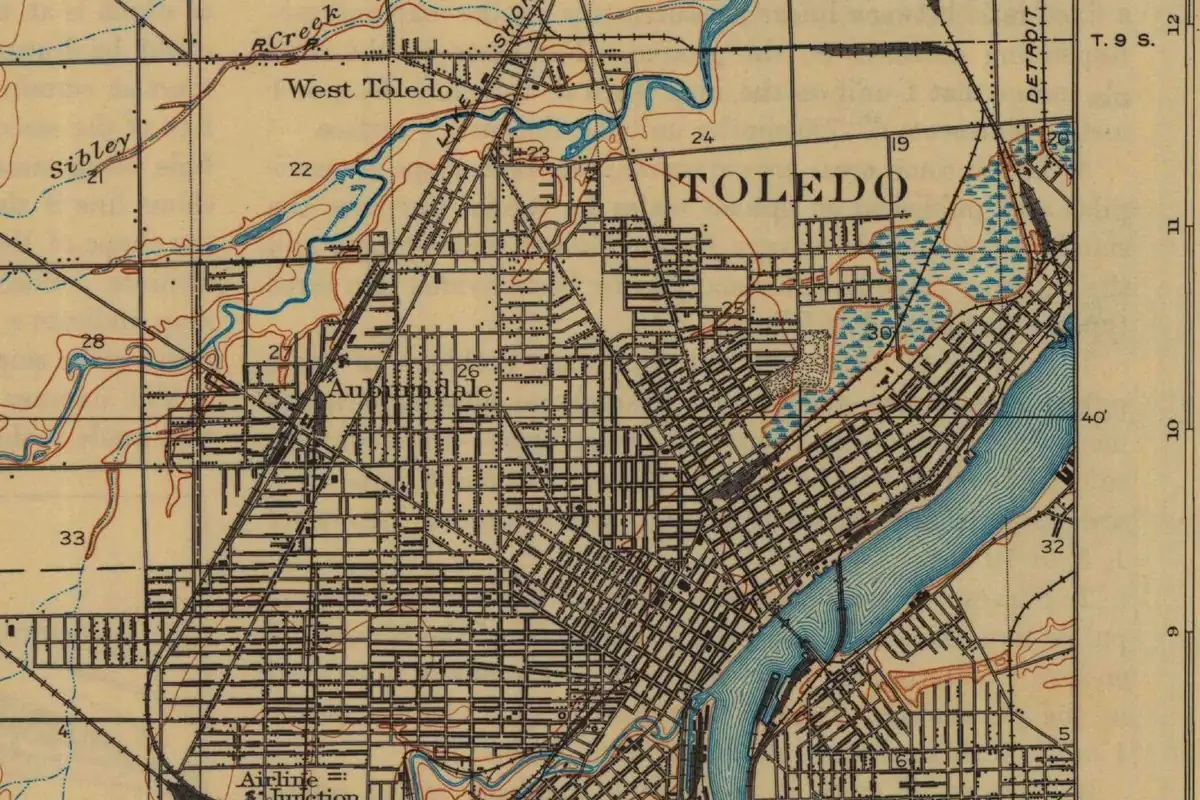
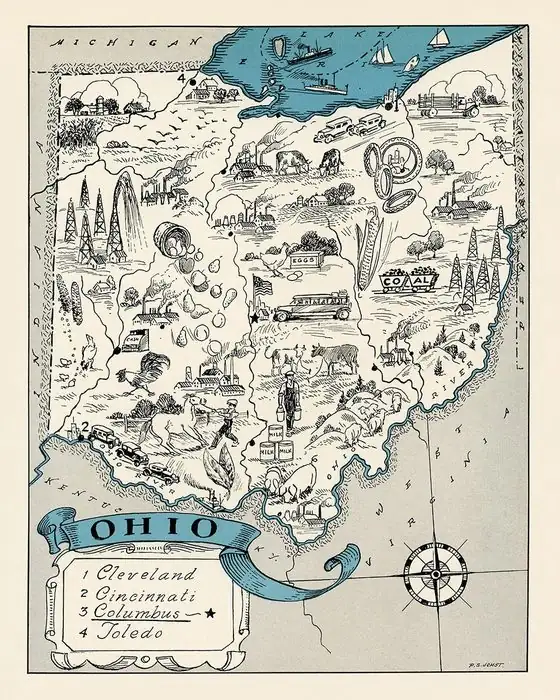
Butterfield’s book follows Crawford’s army to the spot where it first reached the Sandusky, “three miles west of the present village of Crestline.” Aldrich, writing about the town’s early leaders, grumbles that they let the big opportunities slip “and Cleveland and Toledo to reap the harvest.” There’s more on our Ohio page.
Quick answers
What does Sandusky mean?
No one meaning is agreed on. Butterfield (1873) gives Wyandot forms meaning “clear water,” “at the cold water” and “water within water-pools”; Gannett (1905) gives “there is pure water here,” “large pools of water” and “cold spring.”
Is Sandusky named after a Polish trader?
The claim is disputed. Aldrich (1889) says the claim about a trader named Sodowsky is “not sufficiently substantiated,” and the descendant Peeke wrote to in 1922 said he thought the name was of Indian origin.
What was Sandusky called before?
Zalmon Wildman platted it as “Sandusky City” in 1816, and the Erie County Historical Society says people also called it Portland or Ogontz Place before the “City of Sandusky” name settled in.
How do you say Sandusky in Wyandot?
San-doos-tee. Peeke says that’s how William Walker, a Wyandot chief, told John M. James to pronounce it in 1835.
Key dates
- 1720A map published in Amsterdam shows a water called Lac Sandouske, according to Peeke.
- 1733Henry Popple's map, published in London, calls the bay "Lake Sandoski," according to Peeke.
- 1816Zalmon Wildman plats "Sandusky City" in Portland Township, on the site once occupied by the chief Ogontz.
- 1817James Kilbourne brings Wildman and Isaac Mills together and suggests the name "City of Sandusky."
- 1818Hector Kilbourne surveys and plats the new town, with the Masonic square and compass laid over the grid.
- 1824On February 14, the Ohio legislature incorporates the town under the name of Sandusky.
Things to do in Sandusky, Ohio
Cedar Point
The amusement park on the Lake Erie shore, which began more than 150 years ago as a lakeside summer retreat on a mile-long (1.6 km) sandy beach and now has 66 rides, including the Steel Vengeance and Millennium Force roller coasters.
Merry-Go-Round Museum
A museum of carousel art and history, founded in 1990 in Sandusky's former post office, a National Register building, with hand-carved figures, vintage band organs and a restoration workshop.
Maritime Museum of Sandusky
A museum of the Sandusky Bay area's life on the water: passenger boats, commercial fishing, ice harvesting, boat-building, shipwrecks and Sandusky's role in the Underground Railroad, with Lyman boats you can board.
Sandusky History Museum at the Follett House
Sandusky Library's local history museum in Oran Follett's Greek Revival house, with four floors of exhibits on the city and a rooftop widow's walk that looks out over Sandusky Bay toward Cedar Point and Johnson's Island.
Washington Park Historic Walking Tour
The Erie County Historical Society's walking tour around Washington Park, with stops at the Sandusky Plat Marker, the Masonic Temple, Grace Episcopal Church and the Washington Row buildings.
Getting there
Open Sandusky in Google Maps
Opens in a new tab. The pin is the center of Sandusky in the USGS place-name record.
The closest airports, Amtrak stations and intercity bus stops, measured in a straight line from the center of Sandusky.
Airports
- Cleveland-Hopkins International (CLE) 44 mi 71 km
- Eugene F Kranz Toledo Express (TOL) 58 mi 93 km
Amtrak trains
- Sandusky station (SKY) under 1 mi 1 km
- Elyria station (ELY) 32 mi 52 km
Intercity buses
- GoBus Sandusky under 1 mi 1 km
- Greyhound Sandusky Bus Stop under 1 mi 1 km
- Barons Bus Lines Toledo (Amtrak) 45 mi 72 km
Distances are as the crow flies, not by road. We don't list schedules or fares because they change; check with the airline, Amtrak or the bus company before you go. Official data (FAA commercial service airports (2025), FAA airport locations, Amtrak stations and Intercity Bus Atlas) from the FAA and the U.S. Bureau of Transportation Statistics, checked Nov 14, 2026.
Sponsored
Staying in Sandusky?
Compare hotels in Sandusky, Ohio, on Expedia.
See hotels in SanduskyWe may earn a commission if you buy through this link. It never changes what we write. Read our affiliate disclosure
Historical Sources & References
- Gannett, The Origin of Certain Place Names in the United States (1905), p. 273. The entry for the Ohio city, county and river: outsandouke, “there is pure water here”; sa-anduste, “large pools of water”; “cold spring.”
- Butterfield, Expedition against Sandusky (1873), p. 147. Sandusquet; Sah-un-dus-kee, San-doos-tee and Sa-undustee; the quoted line about the marshes; Crawford’s army three miles (5 km) west of Crestline.
- Aldrich, History of Erie County (1889), p. 235. Eickhoff’s Sodowsky claim, “not sufficiently substantiated” and disputed by Bancroft; Cleveland and Toledo reaping the harvest.
- Aldrich (1889), p. 287. Wildman’s 1816 plat, “generally been known as Portland,” named “Sandusky city.”
- Aldrich (1889), p. 291. The act of February 14, 1824, incorporating the town “by the name of Sandusky”; about 300 people.
- Peeke, Centennial History of Erie County (1925), ch. IV. A web transcription. Judge J. M. Sandusky’s 1922 letter; the 1720 and 1733 maps; the tradition told to Harrison; William Walker’s “at the coldwater” and San-doos-tee.
- Erie County Historical Society, “Sandusky Marker”. Wildman’s “Sandusky City” in 1816 on the site of Ogontz; Kilbourne’s compromise and “City of Sandusky”; Hector Kilbourne’s 1818 plat; Portland, Ogontz Place and Sandusky City.
- Erie County Historical Society, “Sandusky Plat Marker”. Kilbourne, Mills and Wildman in 1817; the Masonic square and compass on the 1818 plat.
- GNIS feature 1076832 (U.S. Geological Survey). Federal place-name data for Sandusky, Erie County, with its coordinates.
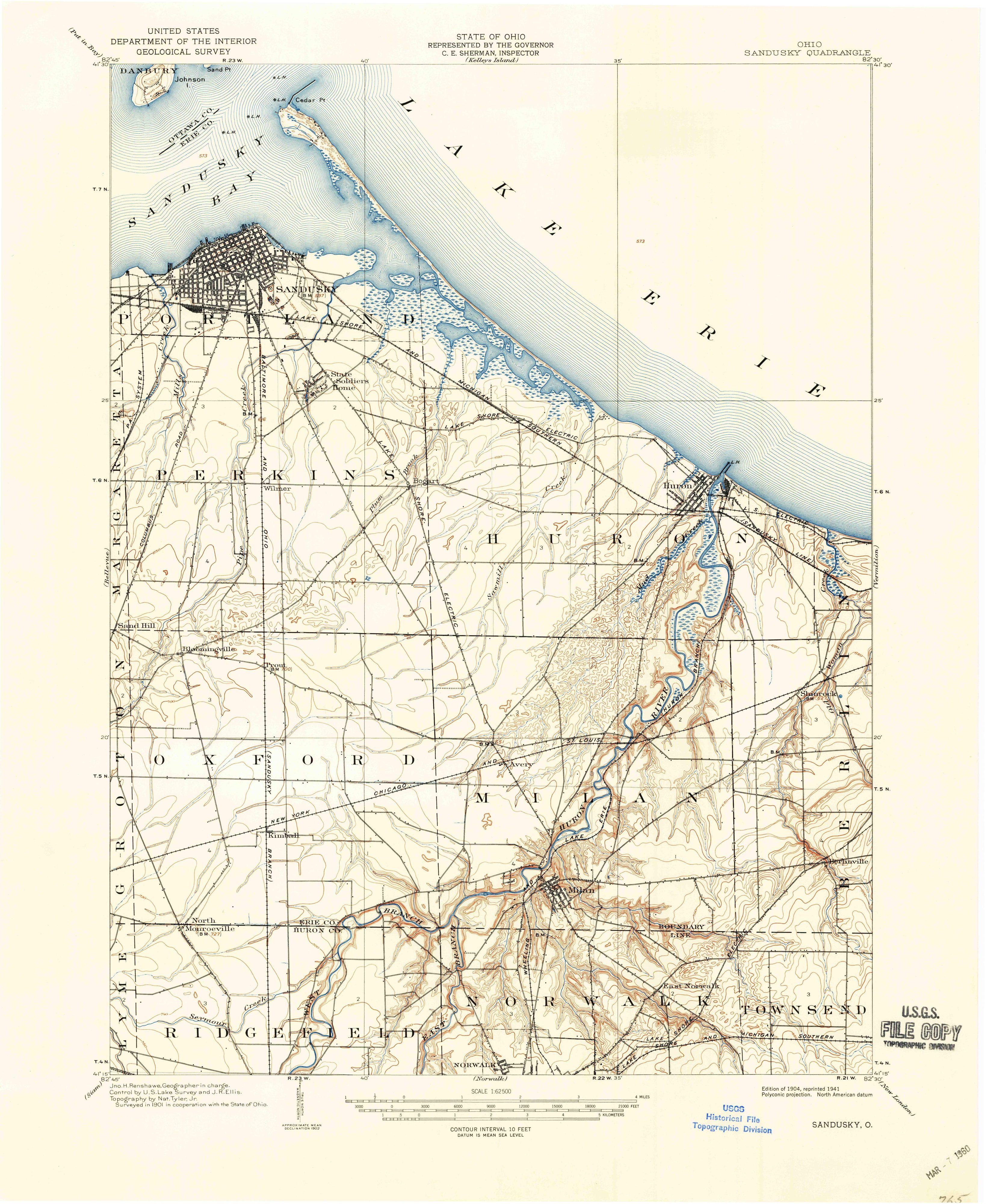
- U.S. Geological Survey, Sandusky sheet (1904). The 1:62,500 map that the image at the top of this page was cropped from.
Sponsored
Put this 1904 map on your wall
The 1904 USGS Sandusky sheet, in a 1941 reprint, is in the public domain. Download the full-size scan for free, then have it printed on canvas with CanvasOnTheCheap.
Print a map on canvasDownload the full-size mapWe may earn a commission if you buy through this link. It never changes what we write. Read our affiliate disclosure
Spot something wrong, or know more? Tell us here. You can also email us or use our contact page. Corrections are noted here with their date, never made silently.