Hood River, Oregon: From Dog River to an Admiral's Name
The city is named for the Hood River, Lewis A. McArthur's Oregon Geographic Names says. Pioneers called the stream Dog River, and Mrs. Nathaniel Coe got local usage changed to Hood River, after Mount Hood, its source. Lt. William Broughton of George Vancouver's expedition named the mountain in 1792 for Lord Hood, a British admiral.
Hood River, Oregon, is named for the river beside it, a stream pioneers called Dog River until it was renamed for Mount Hood. That makes the city’s name a chain with three links: a town named for a river, a river named for a mountain, and a mountain named for an admiral.
Labiche, then Dog River
The river had a different name long before the town. Lewis A. McArthur’s Oregon Geographic Names says Lewis and Clark found it on Tuesday, October 29, 1805, and called it the Labeasche River, “an improvised method of spelling the name of Francis Labiche,” one of the expedition’s French-Canadian boatmen. La biche is French for a doe, McArthur notes, and French Canadians often used it for elk, but nothing in the journals mentions game at that spot, so the river was named for the man. Earlier that year, in June 1805, the same expedition had reached the Missouri River falls that later gave Great Falls, Montana, its name.
That name didn’t last. McArthur explains the next one bluntly: “In pioneer days some travelers, being in a starving condition, ate dog meat near Hood River, and the unpopular name Dog River was the result.” You can find it in print early, too. In October 1852, an ad in the Oregonian said a road had been cleared from “Dog River to the ferry.” And the name hasn’t vanished: McArthur says Dog River is now attached only to a small stream that starts in Brooks Meadows, about eight miles (13 km) southeast of Parkdale, and flows into the East Fork of the Hood River.
Mrs. Coe objects
So who got rid of Dog River? McArthur gives the credit to “Mrs. Nathaniel Coe, a well-known pioneer resident of the valley,” who “objected to the name Dog River and succeeded in changing local usage to Hood River on account of Mount Hood, its source.” The City of Hood River and The Oregon Encyclopedia give her first name, Mary. The encyclopedia says Nathaniel Coe claimed land near the mouth of Dog River in 1854 and that “his wife Mary rechristened the stream Hood River.”
None of these sources dates the change. McArthur says only that “the name Hood River appears on a map as early as 1856,” and the city repeats that line. When the town came along, it simply took the river’s name. “The city of Hood River was named for the stream nearby,” McArthur writes.
The mountain and the admiral
Mount Hood was first sighted 13 years to the day before Lewis and Clark reached the river, by McArthur’s dates. He says Lt. William Robert Broughton, sailing up the Columbia under George Vancouver, saw the mountain on October 29, 1792, and saw it again the next day near Point Vancouver. Vancouver’s own account, printed in 1798, reports what Broughton did: “Mr. Broughton honored it with Lord Hood’s name; its appearance was magnificent.” The same voyage put names on Port Townsend and Bellingham Bay, the source of Bellingham’s name, and Vancouver named Mount Rainier for another British admiral.
Which Lord Hood, though? McArthur, paraphrasing the historian Edmond S. Meany, says “the Lord Hood, to whom Vancouver referred, was Samuel Hood,” a Royal Navy officer born in 1724. Hood River County’s website says the same: “Mt. Hood was named in 1792 after Lord Hood (Samuel).” But Henry Gannett, whose book on American place-name origins the Geological Survey printed in a second edition in 1905, wrote that the river and mountain were “named for Alexander Arthur Hood, afterwards Lord Brinport” (sic). Gannett doesn’t say where he got that, and McArthur rules it out. Alexander Hood, Lord Bridport, was Samuel’s younger brother, and McArthur says he “never had the title Lord Hood”; “there was but one Lord Hood in 1792, when the mountain was named, and that was the first Samuel.” He adds that Samuel Hood was already Lord Hood when he signed the original instructions for Vancouver’s voyage.
Post office, plat, city, county
The Coe name turns up in the town’s early records, too. McArthur says Hood River post office opened on September 30, 1858, with Nathan Benson as the first postmaster, and Charles C. Coe took over on May 16, 1860. The county says the city was first platted in 1881, and The Oregon Encyclopedia says it was incorporated in 1895.
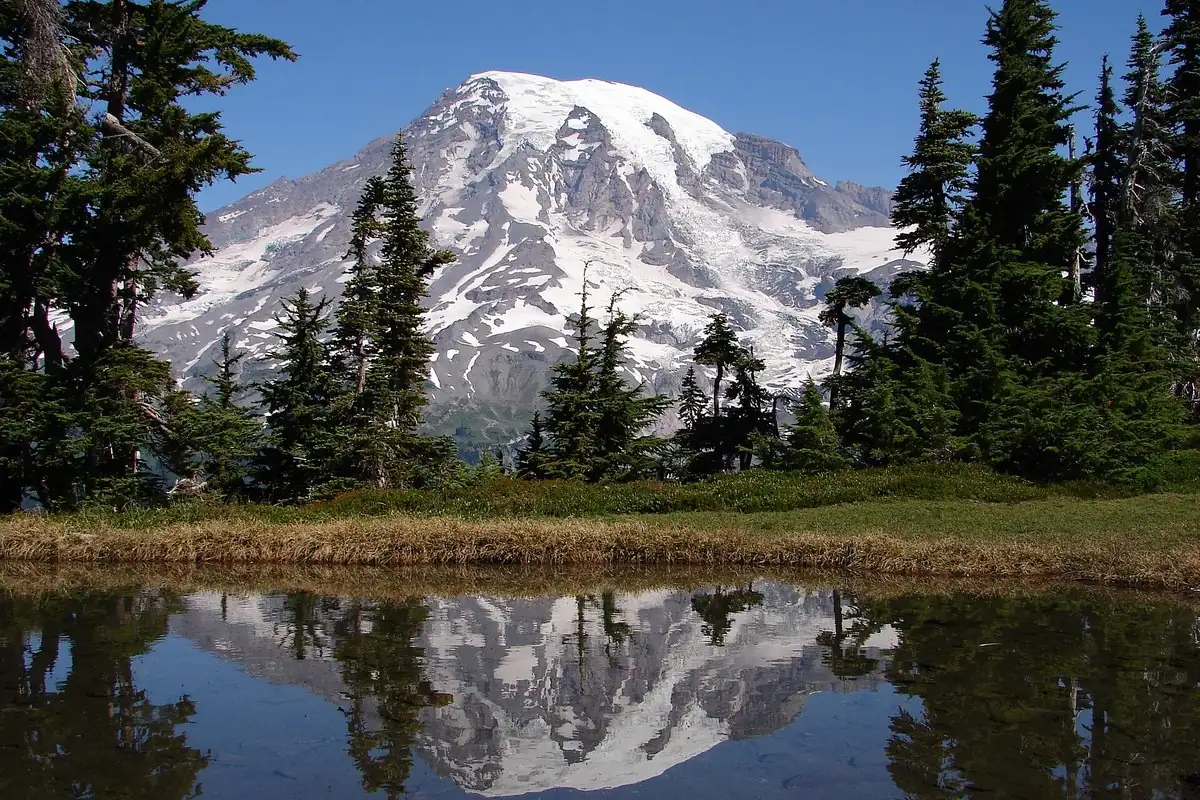
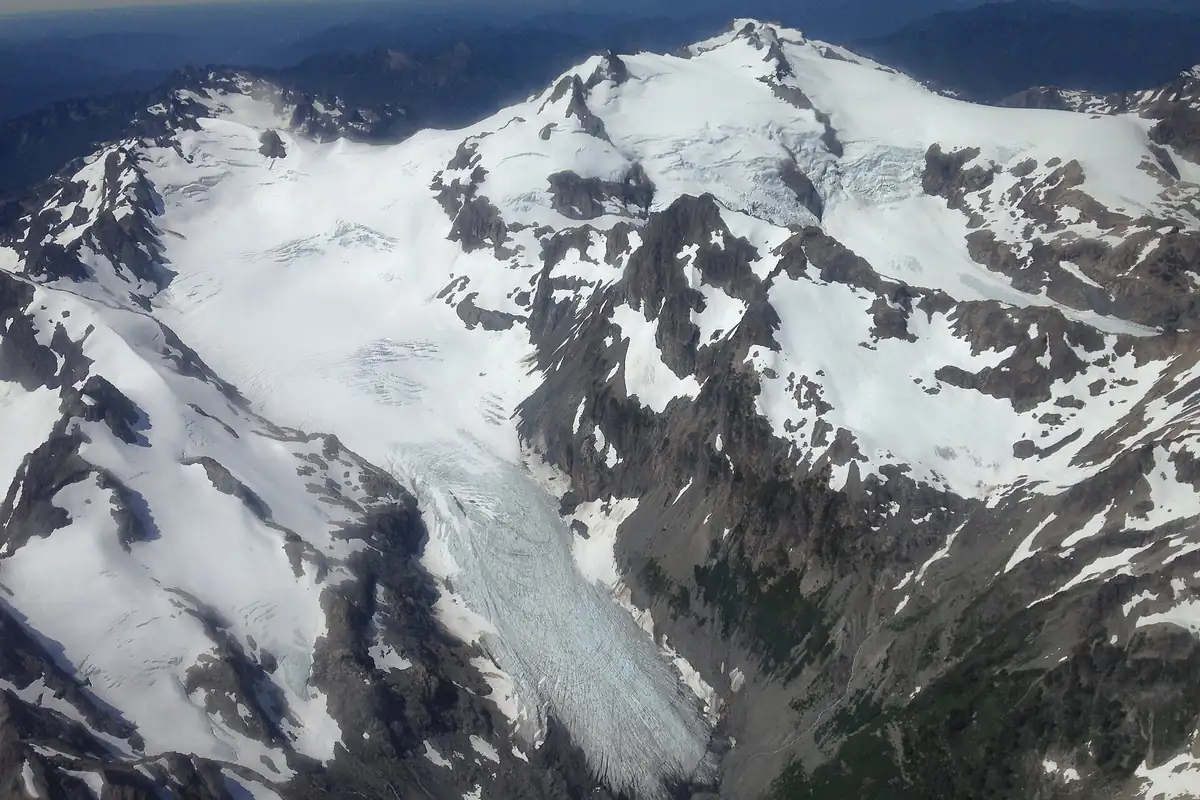
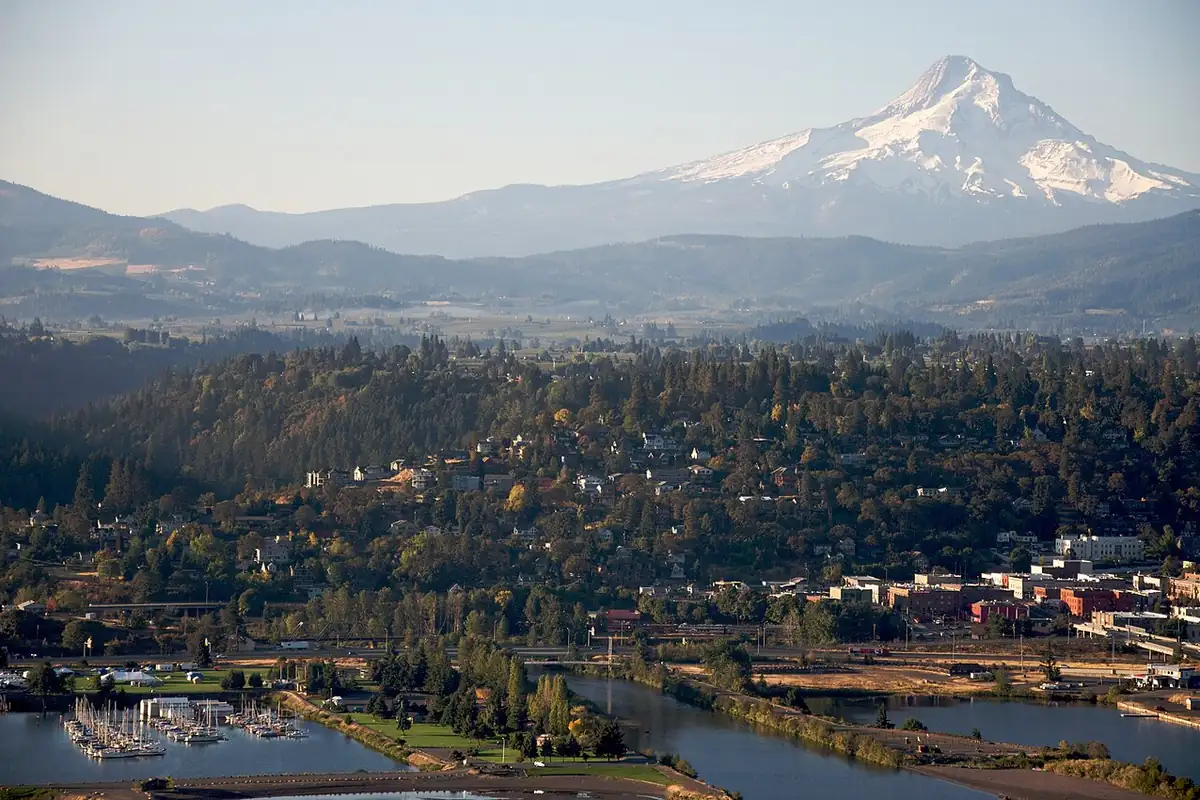
The county came last. McArthur says Hood River County was created on June 23, 1908, out of Wasco County, whose seat is The Dalles. Since most of the new county drained into the Hood River, he writes, “it was appropriate to name it Hood River County.” So the name went from river to town to county, all within Oregon, and the photo below shows the mountain that started it, rising behind the town.
The 1926 map, printed in 1955
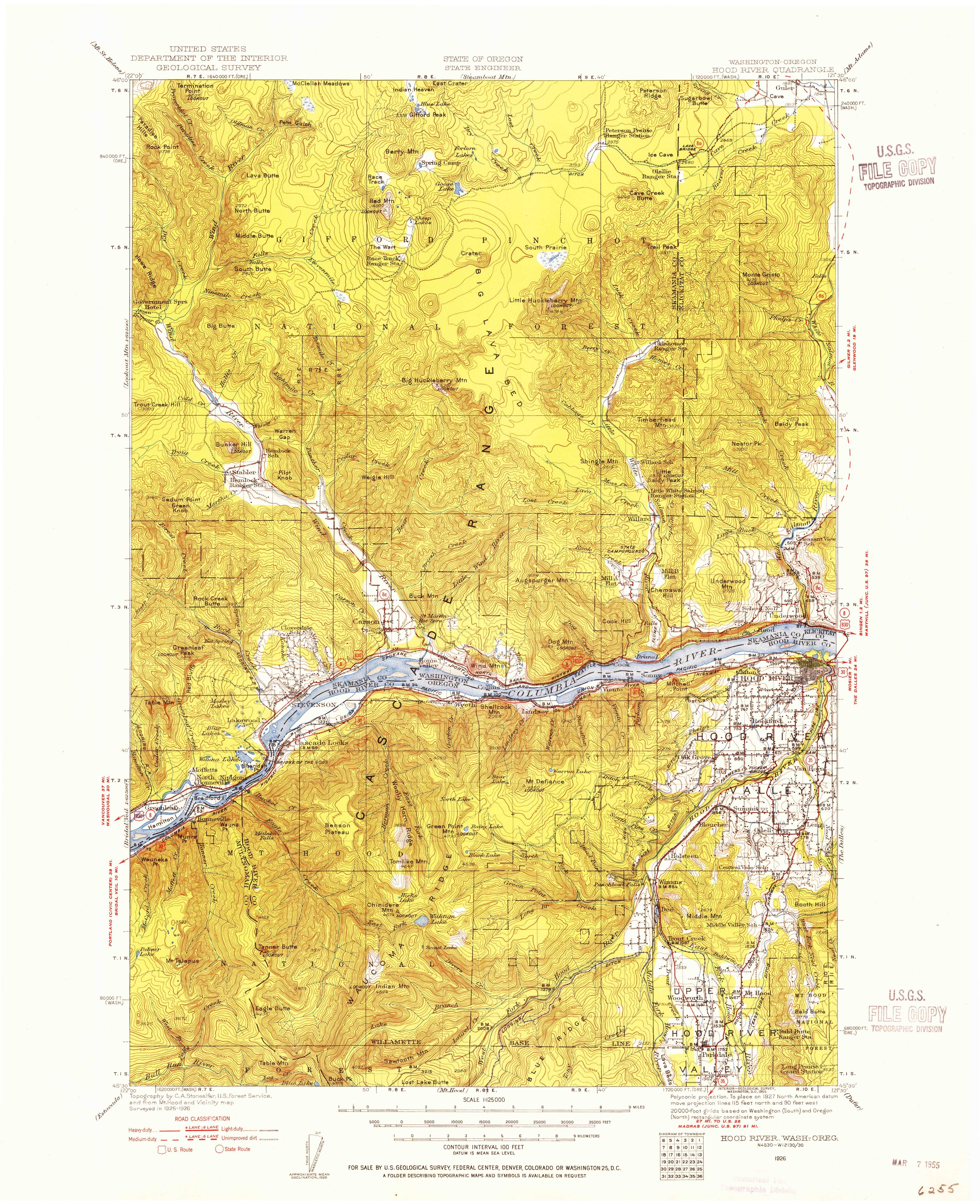
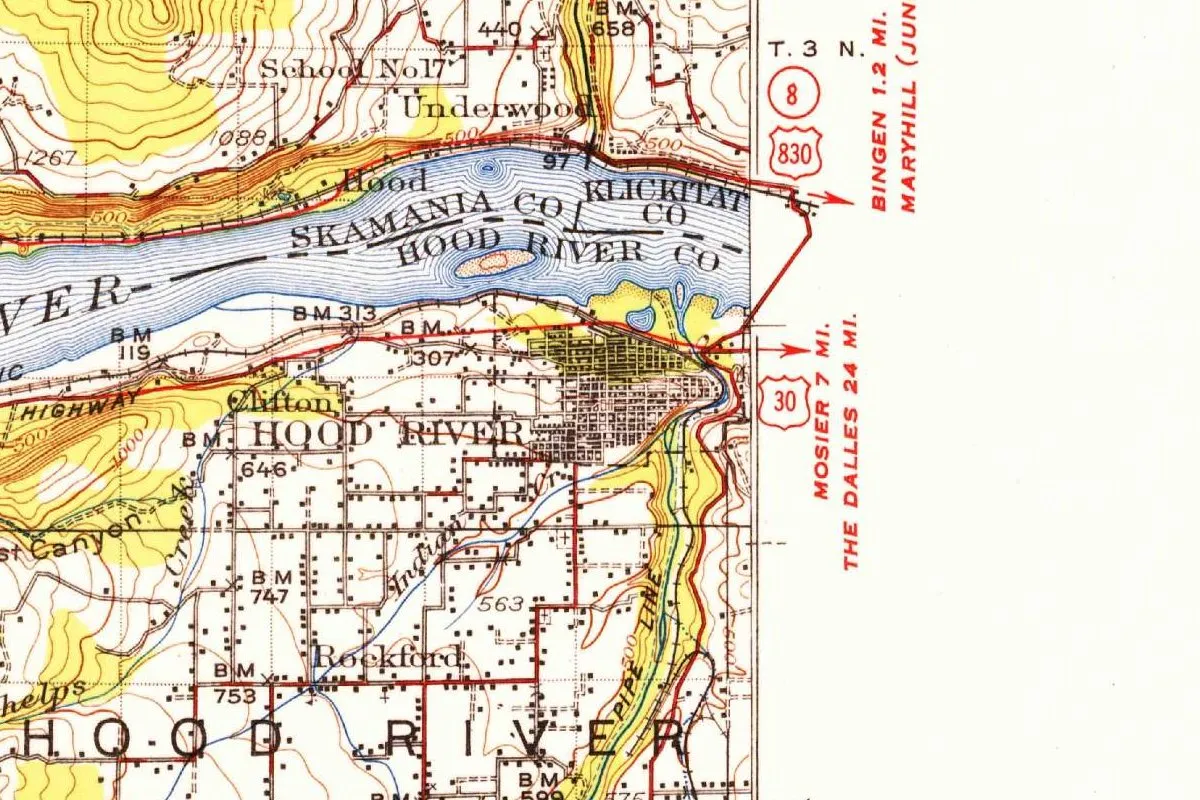
The map at the top of this page comes from the Geological Survey’s Hood River sheet, surveyed in 1925-1926, with topography by C. A. Stonesifer of the U.S. Forest Service and the State of Oregon’s State Engineer named at the top. The copy shown is a 1955 printing. You’ll find the town as a small grid where the Hood River meets the Columbia, near the sheet’s eastern edge. The red notes in the right margin give distances to towns off the sheet; they aren’t distances from Hood River.
Quick answers
Who is Hood River, Oregon, named after?
Nobody directly. The city is named for the Hood River, McArthur says. The river was renamed for Mount Hood, and the mountain for Lord Hood, a British admiral: Samuel Hood, according to McArthur and the county. Gannett named Alexander Arthur Hood in 1905, but McArthur says that can’t be right: Alexander Hood was Lord Bridport and “never had the title Lord Hood.”
Why was it called Dog River?
McArthur says starving pioneer travelers ate dog meat near the river, and “the unpopular name Dog River was the result.” An 1852 newspaper ad already used the name.
Who changed the name to Hood River?
Mrs. Nathaniel Coe, a pioneer of the valley, according to McArthur. The city and The Oregon Encyclopedia call her Mary Coe. No source we read gives the year, but the name was on a map by 1856.
Key dates
- 1792On October 29, Lt. William Broughton of Vancouver's expedition sees Mount Hood; he names it for Lord Hood when he sees it again the next day.
- 1805Lewis and Clark reach the river on October 29 and call it Labeasche River, for Francis Labiche.
- 1852An October ad in the Oregonian mentions a road from "Dog River to the ferry."
- 1854Nathaniel and Mary Coe file their land claim near the river's mouth.
- 1856The name Hood River appears on a map, the earliest McArthur found.
- 1858Hood River post office opens on September 30, with Nathan Benson as postmaster.
- 1881The town of Hood River is first platted.
- 1895Hood River is incorporated as a city.
- 1908Hood River County is created from Wasco County on June 23.
Things to do in Hood River, Oregon
Western Antique Aeroplane & Automobile Museum (WAAAM)
One of the country's largest collections of antique planes that still fly and cars that still run, including a 1917 Curtiss JN-4D Jenny and more than 130 cars.
Hood River County Fruit Loop
A self-guided 35-mile (56 km) loop through the Hood River Valley, with 32 farm stands, wineries, cideries and flower fields, in a valley where the first fruit trees were planted in 1855.
Historic Columbia River Highway State Trail, Twin Tunnels segment
More than four miles (6.4 km) of the old Columbia River Highway, closed to cars, between the Senator Mark O. Hatfield West Trailhead near Hood River and the East Trailhead at Mosier, for hiking and biking.
Hood River Waterfront
The Port of Hood River's waterfront has close to two miles (3 km) of shoreline trails, a nearly six-acre (2.4 ha) Waterfront Park, the Event Site for windsurfing and The Hook, a protected cove used for beginners' windsurfing lessons.
Getting there
Open Hood River in Google Maps
Opens in a new tab. The pin is the center of Hood River in the USGS place-name record.
The closest airports, Amtrak stations and intercity bus stops, measured in a straight line from the center of Hood River.
Airports
- Portland International (PDX) 53 mi 85 km
- Yakima Air Trml/McAllister Field (YKM) 76 mi 122 km
Amtrak trains
- Bingen-White Salmon station (BNG) 3 mi 4 km
- Wishram station (WIH) 27 mi 43 km
Intercity buses
- FlixBus Hood River OR (HOO) under 1 mi 0.9 km
- Northwestern Stage Lines Hood River (CAT) under 1 mi 1 km
- Central Oregon Breeze Government Camp Rest Area 30 mi 48 km
Distances are as the crow flies, not by road. We don't list schedules or fares because they change; check with the airline, Amtrak or the bus company before you go. Official data (FAA commercial service airports (2025), FAA airport locations, Amtrak stations and Intercity Bus Atlas) from the FAA and the U.S. Bureau of Transportation Statistics, checked Nov 17, 2026.
Sponsored
Staying in Hood River?
Compare hotels in Hood River, Oregon, on Expedia.
See hotels in Hood RiverWe may earn a commission if you buy through this link. It never changes what we write. Read our affiliate disclosure
Historical Sources & References
- Lewis A. McArthur, Oregon Geographic Names, 3rd ed. (1952), p. 305. Lewis and Clark’s Labeasche River in 1805, the dog meat and Dog River, and Mrs. Nathaniel Coe’s change to Hood River. Read in the Wikisource transcription of the third edition.
- Lewis A. McArthur, Oregon Geographic Names, 3rd ed. (1952), p. 306. Today’s Dog River, about eight miles (13 km) southeast of Parkdale, the 1852 Oregonian ad, the 1856 map, the city “named for the stream nearby,” the post office of 1858 and the county of 1908.
- Lewis A. McArthur, Oregon Geographic Names, 3rd ed. (1952), p. 421. Broughton and Mount Hood in October 1792, Vancouver’s account, and Samuel Hood, after Edmond S. Meany.
- George Vancouver, A Voyage of Discovery to the North Pacific Ocean, vol. 2 (1798), p. 65. “Mr. Broughton honored it with Lord Hood’s name.” Checked against the page image.
- Lewis A. McArthur, Oregon Geographic Names, 3rd ed. (1952), p. 422. Why the mountain can’t be named for Alexander Hood, Lord Bridport, who “never had the title Lord Hood,” and Samuel Hood as the only Lord Hood in 1792.
- Henry Gannett, The Origin of Certain Place Names in the United States, 2nd ed. (1905), p. 160. The Hood entry naming Alexander Arthur Hood, which McArthur rules out. Checked against the page image.
- Hood River County, “About the County”. Mount Hood named in 1792 for Samuel Hood, the county proclaimed on June 23, 1908, and the city first platted in 1881.
- City of Hood River, “History”. Lewis and Clark in 1805, Mary Coe and Dog River, and the 1856 map.
- The Oregon Encyclopedia, “Hood River (city)”. Labiche, Dog River, the Coe claim of 1854, Mary Coe’s new name for the stream, and incorporation in 1895.
- WAAAM; Hood River County Fruit Loop; Historic Columbia River Highway State Trail; Port of Hood River waterfront. The details in the things-to-do list.
- GNIS feature 1136388 (U.S. Geological Survey). Hood River as a populated place in Hood River County, with its coordinates.
- U.S. Geological Survey, Hood River sheet (1926). The 1:125,000 sheet, surveyed in 1925-1926 and shown in its 1955 printing, that the map at the top of this page was cropped from.
Sponsored
Put this 1926 map on your wall
The Geological Survey's 1926 Hood River sheet (a 1955 printing) is in the public domain. Download the full-size scan for free, then have it printed on canvas with CanvasOnTheCheap.
Print a map on canvasDownload the full-size mapWe may earn a commission if you buy through this link. It never changes what we write. Read our affiliate disclosure
Spot something wrong, or know more? Tell us here. You can also email us or use our contact page. Corrections are noted here with their date, never made silently.