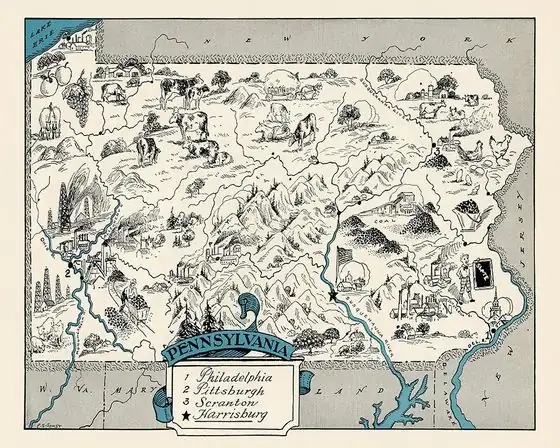
Bethlehem, Pennsylvania: Named at a Christmas Eve Service
Moravian settlers named Bethlehem on Christmas Eve 1741, at a service in their first log house led by Count Nicolaus Ludwig von Zinzendorf. A hymn with the line "Not Jerusalem, rather Bethlehem" suggested the biblical name. A later explanation linking it to the Lecha, or Lehigh, River was dismissed by historian Joseph Levering in 1903.
A log house on the Lehigh
Bethlehem, Pennsylvania, got its name on Christmas Eve 1741, when Moravian settlers sang a hymn in a log house they shared with their cattle. They named their new settlement for the town in Judea where Jesus was born. And unusually for a founding story, people who were in the room wrote down what happened.
The Moravians were a church on a mission, in the literal sense. The Moravian Archives in Bethlehem, which keeps the church’s records, says they first landed in Savannah, Georgia, in 1735, hoping to preach to Native Americans there. Their pacifism caused friction with the neighbors, so in 1740 they took up evangelist George Whitefield’s offer of land in Pennsylvania, at what’s now Nazareth. That partnership fell apart over theology.
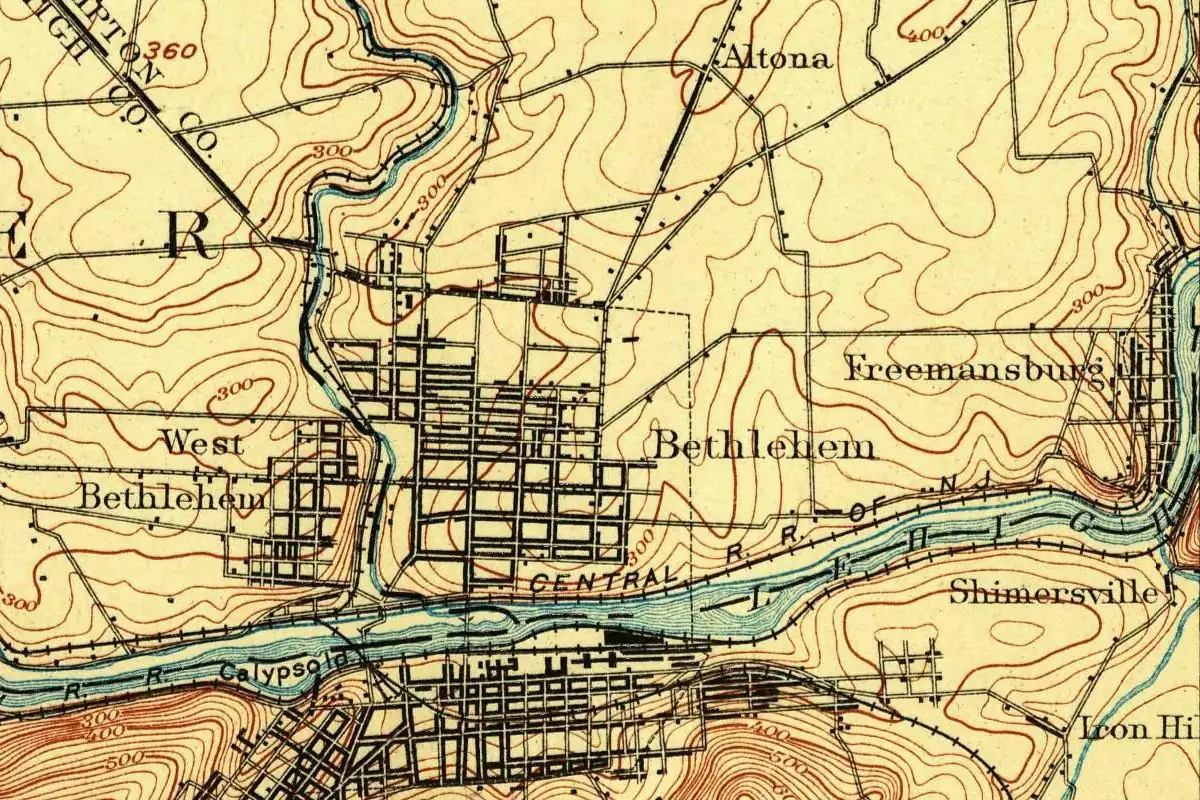
So in 1741 they bought 500 acres of their own from the merchant and politician William Allen, where the Monocacy Creek runs into the Lehigh River. The Bethlehem Area Public Library dates the deed, signed by William and Margaret Allen, to April 2, 1741. Levering adds that Allen, later chief justice, had a son, James, who founded Northampton, the town you now know as Allentown.
The night of the vigil
Joseph M. Levering, a bishop of the Moravian Church and its former archivist at Bethlehem, told the naming story in detail in his 1903 History of Bethlehem. Count Nicolaus Ludwig von Zinzendorf, the church’s leader, had just arrived at the settlement. On Sunday, December 24, the settlers gathered in their little log house for the vigil of Christmas.
That date comes with a twist. England and its colonies still used the old Julian calendar, eleven days behind, but the Moravians kept Christmas by the new style, on the same day as their brethren in Europe. Levering notes, a little dryly, that “vigilant patriots of a neighboring settlement” later held this up as proof the Moravians were secretly Papists, since a pope had introduced the new calendar. So Bethlehem’s name day was, by the colony’s own reckoning, a bit early.
The building was rough. Levering describes “their humble sanctuary, with beasts of the stall sharing its roof.” During the service, Zinzendorf got up and led everyone into the part of the house where the cattle were kept, singing an old German Epiphany hymn. The lines that Martin Mack, one of the settlers, treasured in memory, Levering says, were “Nicht Jerusalem, sondern Bethlehem.” In his own English rendering: “Not Jerusalem, rather Bethlehem.”
You can guess the rest. On page 79 he puts it plainly:
“No name had yet been given to the settlement. That vigil service and that hymn suggested one. By general consent the name of the ancient town of David was adopted and the place was called Bethlehem.”
Levering leaned on eyewitnesses. He cites Mack’s autobiography, and notes that one person present wrote long afterward that the impression was “yet fresh in my memory.” By January 1742, he adds, the name was already used officially in the church’s conference records.
Zinzendorf’s name, or everyone’s?
Who actually picked it depends a little on whom you read. Levering says “by general consent.” The Moravian Archives credits Zinzendorf, and it quotes a diary kept by the community’s Single Brethren. In an English translation by Thomas McCullough, the diary says the place “was called ‘Bethlehem’ by the dear Brother and angel of the Philadelphia congregation, Nicolaus Ludwig von Zinzendorf, as he arrived here on Christmas Eve in 1741.”
Those two versions fit together fine. Zinzendorf led the service and the hymn; the settlers went along with the name. It isn’t the only Moravian place name with his fingerprints on it, either: our story of Winston-Salem traces the Salem half of that city’s name to him, too. The date is almost the only thing the old books argue over. Henry Gannett’s 1905 dictionary of place names says Bethlehem was “named on Christmas Day, 1741, from the birthplace of Christ in Judea.” The diary, the archives and Levering all put it on Christmas Eve.
House of bread, or house on the Lehigh?
There’s a second, cleverer explanation, and it’s in that same diary. It says Zinzendorf “drew an analogy” between the Hebrew name, Bet Lehem, and “the great Lecha (i.e. Lehigh),” the river the big house stood on. The archives explains the pun: Bethlehem means “House of Bread,” and Lecha sounded close enough to the Hebrew lechem, bread, that the name could also be read as “House on the Lehigh.”
Levering knew this version and didn’t like it. In a long footnote he says it was “set forth later,” as in the first records of the Single Brethren’s House in 1748, and that after “a thorough examination” he found no ground for it as “anything more than a fanciful after-thought.” Wordplay of that kind, he wrote, was a fashion of the time, copied from Zinzendorf’s own love of puns. The plain testimony of Mack and other early witnesses, in his view, “should be conclusive.”
So you can enjoy the pun, as the Moravians clearly did. But the name came from the hymn and the holiday, and the river joke came after.
How it became the Christmas City
Bethlehem leaned into its birthday nearly two centuries later. Historic Bethlehem Museums & Sites says that on December 7, 1937, the city lit thousands of lights and an 81-foot star and adopted the name “Christmas City, USA.” It was partly a Depression-era plan to bring shoppers to both sides of the Lehigh. Vernon Melhado, president of the Chamber of Commerce, summed it up that year: “Bethlehem did not create Christmas, but Christmas created Bethlehem.”
In 1939, Bethlehem Steel donated a new 91-foot star with 280 bulbs, visible from more than 20 miles (32 km) away. It’s still lit every night on South Mountain. Few towns in Pennsylvania can point to the exact evening they got their name. This one can, and it put a steel star on a mountain to remind everybody.
Quick answers
Why is Bethlehem, Pennsylvania, called Bethlehem?
Because it was named on Christmas Eve 1741 for the biblical town where Jesus was born. Moravian settlers chose it during a vigil service led by Count Zinzendorf, inspired by a hymn with the line “Not Jerusalem, rather Bethlehem.”
Who named Bethlehem, PA?
Count Nicolaus Ludwig von Zinzendorf and the Moravian settlers. A translated community diary credits Zinzendorf; the historian Joseph Levering wrote in 1903 that the name was adopted “by general consent.”
Does Bethlehem mean “house on the Lehigh”?
Not originally. A 1748 Moravian record played on Bethlehem as “house of bread” and the river’s old name, Lecha, but Levering called that a “fanciful after-thought” that came after the Christmas Eve naming.
When did Bethlehem become the Christmas City?
On December 7, 1937, when the city lit its star and adopted the name “Christmas City, USA,” according to Historic Bethlehem Museums & Sites.
Key dates
- 1741On April 2, the Moravians buy 500 acres where the Monocacy Creek meets the Lehigh River from William and Margaret Allen.
- 1741On Christmas Eve, during a vigil service led by Count Zinzendorf in the log house, the settlement is named Bethlehem.
- 1742In January, the name Bethlehem is already used officially in the proceedings of the Moravian conferences, Levering says.
- 1937On December 7, Bethlehem lights its star and adopts the name "Christmas City, USA."
Things to do in Bethlehem, Pennsylvania
Moravian Museum of Bethlehem
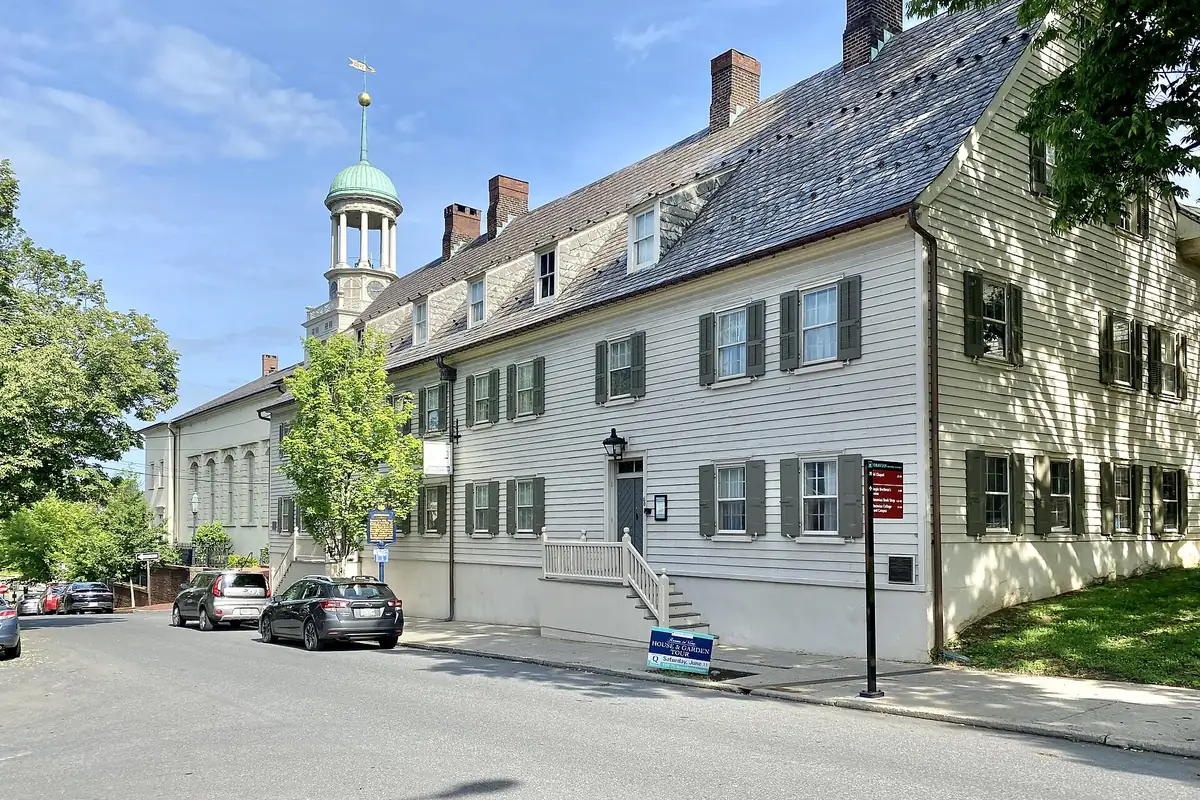
A museum on the early Moravians inside the 1741 Gemeinhaus, the oldest building in Bethlehem, part of the Moravian Church Settlements-Bethlehem World Heritage Site and a National Historic Landmark.
Single Sisters' House
A limestone building first built for the Single Brethren and given to the Single Sisters' Choir in 1748, where you can see what daily life was like for a Single Sister in 1700s Bethlehem.
Colonial Industrial Quarter
Along the Monocacy Creek, Moravian craftsmen set up more than 50 crafts, trades and industries. The quarter includes the Smithy, the Tannery and the 1762 Waterworks, the first pumped municipal water system in America.
SteelStacks
A 10-acre arts and culture campus on the former site of Bethlehem Steel, on the city's SouthSide, with music, art and community events beneath the old blast furnaces.
National Museum of Industrial History
A Smithsonian Affiliate in the former Electric Repair Shop of the Bethlehem Steel plant, with more than 200 artifacts on the 1876 Centennial Exposition, iron, steel and textiles.
Getting there
Open Bethlehem in Google Maps
Opens in a new tab. The pin is the center of Bethlehem in the USGS place-name record.
The closest airports, Amtrak stations and intercity bus stops, measured in a straight line from the center of Bethlehem.
Airports
- Lehigh Valley International (ABE) Allentown 4 mi 7 km
- Trenton Mercer (TTN) 38 mi 61 km
- Philadelphia International (PHL) 53 mi 85 km
Amtrak trains
- Paoli station (PAO) 41 mi 66 km
- Ardmore station (ARD) 43 mi 69 km
Intercity buses
- Fullington Trailways Bethlehem (Transportation Center) under 1 mi 0.9 km
- OurBus Bethlehem, PA (Lehigh University area - bus stop on eastbound Packer Ave. between Webster St. and Vine St.) 1 mi 2 km
- Greyhound Allentown Lehigh Valley Airport Bus Station 4 mi 6 km
Distances are as the crow flies, not by road. We don't list schedules or fares because they change; check with the airline, Amtrak or the bus company before you go. Official data (FAA commercial service airports (2025), FAA airport locations, Amtrak stations and Intercity Bus Atlas) from the FAA and the U.S. Bureau of Transportation Statistics, checked Nov 13, 2026.
Sponsored
Staying in Bethlehem?
Compare hotels in Bethlehem, Pennsylvania, on Expedia.
See hotels in BethlehemWe may earn a commission if you buy through this link. It never changes what we write. Read our affiliate disclosure
Historical Sources & References
- Jonathan Ennis, “Digital Collections Spotlight #14: The Naming of Bethlehem,” Moravian Archives (2020). The Moravians’ arrival in Savannah in 1735, Whitefield’s Nazareth land, the 500 acres bought from William Allen at the Monocacy and the Lehigh, Zinzendorf naming the town on Christmas Eve, and Thomas McCullough’s translation of the Single Brethren’s diary, with the Lecha and “House of Bread” explanation.
- Joseph M. Levering, A History of Bethlehem, Pennsylvania, 1741-1892 (1903), pp. 46-47 and 77-79. The Christmas Eve vigil of December 24, New Style, and the neighbors who called the new calendar a sign of Papists (p. 77, note 13), the log house shared with the stock, the hymn “Nicht Jerusalem, sondern Bethlehem,” the naming “by general consent” (p. 79), Martin Mack’s testimony, official use in January 1742 and the footnote rejecting the Lehigh wordplay as “a fanciful after-thought.” Page 46 explains Lecha as the old name of the Lehigh; page 47 identifies William Allen as chief justice and his son James as founder of Northampton, now Allentown.
- Henry Gannett, The Origin of Certain Place Names in the United States (USGS, 1905), p. 45. Bethlehem as a Moravian settlement “named on Christmas Day, 1741, from the birthplace of Christ in Judea.”
- Bethlehem Area Public Library, “1741, Founding of Bethlehem”. The land bought from William and Margaret Allen on April 2, 1741, and the naming on December 24, 1741.
- Historic Bethlehem Museums & Sites, “Why is Bethlehem Called the Christmas City?”. The adoption of “Christmas City, USA” on December 7, 1937, Vernon Melhado’s words and the Bethlehem Steel star of 1939.
- GNIS feature 1169426 (U.S. Geological Survey). Bethlehem in the national names database: record 1169426, a populated place filed under Northampton County.
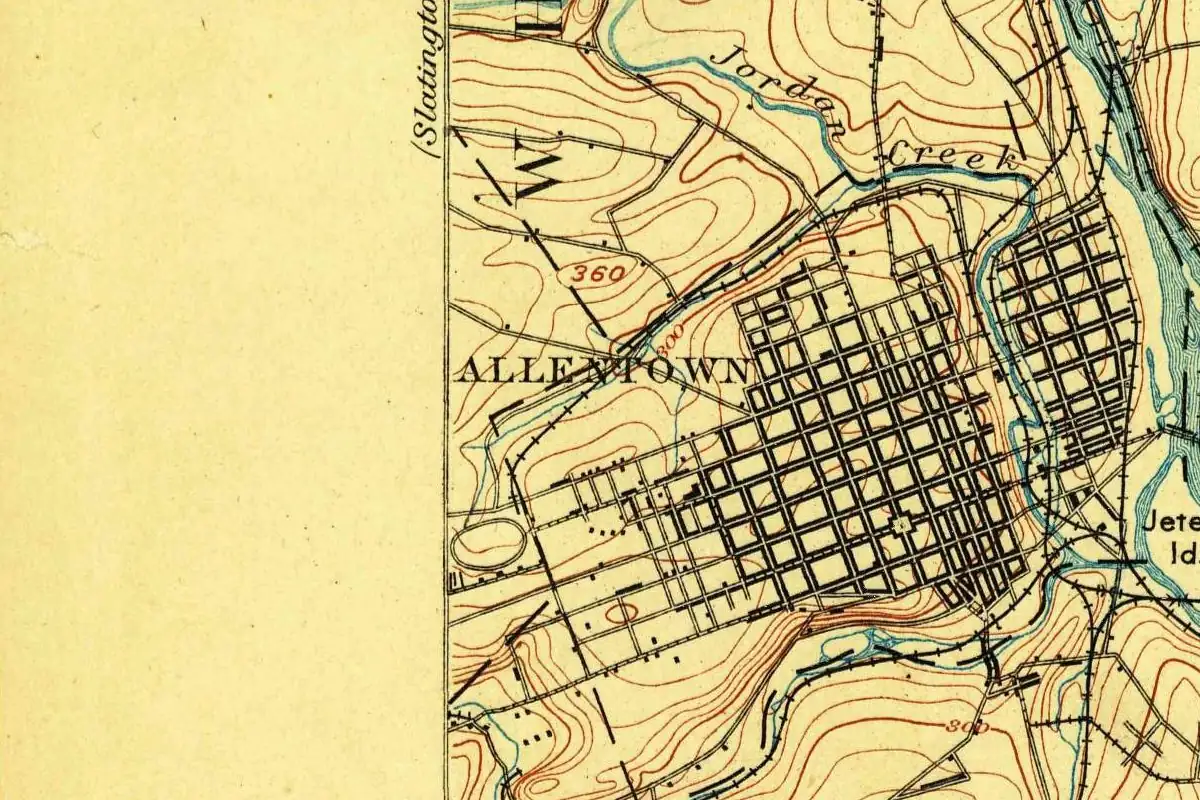
- U.S. Geological Survey, Allentown sheet (1894). The 1:62,500 quadrangle that shows Bethlehem in 1894 and that the old map was cut from.
Spot something wrong, or know more? Tell us here. You can also email us or use our contact page. Corrections are noted here with their date, never made silently.