How Reading, Pennsylvania, Got Its English Name
Reading is named for Reading, the county town of Berkshire, England. Thomas and Richard Penn, the colony's proprietors, had the town laid out on their land in the fall of 1748 and named it after the English town. A Penn agent's 1743 letter already concerned a proposed "Town of Reading." In 1752 it became the seat of Berks County.
A town named before it was built
Reading, Pennsylvania, takes its name from Reading in Berkshire, England, and the Penns planned a “Town of Reading” five years before laying it out. The name came first. The town, it turned out, had to wait for the right piece of land.
The land was the problem. Morton Montgomery’s 1886 history of Berks County explains that the spot where the road from Tulpehocken to Philadelphia crossed the Schuylkill, at the ford, had already been sold. Thomas Lawrence held a patent for 300 acres there from 1733 and added 137½ more in 1739. The city’s own history page says the site was known as Finney’s Ford until 1743.
When the Penn family decided they wanted a town at that crossing, Lawrence wouldn’t sell. So their agent in Philadelphia, William Parsons, was told to look into it. On September 28, 1743, Montgomery writes, Parsons sent them a letter “in reference to the proposed ‘Town of Reading.’” He thought a hollow between Lawrence’s land and the next tract made the spot inconvenient, and recommended that tract, Richard Hockley’s, which ran north along the river.
Water decides the site
So the surveyor Nicholas Scull laid out town lots on Hockley’s land, with Thomas Penn there to see it. Parsons, writing to Penn in November 1746, called the rising ground south of the “Great Hollow” “very elegant.” But there was a catch you couldn’t see on a survey. Water was scarce and deep on Hockley’s land, while on Lawrence’s it was close to the surface and bubbled up in strong springs.
The Penns kept after the Lawrence tract, and Montgomery says the lots laid out next door are what finally got Lawrence to sell. On December 30, 1745, he conveyed his two tracts to Thomas Jenkins, who passed them on four days later to Richard Peters and Richard Hockley, “parties interested in the reconveyance to the proprietaries.” Then, in Montgomery’s words: “During the fall of 1748 a town was laid out on the Lawrence land and named ‘Reading,’ after the county-town of Berkshire, in England.”
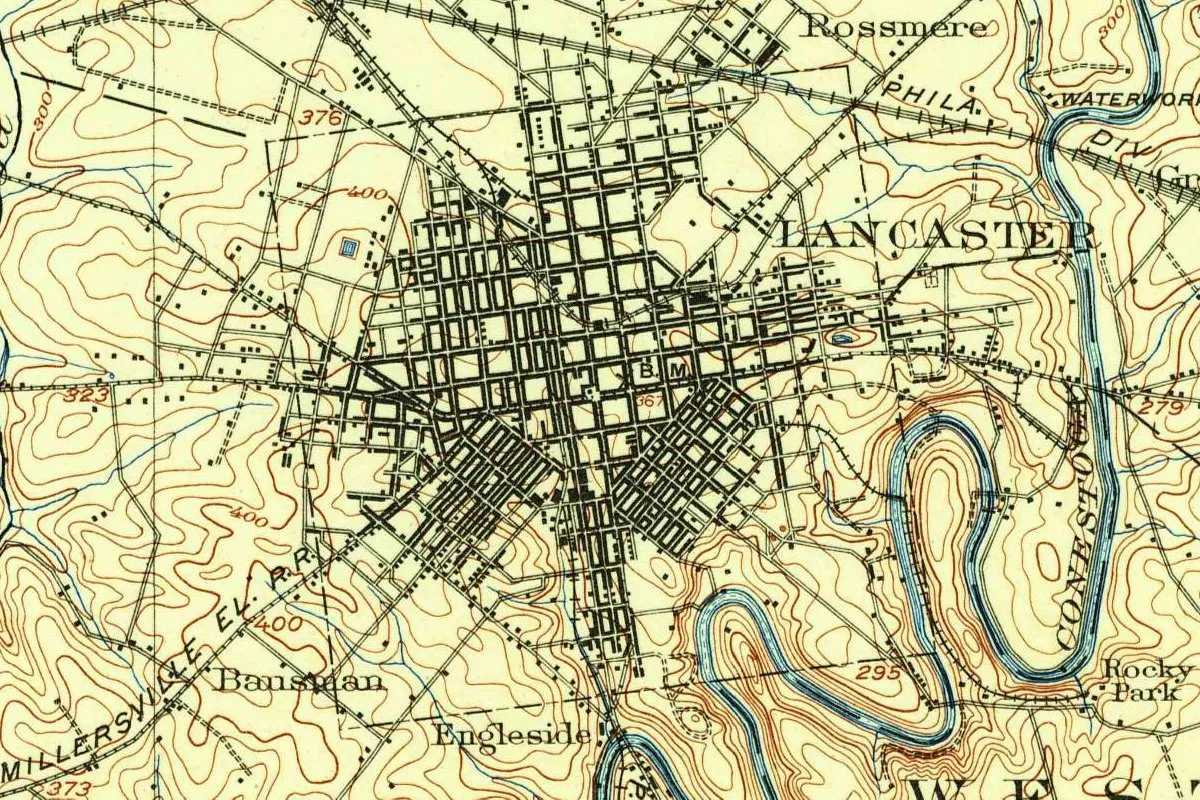
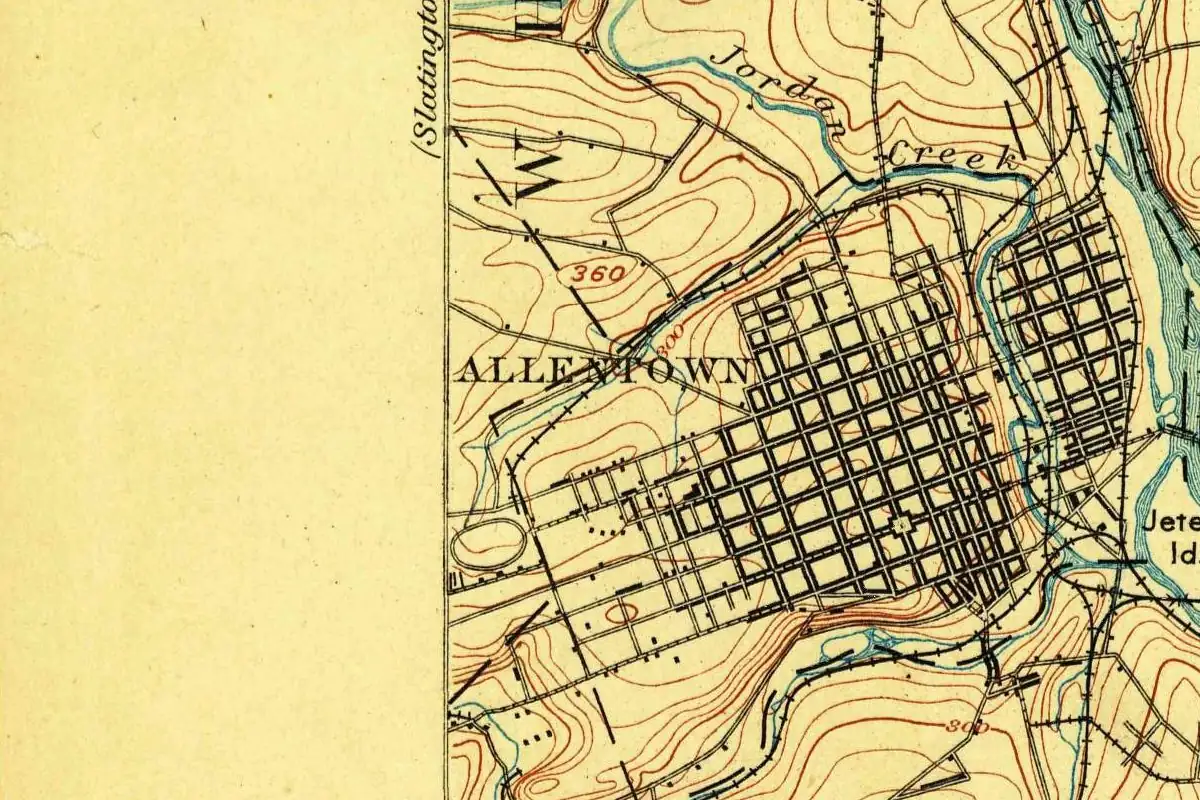
It wasn’t a small plan for an empty spot. Montgomery counts 520 town lots and 204 out-lots, and he says that at the time there wasn’t a town, “not even a village,” anywhere in what’s now Berks County, though about ten thousand people lived in it. Right at the site there was only one house. Montgomery puts the new town at an elevation of about 250 feet (76 m). The closest towns at the time were Lebanon, laid out in 1740 about 28 miles (45 km) to the west, and Lancaster, laid out in 1730, about 30 miles (48 km) to the southwest. Parsons had even suggested borrowing from Lancaster’s town plan, with changes, for Reading’s lots.
The Penns and Berkshire
Pennsylvania Place Names, the book A. Howry Espenshade put out through the Pennsylvania State College in 1925, lays the naming squarely on the family. In the autumn of 1748, he writes, Scull, by then surveyor general, laid out Reading on land that had become the private property of Richard and Thomas Penn, and “the Penns named their new town Reading after the capital of Berkshire.” The city’s history page adds that Thomas and Richard were the sons of William Penn.
Why Berkshire? Espenshade doesn’t spell it out for the town, but he does for the county that followed. When Berks County was created in 1752, it was, in a line he borrowed from an older history, “named from Berkshire in England, where the Penn family held large landed estates.” That year, he says, the Penns made Reading the county seat. It had about 400 people.
So the order runs backward from what you might expect. The town took the name of Berkshire’s chief town first. The county took the name of Berkshire itself four years later.
What the English name means
Espenshade went one step further back, to the English Reading. Its Anglo-Saxon name, Readingas, was in his reading a plural clan name meaning “the descendants of the Red.” That’s his explanation of the old English town’s name, not something anyone in 1748 said about the new one, and it’s the only source here that offers it.
He was more cautious about Berkshire. Its original meaning, he wrote, “is extremely doubtful.” The oldest guess he knew came from a 13th-century abbot, who said the shire was named for a “bare oak” in Windsor Forest where its assembly met. Espenshade wasn’t convinced, and he didn’t think much more of the modern guesses either.
The rest of the family tree
The Penns sold lots fast. On June 15, 1749, the conditions of sale were read out to a crowd, with Conrad Weiser, Francis Parvin and William Hartley as the commissioners. Montgomery thinks the reading happened in Penn Square, though he hedges it with “doubtless.”
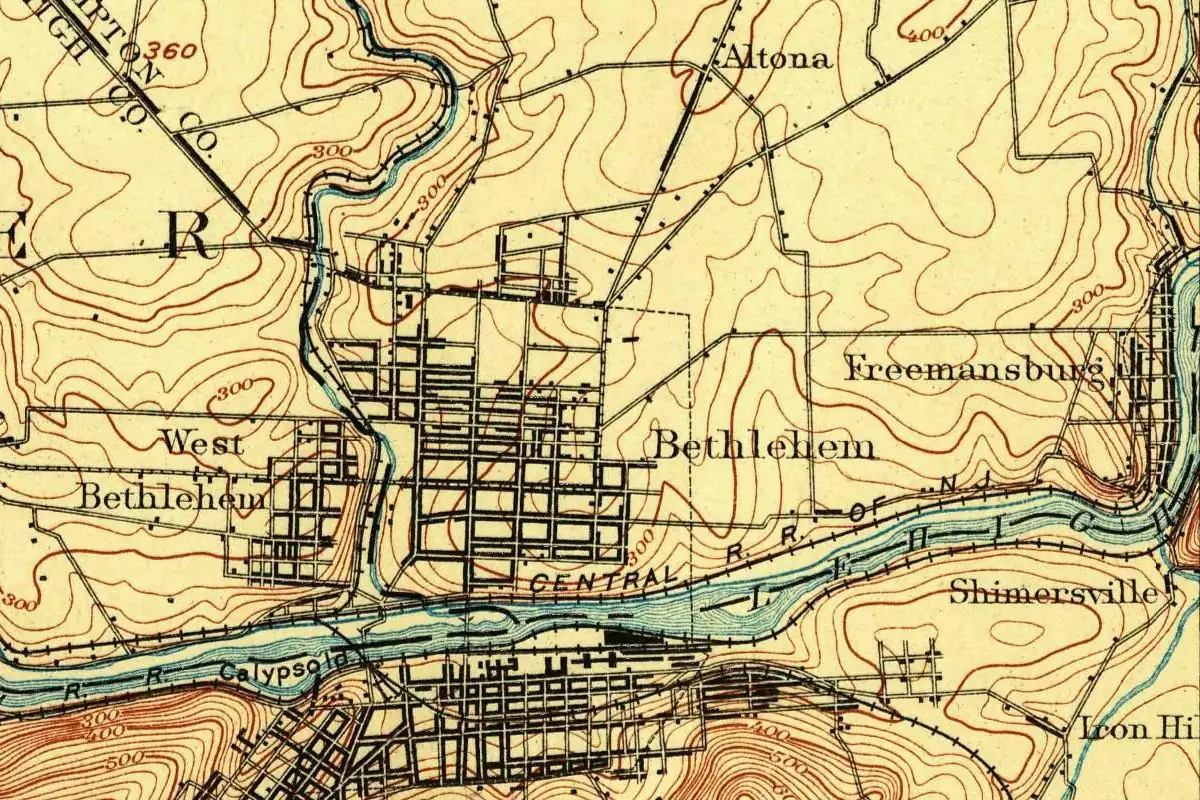
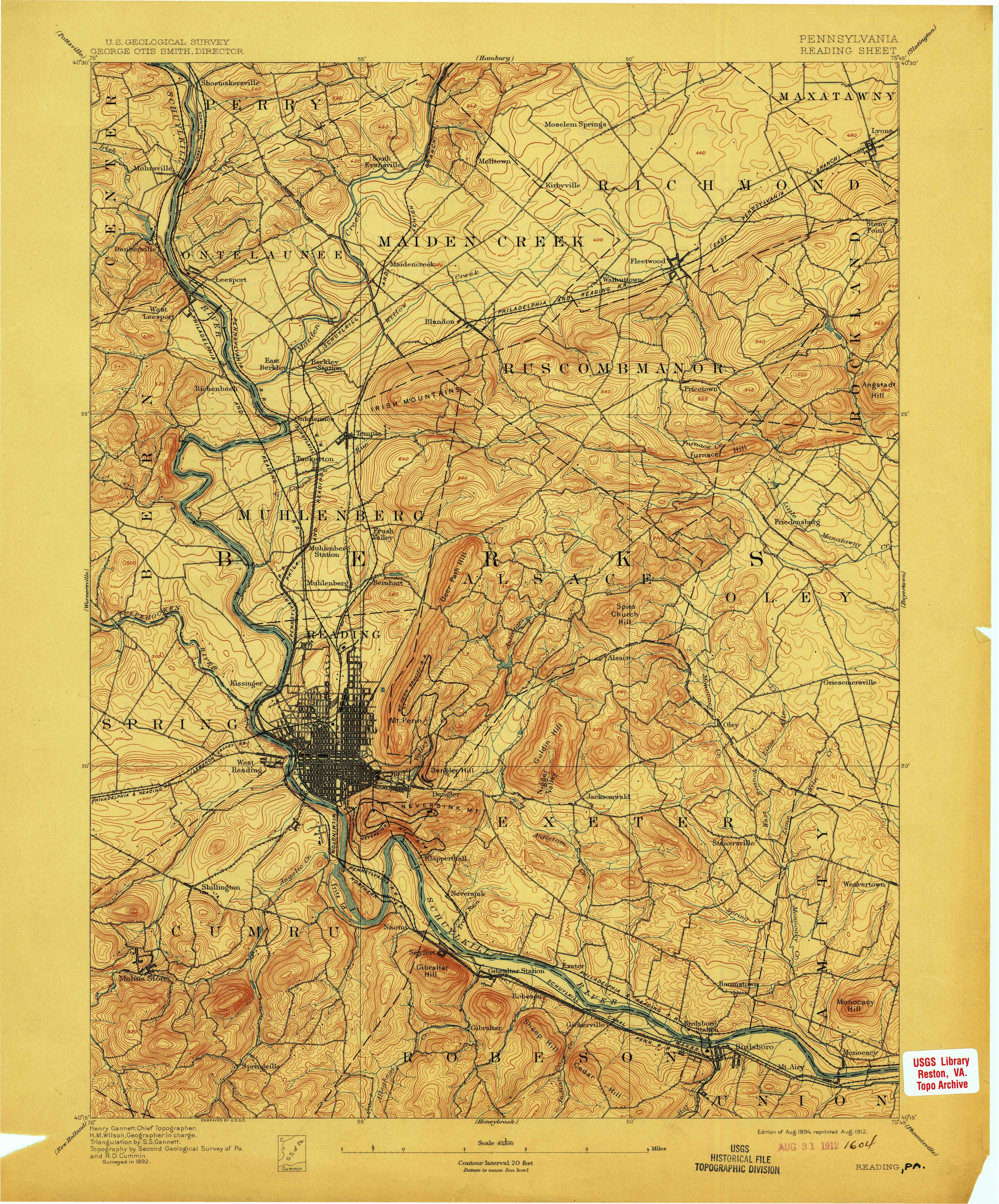
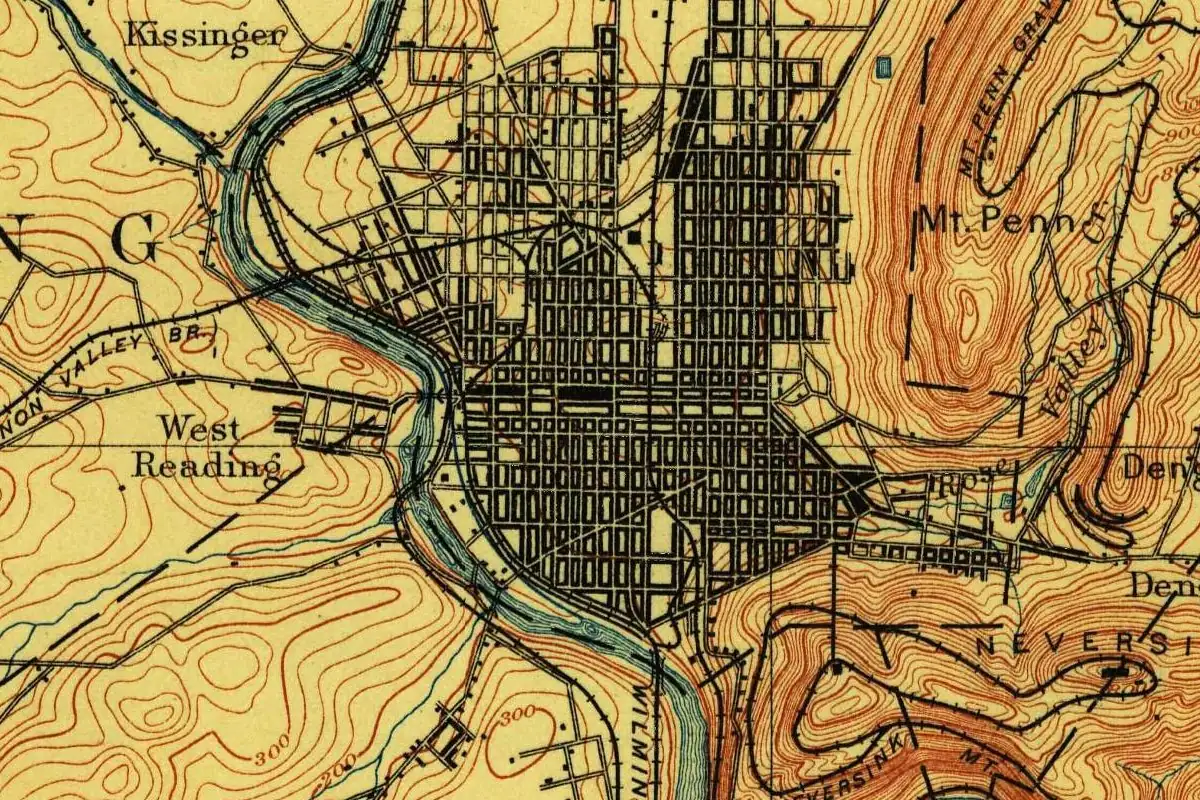
Henry Gannett, assembling place-name origins for the Geological Survey in 1905, put Reading in the same line as Reading, Massachusetts: both “named from the town in Berkshire, England.” And the name kept spreading. On the 1894 map at the top of this page you’ll find West Reading across the Schuylkill. Espenshade says it was laid out in 1873 and named for the county seat, which makes it a namesake of a namesake.
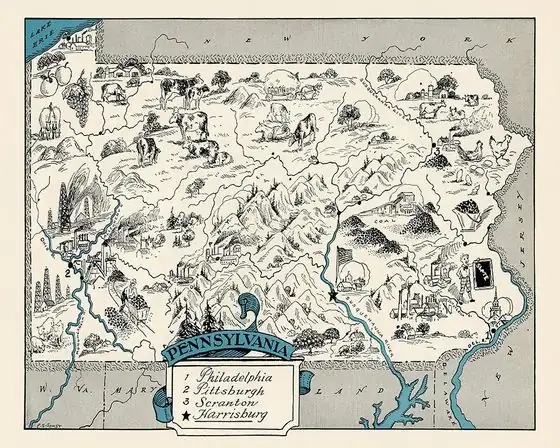
For the rest of the state’s name stories, including the Penns’ own city of Philadelphia, visit our Pennsylvania page.
Quick answers
Is Reading, PA, named after Reading, England?
Yes. Montgomery and Espenshade both say the town was named after the county town, or capital, of Berkshire, England. Gannett agrees.
Who named Reading, Pennsylvania?
The Penns. Espenshade writes that “the Penns named their new town Reading,” and the city names Thomas and Richard Penn, sons of William Penn.
When was Reading, PA, founded?
The town was laid out in the fall of 1748. The name shows up earlier, in Montgomery’s account of a 1743 letter about the proposed “Town of Reading.”
Why is it called Berks County?
Because it’s named for Berkshire, England, where the Penn family held large estates, according to the history Espenshade quotes. The county was created in 1752, four years after the town.
Key dates
- 1733Thomas Lawrence gets a patent for 300 acres at the ford on the Schuylkill, part of the future town site.
- 1743September 28: Penn agent William Parsons writes about the proposed "Town of Reading."
- 1748Fall: A town is laid out for the Penns on the Lawrence land and named Reading, after the county town of Berkshire.
- 1749June 15: The conditions for selling town lots are read out to a crowd.
- 1752Berks County is created, and Reading, with about 400 people, becomes its county seat.

Things to do in Reading, Pennsylvania
Reading Public Museum
A museum that grew out of a Reading High School teacher's classroom collection, opened in 1907, and now holds more than 300,000 objects of art, antiquities, science and world cultures.
Reading Public Museum Arboretum
A 25-acre arboretum around the museum, with many trees from the original planting of the late 1920s and paths and footbridges along Wyomissing Creek.
Berks History Center
Founded in 1869, it's a museum and research library, the Henry Janssen Library, devoted to the history and people of Berks County.
GoggleWorks Center for the Arts
A nonprofit arts campus in a former goggle factory in downtown Reading, opened in 2005, with dozens of on-site studio artists, galleries, a film theater and classes.
Getting there
Open Reading in Google Maps
Opens in a new tab. The pin is the center of Reading in the USGS place-name record.
The closest airports, Amtrak stations and intercity bus stops, measured in a straight line from the center of Reading.
Airports
- Lancaster (LNS) Lititz 24 mi 39 km
- Lehigh Valley International (ABE) Allentown 34 mi 54 km
- Philadelphia International (PHL) 48 mi 78 km
Amtrak trains
- Coatesville station (COT) 25 mi 40 km
- Downingtown station (DOW) 26 mi 41 km
Intercity buses
- OurBus Reading, PA (Downtown Reading- Bus Shelter 2 at 5th Street & Penn Street. Overnight paid parking is available 1 block away at 5th and Cherry.) under 1 mi 0.1 km
- FlixBus Reading BARTA Transportation Center under 1 mi 0.3 km
- Fullington Trailways Quakertown 27 mi 44 km
Distances are as the crow flies, not by road. We don't list schedules or fares because they change; check with the airline, Amtrak or the bus company before you go. Official data (FAA commercial service airports (2025), FAA airport locations, Amtrak stations and Intercity Bus Atlas) from the FAA and the U.S. Bureau of Transportation Statistics, checked Nov 14, 2026.
Sponsored
Staying in Reading?
Compare hotels in Reading, Pennsylvania, on Expedia.
See hotels in ReadingWe may earn a commission if you buy through this link. It never changes what we write. Read our affiliate disclosure
Historical Sources & References
- Morton L. Montgomery, History of Berks County in Pennsylvania (1886), pp. 651-652. Thomas Lawrence’s patents of 1733 and 1739; Parsons’s letter of September 28, 1743, on the proposed “Town of Reading”; Scull’s survey of the Hockley land and the November 1746 letter; the water problem; the quoted naming in the fall of 1748; 520 town lots and 204 out-lots; Lebanon and Lancaster; the sale conditions of June 15, 1749. Page 652 is the next page.
- A. Howry Espenshade, Pennsylvania Place Names (1925), pp. 46-47. Scull’s layout of Reading in the autumn of 1748 on Penn land; “the Penns named their new town Reading after the capital of Berkshire”; Berks County “named from Berkshire in England, where the Penn family held large landed estates”; county seat in 1752 with about 400 people; Readingas; West Reading.
- City of Reading, “Reading’s History”. Finney’s Ford; the town laid out in 1748 by Thomas and Richard Penn, sons of William Penn; the name taken from Reading in Berkshire; county seat in 1752.
- Henry Gannett, The Origin of Certain Place Names in the United States, 2nd ed. (1905), p. 259. Reading, Massachusetts, and the city in Berks County, “named from the town in Berkshire, England.”
- GNIS feature 1184733 (U.S. Geological Survey). Reading’s official listing in the U.S. place-name system, in Berks County.
- U.S. Geological Survey, Reading sheet (1894, reprinted 1912). The 1:62,500 quadrangle, surveyed in 1892, that the map at the top of this page was cropped from.
Sponsored
Put this 1894 map on your wall
The 1894 USGS Reading sheet, in a 1912 reprint, is in the public domain. Download the full-size scan for free, then have it printed on canvas with CanvasOnTheCheap.
Print a map on canvasDownload the full-size mapWe may earn a commission if you buy through this link. It never changes what we write. Read our affiliate disclosure
Spot something wrong, or know more? Tell us here. You can also email us or use our contact page. Corrections are noted here with their date, never made silently.