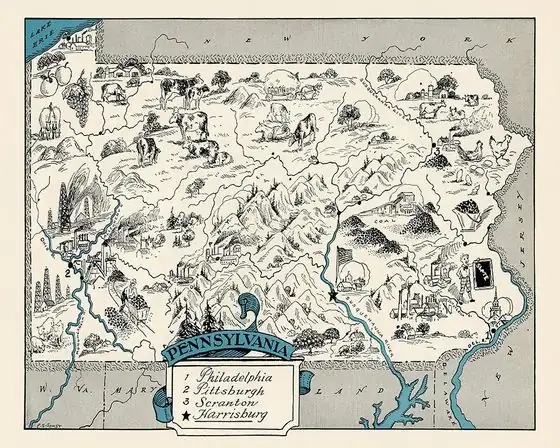
How Lancaster, Pennsylvania, Got Its Name From Lancashire
John Wright, who came to Pennsylvania from Lancashire, England, named Lancaster County after his home county when it was split off from Chester County in 1729, according to a letter from his grandson. The new county seat formally took the same name on May 1, 1730, when the governor approved "the townstead of Lancaster."
A county named from home
John Wright, a settler from Lancashire, England, gave Lancaster County its name in 1729, and the county seat formally took that name on May 1, 1730. So the city’s name came in two steps, first the county and then the town, and both point back to the same English county.
Wright wasn’t a random choice to do the naming. A. Howry Espenshade’s Pennsylvania Place Names, published in 1925, says he had come from Chester to the Susquehanna in 1726 and set up Wright’s Ferry, where Columbia now stands. He was “undoubtedly the leading spirit” behind the new county, Espenshade writes, a justice of the peace for twenty years and a longtime member of the provincial Assembly. “Through his influence it was called Lancaster County from his native shire of Lancaster.”
The grandson’s letter
Espenshade got that from an older book, and you can still read the source he cited. I. Daniel Rupp’s History of Lancaster County, printed in 1844, has a footnote that starts “Lancaster county was named by John Wright” and then quotes a letter from Wright’s grandson:
“When Lancaster county was laid off from Chester, my grand father, says William Wright of Columbia, in a letter to George Ford, Esq., gave it, its name, after the county he came from in England.”
Rupp adds that Wright “came from Lancashire, England, in 1714, and settled in Chester,” and moved to the Susquehanna in 1726. It’s family testimony, written down long after the fact, but it’s specific: a name, a relationship and a letter.
Henry Gannett’s 1905 list of American place names for the Geological Survey said the same thing more broadly. It lists the Lancaster counties of Nebraska, Pennsylvania, South Carolina and Virginia, plus 22 cities, towns and villages, and says “the name is transferred from the county in England.”
If you want the county’s birthday, it’s May 10, 1729. Espenshade and John Loose, writing for Pennsylvania Heritage, both give that date; Loose adds that on May 19 Governor Gordon proclaimed that the new county was organized and that its name was Lancaster.
A tavern, a hickory tree and a townstead
The county needed a seat, and there was a fight over where it would go. Espenshade names three contenders: Postlethwait’s, Wright’s Ferry, and the Indian Field or “Gibson’s Pasture,” where the city stands now. The sheriff, a neighbor of Wright’s, was so sure the ferry would win that he’d already built a wooden jail near his house. He was wrong. Gibson’s Pasture got it, and Espenshade says the only building there at the time was “a log tavern, with the sign of a hickory-tree, kept by George Gibson.”
That hickory tree is where the town’s best-known older name comes in. Rupp passes along a tradition that an Indian council met under a hickory tree on the site, that “the town was called Hickory Town, before Lancaster was laid out,” and that Gibson had a hickory painted on his tavern sign around 1722. Rupp labels it tradition, so you should treat Hickory Town as a remembered name rather than an official one.
On May 1, 1730, the governor signed the document approving the site, “designating the place as ‘the townstead of Lancaster.’” Espenshade’s line is: “Thus the county-seat formally received its name, which was taken from the county town of Lancashire in England.” He adds that the Anglo-Saxon form was Luneceaster, “the castra, or camp, on the Lune.”
When was the town laid out?
Here the sources split. Espenshade says James Hamilton laid out the town in March 1730 on a tract two miles square, about 3.2 km on a side, and didn’t sell any lots until 1735. A footnote in Rupp, citing an author named Gordon, says Hamilton laid it out in 1728. Either way, the name Lancaster is on record by the spring of 1730.
The name travels
The new town sat on the main road west from Philadelphia, and it mattered more than its size suggested. Espenshade says that in September 1777, when General Howe occupied Philadelphia, the state government moved to Lancaster for a while.
The name kept moving, too. Gannett’s 1905 bulletin says Lancaster, Kentucky, was “named from and laid out after the plan of Lancaster, Pennsylvania,” and that Lancaster, California was named from the Pennsylvania city, though the California town’s own story is messier than that. Back in Pennsylvania, the city still carries the name John Wright brought over from home.
Quick answers
Who named Lancaster, Pennsylvania?
John Wright named Lancaster County, according to his grandson’s letter quoted in Rupp’s 1844 history. The town took the county’s name when the governor approved “the townstead of Lancaster” on May 1, 1730.
Is Lancaster, Pennsylvania, named after Lancaster, England?
Yes, by way of Lancashire. Wright named the county for his home shire, and Espenshade says the town’s name was taken from Lancaster, the county town of Lancashire.
Was Lancaster once called Hickory Town?
By tradition. Rupp’s 1844 history says the town “was called Hickory Town, before Lancaster was laid out,” but presents it as tradition, not as a recorded name.
Key dates
- 1714John Wright comes to Pennsylvania from Lancashire, England, and settles in Chester, according to Rupp.
- 1726Wright moves to the Susquehanna, where he sets up Wright's Ferry at what is now Columbia.
- 1729May 10: Lancaster County is established. On May 19, Governor Gordon proclaims the new county and its name, Pennsylvania Heritage says.
- 1730James Hamilton lays out the town in March, per Espenshade. On May 1 the governor approves the site as "the townstead of Lancaster."
- 1735Hamilton sells his first town lots, five years after laying out the town, according to Espenshade.
- 1777September: with General Howe occupying Philadelphia, the state government moves to Lancaster for a time.
Getting there
Open Lancaster in Google Maps
Opens in a new tab. The pin is the center of Lancaster in the USGS place-name record.
The closest airports, Amtrak stations and intercity bus stops, measured in a straight line from the center of Lancaster.
Airports
- Lancaster (LNS) Lititz 6 mi 9 km
- Harrisburg International (MDT) 26 mi 43 km
- Philadelphia International (PHL) 58 mi 93 km
Amtrak trains
- Lancaster station (LNC) 1 mi 2 km
- Mount Joy station (MJY) 12 mi 19 km
Intercity buses
- OurBus Lancaster, PA (Downtown Lancaster In front of Holiday Inn on Chestnut Street, across from Queen Street Garage) under 1 mi 0.4 km
- Fullington Trailways York 22 mi 35 km
- Greyhound York Bus Stop 23 mi 37 km
Distances are as the crow flies, not by road. We don't list schedules or fares because they change; check with the airline, Amtrak or the bus company before you go. Official data (FAA commercial service airports (2025), FAA airport locations, Amtrak stations and Intercity Bus Atlas) from the FAA and the U.S. Bureau of Transportation Statistics, checked Nov 13, 2026.
Sponsored
Staying in Lancaster?
Compare hotels in Lancaster, Pennsylvania, on Expedia.
See hotels in LancasterWe may earn a commission if you buy through this link. It never changes what we write. Read our affiliate disclosure
Sponsored
Want the spooky side of Lancaster?
The name has its story above. For the ghost stories, US Ghost Adventures runs walking ghost tours in Lancaster.
See ghost tours in LancasterWe may earn a commission if you book through this link. It never changes what we write. Read our affiliate disclosure
Historical Sources & References
- I. Daniel Rupp, History of Lancaster County (1844), pp. 135, 240, 242-243. The Hickory Town tradition, Gibson’s hickory tavern sign around 1722 and Gordon’s 1728 date for the town’s layout (p. 135); the footnote quoting William Wright’s letter on his grandfather naming the county, and Wright’s arrival from Lancashire in 1714 and move to the Susquehanna in 1726 (p. 240); the governor’s approval of “the townstead of Lancaster” dated May 1, 1730 (pp. 242-243).
- A. Howry Espenshade, Pennsylvania Place Names (1925), pp. 41-43. The county’s creation on May 10, 1729, John Wright’s role and the naming “from his native shire,” the three contenders for the county seat (pp. 41-42); Gibson’s log tavern, Hamilton’s layout in March 1730 and first lot sales in 1735, the “townstead of Lancaster,” Luneceaster and the 1777 move of the state government (p. 43).
- Henry Gannett, The Origin of Certain Place Names in the United States (USGS, 1905), p. 180. The Lancaster counties and towns whose name “is transferred from the county in England,” and the Lancasters of Kentucky and California named from the Pennsylvania city.
- John Loose, “Lancaster County: Diversity of People, Ideas and Economy” (Pennsylvania Heritage). The county’s establishment on May 10, 1729, John Wright naming it for his native shire, and Governor Gordon’s proclamation of May 19.
- GNIS feature 1178842 (U.S. Geological Survey). Lancaster as GNIS lists it, inside Lancaster County.
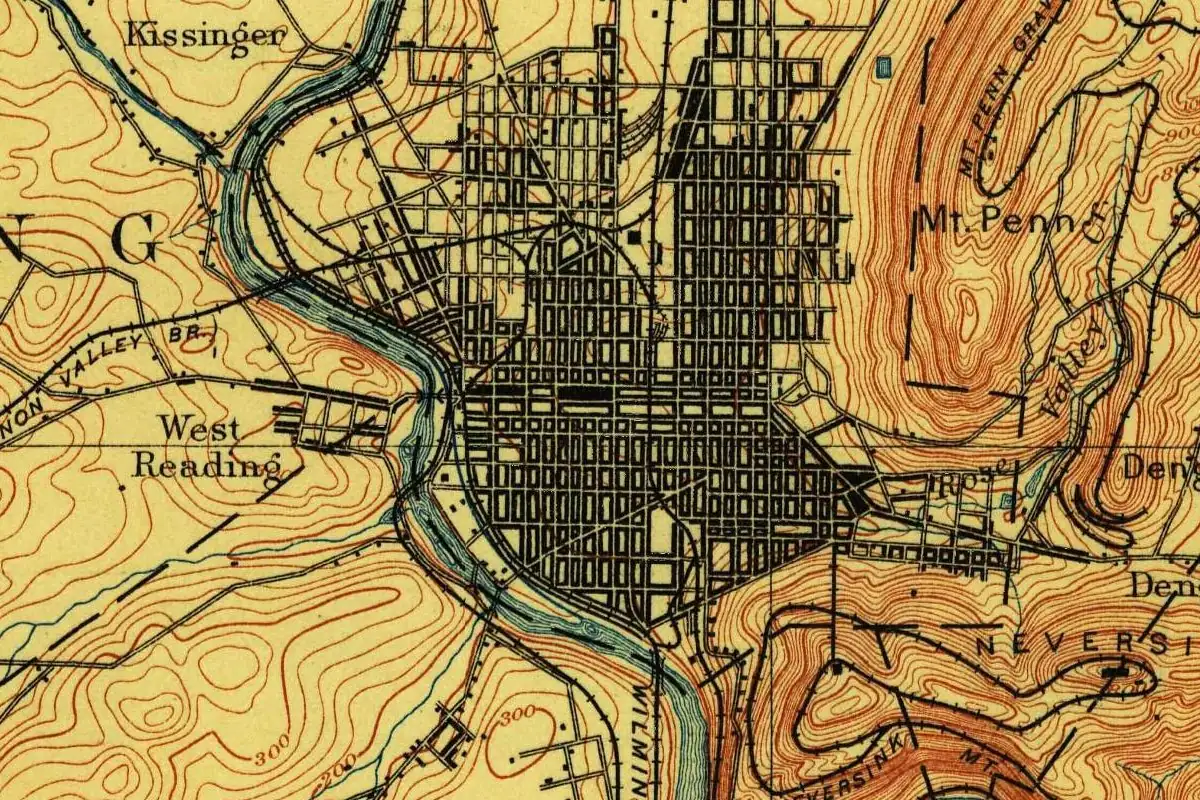
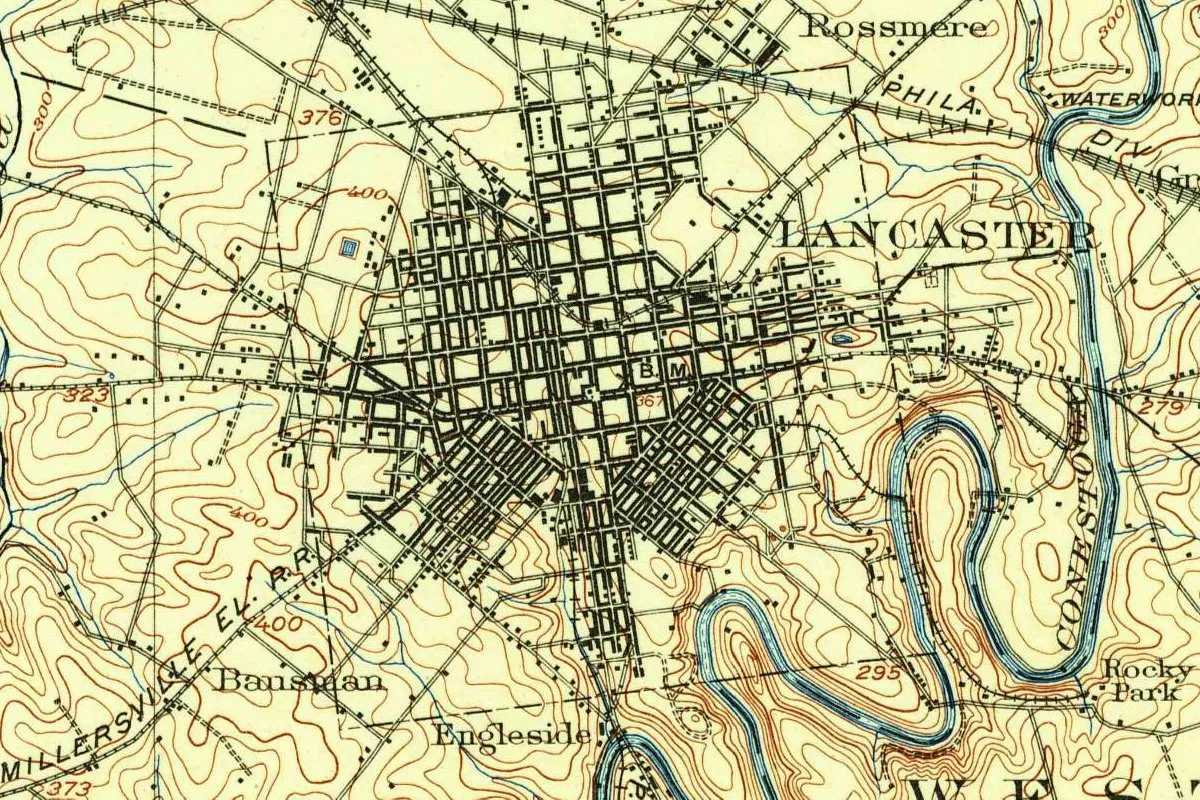
- U.S. Geological Survey, Lancaster sheet (1902). The 1902 Lancaster quadrangle, with the city inside the bends of the Conestoga.
Spot something wrong, or know more? Tell us here. You can also email us or use our contact page. Corrections are noted here with their date, never made silently.