Lancaster, California: A Railroad Name Older Than Its Town
Nobody knows for sure who named Lancaster, California. The name was on the Southern Pacific line by 1879, when a travel guide listed it as a side track. The 1905 USGS bulletin on place-name origins says it came from Lancaster, Pennsylvania, while local histories credit railroad officials, a station clerk or town founder Moses L. Wicks.
A side track in the desert
Lancaster, California, was already in an 1879 railroad guide, five years before Moses L. Wicks, whom one account credits with the name, laid out the town. Where the word came from is less settled: a 1905 federal guide says it was borrowed from Lancaster, Pennsylvania, while local histories also point to the Southern Pacific and one of its clerks.
The railroad came first. The LA County Library’s history of the Antelope Valley says the Southern Pacific laid track through the town’s future location in the summer of 1876, and by September it had finished a line across the valley linking San Francisco and Los Angeles.
H. T. Williams’s guidebook The Pacific Tourist, published in New York in 1879, walked travelers down that line station by station. Here’s what it had to say about this one:
“Between Sand Creek and Lancaster the road begins to ascend… Lancaster, 395 miles, is only a side track.”
That’s the whole entry. It doesn’t mention a town, a hotel or a single settler, just the siding. The name was there before the town was.
Three stories and no paperwork
So who picked it? The LA County Library says plainly that the origin “is unclear, attributed variously to the surname of a railroad station clerk, the moniker given by railroad officials, and the former Pennsylvania home of settlers.” It doesn’t name the clerk, and none of the sources for this page do either.
The City of Lancaster’s own history lays out the competing claims. Many early settlers, it says, held that the railroad named the train stop in 1876. Another account credits Wicks, who supposedly named the town after Lancaster, Pennsylvania, when he laid out the townsite in 1884, “although some history shows his birthplace as Aberdeen, Miss.” The city then points to the same 1879 book and concludes that the Southern Pacific “must be given credit for naming Lancaster.”
You can see why. A man who laid out his town in 1884 can’t easily have named a stop that was already in a New York guidebook in 1879. The railroad story fits the dates; the Wicks story doesn’t.
What the federal guide said in 1905
Henry Gannett’s bulletin on the origin of place names came out from the U.S. Geological Survey in 1902, with an expanded edition in 1905. The first edition has no entry for the California town. The second gives it one line:
“Lancaster; town in Los Angeles County, California, named from the city in Pennsylvania.”
Gannett doesn’t say who did the borrowing, or why. That leaves room for both versions to be partly right: railroad officials could have taken an eastern name for their desert siding. But nothing in these sources shows that happening, so for now the “where” has a printed source and the “who” doesn’t.
Wicks builds the town
Whoever named the siding, Wicks is the man who turned it into a town. The LA County Library says he bought property from the railroad in 1884 for $2.50 an acre, mapped out streets and lots, and by September was advertising 160-acre tracts for $6 an acre. The Lancaster News followed in 1885, the first weekly paper in the Antelope Valley, and by 1890 farmers were planting thousands of acres of wheat and barley.
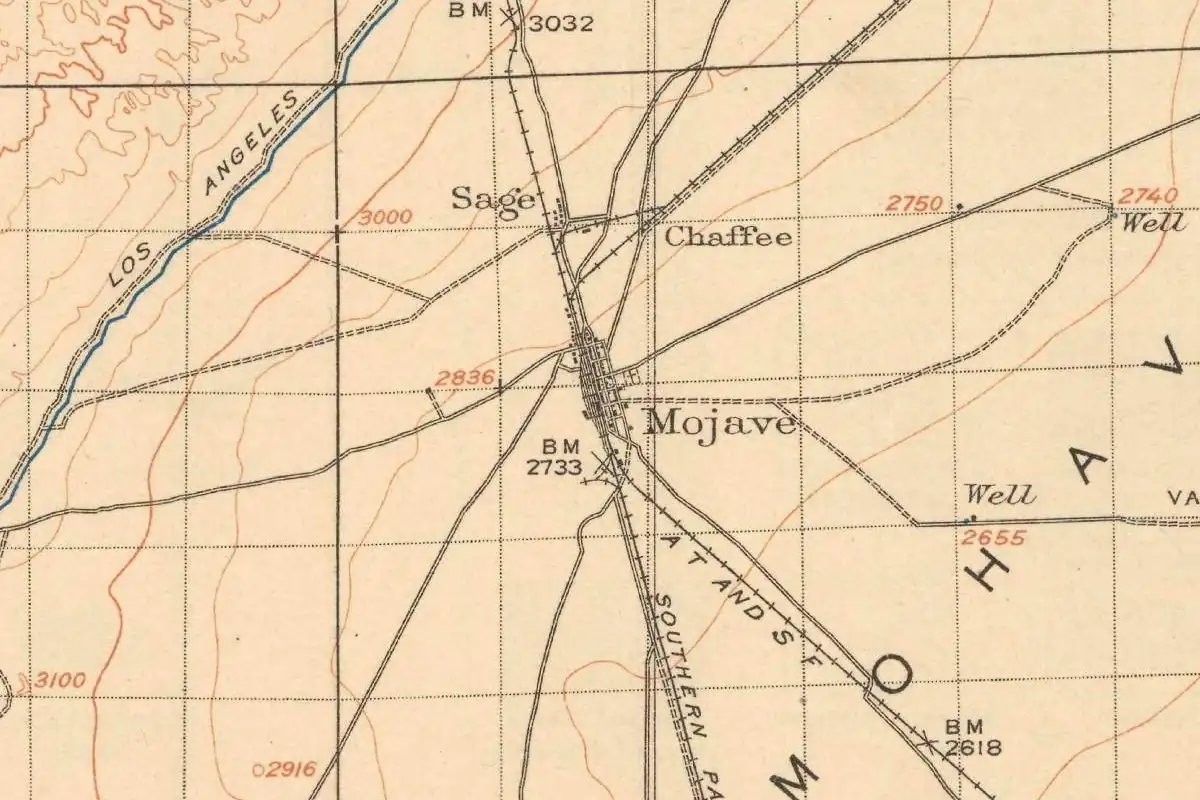
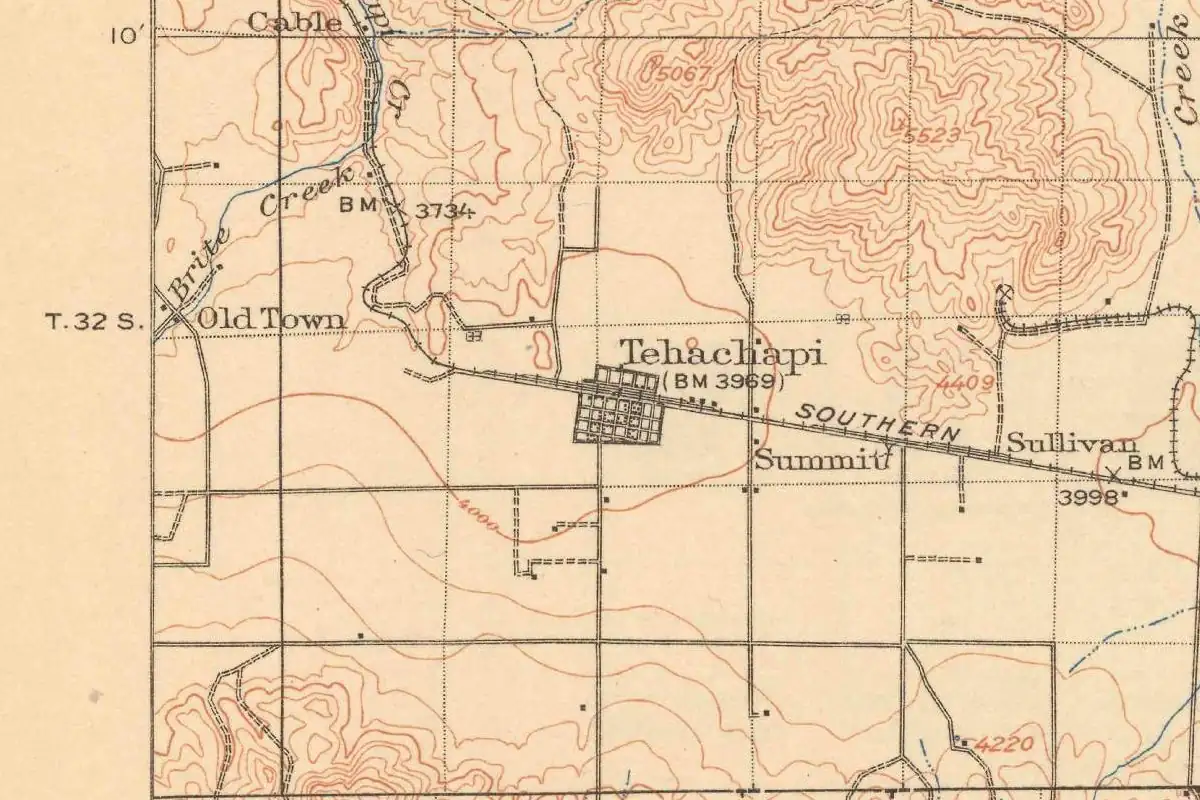
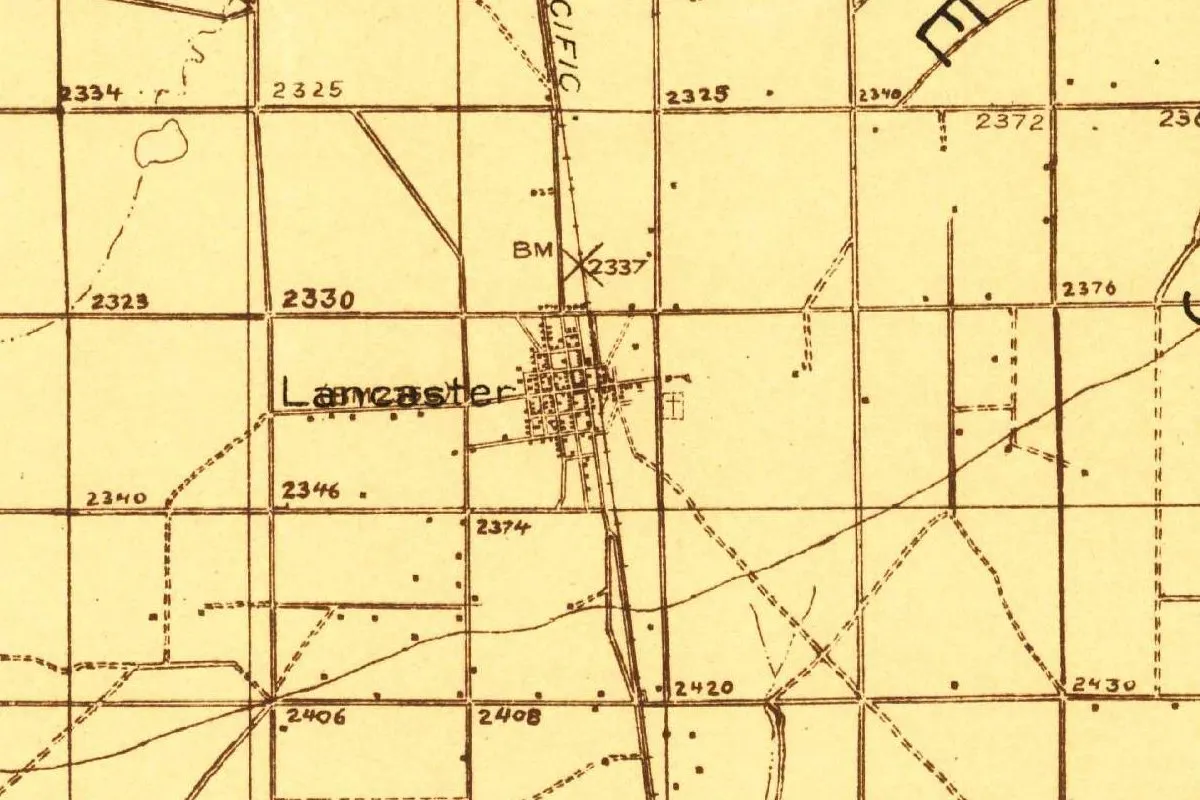
The good years didn’t last. A drought that began in 1894 wrecked the local economy, and Lancaster only became a boom town again when it housed the workers who started building the Los Angeles Aqueduct in 1908. If you look at the 1915 survey map at the top of this page, you’ll see what it had become by then: a small grid of streets hugging the Southern Pacific tracks, in a landscape cut into square-mile sections. In the 1879 guide, Lancaster comes a few stops after Mojave, another town the Southern Pacific put on the map in 1876, as the line heads south.
Lancaster stayed unincorporated, run by Los Angeles County, until 1977, which makes it a young city with an old name. In the story of California town names, it’s a reminder that a railroad siding could carry a name for decades before anyone wrote down where it came from.
Quick answers
Was Lancaster, California, named after Lancaster, Pennsylvania?
Possibly. The 1905 USGS bulletin says it was “named from the city in Pennsylvania,” and the LA County Library lists a Pennsylvania connection as one of three explanations, but no record shows who chose it.
Did Moses Wicks name Lancaster?
Probably not. The name was already in an 1879 travel guide, and Wicks didn’t lay out his townsite until 1884, which is why the City of Lancaster credits the Southern Pacific instead.
When did Lancaster become a city?
In 1977. The railroad came through in 1876 and Wicks laid out the town in 1884, but Lancaster was governed by Los Angeles County until it incorporated.
Key dates
- 1876Summer: the Southern Pacific lays track through the future site of Lancaster; by September the line links San Francisco and Los Angeles.
- 1879H. T. Williams's Pacific Tourist lists Lancaster on the line as "only a side track."
- 1884Moses L. Wicks buys land from the railroad at $2.50 an acre and lays out a town of streets and lots.
- 1885The Lancaster News starts up, the first weekly newspaper in the Antelope Valley.
- 1905The 1905 USGS bulletin on place-name origins says the town was named from the city in Pennsylvania.
- 1977Lancaster incorporates as a city.
Getting there
Open Lancaster in Google Maps
Opens in a new tab. The pin is the center of Lancaster in the USGS place-name record.
The closest airports, Amtrak stations and intercity bus stops, measured in a straight line from the center of Lancaster.
Airports
- Hollywood Burbank (BUR) 37 mi 59 km
- Ontario International (ONT) 54 mi 87 km
Amtrak trains
- Burbank station (BUR) 37 mi 60 km
- Burbank station (BBK) 38 mi 60 km
Intercity buses
- Alvand Transportation Amtrak Connecting Service · Mojave Amtrak Bus Stop 25 mi 40 km
- Gold Runner Mojave - Carl's Jr. 25 mi 40 km
- Amtrak Chartered Vehicle Amtrak Connecting Service · Santa Clarita-Newhall Amtrak Station 31 mi 50 km
Distances are as the crow flies, not by road. We don't list schedules or fares because they change; check with the airline, Amtrak or the bus company before you go. Official data (FAA commercial service airports (2025), FAA airport locations, Amtrak stations and Intercity Bus Atlas) from the FAA and the U.S. Bureau of Transportation Statistics, checked Nov 13, 2026.
Sponsored
Staying in Lancaster?
Compare hotels in Lancaster, California, on Expedia.
See hotels in LancasterWe may earn a commission if you buy through this link. It never changes what we write. Read our affiliate disclosure
Historical Sources & References
- H. T. Williams, The Pacific Tourist (New York, 1879), p. 289. The quoted entry: Lancaster at 395 miles, “only a side track,” with the climb from Sand Creek on the course south from Mojave.
- Henry Gannett, The Origin of Certain Place Names in the United States (USGS, 1905), p. 180. The one-line entry saying the town was “named from the city in Pennsylvania.”
- LA County Library, “Antelope Valley Local History”. The Southern Pacific line of 1876, the three explanations for the name, Wicks’s purchase and town plan of 1884, the Lancaster News in 1885, the 1894 drought, the aqueduct work from 1908 and incorporation in 1977.
- City of Lancaster, “1876-1910: The Beginning”. The settlers’ account that the railroad named the stop, the version crediting Wicks and its doubts about his birthplace, and the city’s reading of the 1879 Pacific Tourist.
- GNIS feature 1652741 (U.S. Geological Survey). Feature record for the Los Angeles County location of Lancaster.
- U.S. Geological Survey, Elizabeth Lake sheet (1915). The source of the map at the top of this page.
Spot something wrong, or know more? Tell us here. You can also email us or use our contact page. Corrections are noted here with their date, never made silently.