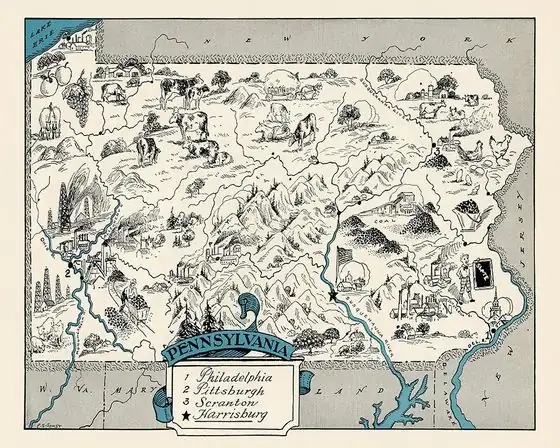
Why Allentown, PA, Was Officially Northampton Until 1838
Allentown is named for William Allen, chief justice of colonial Pennsylvania, who had the town laid out on his land in 1762. He called it Northampton, but people called it Allen's town. The borough was even incorporated as Northampton in 1811, and only an 1838 act of the legislature made Allentown the legal name.
A town with two names
Allentown, Pennsylvania, was laid out in 1762 as Northampton, and it took a state law in 1838 to make its everyday name, Allentown, official. For most of those years the paperwork said one thing and the people said another.
The man behind both names was William Allen. A. Howry Espenshade, who wrote the 1925 book Pennsylvania Place Names for Pennsylvania State College, says Allen served as chief justice of Pennsylvania from 1750 to 1774 and, around 1735, got a grant of 3,000 acres from the Penns. That land included the spot where the city stands now.
Allen was about as well connected as a man could be in colonial Pennsylvania. Espenshade notes he was the son-in-law of Andrew Hamilton, a deputy governor of the province, and that his daughter Anne married John Penn, a grandson of William Penn himself.
His name was already on the map, just not on a town. Espenshade says that in 1748 Allen’s tract became part of the newly organized Allen Township in Northampton County. So there was an Allen Township years before anyone laid out a single street.
Chief Justice Allen’s Northampton
Before the town had a name, it had neighbors asking for a road. In 1762, residents of neighboring Whitehall Township petitioned the county court for a road to “a new Town to be erected on part of a Tract of Land belonging to the Honorable William Allen.” Notice there’s no name in it yet, just Allen’s land.
And when the name came, it wasn’t his. The 1914 History of Lehigh County says it was “laid out in 1762 by direction of Chief Justice William Allen and named Northampton Town.” Espenshade guesses at the reason: the land was in Northampton County, so the name was “doubtless” borrowed from the county.
Allen left his mark in the streets instead. The county history says Hamilton Street was named for Governor James Hamilton, his brother-in-law, and that the main street was called Allen. The plan, it adds, covered 42 blocks and 756 lots.
There’s a catch, though. The City of Allentown’s own planning document, Vision 2030, says that “despite its formal name, from its founding, nearly everyone called it ‘Allen’s town.’” A name on a survey is one thing. What people say on the road is another.
The grandchildren pick a name
Allen died, and the townsite went to his son James, who lived in Philadelphia. According to Espenshade, James Allen left the property to his five children in 1782, and they “changed the name from Northampton to Allentown in honor of their grandfather.”
The new name spread. By 1795, Joseph Scott’s United States Gazetteer had an entry for Allentown, which the county history quotes, calling it “a handsome and flourishing town of Northampton county,” with about 90 houses, two churches, an academy and three mills.
The mail used the new name, too. The county history says people picked up their letters in Bethlehem until 1803, when a post office opened in Allentown in the Compass and Square hotel, with the innkeeper, George Savitz, as postmaster.
The town was also part of a famous hiding job. Vision 2030 says the Liberty Bell was brought there in 1777 and hidden in what’s now Zion’s Reformed United Church of Christ, downtown. You may know that story better than the town’s name.
Incorporated as Northampton anyway
You’d think that settled it. It didn’t. Espenshade says the residents “seemed reluctant to give up the name of Northampton,” maybe because the town hoped to become the county seat. When Allentown did become the seat of the new Lehigh County, he writes, it celebrated by getting incorporated “under its old name of Northampton.”
The county history dates that to March 1811, when Governor Simon Snyder approved the act. It quotes the law itself:
“The town of Northampton shall be and the same is hereby erected into a borough, which shall be called the ‘Borough of Northampton,’…”
So in 1811, the place most people called Allentown became, by law, the Borough of Northampton. The founder’s grandchildren had picked one name, and the legislature wrote down the other.
The 1838 fix
It took 27 more years to line the paperwork up with the street. The county history says the borough’s corporate name “was changed from Northampton to Allentown by authority of Section 20 of an act passed April 16, 1838.” The same act doubled the town council from five members to ten. Vision 2030 gives the same year.
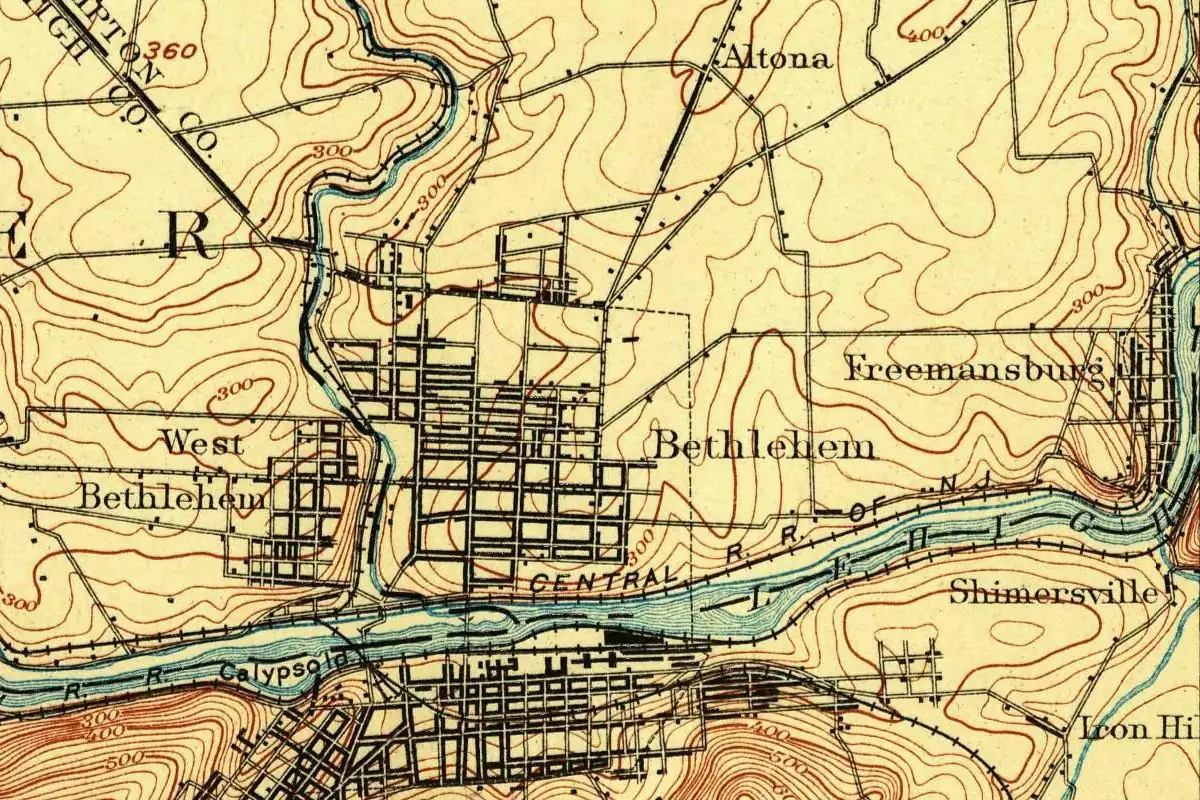
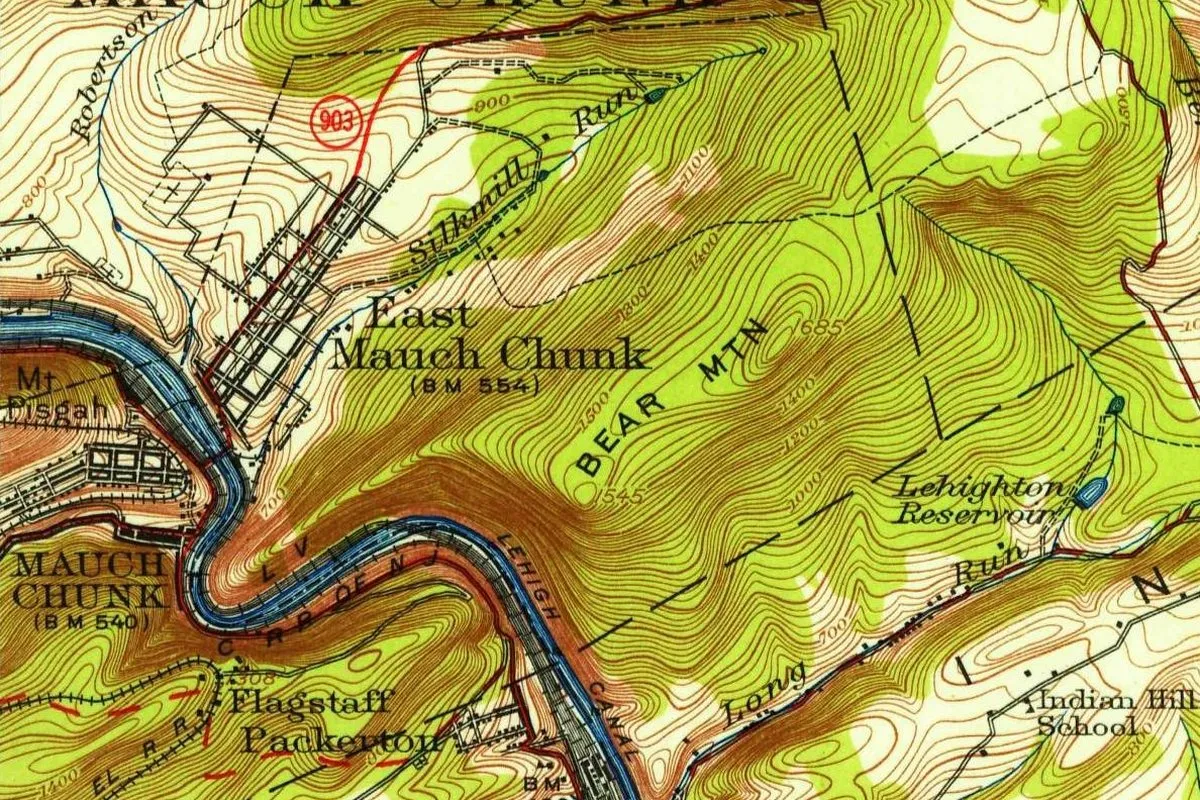
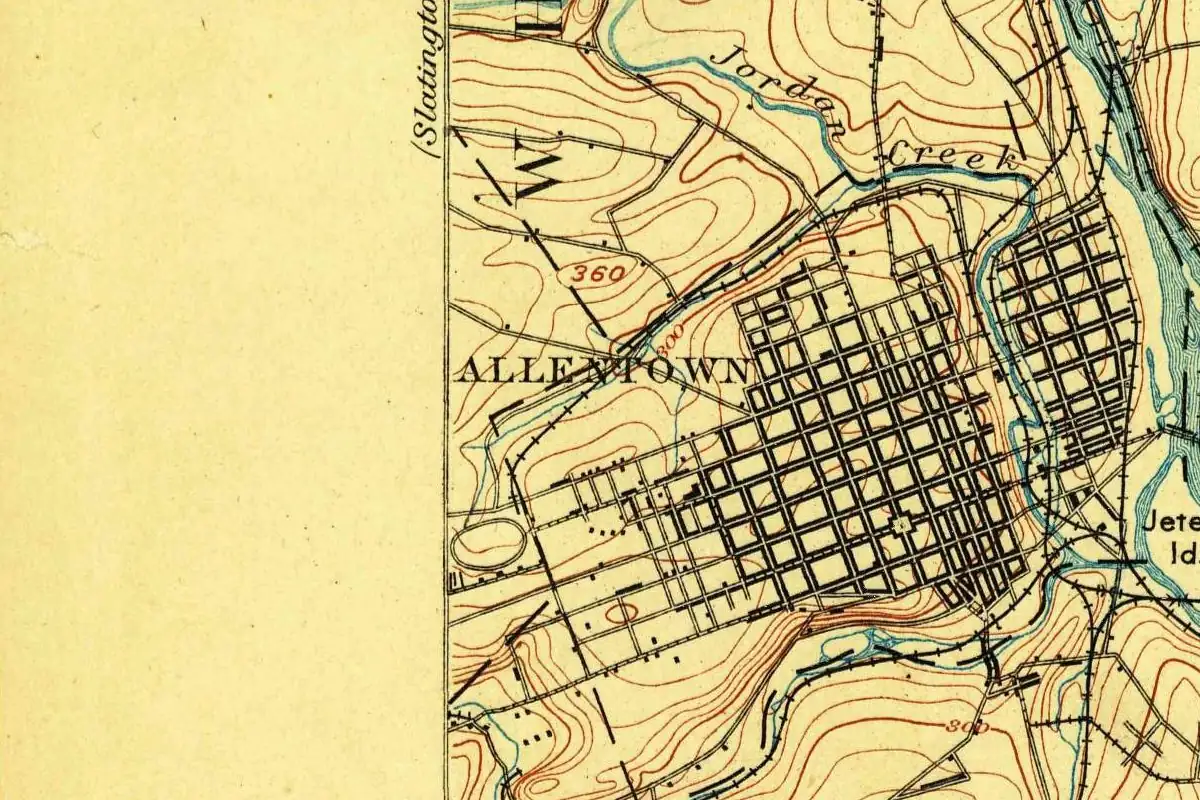
That’s also the year Vision 2030 says the Lehigh Canal opened, giving the town a route for shipping iron, lumber and lime. Follow the Lehigh River upstream and you reach the boroughs that later became Jim Thorpe, another Pennsylvania town that swapped names. Allentown’s industry boomed from there, with the railroad arriving in 1851. By the time the U.S. Geological Survey mapped the area in 1894, the old map at the top of this page shows a big grid of blocks between Jordan Creek and the river, labeled ALLENTOWN in capital letters. No trace of Northampton.
Henry Gannett’s 1905 federal dictionary of place names kept it simple: Allentown is “named for William Allen, of Pennsylvania, at one time chief justice of the province.” He’s right about the man. He just skipped the decades when the name on the paperwork was something else.
If you’re looking for the name Northampton today, you’ll find it on Northampton County, the county Allen borrowed it from in the first place. The town he laid out ended up with the name he never chose for it.
Quick answers
What was Allentown’s original name?
Northampton. Chief Justice William Allen had the town laid out in 1762 as Northampton Town, and the borough was incorporated under that name in 1811.
When did Allentown get its name?
Officially, in 1838. An act passed on April 16, 1838, changed the borough’s name from Northampton to Allentown, though people had called it Allen’s town from the start.
Who is Allentown, Pennsylvania, named after?
William Allen, chief justice of Pennsylvania from 1750 to 1774, who owned the land. Espenshade says his grandchildren chose the name in his honor after 1782.
Key dates
- 1748William Allen's tract becomes part of the newly organized Allen Township in Northampton County.
- 1762Chief Justice William Allen has a town laid out on his land and names it Northampton Town.
- 1777The Liberty Bell is hidden in the town, in the church now known as Zion's Reformed United Church of Christ.
- 1782James Allen leaves the townsite to his five children, who, Espenshade says, rename it Allentown for their grandfather.
- 1795Joseph Scott's United States Gazetteer describes Allentown as a flourishing town of Northampton County.
- 1811The town is incorporated as the Borough of Northampton.
- 1838An act of April 16 changes the borough's corporate name from Northampton to Allentown.
Things to do in Allentown, Pennsylvania
Trout Hall
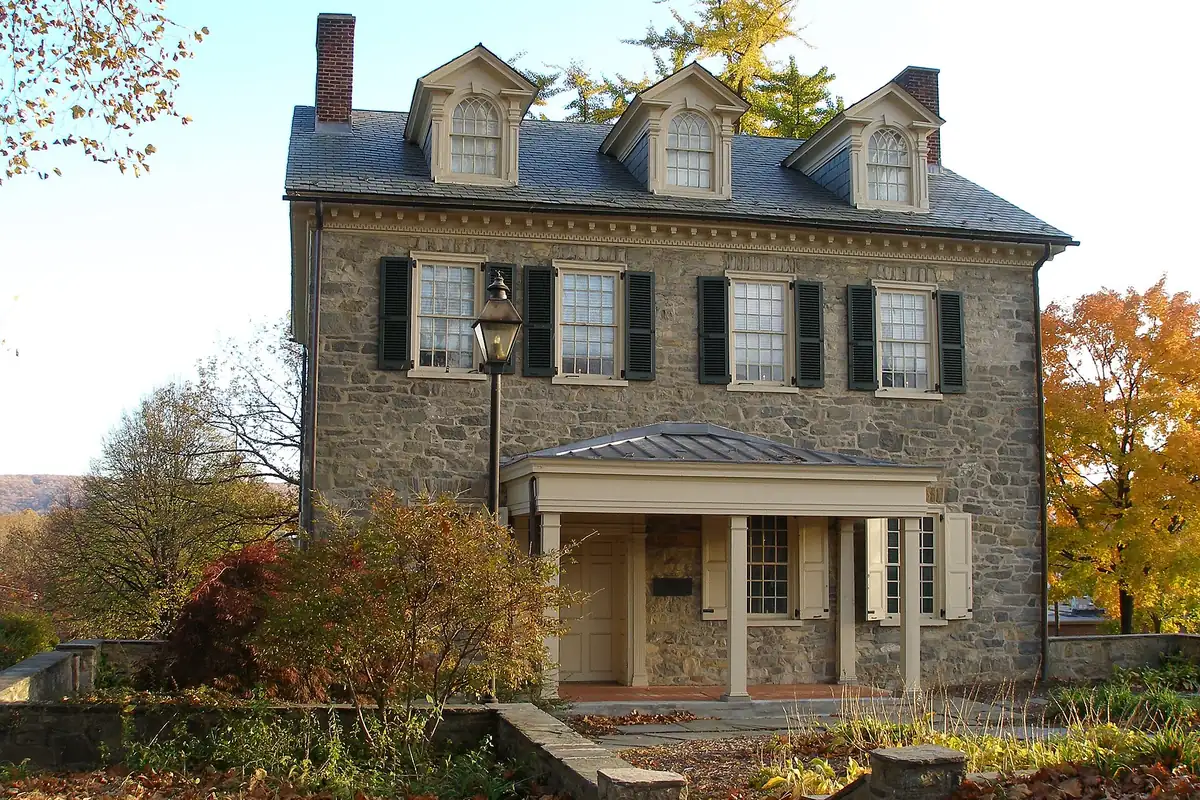
The oldest home in Allentown, built as the summer estate of James Allen, son of the town's founder. The Lehigh County Historical Society runs it as a house museum, listed on the National Register, with guided tours about colonial America.
Lehigh Valley Heritage Museum
Home of the Lehigh County Historical Society, with galleries that run from the Lenni Lenape through industry, immigration and the world wars, plus a research library for genealogists.
Allentown Art Museum
A collection of about 17,000 works, from European Renaissance and Baroque paintings, including a Rembrandt, to American art and a library designed by Frank Lloyd Wright.
America On Wheels Museum
Cars, trucks, motorcycles and bicycles, with two regional stories at the center: the history of Mack Trucks and the early automobile industry and highways in Pennsylvania.
Getting there
Open Allentown in Google Maps
Opens in a new tab. The pin is the center of Allentown in the USGS place-name record.
The closest airports, Amtrak stations and intercity bus stops, measured in a straight line from the center of Allentown.
Airports
- Lehigh Valley International (ABE) Allentown 4 mi 6 km
- Trenton Mercer (TTN) 42 mi 68 km
- Philadelphia International (PHL) 53 mi 85 km
Amtrak trains
- Paoli station (PAO) 39 mi 63 km
- Exton station (EXT) 41 mi 66 km
Intercity buses
- OurBus Allentown - Wescosville, PA (Allentown Transportation Center - Platform C) 1 mi 2 km
- FlixBus Allentown PA (AWN) 1 mi 2 km
- Fullington Trailways Allentown 1 mi 2 km
Distances are as the crow flies, not by road. We don't list schedules or fares because they change; check with the airline, Amtrak or the bus company before you go. Official data (FAA commercial service airports (2025), FAA airport locations, Amtrak stations and Intercity Bus Atlas) from the FAA and the U.S. Bureau of Transportation Statistics, checked Nov 13, 2026.
Sponsored
Staying in Allentown?
Compare hotels in Allentown, Pennsylvania, on Expedia.
See hotels in AllentownWe may earn a commission if you buy through this link. It never changes what we write. Read our affiliate disclosure
Historical Sources & References
- A. Howry Espenshade, Pennsylvania Place Names (1925), pp. 132-133. William Allen’s term as chief justice, his land grant of about 1735 and his ties to the Hamilton and Penn families; Allen Township, organized in 1748; the town laid out as Northampton, “doubtless because it was in Northampton County”; the 1762 reference to “the new town of Northampton”; the grandchildren’s change to Allentown after 1782; the residents’ reluctance; incorporation as Northampton; the 1838 act.
- Charles R. Roberts and others, History of Lehigh County, Pennsylvania, vol. 1 (1914). The 1762 Whitehall Township petition for a road to Allen’s new town (p. 387); the town “named Northampton Town” in 1762, its 42 blocks and 756 lots, and Hamilton and Allen streets (pp. 389-390); Joseph Scott’s 1795 gazetteer entry and the 1803 post office (pp. 415-416); the 1811 act creating the “Borough of Northampton” (p. 416); the April 16, 1838, act changing the name to Allentown (p. 418).
- City of Allentown, Allentown Vision 2030, “Historical Narrative” (2019). “Nearly everyone called it ‘Allen’s town’”; the Liberty Bell hidden there in 1777; the Lehigh Canal and the official name, both in 1838; the railroad in 1851.
- Henry Gannett, The Origin of Certain Place Names in the United States (USGS, 1905), p. 21. Allentown “named for William Allen, of Pennsylvania, at one time chief justice of the province.”
- GNIS feature 1213700 (U.S. Geological Survey). Feature 1213700 in the USGS’s Geographic Names Information System, the Lehigh County city (not the Pittsburgh neighborhood with the same name).
- U.S. Geological Survey, Allentown sheet (1894). The 1:62,500 map the 1894 view of Allentown comes from.
Spot something wrong, or know more? Tell us here. You can also email us or use our contact page. Corrections are noted here with their date, never made silently.