New Hope, Pennsylvania: Named for Mills Rebuilt After a Fire
New Hope took its name from Benjamin Parry's mills. After fire destroyed his mills around 1790, Parry rebuilt them and called them the New Hope Mills, and the name spread to the village, then known as Coryell's Ferry. Sources differ on the year of the fire, 1790 or 1791, and on which mill burned.
New Hope, Pennsylvania, was a ferry crossing called Coryell’s Ferry until a fire burned Benjamin Parry’s mills and he rebuilt them as the New Hope Mills. The new name was meant for the mills. Within a decade, it belonged to the whole village, and the ferry name was on its way out.
Wells’ Ferry, then Coryell’s Ferry
The town grew up around a crossing of the Delaware. The borough’s 1984 nomination to the National Register of Historic Places says John Wells got the right to run a ferry here in 1719 by an act of the Pennsylvania Assembly. Emanuel Coryell was licensed in 1733 to run one from the New Jersey side, the nomination says, and eventually took over Wells’s operation, so the settlements on both banks came to be known as Coryell’s Ferry.
W. W. H. Davis’s History of Bucks County, published in 1876, tells it a little differently. “Down to near 1770,” he wrote, “it was known as Wells’ ferry, after John Wells, who kept the ferry on this side, but the name was afterward changed to Coryell’s ferry, after George Coryell, who kept the ferry on the New Jersey side.” The New Hope Chamber of Commerce gives a third version: Robert Heath held the first ferry license in 1722, and the Coryell family bought the business in 1748.
Whichever Coryell you follow, the crossing carried his family’s name for much of the 18th century. Farther down the Delaware, across from Philadelphia, Camden, New Jersey, was known as Cooper’s Ferry after its own ferry family.
The crossing in the Revolution
The Chamber of Commerce says Washington gathered his army along the Pennsylvania bank in December 1776, from Trenton up to Coryell’s Ferry, before crossing back into New Jersey on the night of December 25. It also says Washington is documented crossing at Coryell’s Ferry itself in the summer of 1777, moving troops north. The inn by the ferry, now the Logan Inn, traces back to 1727, by the Chamber’s account.
The fire and the New Hope Mills
Benjamin Parry is the man who renamed the town. The New Hope Historical Society says his house, now the Parry Mansion, was completed around 1784, about the time he started several mills on the river. By 1790, according to the National Register nomination, Parry ran three: one at Hopewell, New Jersey, called the Hope Mills; one at Titusville, New Jersey, called the Prime Hope Mills; and one at Coryell’s Ferry.
Then came the fire. Here’s how the nomination tells it: “In 1791 his Coryell’s Ferry grist and oil mill were burned. Parry rebuilt his mill and as a reference to the fire and the disaster of the loss of his mills, he titled the new mills ‘New Hope Mills’, and also gave this name to the settlement along the river.” It sums it up plainly: “It was Parry who gave the village of New Hope its name.”
The historical society and the Chamber both date the fire to 1790. The society says it was “another of Parry’s mills, Hope Mill,” that burned and “was rebuilt as the New Hope Mill, lending itself to the name of the community.” The Chamber says that in May 1790 “a fire destroyed every one of them,” and that Parry finished the new mills the next year and “christened them with the name New Hope.” The Bucks County Playhouse, which stands on the site of a Parry mill, says its original structure was built in 1790 when Parry rebuilt the Hope Mills.
So you’ll find the fire in 1790 or 1791, and the burned mill described as the Hope Mills or as the mill at Coryell’s Ferry. On the name itself, the sources agree.
“New Hope, lately Coryell’s ferry”
Davis recorded the same story from Martin Coryell, “a native of the borough,” who, in Davis’s words, accounted for the name this way: the mills “were called the Hope mills, that they were afterward burned, and when re-built were called the New hope mills, and from that the name of the town.” Davis also recorded another claim, that “the name was given to it by Joseph Todd,” and added, “we think this doubtful.”
The change took a few years to settle. The nomination says the village was known as Coryell’s Ferry until the end of the 1790s. Davis found that “in 1800 the place was called ‘New Hope, lately Coryell’s ferry.’” Not every Hope on the map comes from a mill, by the way: Hope, Arkansas, was named for a railroad director’s daughter.
The bridge and the canal
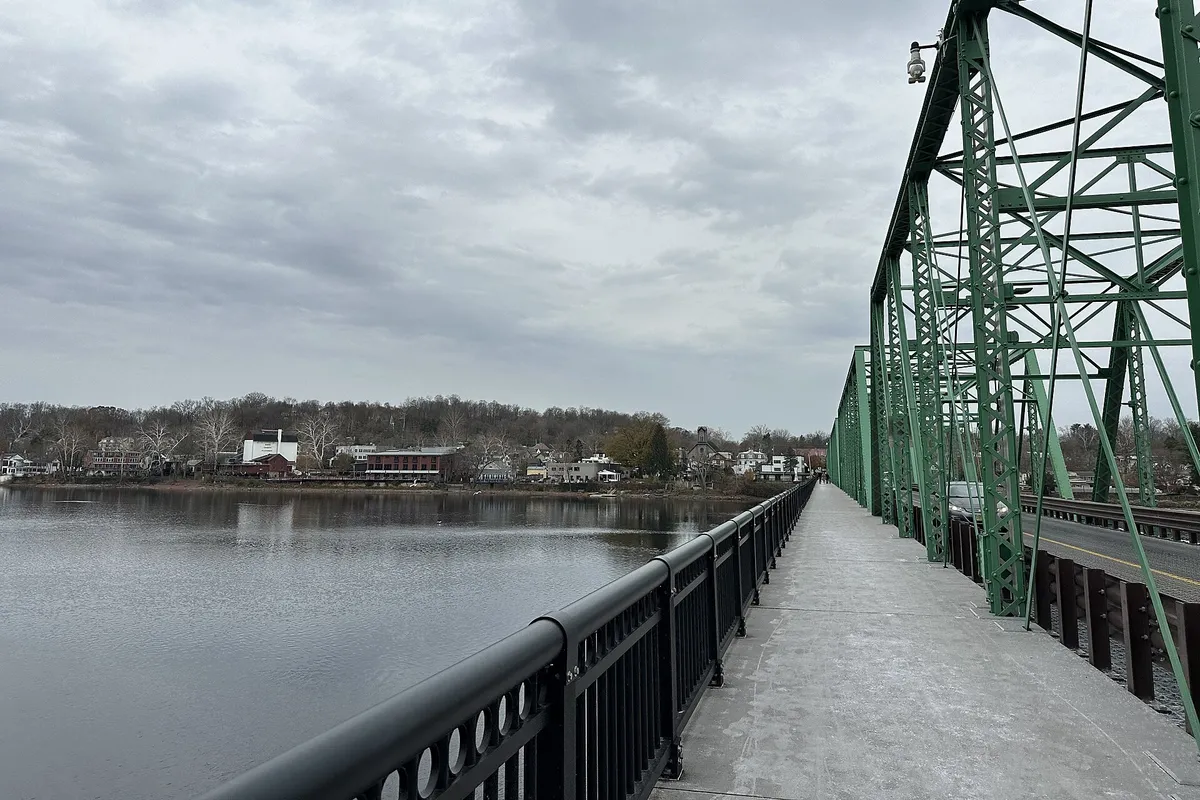
The ferry didn’t last much longer than the old name. The nomination says a bridge replaced it in 1814. Parry paid for the one-mile (1.6 km) stretch of the Delaware Canal that runs through town, the nomination adds, and the canal was operating by 1832. The Chamber says the last commercial boat ran in 1931.
The Bucks County Playhouse opened on July 1, 1939, on the site of the old mill. The theater says the “newly christened New Hope Mills inspired the village to change its name from Coryell’s Ferry to New Hope.”
New Hope on the 1890 map
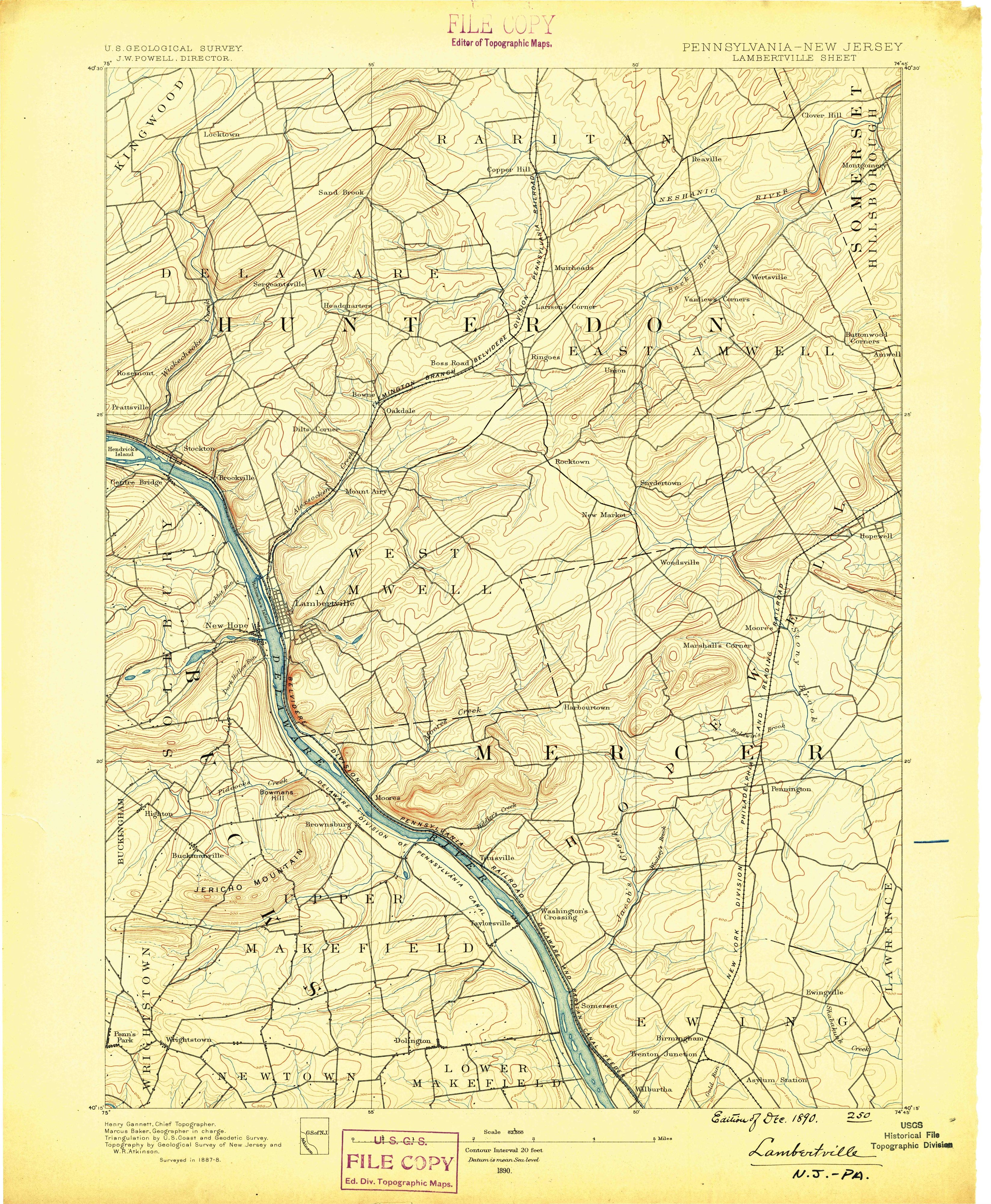
The map at the top of this page is the Geological Survey’s Lambertville sheet, surveyed in 1887 and 1888 and issued in December 1890. On the full sheet, New Hope sits on the Pennsylvania bank, left of center and about halfway down, facing Lambertville. Farther down the river, the same sheet marks Washington’s Crossing.
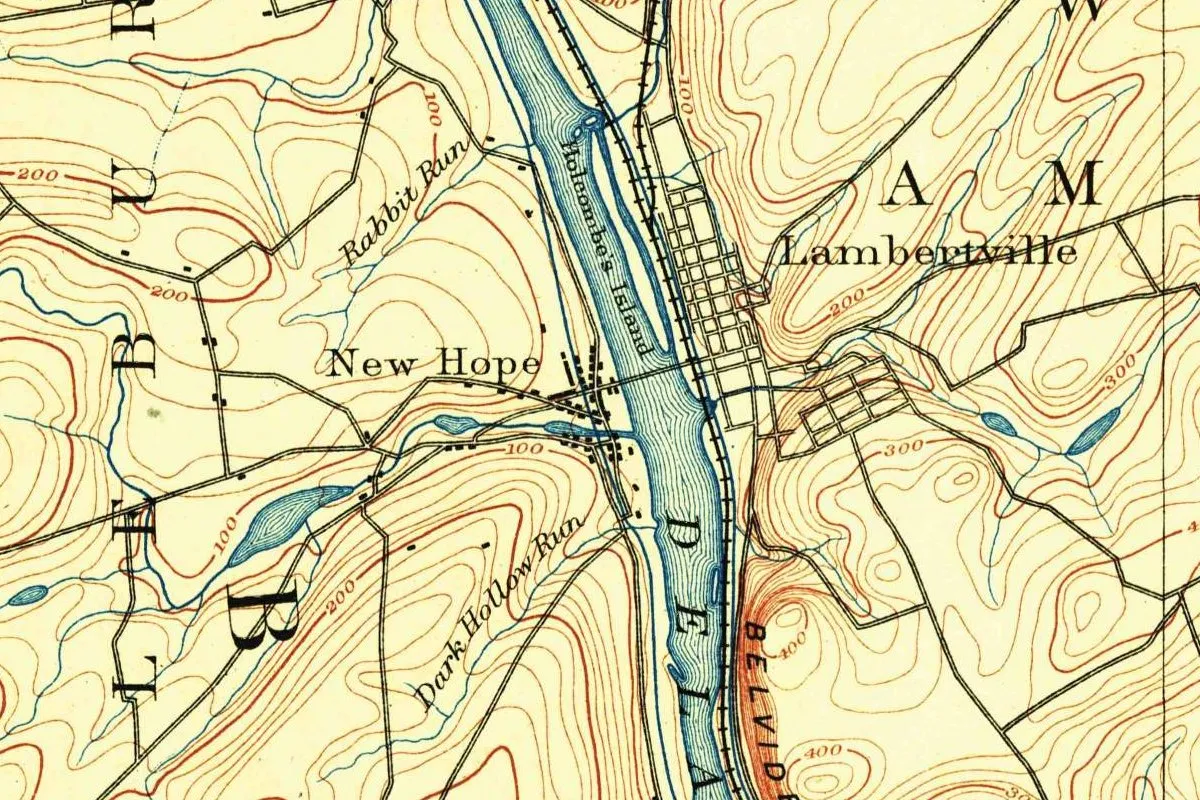
In this detail, you can see New Hope as a small cluster of buildings where a creek reaches the river, with a pond and stream to its west. Lambertville’s grid fills the opposite bank, Holcombe’s Island lies in the river just above, and a line crosses the water between the two towns. Contours are drawn every 20 feet (6 m).
Quick answers
Why is it called New Hope?
For Benjamin Parry’s New Hope Mills. After fire destroyed his mills, Parry rebuilt them under that name, and the name passed to the village, according to the 1984 National Register nomination and the New Hope Historical Society.
What was New Hope, PA, called before?
Coryell’s Ferry, and earlier Wells’ Ferry, according to W. W. H. Davis’s 1876 history of Bucks County.
When did the fire happen?
The New Hope Historical Society and the Chamber of Commerce say 1790. The 1984 National Register nomination says 1791.
Key dates
- 1719An act of the Pennsylvania Assembly gives John Wells the right to run a ferry, according to the National Register nomination.
- 1733Emanuel Coryell is licensed to run a ferry on the New Jersey side.
- 1777Washington crosses the Delaware at Coryell's Ferry in the summer, according to the Chamber of Commerce.
- 1784Benjamin Parry's house, now the Parry Mansion, is completed around this year.
- 1790Fire destroys Parry's mills, by the Chamber's and the historical society's date; the nomination puts the fire in 1791.
- 1800The place is called "New Hope, lately Coryell's ferry," according to W. W. H. Davis.
- 1814A bridge replaces the ferry across the Delaware.
- 1939The Bucks County Playhouse opens on July 1, on the site of a Parry mill.
Things to do in New Hope, Pennsylvania
Parry Mansion
The house Benjamin Parry completed around 1784, now owned by the New Hope Historical Society, which bought it in 1966 and furnished it as a museum of decorative arts with five distinct periods, following a plan representing five generations of the Parry family.
Bucks County Playhouse
A theater on the site of a former Parry grist mill on the Delaware. The playhouse says its building began as the mill Parry rebuilt in 1790, and that it opened as a theater on July 1, 1939.
Delaware Canal State Park
A state park built around the 58.89-mile (94.8 km) towpath of the Delaware Canal, which runs along the river between Easton and Bristol. The Locktender's House in New Hope explains the canal's history and is the headquarters of the Friends of the Delaware Canal.
Logan Inn
An inn beside the old ferry site that the Chamber of Commerce traces back to 1727. It was later renamed for James Logan, William Penn's longtime secretary.
Getting there
Open New Hope in Google Maps
Opens in a new tab. The pin is the center of New Hope in the USGS place-name record.
The closest airports, Amtrak stations and intercity bus stops, measured in a straight line from the center of New Hope.
Airports
- Trenton Mercer (TTN) 9 mi 15 km
- Lehigh Valley International (ABE) Allentown 33 mi 52 km
- Philadelphia International (PHL) 37 mi 60 km
Amtrak trains
- Trenton station (TRE) 14 mi 23 km
- Princeton Junction station (PJC) 18 mi 28 km
Intercity buses
- Greyhound Doylestown Septa Station 10 mi 17 km
- OurBus Princeton, NJ (Nassau Park shopping center on Route 1, in the outer parking lot of Burlington Coat Factory) 15 mi 24 km
- Suburban Transit Nassau St & Witherspoon St - Palmer Square 15 mi 25 km
Distances are as the crow flies, not by road. We don't list schedules or fares because they change; check with the airline, Amtrak or the bus company before you go. Official data (FAA commercial service airports (2025), FAA airport locations, Amtrak stations and Intercity Bus Atlas) from the FAA and the U.S. Bureau of Transportation Statistics, checked Nov 18, 2026.
Sponsored
Staying in New Hope?
Compare hotels in New Hope, Pennsylvania, on Expedia.
See hotels in New HopeWe may earn a commission if you buy through this link. It never changes what we write. Read our affiliate disclosure
Historical Sources & References
- W. W. H. Davis, The History of Bucks County (1876), pp. 680-681. Wells’ Ferry and Coryell’s Ferry, Martin Coryell’s account of the Hope and New Hope mills, the doubtful Joseph Todd story, and “New Hope, lately Coryell’s ferry” in 1800. Checked against the page image.
- National Register of Historic Places, “Historic Resources of New Hope Borough” (1984). The ferry of 1719, Emanuel Coryell in 1733, Parry’s three mills, the fire of 1791, the bridge of 1814 and the canal.
- New Hope Historical Society, “Parry Mansion & Barn”. The house of about 1784, the first mill on the Playhouse site, and the Hope Mill fire of 1790.
- New Hope Chamber of Commerce, “History”. Robert Heath’s license of 1722, the Coryells in 1748, the Logan Inn, Washington in 1776 and 1777, the fire of May 1790, and the canal.
- Bucks County Playhouse, “Our History”. The mill rebuilt in 1790 and the opening of July 1, 1939.
- Pennsylvania DCNR, Delaware Canal State Park. The 58.89-mile (94.8 km) towpath and the Locktender’s House.
- New Hope, GNIS feature 1182332 (U.S. Geological Survey). The borough’s listing as a populated place in Bucks County, with its coordinates.
- U.S. Geological Survey, Lambertville sheet (December 1890). The 1:62,500 sheet the map at the top was cropped from.
Sponsored
Put this 1890 map on your wall
The Geological Survey's 1890 Lambertville sheet, with New Hope on the Pennsylvania bank of the Delaware across from Lambertville, is in the public domain. Download the full-size scan for free, then have it printed on canvas with CanvasOnTheCheap.
Print a map on canvasDownload the full-size mapWe may earn a commission if you buy through this link. It never changes what we write. Read our affiliate disclosure
Spot something wrong, or know more? Tell us here. You can also email us or use our contact page. Corrections are noted here with their date, never made silently.