Erie, Pennsylvania: Named for a Lake, a People and a Cat
Erie is named for Lake Erie: the state says the town got the name because it was a port on the lake. The lake took its name from the Erie, a southern-shore people the Iroquois broke up in the 1650s. French writers said erie meant cat in the Erie's own language, of the Huron family.
A port named for its lake
Erie, Pennsylvania, is named for the lake at its door, and the lake is named for the Erie, a people the French knew as the Cat Nation. So the name passed through three hands before it reached the city: the Erie people, the French mapmakers who wrote them down, and the lake that carried the word to the town.
The city’s step is the simplest. In 1905 Henry Gannett, digging into the origins of the country’s place names for the U.S. Geological Survey, grouped Erie County and the city of Erie, Pennsylvania, with the Erie counties of New York and Ohio and said they were “Named from the lake.” The Pennsylvania Historical and Museum Commission puts it more plainly still: Erie, the county seat, “was so named because it was a port on Lake Erie.”
The Erie people
The lake’s name is older, and harder. Erie County’s own history page says the county “derives its name from the Eriez Indians, who settled on the fertile lake shore,” and that the Iroquois Confederacy conquered and destroyed them in the mid-1600s. The state’s park history for Presque Isle says the Erie lived along the southern shore of the lake, hunting, gathering and fishing from birch-bark canoes.
You’ll notice the spelling. The county says Eriez. John Miller, in his 1909 history of Erie County, insisted that the nation “was never known by the name Eriez.” He blamed a French cartographer who wrote “Lac des Eries” on a map and turned the final s the wrong way, so it looked like a z. Miller calls the people “the Eries or Cats.”
Why the Cat Nation?
That “Cats” comes from the French. A. Howry Espenshade, in his 1925 book Pennsylvania Place Names, says that “according to the French,” the word meant chat sauvage, a “wild cat,” which was their name for the raccoon. The earliest reference he found was a French map of 1651 that labels the lake Lac du Chat, “Lake of the Cat.”
He also quotes the French writer Charlevoix, in English, on where the lake’s name came from:
“Erie in that language signifies ‘cat,’ and in some accounts this nation is called the Cat Nation. This name probably comes from the large number of these animals found in this country.”
Espenshade wasn’t sure Charlevoix had the reason right. Some people thought the name described the tribe’s character, he wrote, while “others suppose, apparently with more reason, that the chat sauvage, or raccoon, was the tribal totem.” Gannett in 1905 went with “wildcat.” Notice who’s doing the talking, though. Charlevoix wrote that the lake carries the name of a nation “of the Huron language” and that in that language erie meant “cat.” That’s a Frenchman’s report of their word, and nothing from the Erie themselves survives in these sources.
What happened to the Erie
Espenshade repeats the old line that the Erie “are said to have been utterly annihilated by the Iroquois in 1654.” Then he pushes back on it. “It is more reasonable to suppose,” he wrote, that the Erie stopped existing as a separate tribe, with some captured and others scattered, and that the survivors joined other nations.
That’s the grim part of the name. By Espenshade’s dates, the Erie were gone as a separate nation within a few years of that 1651 French map, but the lake kept their name, and about a century and a half later a town borrowed it.
A town laid out at Presque Isle
For a while the shore wasn’t even clearly Pennsylvania’s. Espenshade says the state’s original northern line ran due west and gave it only about four miles (6 km) of lakefront. New York, Massachusetts and Connecticut all claimed the “Erie triangle” above it, until the United States sold the triangle to Pennsylvania for $150,000 eight years before Erie County was created, giving the state 50 miles (80 km) of shoreline.
The French had already built a fort on the bay, Fort de la Presqu’isle, where the city now stands, and in 1753-4 they cut a road 14 miles (23 km) inland to Fort Le Boeuf, now Waterford. Then in 1795, Espenshade says, the Pennsylvania legislature authorized four new towns, one of them “at Presqu’isle,” and sent Andrew Ellicott and Gen. William Irvine to survey them. “Thus Erie, Waterford, Franklin, and Warren all began their existence in the same year.” When Erie County was formed on March 12, 1800, Erie became the seat. By 1805, with about a hundred houses, it was a borough, and it became a city in 1851.
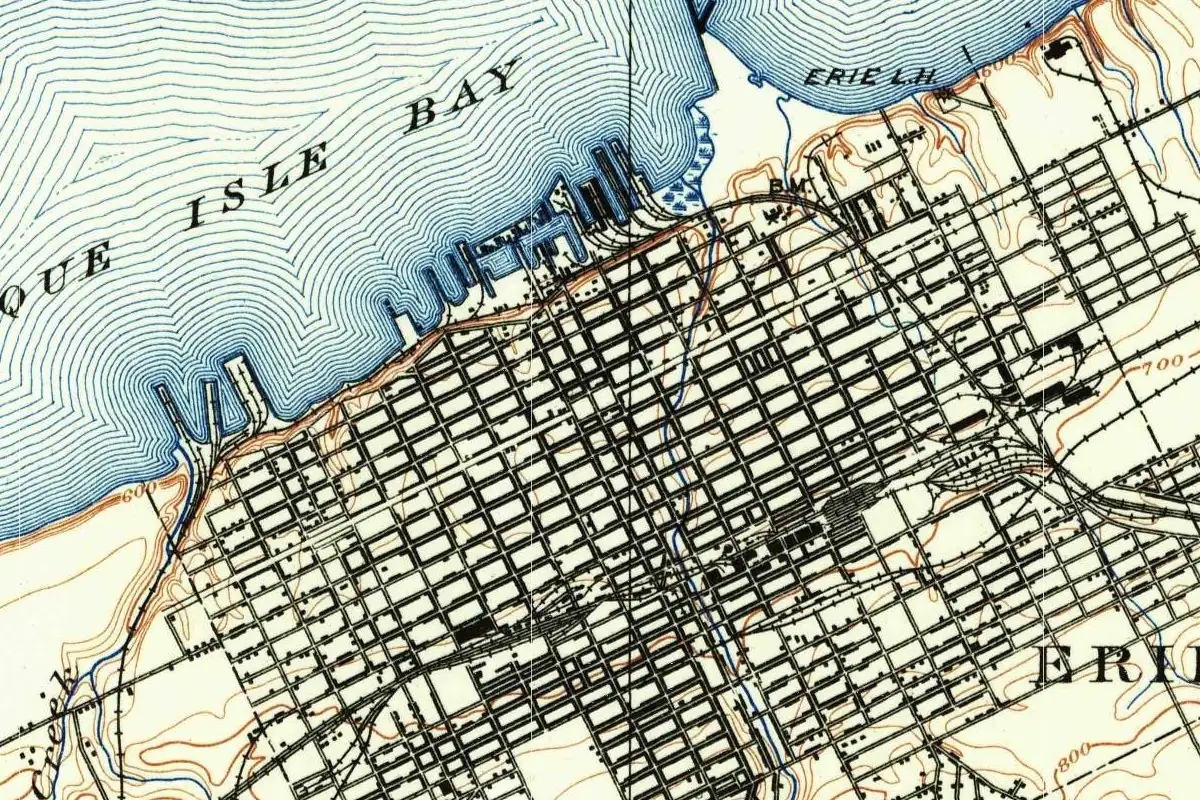
The peninsula kept its French name. Presque Isle means “almost an island,” the state park says, and storms have cut through its neck to make it a real one at least four times since 1819. On the old map at the top of this page, you can see the town in 1899, its piers lined up along Presque Isle Bay.
Three hops from a people to a port
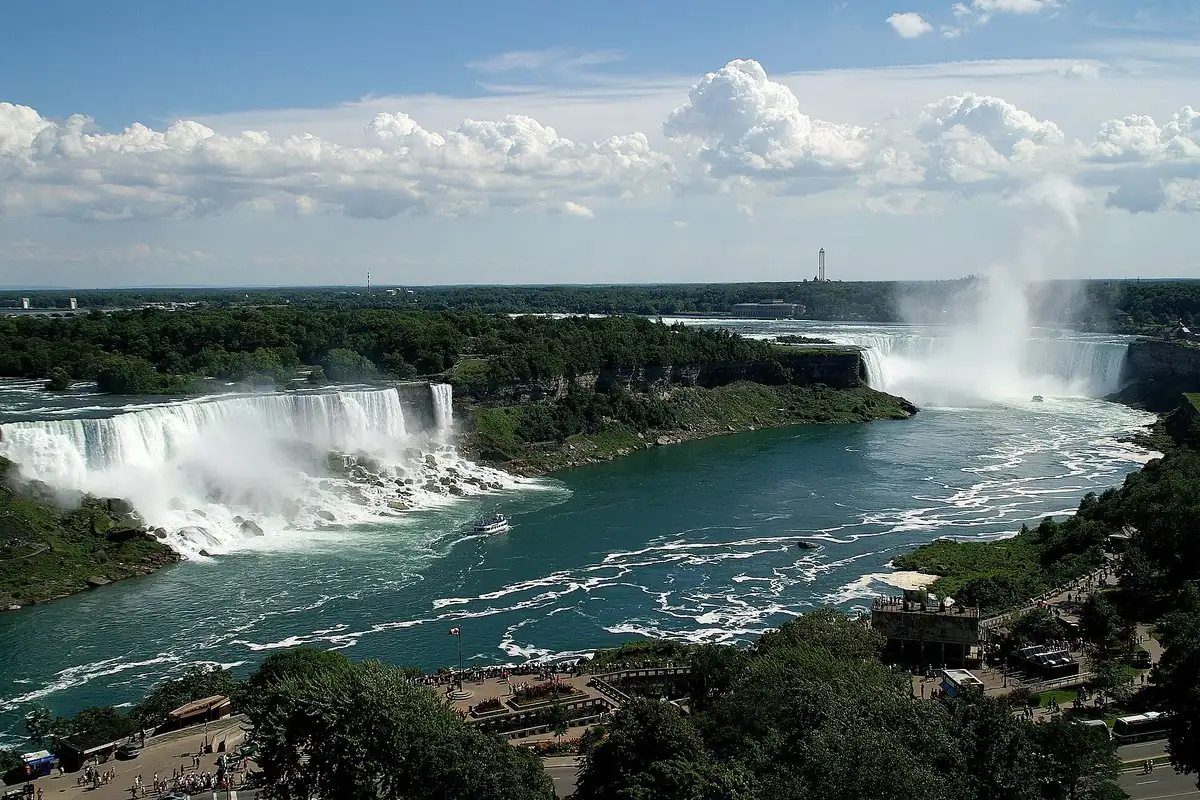
So the name of the city is easy and the name of the lake is not. Erie wasn’t the only place to borrow it. Gannett lists Erie counties in New York and Ohio named the same way, and New York’s, home of Buffalo, sits at the foot of the lake. Cleveland, Ohio, surveyed in 1796, the year after Erie, was described by its founder as “a town on the banks of Lake Erie.” And the lake’s water heads to Lake Ontario through the short river that drops over Niagara Falls. For more Keystone State names, see our Pennsylvania page.
Quick answers
Why is it called Erie, Pennsylvania?
Because it’s a port on Lake Erie. Henry Gannett wrote in 1905 that the city and county were “Named from the lake,” and the state’s historical commission says the same.
What does the word Erie mean?
“Cat,” according to French writers. Charlevoix wrote that the word meant “cat” in the Erie’s own language, which he placed in the Huron family, and Espenshade (1925) says the French meant chat sauvage, the raccoon. It’s an outsiders’ account; nothing from the Erie themselves survives in these sources.
Who were the Erie people?
A nation that lived along the southern shore of Lake Erie and was broken up by the Iroquois in the mid-1600s. Espenshade says the survivors probably joined other tribes rather than being wiped out.
Is it Erie or Eriez?
Erie. Erie County’s website uses “Eriez,” but the 1909 county historian John Miller said the people were never called that, and blamed a misdrawn s on a French map.
Key dates
- 1651A French map labels the lake Lac du Chat, the Lake of the Cat, the earliest reference Espenshade found.
- 1654The Erie are said to have been destroyed or scattered by the Iroquois.
- 1795Pennsylvania's legislature orders a town laid out at Presque Isle, and Erie is surveyed that year.
- 1800On March 12, Erie County is created, named for the lake, with Erie as its seat.
- 1805Erie, with about a hundred houses, is incorporated as a borough.
- 1851Erie is incorporated as a city.
Things to do in Erie, Pennsylvania
Presque Isle State Park
A sandy peninsula, joined to the mainland four miles (6 km) west of downtown, that shelters Presque Isle Bay. A National Natural Landmark with beaches and a favorite stop for migrating birds.
Presque Isle Lighthouse
A 57-foot (17 m) lighthouse tower with a red-brick dwelling, built in 1872 and first lit in 1873, still flashing a white light maintained by the U.S. Coast Guard.
Erie Maritime Museum and U.S. Brig Niagara
Home dock of the U.S. Brig Niagara, a replica of the flagship Commodore Perry sailed to victory in the 1813 Battle of Lake Erie.
Hagen History Center
Erie's history museum, with an exhibit on Oliver Hazard Perry, the man, his family and his heroism, and what it calls the only Frank Lloyd Wright Field Office Museum.
Getting there
Open Erie in Google Maps
Opens in a new tab. The pin is the center of Erie in the USGS place-name record.
The closest airports, Amtrak stations and intercity bus stops, measured in a straight line from the center of Erie.
Airports
- Erie International/Tom Ridge Field (ERI) 6 mi 9 km
- Youngstown/Warren Regional (YNG) 67 mi 108 km
- Buffalo Niagara International (BUF) 89 mi 143 km
Amtrak trains
- Erie station (ERI) under 1 mi 1 km
- Grimsby station (GMS) 78 mi 126 km
Intercity buses
- FlixBus Erie Erie Bus Stop under 1 mi 0.9 km
- Barons Bus Lines Erie (Perry Hwy) 5 mi 7 km
- OurBus Erie, PA (Pilot Travel Center, 8035 Perry Hwy Erie, PA 16509) 5 mi 8 km
Distances are as the crow flies, not by road. We don't list schedules or fares because they change; check with the airline, Amtrak or the bus company before you go. Official data (FAA commercial service airports (2025), FAA airport locations, Amtrak stations and Intercity Bus Atlas) from the FAA and the U.S. Bureau of Transportation Statistics, checked Nov 14, 2026.
Sponsored
Staying in Erie?
Compare hotels in Erie, Pennsylvania, on Expedia.
See hotels in ErieWe may earn a commission if you buy through this link. It never changes what we write. Read our affiliate disclosure
Historical Sources & References
- Henry Gannett, The Origin of Certain Place Names in the United States (USGS, 1905), p. 120. Erie County and the city of Erie, Pennsylvania, with the Erie counties of New York and Ohio, “Named from the lake”; Lake Erie from “erie, erike, or eriga, meaning ‘wildcat,’” the name of a tribe conquered by the Iroquois.
- A. Howry Espenshade, Pennsylvania Place Names (1925), pp. 126-128. Erie County of March 12, 1800, named for the lake; the “Erie triangle” and the $150,000 sale; chat sauvage and the 1651 map with Lac du Chat; the Charlevoix quotation; the raccoon totem; the Erie “said to have been utterly annihilated” in 1654, or dispersed; Fort de la Presqu’isle and the road to Fort Le Boeuf; the 1795 towns and the borough of 1805.
- John Miller, A Twentieth Century History of Erie County, Pennsylvania, vol. I (1909), p. 14. “The Eries or Cats” and the spelling “Eriez” as a French cartographer’s mistake.
- Pennsylvania Historical and Museum Commission, Erie County municipalities (PDF). The county named for Lake Erie, which was named for the Indians of the same name; Erie “so named because it was a port on Lake Erie”; laid out in 1795, a borough in 1805 and a city in 1851.
- Erie County, Pennsylvania, “History of Erie County”. The county’s name from the “Eriez Indians” and their conquest by the Iroquois Confederacy in the mid-1600s.
- Pennsylvania DCNR, “History of Presque Isle State Park”. The Erie on the southern shore of the lake, Presque Isle as “almost an island” and the storm breaches since 1819.
- GNIS feature 1174305 (U.S. Geological Survey). The government’s geographic names record files Erie as a populated place in Erie County.
- U.S. Geological Survey, Erie sheet (1899). The 1:62,500 quadrangle the map at the top of this page was cropped from.
Spot something wrong, or know more? Tell us here. You can also email us or use our contact page. Corrections are noted here with their date, never made silently.