Clifton Forge, Virginia: A Rail Town With an Ironworks Name
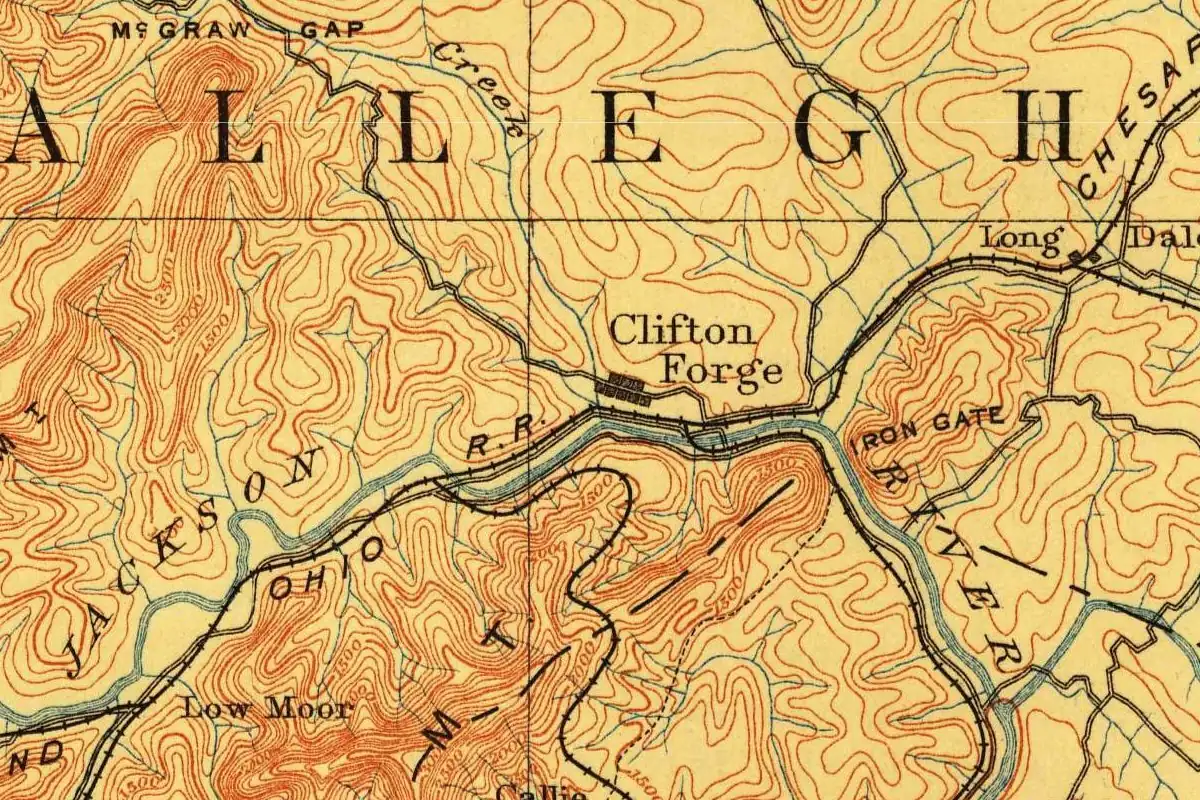
Clifton Forge, Virginia, is a railroad town with an ironworks name: William Lyle Alexander named his forge Clifton, for his father’s Lexington estate. The trains made the town, but they didn’t name it. The name was already there, on an ironworks in the gap downriver, where a stone furnace still stands.
Alexander’s forge in Rainbow Gap
The town’s own history puts it in one sentence. Alexander, a Lexington man, “owned a forge in the Rainbow Gorge near Iron Gate, and he named the forge ‘Clifton’ in honor of his father’s estate in Lexington; thus, we have the name ‘Clifton Forge’.”
The Virginia Department of Historic Resources fills in the ironworks. Its listing for Clifton Furnace says the site was working as early as 1822, and that the cold-blast charcoal furnace still standing there, a stone stack that narrows toward the top, was put up in 1846 by Alexander, “the forge’s owner.” The furnace went out of blast in 1854, and iron making ended there for good in 1877. “The nearby town of Clifton Forge, originally called Williamson’s Station,” the state says, “takes its name from this early industrial site.”
So the name is a little like a forwarding address, if you follow it back. It started at an estate in Lexington, moved to an ironworks in the gap, and then settled on a railroad town that outgrew both.
Williamson’s Station
Before it took the forge’s name, the settlement was Williamson’s Station. The town says the Williamson and Smith families owned the land by the 1820s, and that a settlement grew up on both banks of the Jackson River, from Slaughter Pen Hollow to Smith Creek, helped along by the iron trade and by the road over North Mountain, finished in 1826.
The town dates its first passenger train to 1857. Virginia’s 1940 Writers’ Program guide adds that by 1861 the Virginia Central had reached the Jackson River at the edge of the present town, that the Civil War held up tracklaying to the west until 1867, and that later lines along the James River were all combined under the Chesapeake and Ohio, with Clifton Forge as “the division point of the large east-to-west system.”
A town that a railroad built
The guide’s verdict on the place was blunt: Clifton Forge “is a city that a railroad built, for here are shops and a terminal of the Chesapeake & Ohio Railway.” The town says the C&O once employed nearly 2,000 people there, until the company moved its diesel shops to West Virginia in the early 1950s. The Chesapeake and Ohio Historical Society is still based in town.
The title changed along the way. The national gazetteer notes that Clifton Forge got a city charter in 1906 and went back to being a town on July 1, 2001. If you’re keeping score, that’s a settlement, a station, a city and a town, all under the name of an ironworks that was abandoned in 1877.
Quick answers
Where does the name Clifton Forge come from?
Because of an ironworks. William Lyle Alexander named his forge near Iron Gate “Clifton” for his father’s estate in Lexington, and the town later took on the name of that site.
Is there still a forge at Clifton Forge?
Not a working one. Iron making at the site ended in 1877, but the Virginia Department of Historic Resources says the stone furnace Alexander built in 1846 still stands in the gap.
Did the railroad name Clifton Forge?
No. The name came from the forge. The railroad, later the Chesapeake and Ohio, is what made the town grow, and the 1940 state guide called it “a city that a railroad built.”
Is Clifton Forge a city or a town?
A town. It had a city charter from 1906 and went back to town status on July 1, 2001.
Key dates
- 1846William Lyle Alexander builds the stone Clifton Furnace in Rainbow Gap.
- 1857The first passenger train reaches Clifton Forge, according to the town.
- 1906Clifton Forge receives a city charter.
- 2001Clifton Forge goes back to being a town on July 1.
Getting there
Open Clifton Forge in Google Maps
Opens in a new tab. The pin is the center of Clifton Forge in the USGS place-name record.
The closest airports, Amtrak stations and intercity bus stops, measured in a straight line from the center of Clifton Forge.
Airports
- Roanoke/Blacksburg Regional (Woodrum Field) (ROA) 35 mi 56 km
- Lynchburg Regional/Preston Glenn Field (LYH) Timberlake 48 mi 77 km
- Richmond International (RIC) Highland Springs 139 mi 223 km
Amtrak trains
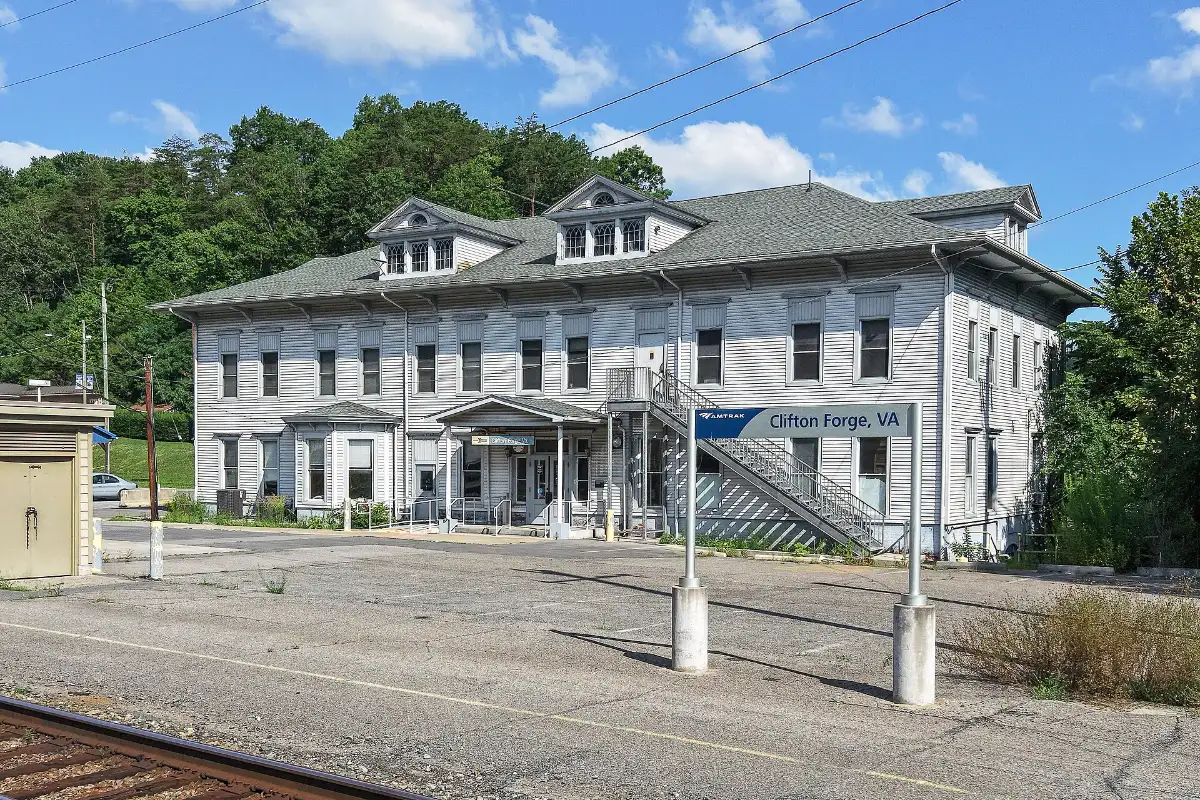
- Clifton Forge station (CLF) under 1 mi 0.3 km
- White Sulphur Springs station (WSS) 26 mi 42 km
Intercity buses
- Virginia Breeze, Operated by Dillon's Virginia Breeze · Lexington (Food Lion) 21 mi 35 km
- OurBus Roanoke, VA (Roanoke-Blacksburg Regional Airport. Bus will stop at the Kiss and Fly zone in front of the terminal.) 35 mi 57 km
- FlixBus Roanoke Orange Avenue Northeast 37 mi 60 km
Distances are as the crow flies, not by road. We don't list schedules or fares because they change; check with the airline, Amtrak or the bus company before you go. Official data (FAA commercial service airports (2025), FAA airport locations, Amtrak stations and Intercity Bus Atlas) from the FAA and the U.S. Bureau of Transportation Statistics, checked Nov 6, 2026.
Sponsored
Staying in Clifton Forge?
Compare hotels in Clifton Forge, Virginia, on Expedia.
See hotels in Clifton ForgeWe may earn a commission if you buy through this link. It never changes what we write. Read our affiliate disclosure
Historical Sources & References
- Town of Clifton Forge, “About”. Alexander’s forge “in the Rainbow Gorge near Iron Gate,” named “Clifton” for his father’s estate in Lexington; the Williamson and Smith families; the first passenger train in 1857; the C&O shops and the 1906 charter.
- Virginia Department of Historic Resources, “Clifton Furnace” (003-0019). The site in operation by 1822; the stone furnace built in 1846 by Alexander, “the forge’s owner”; the end of iron making in 1877; the town “originally called Williamson’s Station” taking its name from the site.
- Writers’ Program, Virginia: A Guide to the Old Dominion (1940), p. 493. “A city that a railroad built”; the Virginia Central at the Jackson River by 1861; tracks west in 1867; Clifton Forge as the C&O division point.
- GNIS feature 1492780 (U.S. Geological Survey). The federal place-name entry for Clifton Forge, which notes the 1906 city charter and the return to town status on July 1, 2001.
Spot something wrong, or know more? Tell us here. You can also email us or use our contact page. Corrections are noted here with their date, never made silently.