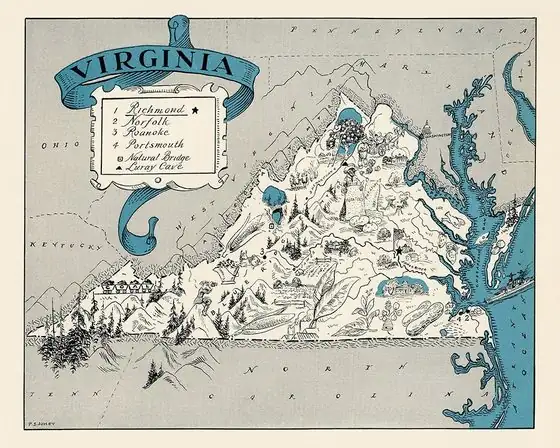
Staunton, Virginia: Was It Named for the Governor's Wife?
Staunton most likely carries the maiden name of Rebecca Staunton, who married William Gooch, later Virginia's lieutenant governor, in 1714. That's the version in Virginia's legislative charter records and Encyclopedia Virginia. Joseph Waddell's Augusta County history repeated it in 1902 but wouldn't vouch for it, and Henry Gannett, in his 1905 federal list, said a parish in England.
Most sources say Staunton, Virginia, carries the maiden name of Governor William Gooch’s wife, but Augusta County’s old historian wouldn’t vouch for it. Her name was Rebecca Staunton, and the story fits nicely. It just wasn’t nailed down by anyone who was there.
A town at Beverley’s “Mill Place”
The town began as a real estate plan. Joseph A. Waddell’s Annals of Augusta County, revised in 1902, says William Beverley laid out “the beginning of the town, within his manor, and at his ‘Mill Place.’” Thomas Lewis, the county surveyor, did the work.
There were actually two tries. Waddell found an original plot, never recorded, showing that Lewis laid off 13 lots for Beverley on July 15, 1747. A year later the plan grew to 44 half-acre lots, with streets named Beverley, Frederick, Johnson, Augusta, Water and Lewis. Under that 1748 drawing the surveyor wrote “A plan of the town of Staunton, in Augusta county,” so the name was on paper by then. Waddell adds that it was “originally often written Stanton.”
Here’s the detail that makes the governor’s-wife story tempting. On the first plot of 1747, the street now called Augusta was “Gooch street.” William Gooch was Virginia’s lieutenant governor from 1727 to 1749.
“We do not vouch for the truth”
You’d think a county historian would settle it. Waddell was honest that he couldn’t:
“Why Staunton was so called has been a question for many years. We long ago saw a statement in print somewhere, that the new town was named in honor of Lady Gooch, wife of the Governor, who, it was said, was a member of the English family of Staunton, but we do not vouch for the truth of the statement.”
That’s page 65. He also pointed out a small town called Staunton near Kendal, in Westmorland, England, though he didn’t claim that’s where the name came from.
Henry Gannett went another way in 1905. His bulletin for the U.S. Geological Survey, a long federal list of American place names, says the river and city of Staunton were “named from the parish in England.” It doesn’t say which parish, and it doesn’t mention Gooch at all.
What the modern sources say
The governor’s-wife version is the one you’ll find in official Virginia references today. The history note on Staunton’s charter, published by the General Assembly, says the city was “Named for Rebecca Staunton, wife of Sir William Gooch, Lieutenant Governor of Virginia, 1727-1749.” Encyclopedia Virginia’s list of cities is a little more careful: named “according to most authorities” for Rebecca Staunton.
Encyclopedia Virginia’s biography of Gooch adds the wedding. He married Rebecca Staunton, of Hampton Parish in Middlesex, on or shortly after April 14, 1714, at Fulham Palace, the bishop of London’s residence. It also says that in May 1749 Gooch signed a bill to create a town in Augusta County “that its planners had named Staunton, his wife’s maiden surname.”
So the case for Lady Gooch rests on that surname, the old Gooch Street and later writers who agree. Waddell had the original plots in front of him and still called it “a question for many years.” That’s why this one stays in the disputed column.
A town the king said no to
Even the town’s legal birth took two tries. Waddell writes that an act “for establishing a town in Augusta county, and allowing fairs to be kept there” passed in 1748, but King George II “disallowed” it, and Governor Dinwiddie announced in a proclamation of April 8, 1752, that it was “utterly void and of none effect.” As Waddell put it, the town “had to wait thirteen years for a new king.”
The new act came in the November 1761 session. It says the late William Beverley had laid out land “at the court-house” into lots and streets, then given 25 more acres, and that the town “shall be called and known by the name of Staunton,” with two fairs a year. That’s on pages 473 and 474 of Hening’s Statutes at Large, volume 7. Like most of these laws, it gives the name without a word about why.
Staunton was later incorporated as a town in 1801 and as a city in 1871, according to the charter history. If you go looking for proof of the Lady Gooch story in the law that finally created the town, you won’t find it. You’ll find it in a surname, a street and a lot of agreement after the fact, which in Virginia has been enough to make it the accepted answer.
Quick answers
Who was Staunton, Virginia, named after?
Probably Rebecca Staunton, wife of Lieutenant Governor Sir William Gooch. Virginia’s charter history and Encyclopedia Virginia say so, but Waddell’s 1902 county history wouldn’t vouch for it, and Gannett, writing for the USGS in 1905, credits “the parish in England.”
Was there ever a Gooch Street in Staunton?
Yes, briefly. Waddell says that on the first plot of July 15, 1747, the street now called Augusta was “Gooch street.”
Why was Staunton spelled Stanton?
Waddell says the name “was originally often written Stanton.” He doesn’t explain the spelling.
When did Staunton become a town?
Lots were laid out in 1747 and 1748, but a 1748 act was disallowed by the king. The General Assembly established Staunton as a town in its November 1761 session.
Key dates
- 1714William Gooch marries Rebecca Staunton of Hampton Parish, Middlesex, at Fulham Palace.
- 1747July 15: Thomas Lewis lays off 13 lots for William Beverley. On this first plot, Augusta Street is called Gooch Street.
- 1748Lewis draws "A plan of the town of Staunton," with 44 lots at Beverley's "Mill Place" by the Augusta courthouse.
- 1749May: Gooch signs a bill to create the town, Encyclopedia Virginia says. A 1752 proclamation says the king disallowed a 1748 town act.
- 1761November session: the General Assembly establishes Staunton as a town, with two fairs a year.
- 1801Staunton is incorporated as a town.
- 1871Staunton is incorporated as a city.
Getting there
Open Staunton in Google Maps
Opens in a new tab. The pin is the center of Staunton in the USGS place-name record.
The closest airports, Amtrak stations and intercity bus stops, measured in a straight line from the center of Staunton.
Airports
- Charlottesville-Albemarle (CHO) Charlottesville-Albemarle Airport 34 mi 54 km
- Lynchburg Regional/Preston Glenn Field (LYH) Timberlake 57 mi 92 km
- Washington Dulles International (IAD) 103 mi 166 km
Amtrak trains
- Staunton station (STA) under 1 mi 0.2 km
- Charlottesville station (CVS) 33 mi 52 km
Intercity buses
- Virginia Breeze, Operated by Dillon's Virginia Breeze · Staunton (Crossing Way Park & Ride) 2 mi 4 km
- Virginia Breeze, Operated by Academy Virginia Breeze · Staunton (Crossing Way Park & Ride) 2 mi 4 km
- OurBus Harrisonburg, VA (James Madison University - Godwin Hall. The bus will stop on the parking lot side of Godwin Hall. Look for an OurBus bus stop sign along the retaining wall. Note that this is a slightly different location from where HDPT buses stop at this location.) 23 mi 36 km
Distances are as the crow flies, not by road. We don't list schedules or fares because they change; check with the airline, Amtrak or the bus company before you go. Official data (FAA commercial service airports (2025), FAA airport locations, Amtrak stations and Intercity Bus Atlas) from the FAA and the U.S. Bureau of Transportation Statistics, checked Nov 13, 2026.
Sponsored
Staying in Staunton?
Compare hotels in Staunton, Virginia, on Expedia.
See hotels in StauntonWe may earn a commission if you buy through this link. It never changes what we write. Read our affiliate disclosure
Historical Sources & References
- Joseph A. Waddell, Annals of Augusta County, Virginia (2nd ed., 1902), pp. 64-66. Beverley’s “Mill Place,” Thomas Lewis’s 44-lot plan and its inscription “A plan of the town of Staunton” (p. 64); the 13 lots of July 15, 1747, Gooch Street, the spelling Stanton, the “we do not vouch” passage and the town near Kendal (p. 65); the 1748 act disallowed by George II and Dinwiddie’s proclamation of April 8, 1752 (p. 66).
- William Waller Hening, ed., The Statutes at Large, vol. 7 (1820), pp. 473-474. Chapter VII of the November 1761 session, establishing Staunton, New London and Strasburg: Beverley’s lots at the courthouse, the 25 added acres, the clause “shall be called and known by the name of Staunton” and the fairs.
- Henry Gannett, The Origin of Certain Place Names in the United States (USGS, 1905), p. 289. The river and city “named from the parish in England.”
- Virginia General Assembly, Charter: City of Staunton. History note: named for Rebecca Staunton, wife of Sir William Gooch; laid out in 1748; established as a town in 1761; incorporated as a town in 1801 and as a city in 1871.
- Brent Tarter and the Dictionary of Virginia Biography, “Sir William Gooch (1681-1751),” Encyclopedia Virginia. Gooch’s marriage to Rebecca Staunton in 1714 at Fulham Palace, and the bill of May 1749 for a town in Augusta County named Staunton, “his wife’s maiden surname.”
- Encyclopedia Virginia, “Cities of Virginia”. Staunton named “according to most authorities” for Rebecca Staunton, with Gooch’s years as lieutenant governor, 1727 to 1749.
- Virginia American Revolution 250 Commission, “Staunton”. A modern summary that dates the naming for Lady Rebecca Staunton to 1747.
- GNIS feature 1500154 (U.S. Geological Survey). Staunton as it’s catalogued on the national names list: a populated place in the independent city of Staunton.
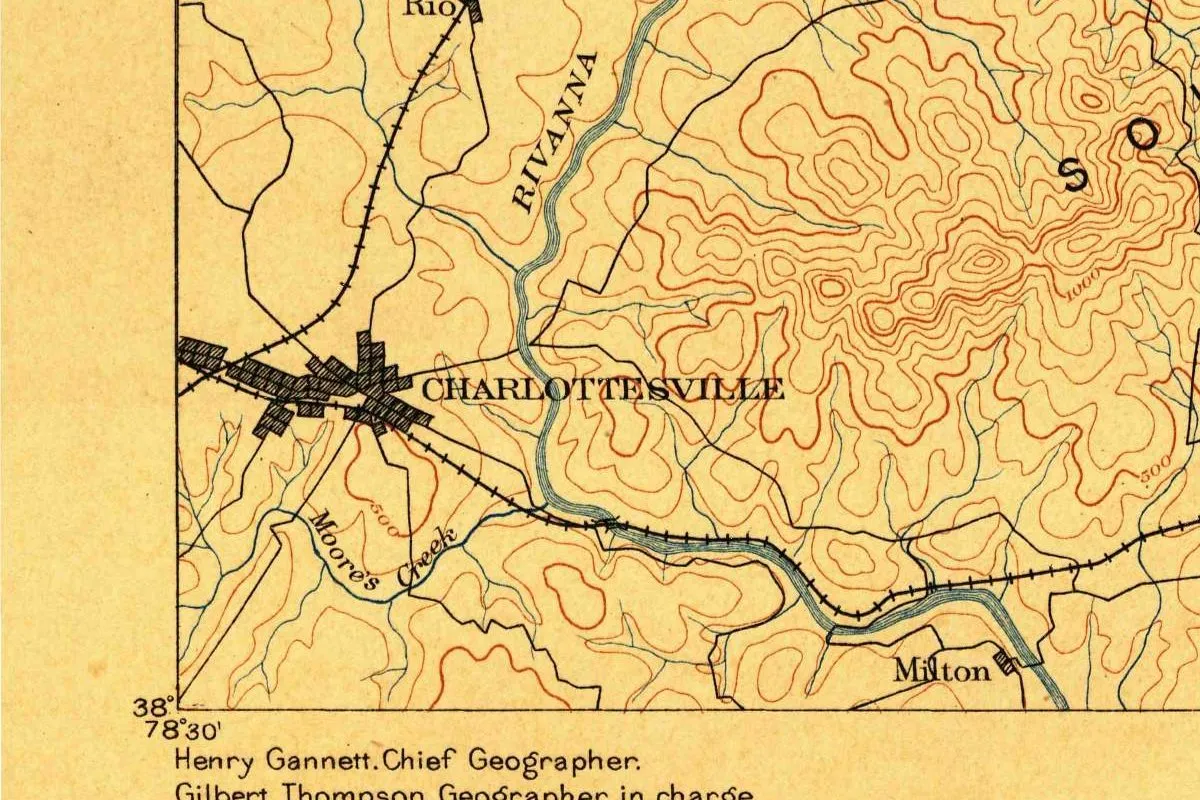
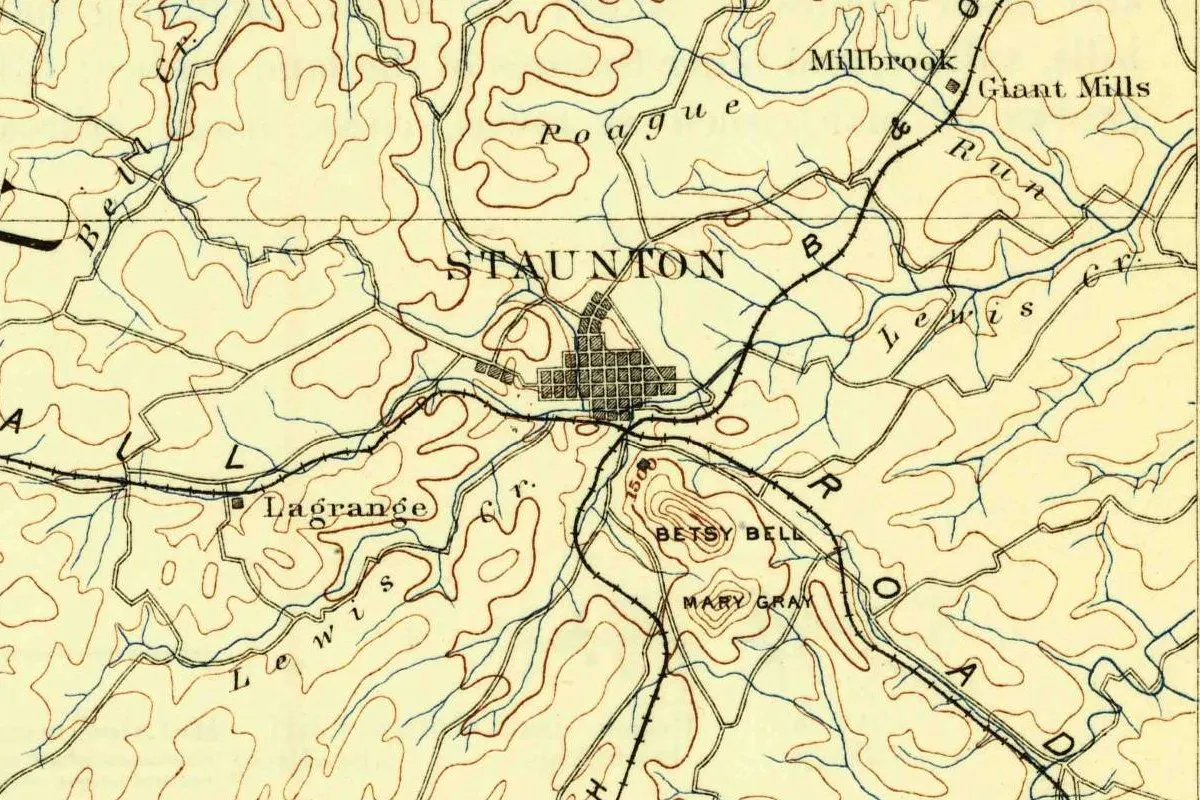
- U.S. Geological Survey, Staunton sheet (1894). The 1894 Staunton quadrangle at 1:125,000, the earliest sheet for this spot in the Survey’s historical collection, with Lewis Creek running past the street grid.
Spot something wrong, or know more? Tell us here. You can also email us or use our contact page. Corrections are noted here with their date, never made silently.