Who Is Petersburg, Virginia, Named After? Peter Jones
Petersburg is named for Peter Jones, who opened a trading post with the Indians at a spot on the Appomattox River called Peter's Point. He was William Byrd's friend and rode with him in 1733, the year Byrd wrote that a town there was to be named Petersburgh. Virginia established the town in 1748.
Petersburg, Virginia, is one of seven Petersburgs Henry Gannett listed, each tied to its own Peter, and its Peter kept a trading post on the Appomattox. His name was Peter Jones, and his first name stuck to the spot long before there was a town.
Seven Petersburgs, seven Peters
When Henry Gannett sorted the country’s place names for the Geological Survey in 1905, the Petersburgs took up a good stretch of one page. There was one in Colorado for Peter Magnes, one in Delaware for the descendants of Peter Fowler, one in Illinois for Peter Lukins, one in Indiana for Peter Brenton, one in New York for Peter Simmons and one in Pennsylvania for Peter Fleck.
The Virginia city comes last in his list, and it’s the only one where he names two founders. Gannett says it was “founded by Col. William Byrd and Peter Jones, and named for the latter.” So you can see the pattern: in almost every case, a Peter, and the burg added on. What makes this one different is that you can follow its Peter back into the colonial record.
Peter’s Point
Henry Howe’s Historical Collections of Virginia, published in 1845, gives the most detail on where the name came from. “The town derived its name from Peter Jones,” he wrote, “who opened a trading establishment with the Indians at an early day, a few rods west of what is now the junction of Sycamore and Old streets. The locality was called Peter’s Point, subsequently changed to Petersburg.”
So the name started as a landmark: the point where Peter traded. Howe doesn’t give a year for the trading post, only “at an early day.”
Byrd had passed this way before. Howe quotes his account of the 1728 boundary survey with North Carolina, when Byrd stopped at Col. Bolling’s house, “within hearing of the falls of Appomattox river, which are very noisy whenever a flood happens to roll a greater stream than ordinary over the rocks.” The river, Byrd added, was navigable for small craft as high as those falls. That detail comes back in Byrd’s own reasoning five years later.
Howe also lays out how old the ground already was. A 1646 act, he says, granted Captain Abraham Wood 600 acres next to Fort Henry, and the land the fort stood on had been granted even earlier to Thomas Pitt, who, Howe says, “may, therefore, be considered the earliest proprietor of the site of Petersburg.”
There’s a puzzle on the same page. Howe quotes a 1675 order for forts on the frontier, one of them near the falls of the Appomattox, “of which Major Peter Jones be captain or chief commander.” That’s 58 years before the trip with Byrd. Howe doesn’t say whether that Major Peter Jones is the same man as the trader or a relative, and you shouldn’t assume either.
Byrd’s friend, Byrd’s town
The Peter Jones Howe ties to the name was, in his words, “an old friend and fellow-traveller of Col. William Byrd, of Westover.” Byrd’s own journal backs him up. In September 1733, as Byrd set out on what Howe calls a journey to Roanoke, he wrote that “my Old Friend and Fellow Travellor, Peter Jones, came to us compleatly accoutred.”
Later on the same trip, Byrd made the entry that put the name in writing. He and his companions, he said, had planned two towns, one at Shacco’s to be called Richmond, “and the other at the Point of Appamattuck River, to be nam’d Petersburgh.” Then he explained the logic:
“These Major Mayo offered to lay out into Lots without Fee or Reward. The Truth of it is, these two places being the uppermost Landing of James and Appamattux Rivers, are naturally intended for Marts, where the Traffick of the Outer Inhabitants must Center.”
In other words, Byrd picked the farthest point boats could reach on each river, the natural place for trade to collect. His name for the town kept the Peter and added “burgh.” His 1901 editor, John Spencer Bassett, added a footnote that the town “took its name from a local inhabitant.”
That one diary entry is also where Richmond picked up its name, and that city gets a page of its own. Byrd’s journals reach Danville too: the city takes its name from the Dan, a river his boundary expedition christened five years before the Petersburg trip.
From plan to town
Byrd’s plan took 15 years to become law. According to Howe, the towns of Petersburg and Blandford were established in the October session of 1748, “in the 22d year of the reign of King George II.” By 1762, an act enlarging the town said it “had very greatly increased, and become a place of considerable trade,” much as Byrd had expected. In 1784, Petersburg was incorporated, and Blandford, Pocahontas and Ravenscrofts were united with it.
Armies came through, too. Howe describes how the British under General Phillips marched on Petersburg in April 1781, where Baron Steuben met them with somewhat under 1,000 militia against 2,300 men. In the Civil War, the National Park Service says, the Siege of Petersburg lasted 292 days, with eight offensives and more than 70,000 casualties, as U.S. forces cut off supplies to Petersburg and to Richmond.
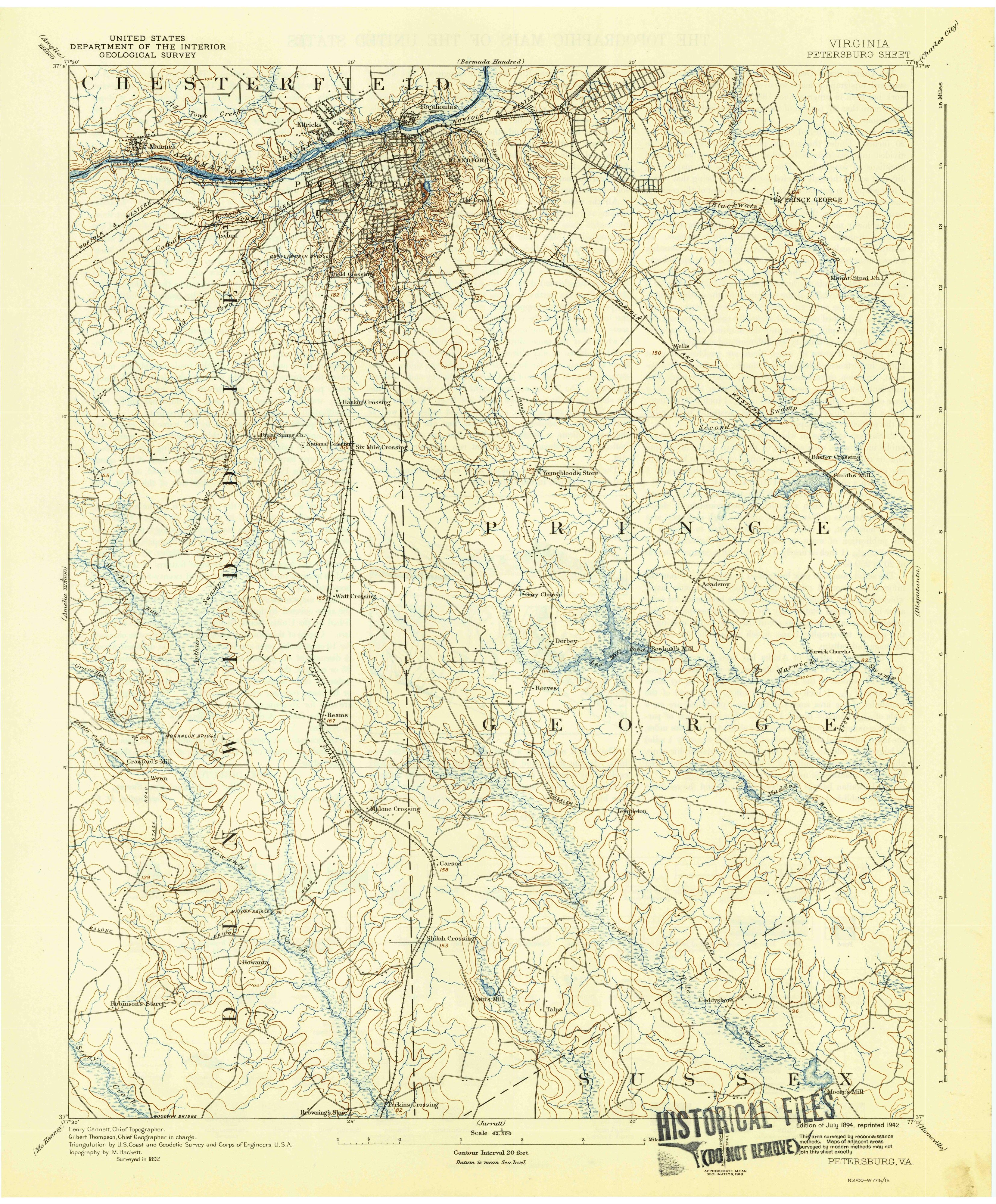
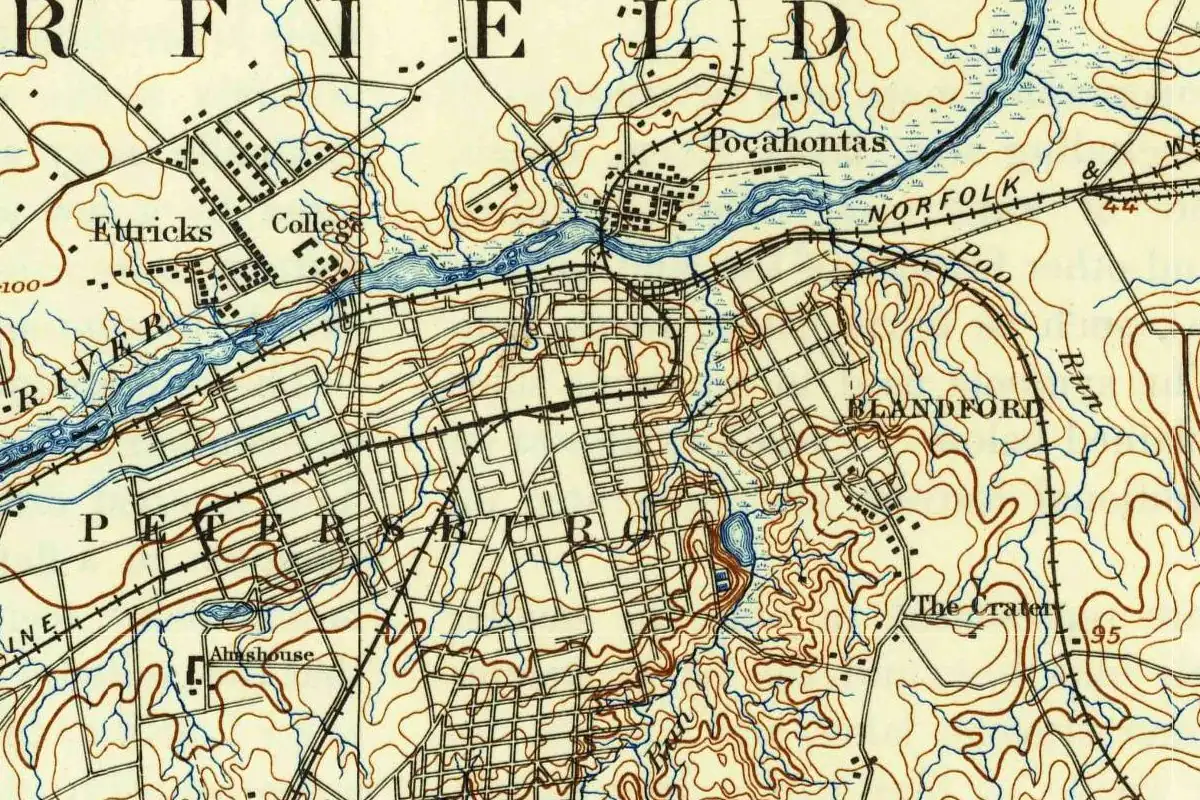
Two of those absorbed names still sit on the map at the top of this page, which comes from the Geological Survey’s 1894 Petersburg sheet. You’ll find BLANDFORD to the east of the city and Pocahontas across the river to the north. The Crater is marked to the southeast. And if you could see the bottom margin of the full sheet, you’d find “Henry Gannett, Chief Topographer,” the same Gannett whose 1905 list ends with Peter Jones.
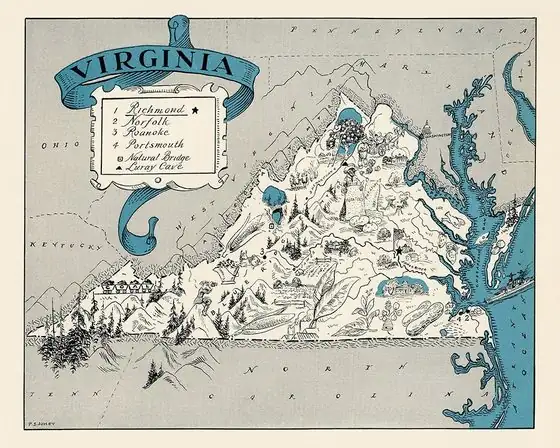
There’s more to see of Virginia’s city names on our Virginia page.
Quick answers
Who is Petersburg, Virginia, named after?
Peter Jones. Gannett (1905) says the city was “named for the latter,” meaning Jones, and Howe (1845) says the town took its name from him and his trading post at Peter’s Point.
What was Petersburg called before it was a town?
Peter’s Point. Howe says “the locality was called Peter’s Point, subsequently changed to Petersburg.”
Who founded Petersburg, Virginia?
Gannett credits Col. William Byrd and Peter Jones. Byrd’s journal for September 1733 says the town at the Point of Appomattox River was “to be nam’d Petersburgh,” and Virginia established it in 1748.
Is Petersburg, Virginia, named after St. Petersburg in Russia?
No. Every source here traces it to Peter Jones, and Byrd wrote the name in 1733 about a place already known as Peter’s Point.
Key dates
- 1646An act grants Captain Abraham Wood 600 acres next to Fort Henry, at the future site of Petersburg.
- 1675A Major Peter Jones is named commander of a fort near the falls of the Appomattox.
- 1733In September, Peter Jones rides with William Byrd, who writes that a town at the Point of Appomattox River is to be named Petersburgh.
- 1748The towns of Petersburg and Blandford are established in the October session of the General Assembly.
- 1762An act enlarges the town, which has become "a place of considerable trade."
- 1784Petersburg is incorporated, with Blandford, Pocahontas and Ravenscrofts united with it.
Things to do in Petersburg, Virginia
Petersburg National Battlefield
The park preserves the sites of the Siege of Petersburg, 292 days and eight offensives in which U.S. forces cut off supplies to Petersburg and to the Confederate capital, Richmond.
Blandford Church Museum & Cemetery
An 18th-century Anglican church, used as a field hospital during the siege, with 15 stained-glass windows made under Louis Comfort Tiffany's direction between 1901 and 1912, beside one of the oldest and largest cemeteries in America.
Centre Hill Museum
A Federal-style mansion built in 1823 by Revolutionary War veteran Robert Bolling IV, where President Abraham Lincoln visited Union General George Hartsuff on April 7, 1865.
Pamplin Historical Park
A 424-acre (172 ha) Civil War campus near Petersburg with four museums, three historic homes and the Breakthrough battlefield of April 2, 1865.
Getting there
Open Petersburg in Google Maps
Opens in a new tab. The pin is the center of Petersburg in the USGS place-name record.
The closest airports, Amtrak stations and intercity bus stops, measured in a straight line from the center of Petersburg.
Airports
- Richmond International (RIC) Highland Springs 20 mi 32 km
- Newport News/Williamsburg International (PHF) 50 mi 81 km
Amtrak trains
- Petersburg station (PTB) 2 mi 3 km
- Richmond station (RVM) 21 mi 34 km
Intercity buses
- Greyhound Petersburg Transportation Center under 1 mi 0.3 km
- FlixBus Colonial Heights Temple Ave 2 mi 3 km
- Virginia Breeze, Operated by Academy Virginia Breeze · Richmond (Airport) 20 mi 32 km
Distances are as the crow flies, not by road. We don't list schedules or fares because they change; check with the airline, Amtrak or the bus company before you go. Official data (FAA commercial service airports (2025), FAA airport locations, Amtrak stations and Intercity Bus Atlas) from the FAA and the U.S. Bureau of Transportation Statistics, checked Nov 14, 2026.
Sponsored
Staying in Petersburg?
Compare hotels in Petersburg, Virginia, on Expedia.
See hotels in PetersburgWe may earn a commission if you buy through this link. It never changes what we write. Read our affiliate disclosure
Historical Sources & References
- Bassett, ed., The Writings of Colonel William Byrd (1901), p. 282. Byrd’s September 1733 journal: “my Old Friend and Fellow Travellor, Peter Jones, came to us compleatly accoutred.”
- Bassett, ed. (1901), p. 292. The two towns, “the other at the Point of Appamattuck River, to be nam’d Petersburgh”; the quoted passage on the “uppermost Landing” and “Marts”; Bassett’s footnote that Petersburg “took its name from a local inhabitant.”
- Henry Howe, Historical Collections of Virginia (1845), p. 243. Byrd’s 1728 stop at Col. Bolling’s by the noisy falls; the 1675 fort under “Major Peter Jones”; Abraham Wood, Fort Henry and Thomas Pitt; the name from Peter Jones’s trading establishment and Peter’s Point; Jones as Byrd’s “old friend and fellow-traveller”; 1748, 1762 and 1784; the British march on Petersburg in April 1781 and Steuben’s militia.
- Henry Gannett, The Origin of Certain Place Names in the United States (1905), p. 243. Seven Petersburgs and their Peters; the Virginia city “founded by Col. William Byrd and Peter Jones, and named for the latter.”
- National Park Service, Petersburg National Battlefield. “Two hundred ninety-two days, eight offensives, over 70,000 casualties”: the Siege of Petersburg and the park that preserves its sites.
- GNIS feature 1497087 (U.S. Geological Survey). GNIS lists Petersburg as an independent city, with its coordinates.
- U.S. Geological Survey, Petersburg sheet (1894). The 1:62,500 map, surveyed in 1892 and reprinted in 1942, that the image at the top of this page was cropped from; its margin names Henry Gannett as chief topographer.
Sponsored
Put this 1894 map on your wall
The 1894 USGS Petersburg sheet, in a 1942 reprint, is in the public domain. Download the full-size scan for free, then have it printed on canvas with CanvasOnTheCheap.
Print a map on canvasDownload the full-size mapWe may earn a commission if you buy through this link. It never changes what we write. Read our affiliate disclosure
Spot something wrong, or know more? Tell us here. You can also email us or use our contact page. Corrections are noted here with their date, never made silently.