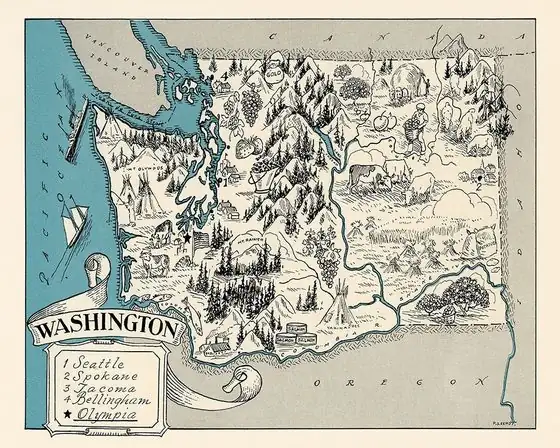
Yakima, Washington: Black Bear, Runaway or Lake Water?
Yakima took its name from the river and the people who lived along it, but no one agrees on what the word means. A 1905 federal guide said "black bear" or "coward," a Smithsonian handbook said "runaway," and a pioneer said "lake water." The city itself says nobody really knows for sure.
A word on the river first
Old books translate Yakima, Washington, as “black bear,” “runaway” or “lake water,” and the city’s history says nobody really knows how it got its name. What isn’t in doubt is where the city found it. The word was on the river, and on the people who lived along it, long before there was a town.
Edmond Meany’s 1923 book on Washington place names calls Yakima one of the most widely used names in the state: a county, a city, a river, a valley, a pass in the Cascades, a people and a reservation. As in many other cases, he wrote, “the name was first applied to the river and the natives who occupied the land drained by the river.” The outsiders who wrote it down couldn’t agree on how to spell it. David Thompson of the North West Company put down “Skaemena” on July 8, 1811. Alexander Ross, who came through the same year, used “Eyakema” in a book he published in 1849. The Wilkes Expedition spelled the river the modern way in 1841, and the treaty Governor Isaac Stevens framed on June 9, 1855, used “Yakama.”
That second spelling never went away. HistoryLink, Washington’s online encyclopedia, calls the people of the reservation the Confederated Tribes and Bands of the Yakama Nation, while the city, county and river kept the “i.”
Three translations and a legend
That’s where it gets tangled. Henry Gannett’s survey bulletin on the origins of American place names, published in 1905, said Yakima was “said to have been named for a tribe of Indians, the name meaning ‘black bear,’ or, according to other authorities, ‘coward.’” The Smithsonian’s Bureau of American Ethnology, in its Handbook of American Indians, gave it as “runaway.” And Meany found a letter from John H. Lynch of Yakima, who quoted the pioneer Jack Splawn as his authority for “lake water.”
Meany printed all of them side by side and didn’t pick one. Neither does the city. Its history page says plainly, “Nobody really knows for sure how Yakima got its name.” It mentions a popular legend about a chief’s daughter who broke tribal rules, fled her home and settled along the river, near where the city stands now. It also mentions the belief that Yakima is a plural of a Native word for black bear, “yah-kah.”
You’ll notice what’s missing. None of these sources quotes a speaker of the language explaining the word, and none of them shows its work. Gannett hedged with “said to,” the handbook gave a single word without an explanation, and the “lake water” version came secondhand through a letter. So the safest version is the city’s: the name is old, it belongs to the river and its people, and its meaning isn’t settled.
The town that rolled north
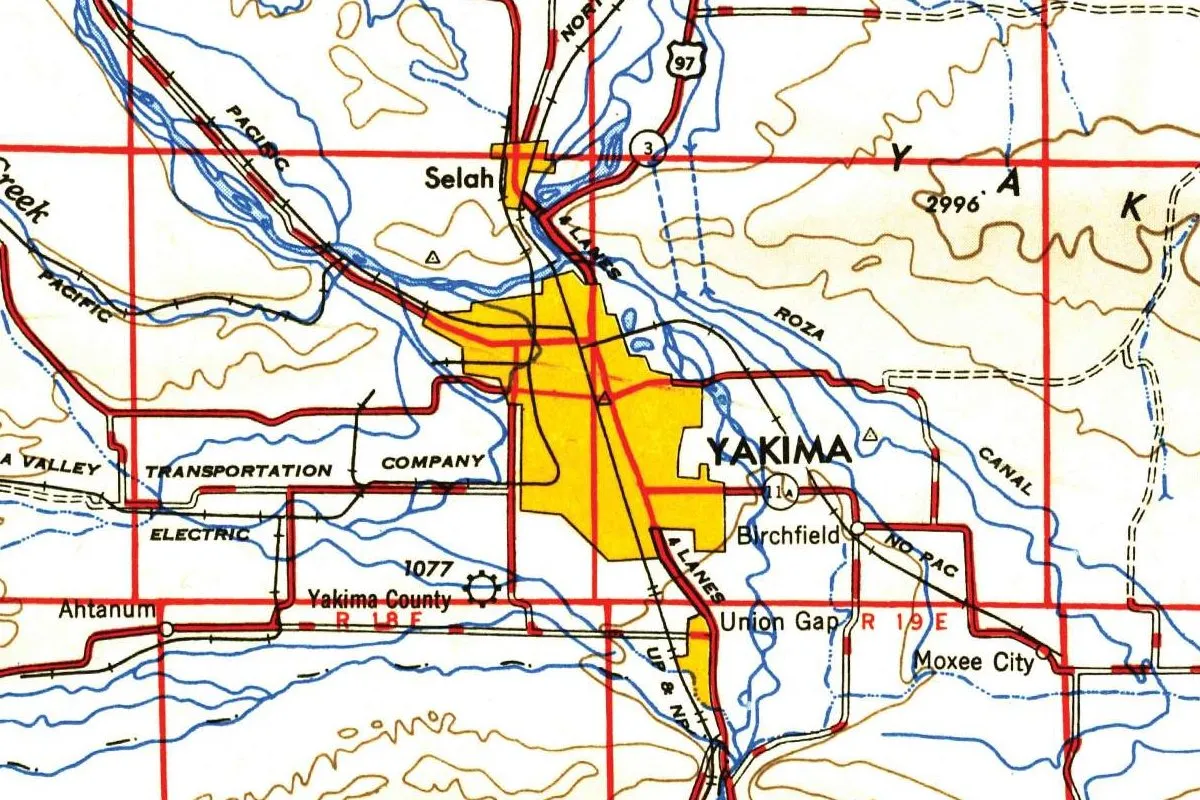
The city’s own name has a much clearer paper trail, and a strange one. There was a Yakima before today’s Yakima. HistoryLink says a small village farther south, near Ahtanum Creek, grew up in the 1860s and came to be called Yakima City. Meany notes that the territorial legislature created Yakima County on January 21, 1865, and HistoryLink says Yakima City became the county seat in 1870. Then the Northern Pacific Railway came up the valley. Bancroft says its surveyors laid out a brand-new town about 4 miles (6 km) away a year after Yakima City’s incorporation, and HistoryLink has the railroad arriving in 1885. They called it North Yakima.
Hubert Howe Bancroft, writing in 1890, described what happened next in a footnote that’s hard to beat:
“Such an agreement in writing was signed by a majority of the citizens, and in the winter and spring of 1884-5 over 100 buildings were moved on trucks and rollers, hotels, a bank, and other business houses doing their usual business while en route.”
In other words, Yakima City picked itself up and went north, and some of its shops stayed open on the way. Not everyone went happily. HistoryLink tells of a diehard who dynamited the Yakima City Signal newspaper building rather than let it be moved, and of the owner who gathered up the lumber and rebuilt in North Yakima anyway.
Dropping the “North”
North Yakima was incorporated in 1886 and took the county seat. For the next three decades the bigger town carried a direction in front of its name, while the old town to the south kept the plain one. Meany says a state law approved January 30, 1917, let the city drop “North” starting January 1, 1918, and that the same legislature renamed the older town Union Gap. HistoryLink adds that the change came at the request of the Post Office, which didn’t like two cities side by side with the same word in their names.
So when you read an old newspaper about “Yakima,” check the date. Before 1918 it may well mean the town that’s now Union Gap. The name that city in Washington finally kept is the river’s, and the river’s name is older than anyone’s explanation of it.
Quick answers
What does the name Yakima mean?
Nobody agrees. The 1905 Gannett entry said “black bear” or “coward,” the Bureau of American Ethnology’s handbook said “runaway,” and a pioneer quoted by Meany said “lake water.” The City of Yakima says nobody really knows for sure.
Was Yakima ever called North Yakima?
Yes. The Northern Pacific laid out the town as North Yakima in 1884-85, and a state law let it drop “North” as of January 1, 1918.
Is Union Gap the original Yakima?
Yes. Union Gap was Yakima City, incorporated December 1, 1883, about 4 miles (6 km) south of the new railroad town. The legislature renamed it Union Gap in 1917.
Why are there two spellings, Yakima and Yakama?
Both are old. The 1855 treaty spelled it “Yakama,” which is the spelling of the Yakama Nation today. “Yakima,” the form the Wilkes Expedition used in 1841, is the one on the river, the county and the city.
Key dates
- 1811July 8: David Thompson of the North West Company writes down the people of the river as "Skaemena."
- 1841The Wilkes Expedition uses the spelling Yakima for the river.
- 1855June 9: the treaty framed by Governor Isaac Stevens refers to the river and tribe as "Yakama."
- 1865January 21: the territorial legislature creates Yakima County.
- 1883December 1: Yakima City, the older town to the south, is incorporated.
- 1885The Northern Pacific reaches the valley; over 100 buildings are moved from Yakima City to North Yakima in the winter and spring of 1884-85.
- 1886North Yakima is incorporated and becomes the county seat.
- 1918January 1: a 1917 state law takes effect and North Yakima becomes simply Yakima. The old Yakima City had already become Union Gap.
Getting there
Open Yakima in Google Maps
Opens in a new tab. The pin is the center of Yakima in the USGS place-name record.
The closest airports, Amtrak stations and intercity bus stops, measured in a straight line from the center of Yakima.
Airports
- Yakima Air Trml/McAllister Field (YKM) 3 mi 5 km
- Pangborn Memorial (EAT) East Wenatchee 57 mi 91 km
- Seattle-Tacoma International (SEA) 103 mi 166 km
Amtrak trains
- Wenatchee station (WEN) 57 mi 92 km
- Ephrata station (EPH) 67 mi 108 km
Intercity buses
- Greyhound Yakima Tall Mens Supermarket under 1 mi 0.9 km
- Grape Line Travel Washington · Yakima Air Terminal 3 mi 4 km
- Apple Line Travel Washington · Ellensburg (CWU) 28 mi 44 km
Distances are as the crow flies, not by road. We don't list schedules or fares because they change; check with the airline, Amtrak or the bus company before you go. Official data (FAA commercial service airports (2025), FAA airport locations, Amtrak stations and Intercity Bus Atlas) from the FAA and the U.S. Bureau of Transportation Statistics, checked Nov 13, 2026.
Sponsored
Staying in Yakima?
Compare hotels in Yakima, Washington, on Expedia.
See hotels in YakimaWe may earn a commission if you buy through this link. It never changes what we write. Read our affiliate disclosure
Historical Sources & References
- Hubert Howe Bancroft, History of Washington, Idaho, and Montana, 1845-1889 (1890), pp. 298-299, note 73. Yakima City incorporated December 1, 1883; the Northern Pacific’s surveyors laying out North Yakima 4 miles away; the written agreement and the more than 100 buildings moved “on trucks and rollers” in the winter and spring of 1884-85.
- Henry Gannett, The Origin of Certain Place Names in the United States (USGS, 1905), p. 332. Yakima “said to have been named for a tribe of Indians, the name meaning ‘black bear,’ or, according to other authorities, ‘coward.’”
- Frederick Webb Hodge, ed., Handbook of American Indians North of Mexico, part 2 (1910), p. 983. The entry “Yakima,” glossed as “runaway,” an important Shahaptian tribe on the river formerly called Tapteal, and the treaty that created the reservation.
- Edmond S. Meany, Origin of Washington Geographic Names (1923), pp. 354-355. The name first applied to the river and its people; Thompson’s “Skaemena” (1811), Ross’s “Eyakema,” Wilkes (1841), Stevens’s “Yakama” (1855); Yakima County (1865); the “lake water,” “black bear” and “runaway” versions; Bancroft’s account; and the 1917 law that dropped “North” as of 1918 and renamed the old town Union Gap.
- City of Yakima, “About Yakima”. “Nobody really knows for sure how Yakima got its name,” the chief’s daughter legend, the “yah-kah” black bear belief, and North Yakima’s move and renaming.
- Jim Kershner, “Yakima – Thumbnail History” (HistoryLink.org). Yakima City near Ahtanum Creek and county seat in 1870, the Northern Pacific’s arrival in 1885, the dynamited newspaper building, North Yakima’s incorporation in 1886, the Post Office’s request behind the 1917-1918 renamings, and the Yakama Nation.
- GNIS feature 1509643 (U.S. Geological Survey). The city’s record in the national names system, which gives this page its ID.
- U.S. Geological Survey, Yakima sheet (1950). A 1950 topographic sheet showing Yakima with Union Gap, the old Yakima City, just to the south.
Spot something wrong, or know more? Tell us here. You can also email us or use our contact page. Corrections are noted here with their date, never made silently.