Pasco, Washington: Named for Peru, or Maybe Mexico
Pasco, Washington, got its name from a railroad engineer thinking of a town far away, but the stories can’t agree whether it was in Peru or in Mexico. They don’t even agree on the engineer.
The Peru story
The version most people tell comes from Cerro de Pasco, a mining town high in the Andes. HistoryLink’s David Wilma says that on November 28, 1884, the Northern Pacific established Pasco where the Snake meets the Columbia, and that its engineer Virgil G. Bogue “names the site after the Andean mining town of Cerro de Pasco in Peru, which was also windy and dry.” Jim Kershner’s 2008 history of the city calls this “the most likely and most widely accepted” story, and traces it to Captain William P. Gray, who said Bogue had recently built a railroad through the Andes.
There’s a twist inside that story, though. Edmond Meany, writing in 1923, cites a letter from Lewis A. McArthur for a version in which the name was picked “by way of contrast.” In this telling the namer was Harry McCartney, who worked with Bogue as a locating engineer: “Pasco was the flattest and hottest place he had found while Cerro de Pasco, Peru, was the highest and coldest place he had ever been in.”
So even if you take the Peru story, you have to choose. Did Pasco remind somebody of Cerro de Pasco, or was it the exact opposite?
The Mexico story
Meany’s first version doesn’t mention Peru at all. He credits Bogue, “Location Engineer of the Northern Pacific Railroad,” and, citing a letter from F. W. Dewart of Spokane, writes that “At that time the place was dusty, hot and disagreeable. He had read of a disagreeable town in Mexico by that name and gave it to the new station with no suspicion that it would become an important county seat and railroad center.”
Kershner lists that one too, along with a fourth story, told without any source: that an engineer stuck for a name glanced at a railroad car marked with the initials of the Pacific American Shipping Co., PASCO.
Ainsworth moves up the river
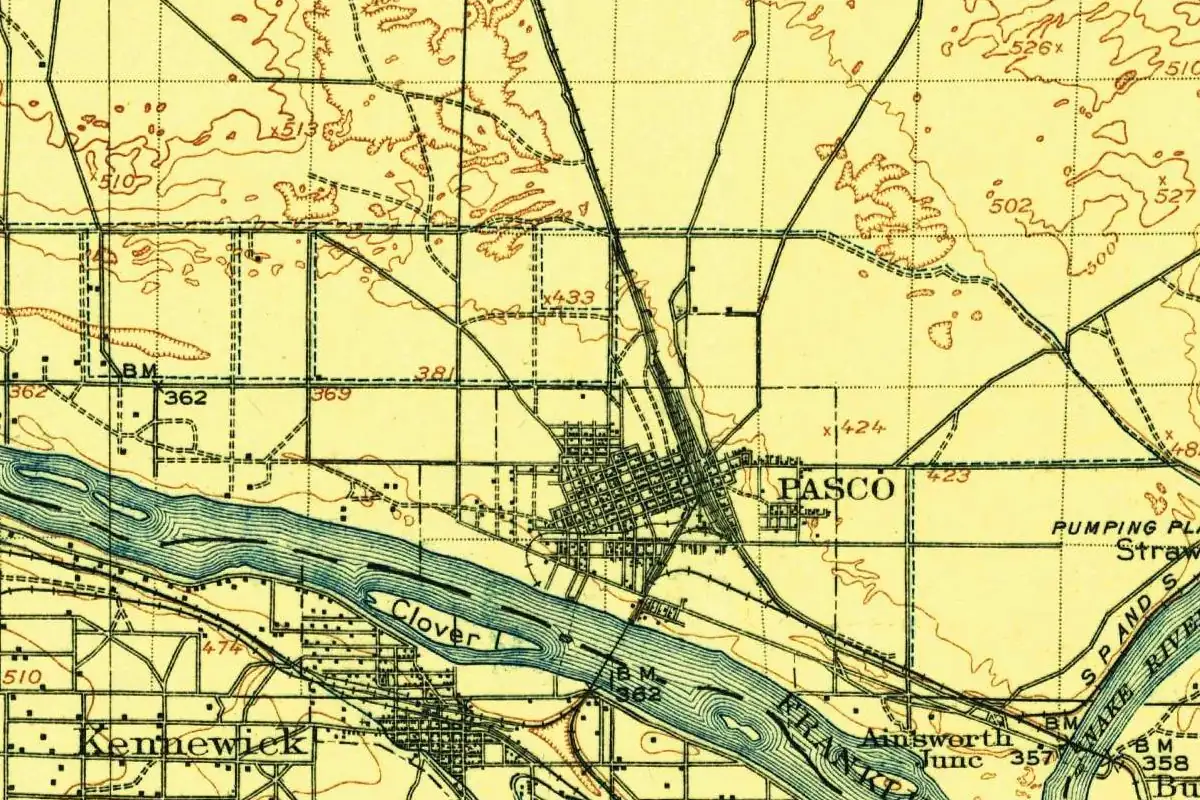
What’s not in doubt is that Pasco replaced another railroad town. The Northern Pacific built Ainsworth on the north bank of the Snake in 1879 as a construction camp, and Meany says that town was named for J. C. Ainsworth, “a prominent railroad man of the West.” Once the Snake River bridge was finished in 1884, Wilma writes, the railroad abandoned Ainsworth and moved its operations and buildings about two miles (3 km) up the Columbia. The landing at the new spot had been called Hummely and Melton before Bogue picked the name Pasco.
The federal names file gives the short version: founded in 1884, incorporated in 1891. The two HistoryLink writers don’t quite agree on the dates, though. Kershner says the railroad set up the new townsite in early 1885, not November 1884, and that by February 1885 many of Ainsworth’s buildings had been taken apart and moved there. He has the county seat going to Pasco that December, while Wilma has the courthouse moving in 1887. Either way, Ainsworth itself didn’t last: Wilma says it was officially “vacated, set aside and annulled” in 1898. Bogue, by the way, was also the engineer the Northern Pacific sent to find a tunnel site over the Cascades, on the line that later gave us the helper town of Lester.
Quick answers
Is Pasco, Washington, named after Cerro de Pasco in Peru?
It’s the most common answer, but it’s disputed. The usual story says engineer Virgil Bogue named it for Cerro de Pasco, which was also dry and windy. Meany (1923) also prints a version that ties it to a “disagreeable town in Mexico.”
Who named Pasco, Washington?
The sources disagree. Most credit Northern Pacific engineer Virgil G. Bogue, but one letter in Meany’s book says it was his fellow locating engineer, Harry McCartney.
Was Pasco named because it looked like Peru or because it didn’t?
Both stories exist. One says the dry site reminded Bogue of Cerro de Pasco; another says McCartney chose the name by contrast, because Pasco was flat and hot and Cerro de Pasco was high and cold.
Key dates
- 1879The Northern Pacific builds Ainsworth at the mouth of the Snake River as a construction camp.
- 1884The Snake River bridge is finished, and the Northern Pacific establishes Pasco on November 28, according to Wilma.
- 1885Buildings from Ainsworth are moved to the new townsite, and Pasco becomes the county seat in December.
- 1891Pasco is incorporated.
Getting there
Open Pasco in Google Maps
Opens in a new tab. The pin is the center of Pasco in the USGS place-name record.
The closest airports, Amtrak stations and intercity bus stops, measured in a straight line from the center of Pasco.
Airports
- Tri-Cities (PSC) Pasco 2 mi 3 km
- Walla Walla Regional (ALW) 40 mi 65 km
Amtrak trains
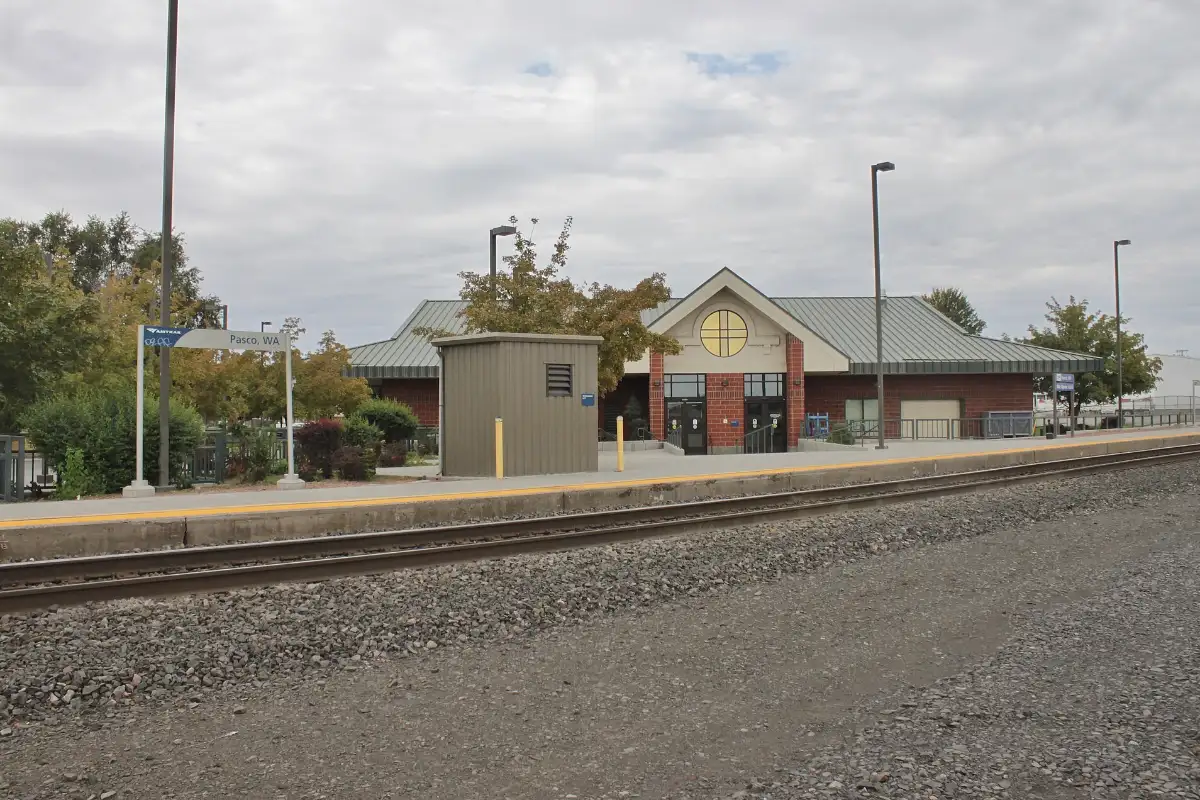
- Pasco station (PSC) under 1 mi 1 km
- Ephrata station (EPH) 78 mi 125 km
Intercity buses
- Wheat Line Travel Washington · Pasco Intermodal under 1 mi 1 km
- Grape Line Travel Washington · Pasco Intermodal under 1 mi 1 km
- Northwestern Stage Lines Pasco under 1 mi 1 km
Distances are as the crow flies, not by road. We don't list schedules or fares because they change; check with the airline, Amtrak or the bus company before you go. Official data (FAA commercial service airports (2025), FAA airport locations, Amtrak stations and Intercity Bus Atlas) from the FAA and the U.S. Bureau of Transportation Statistics, checked Nov 6, 2026.
Sponsored
Staying in Pasco?
Compare hotels in Pasco, Washington, on Expedia.
See hotels in PascoWe may earn a commission if you buy through this link. It never changes what we write. Read our affiliate disclosure
Historical Sources & References
- Edmond S. Meany, Origin of Washington Geographic Names (1923), pp. 2 and 208. Bogue and the “disagreeable town in Mexico” (from F. W. Dewart); McCartney and the contrast with Cerro de Pasco (from Lewis A. McArthur); Ainsworth, named for J. C. Ainsworth.
- David Wilma, “Northern Pacific Railroad establishes Pasco on November 28, 1884,” HistoryLink.org Essay 5194 (2003). Pasco established on November 28, 1884; Bogue and Cerro de Pasco, “also windy and dry”; Ainsworth abandoned after the bridge and “vacated, set aside and annulled” in 1898; the landing once called Hummely and Melton; the courthouse moved in 1887.
- Jim Kershner, “Pasco – Thumbnail History,” HistoryLink.org Essay 8604 (2008). The four stories about the name and Captain William P. Gray; Ainsworth as a construction camp from 1879; the buildings moved by February 1885; the county seat in December 1885.
- GNIS feature 1513388 (U.S. Geological Survey). The national names file for Pasco: founded in 1884, incorporated in 1891.
Spot something wrong, or know more? Tell us here. You can also email us or use our contact page. Corrections are noted here with their date, never made silently.