Morgantown, West Virginia: Zackquill Morgan's Town
Morgantown is named for Zackquill Morgan, a frontier settler and Revolutionary War officer who held the land at the mouth of Deckers Creek. In October 1785 the Virginia General Assembly vested 50 acres of his property in five trustees and established a town "by the name of Morgans-town." The spelling settled into Morgantown over the following decades.
Fifty acres and a town by law
Morgantown, West Virginia, was born in a 1785 Virginia law that turned 50 acres of Zackquill Morgan’s land into a town “by the name of Morgans-town.” So the name is about as direct as it gets: the town sat on Morgan’s land, and it was called Morgan’s town. West Virginia didn’t exist yet. This was Monongalia County, Virginia, and it was the General Assembly in Richmond that did the naming.
You can still read the act. William Waller Hening printed it in 1823 in the twelfth volume of his collection of Virginia’s laws, as chapter 97 of the October 1785 session. Its title is plain enough: “An act to establish a town on the lands of Zackquell Morgan, in the county of Monongalia.” Note the spelling. We’ll come back to it.
The act put the land in the hands of five trustees, Samuel Hanway, John Evans, David Scot, Michael Kearnes and James Daugherty, who were to lay it out in half-acre lots. Then came the line that matters:
“…with convenient streets, which shall be, and the same are hereby established a town, by the name of Morgans-town.”
No apostrophe, a hyphen, a lowercase t. The lots were to be auctioned after two months of ads in the Virginia Gazette, the money went to Morgan, and every buyer had four years to put up a house at least 18 feet (5.5 m) square with a brick or stone chimney. That’s the whole birth certificate of a city.
Zackquell, Zackwell, Zackquill
Back to that first name. Samuel T. Wiley, who wrote the big 1883 history of Monongalia County, noticed that the old records couldn’t agree on it. He listed several spellings and pointed out that Morgan’s own signature on a deed read “Zack.ll.” Wiley went with Zackwell, and he wondered whether the name was “perhaps, a corruption of Jacquelin.” That’s a guess, and he said so. The West Virginia Encyclopedia and the city today write Zackquill. And in 1905, Henry Gannett’s alphabetical rundown of American place names for the U.S. Geological Survey added one more: Morgantown, it said, was “named for Gen. Zacquell Morgan, the original owner of the land.” The “Gen.” is Gannett’s; the encyclopedia gives him the rank of colonel.
Whatever the spelling, Wiley was sure about the namesake. His chapter on the town opens by saying Morgantown “was named for the adventure-loving and Indian-fighting pioneer, Zackwell Morgan.”
The encyclopedia fills in the man. Zackquill Morgan was born in Berkeley County in 1735, the seventh of eight children of Col. Morgan Morgan, who is traditionally considered the first European-American settler of West Virginia. Zackquill and his brother David fought in Braddock’s expedition of 1755 and Forbes’s of 1758. Early in the Revolution he was made county lieutenant with the title of colonel, and he fought under General Gates at Saratoga in 1777.
Who got there first
If you go looking for the year Morgan arrived, you’ll find several. The city says 1772. The encyclopedia says he moved to the area about 1771 and claimed land along the Monongahela and Deckers Creek “by tomahawk right.” Wiley collected even more: Col. William Crawford swore in a deposition that “Zachel Morgan” came out in 1766, and Alexander Withers’s Border Warfare put David and Zackwell Morgan there in 1768.
Then Wiley found a snag in the paperwork. The county’s first survey book named Isaac Lemasters as the first owner of the site, settling in 1772, with Morgan getting the land as Lemasters’s assignee. Why would a man who’d been living there for years take the title through someone else? “No one knows,” Wiley wrote. Others had been there before either of them, too. Wiley quotes Border Warfare on Thomas Decker and others starting a settlement at the mouth of Decker’s Creek in the fall of 1758.
What’s not in doubt is the deed. The encyclopedia says Morgan’s claim was surveyed and deeded to him on April 29, 1781. On 50 acres of it, Maj. William Haymond laid out streets and lots in 1783 and 1784, and Morgan started selling parcels. He kept an “ordinary,” a tavern or inn, and the General Assembly made his house the county courthouse until a real one could be built. George Washington came through in 1784 and talked roads with him.
So by the time the 1785 act passed, there was already a little town on Morgan’s land. The law made it official and gave it his name. It even said the trustees couldn’t resell any lot Morgan had already sold.
From Morgans-town to Morgantown
The name didn’t sit still on paper. The city’s own history calls it “Morgan’s Town,” and the encyclopedia says “Morgan’s Town was established by the General Assembly on October 17, 1785.” Hening’s printed act has “Morgans-town,” and Wiley, retelling it, wrote “Morgans-Town.”
Two years later, the lawmakers were already shortening it. An act passed on December 22, 1787, printed in the same volume, mentions a wagon road “from Morgan-town, in the county of Monongalia,” to the mouth of Fishing Creek on the Ohio River. By February 3, 1838, when the town was incorporated, Wiley gives its legal name as “The Borough of Morgantown.” The encyclopedia counts about 650 people at that first charter.
Morgan didn’t see much of that. He died on January 1, 1795, and was buried in the cemetery at Pricketts Fort. In 1925 some Morgantown citizens tried to move his remains to the town that carries his name. It didn’t work, and in 1927 a granite monument was put up at his grave instead.
The town on the 1902 map
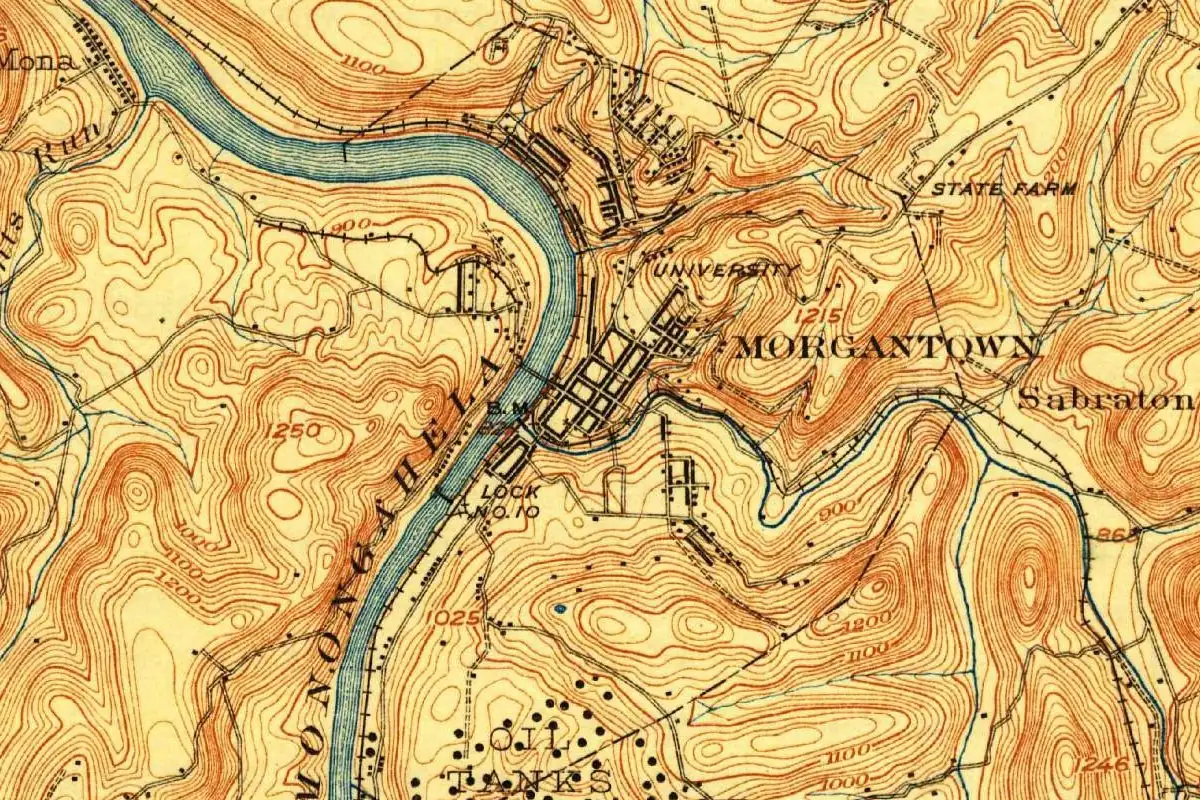
Look at the map at the top of this page and you’ll see the town the act laid out, still hugging the east bank of the Monongahela. The U.S. Geological Survey surveyed it in 1900. By then the 1867 college had become West Virginia University, labeled just north of town, and Sabraton shows up to the east. The encyclopedia says Morgantown barely grew beyond its original 1785 boundaries until the mid-1890s.
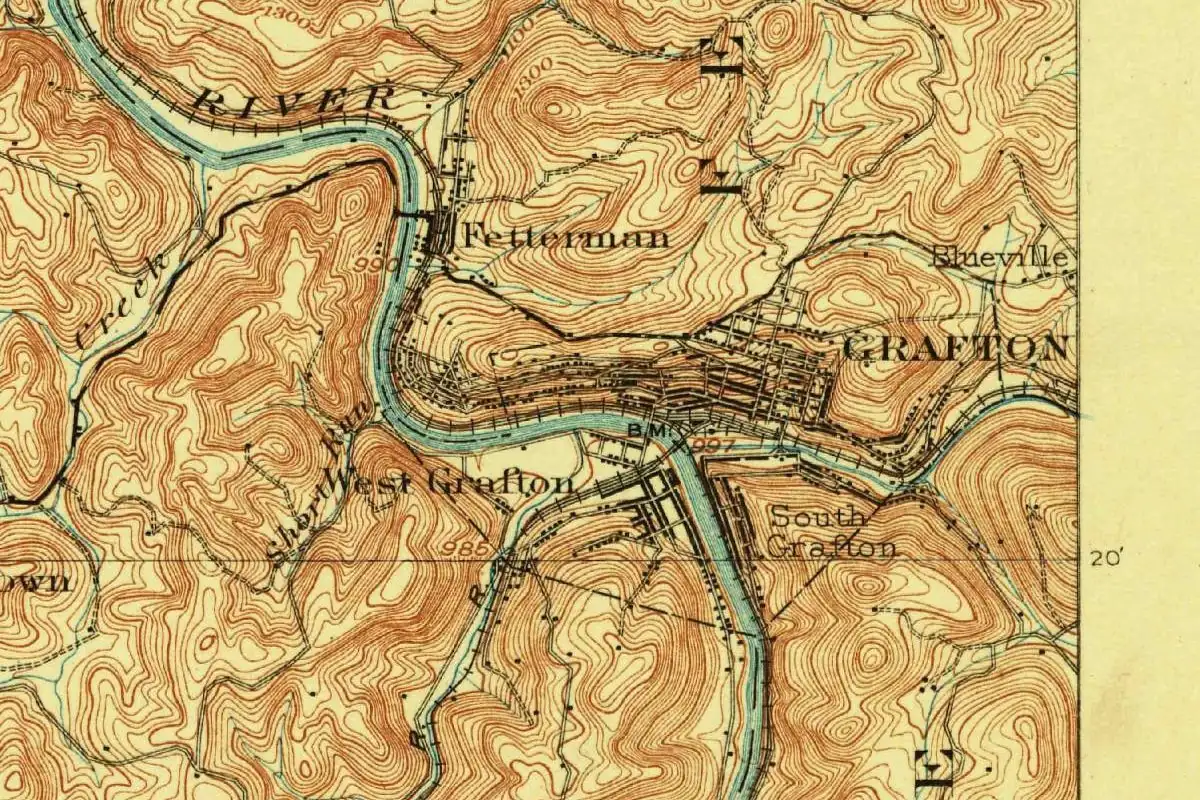
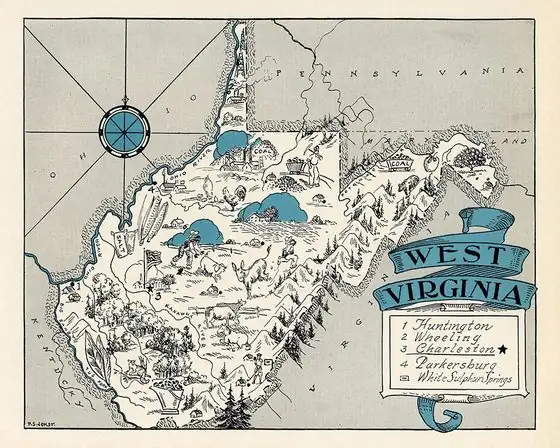
Morgantown isn’t the only West Virginia town that began as a Virginia act before the state split off. Grafton got its charter from the same General Assembly in 1856. Follow the Monongahela north from Morgantown, the way early boat builders sent migrants toward the Ohio, and you end up in Pittsburgh. The rest of the state’s town names are on our West Virginia page.
Quick answers
Who was Morgantown, WV, named after?
Zackquill Morgan, a frontier settler and Revolutionary War colonel. The 1785 act set the town on 50 acres of his land, and Wiley’s 1883 county history says outright that it was named for him.
Was Morgantown once called Morgan’s Town?
Yes, in effect. The 1785 Virginia act spelled it “Morgans-town,” the city writes “Morgan’s Town,” and a 1787 act already used “Morgan-town.”
When was Morgantown founded?
The Virginia General Assembly established it in October 1785; the encyclopedia and the city give October 17. Streets and lots had been laid out on Morgan’s land in 1783 and 1784, and the town was incorporated in 1838.
Why are there different spellings of Zackquill?
The old records disagree. The 1785 act has Zackquell, Gannett printed Zacquell, and Wiley found several more, noted that Morgan signed a deed “Zack.ll,” and suggested the name was perhaps a corruption of Jacquelin.
Key dates
- 1781On April 29, Zackquill Morgan's land at the mouth of Deckers Creek is surveyed and deeded to him.
- 1785In October, the Virginia General Assembly establishes a town on 50 acres of Morgan's land "by the name of Morgans-town."
- 1787A Virginia act passed on December 22 already spells it Morgan-town.
- 1795Zackquill Morgan dies on January 1 and is buried at Pricketts Fort.
- 1838Incorporated on February 3 as "The Borough of Morgantown."
Things to do in Morgantown, West Virginia
Core Arboretum
West Virginia University's 91-acre (37-hectare) arboretum, with 3.5 miles (5.6 km) of trails through old-growth and floodplain forest and a big show of woodland wildflowers in April.
WVU Personal Rapid Transit (PRT)
An automated people mover running since October 1975 on 8.7 miles (14 km) of its own guideway, linking five stations between downtown and the campuses. The U.S. Department of Transportation paid for it and Boeing built it.
Mon River Rail-Trails
Three linked rail-trails, the Mon River, Caperton and Deckers Creek trails. The paved Caperton Trail runs 6 miles (10 km) through Morgantown and Star City, and the Deckers Creek trail climbs along the creek for 19.5 miles (31 km).
Prickett's Fort State Park
A living-history park at the south end of the Mon River Trail, with an 18th-century re-creation of the original fort, the 19th-century Job Prickett House, the Prickett Cemetery and a museum.
Getting there
Open Morgantown in Google Maps
Opens in a new tab. The pin is the center of Morgantown in the USGS place-name record.
The closest airports, Amtrak stations and intercity bus stops, measured in a straight line from the center of Morgantown.
Airports
- Morgantown Municipal/Walter L Bill Hart Field (MGW) 2 mi 4 km
- North Central West Virginia (CKB) Clarksburg 27 mi 44 km
- Pittsburgh International (PIT) 61 mi 99 km
Amtrak trains
- Connellsville station (COV) 33 mi 53 km
- Greensburg station (GNB) 51 mi 83 km
Intercity buses
- Barons Bus Lines Morgantown Mt Line 1 mi 2 km
- Greyhound Morgantown Mountaineer Station Wvu 2 mi 3 km
- BayRunner Shuttle Grantsville 46 mi 74 km
Distances are as the crow flies, not by road. We don't list schedules or fares because they change; check with the airline, Amtrak or the bus company before you go. Official data (FAA commercial service airports (2025), FAA airport locations, Amtrak stations and Intercity Bus Atlas) from the FAA and the U.S. Bureau of Transportation Statistics, checked Nov 14, 2026.
Sponsored
Staying in Morgantown?
Compare hotels in Morgantown, West Virginia, on Expedia.
See hotels in MorgantownWe may earn a commission if you buy through this link. It never changes what we write. Read our affiliate disclosure
Historical Sources & References
- William Waller Hening, The Statutes at Large … of Virginia, vol. 12 (1823), ch. XCVII, pp. 212-214. The October 1785 act “to establish a town on the lands of Zackquell Morgan”; the 50 acres, the five trustees, the half-acre lots and the quoted line “by the name of Morgans-town”; the lot sale, the Virginia Gazette ads and the 18-foot house rule; lots Morgan had already sold. Page 212 is the previous page.
- William Waller Hening, The Statutes at Large … of Virginia, vol. 12 (1823), p. 513. The act passed December 22, 1787, with the wagon road “from Morgan-town.”
- Samuel T. Wiley, History of Monongalia County (1883), p. 37. The footnote on the spellings of Morgan’s first name, the signature “Zack.ll” and “perhaps, a corruption of Jacquelin”; Crawford’s deposition about 1766.
- Samuel T. Wiley, History of Monongalia County (1883), p. 568. Morgantown “was named for the adventure-loving and Indian-fighting pioneer, Zackwell Morgan.”
- Samuel T. Wiley, History of Monongalia County (1883), pp. 570-571. The Deckers in 1758, from Border Warfare; Withers’s 1768; Isaac Lemasters in the first survey book, 1772; “No one knows.”
- Samuel T. Wiley, History of Monongalia County (1883), pp. 575-576. “Morgans-Town” established in October 1785; incorporation on February 3, 1838, as “The Borough of Morgantown.”
- Henry Gannett, The Origin of Certain Place Names in the United States, 2nd ed. (1905), p. 215. Morgantown “named for Gen. Zacquell Morgan, the original owner of the land.”
- Harold Malcolm Forbes, “Zackquill Morgan,” e-WV. Birth in 1735, Col. Morgan Morgan, Braddock and Forbes, tomahawk right about 1771, Saratoga; the April 29, 1781, deed; Haymond’s survey of 1783-84; the ordinary and the courthouse; Washington’s 1784 visit; October 17, 1785; death in 1795, burial at Pricketts Fort, the 1925 attempt and the 1927 monument.
- Barbara J. Howe, “Morgantown,” e-WV. The 1838 charter with 650 residents; boats heading north on the Monongahela to the Ohio; West Virginia University from the 1867 college; little growth beyond the 1785 boundaries until the mid-1890s.
- City of Morgantown, “History”. Settled in 1772 by Zackquill Morgan; the charter for “Morgan’s Town” on October 17, 1785.
- GNIS feature 1555161 (U.S. Geological Survey). The GNIS entry for Morgantown, in Monongalia County.
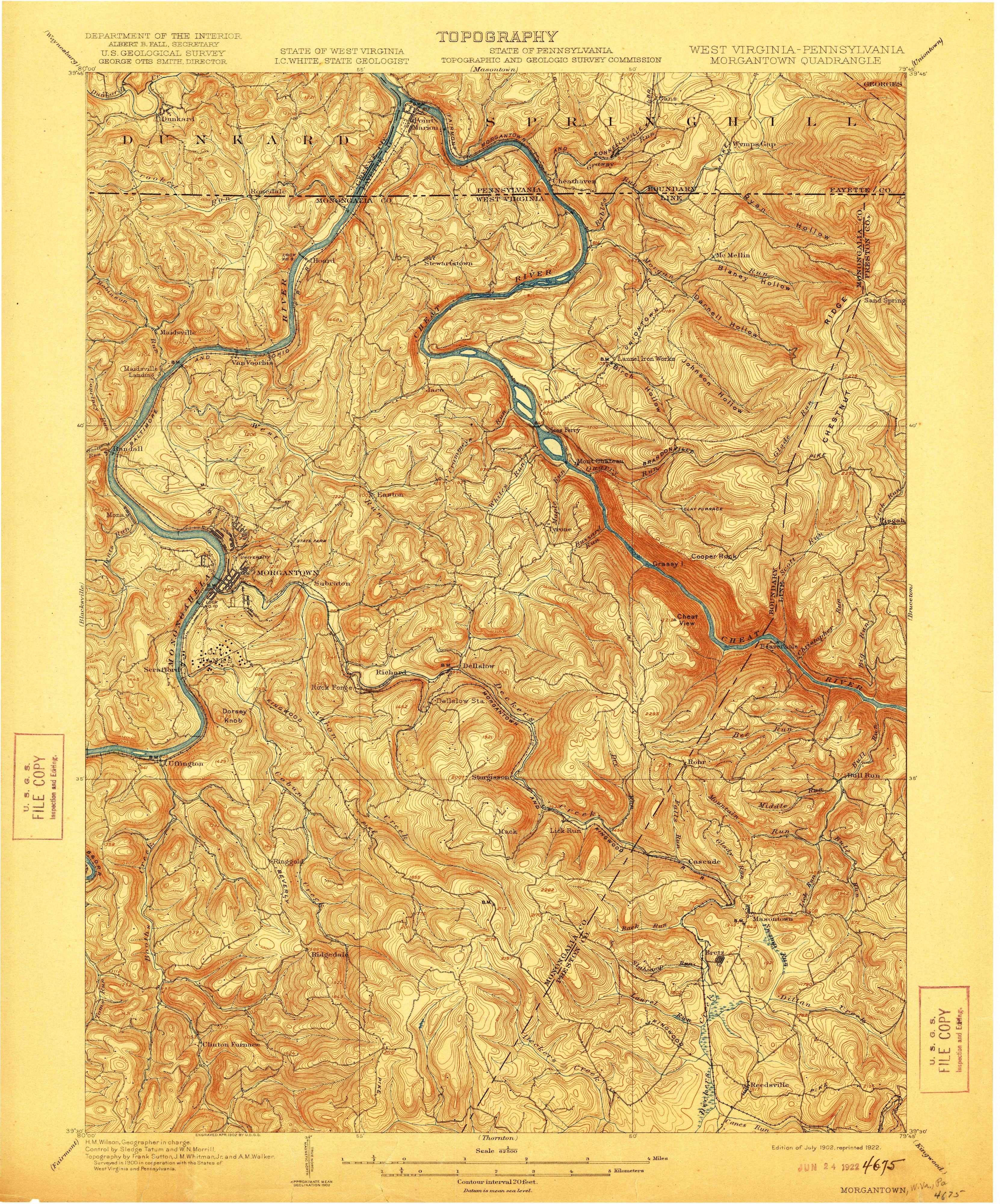
- U.S. Geological Survey, Morgantown sheet (1902, 1922 reprint). The 1:62,500 quadrangle, surveyed in 1900, that the map at the top of this page was cropped from.
Sponsored
Put this 1902 map on your wall
The 1902 USGS Morgantown sheet (West Virginia and Pennsylvania), in a 1922 reprint, is in the public domain. Download the full-size scan for free, then have it printed on canvas with CanvasOnTheCheap.
Print a map on canvasDownload the full-size mapWe may earn a commission if you buy through this link. It never changes what we write. Read our affiliate disclosure
Spot something wrong, or know more? Tell us here. You can also email us or use our contact page. Corrections are noted here with their date, never made silently.