What Does Talkeetna Mean? The River Behind the Name
Talkeetna is named for the Talkeetna River, and the river's Native name has two translations. Surveyors G. H. Eldridge and Robert Muldrow reported in 1898 that it was 'said to mean river of plenty,' as Marcus Baker put it in 1906. A Dena'ina place-name list compiled by James Kari gives the river and townsite as K'dalkitnu, 'Food Is Stored River.'
Talkeetna, Alaska, carries the Dena’ina name of its river, and the translations don’t agree: river of plenty, or food is stored river. Both go back to the same word. The difference is who wrote it down, and when.
What the surveyors heard in 1898
The first written explanation comes from two Geological Survey men, G. H. Eldridge and Robert Muldrow, who reported the name in 1898. Marcus Baker’s Geographic Dictionary of Alaska, published by the Survey in 1906, passes on what they reported. Under the Talkeetna River, Baker writes:
“Native name, from Eldridge and Muldrow, 1898, who wrote Talkeetna, i. e., Talkeet river, said to mean river of plenty.” (Baker, p. 614)
Two things are worth noticing. First, “said to mean”: Baker isn’t vouching for the translation himself. Second, he splits the word as Talkeet-na and glosses it as “Talkeet river.” Under the Talkeetna Mountains, he adds that Eldridge proposed that name in 1898 and noted that “the last syllable is often pronounced no,” so you might have heard Talkeet-no.
Donald Orth’s 1967 Dictionary of Alaska Place Names says much the same. It calls Talkeetna a “Tanaina Indian name” that was “reported in 1898 to mean ‘river of plenty’ by G. H. Eldridge and Robert Muldrow, USGS.” It also lists older spellings, among them Talkeetno, Talkitnu and Talkutna. In 1993 the National Register nomination for the Talkeetna Historic District put it flatly: “Talkeetna means ‘River of Plenty’ and comes from the Tanaina Indian language.”
That’s three sources, but they aren’t three separate witnesses. Baker and Orth both credit the 1898 report, and the 1993 form repeats the same phrase. They all lead back to what Eldridge and Muldrow were told.
K’dalkitnu, “food is stored river”
The other translation comes from the Dena’ina language itself. A Park Service study of Denali’s ethnographic landscapes says a mixed band of Dena’ina and Ahtna, called the “mountain people,” used the Talkeetna River drainage, while a Dena’ina band known as the Susitna River people held the country north from the Susitna’s mouth. Dena’ina Qenaga, a digital archive of the language, lists the river and the townsite together as K’dalkitnu, “Food Is Stored River.” Its source is James Kari, the linguist who compiled a dictionary and a list of Dena’ina place names, the list dated 1994.
Food stored, or plenty: the two ideas aren’t far apart, but they aren’t the same claim either. One says the river was rich, and the other names a practice, storing food. The sources here don’t settle which is closer to what the name meant to the people who gave it, so both stay on the table.
From a supply station to a railroad camp
The town got the river’s name early. The 1993 nomination says prospectors found gold at Cache Creek in 1906 and that “within a couple of years” miners were coming to Talkeetna for supplies. In 1910 the Alaska Commercial Company set up a little trading post named “Talkeetna” at the meeting of the Chulitna, Talkeetna and Susitna rivers. It closed by 1912.
The railroad brought it back. In 1915, President Woodrow Wilson picked the Susitna River and Broad Pass route for the government railroad, and in 1916 the Alaska Engineering Commission picked Talkeetna to run one of its construction districts. A post office opened that year. The commission surveyed a townsite in September 1918, and in October 1919 residents bought 80 lots at auction. Anchorage started the same way, as a construction camp for that railroad, though Talkeetna, as the nomination notes, never grew as large or as fast. It never incorporated, either.
Orth puts the village at mile 226.7 of the Alaska Railroad, and the nomination says it’s 226 miles (364 km) from Seward and 259 miles (417 km) from Fairbanks, about 115 miles (185 km) north of Anchorage, in southcentral Alaska. Naming a town for its river is an old habit elsewhere too. Chicago got its name from a Native word for its river, which the oldest records tie to wild garlic, and Flint, Michigan, borrowed its river’s name as well.
Talkeetna on the 1950 map
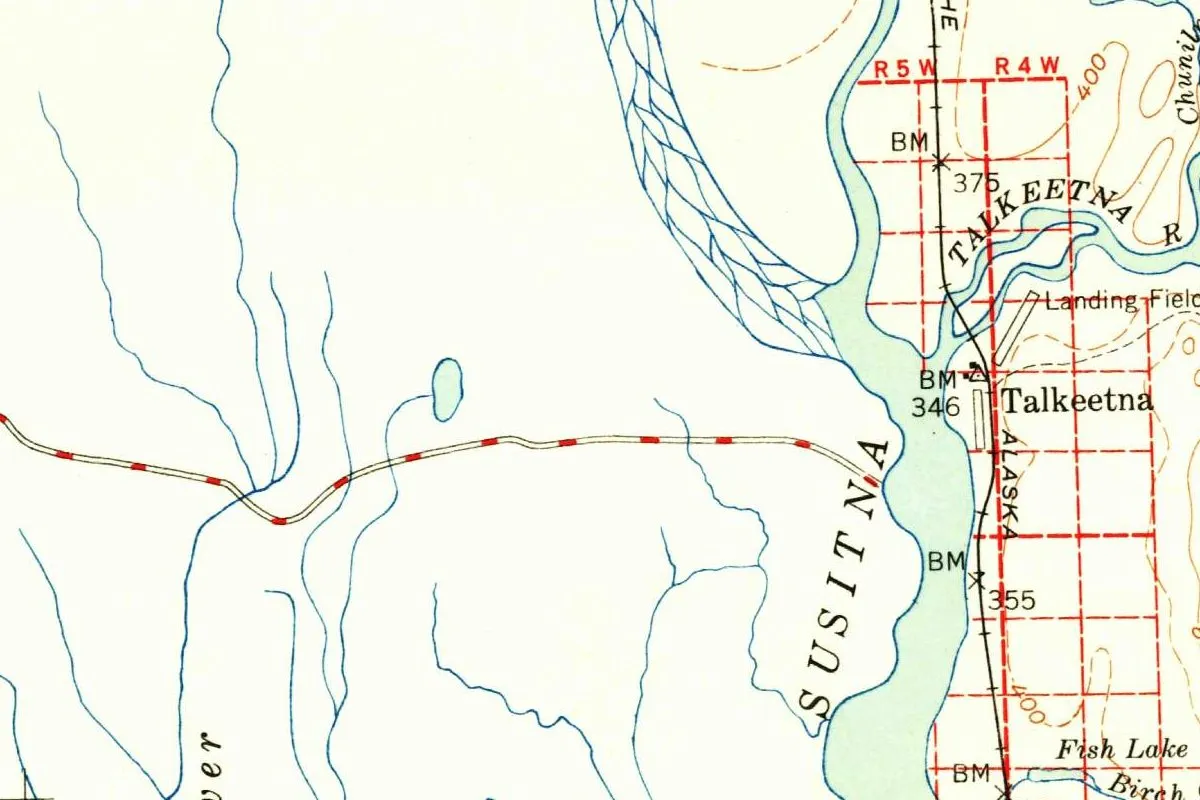
The map at the top comes from the Geological Survey’s 1:250,000 Talkeetna sheet. The margin says it was “Mapped, edited, and published by the Geological Survey,” from aerial photographs taken 1942–1947 and older surveys going back to 1898, and the title block carries the date 1950. The printer’s line reads “INTERIOR—GEOLOGICAL SURVEY, WASHINGTON, D. C. 1954,” so this copy is a 1954 printing.
In the crop you’ll see Talkeetna next to the railroad, marked ALASKA along the line, with a Landing Field just north of town. The braided SUSITNA runs past on the left, and TALKEETNA R comes in at the town. Red township lines are marked R 5 W and R 4 W, and Fish Lake sits near the bottom.
Quick answers
What does Talkeetna mean?
It depends on the source. Eldridge and Muldrow reported “river of plenty” in 1898, as Baker (1906) and Orth (1967) record. A Dena’ina place-name list compiled by James Kari gives K’dalkitnu, “Food Is Stored River.”
What language is Talkeetna?
Orth (1967) and the 1993 nomination call it a Tanaina name. The Dena’ina language archive Dena’ina Qenaga lists it as K’dalkitnu, and the Park Service counts the Dena’ina among the Northern Athabascan groups around Denali.
Is Talkeetna named after the river?
Yes. The river’s name was reported in 1898, and the Alaska Commercial Company’s 1910 supply station at the river mouth was called Talkeetna, the 1993 National Register nomination says.
When did Talkeetna become a town?
In 1916, the Alaska Engineering Commission made it a railroad construction headquarters and a post office opened. Lots were auctioned in 1919, but Talkeetna has never incorporated.
Key dates
- 1898G. H. Eldridge and Robert Muldrow of the Geological Survey report the river's name and that it is 'said to mean river of plenty.'
- 1906Prospectors find gold at Cache Creek; within a couple of years, the 1993 nomination says, miners were coming to Talkeetna for supplies.
- 1910The Alaska Commercial Company opens a supply station called Talkeetna where the rivers meet; it closes by 1912.
- 1915President Wilson picks the Susitna River and Broad Pass route for the government railroad.
- 1916The Alaska Engineering Commission makes Talkeetna a district construction headquarters, and a post office opens.
- 1919Residents buy 80 townsite lots at an auction in October, after a survey in September 1918.
- 1967Donald Orth's dictionary repeats 'river of plenty' and credits it to Eldridge and Muldrow.
- 1994James Kari's list of Dena'ina place names includes K'dalkitnu, 'Food Is Stored River.'
Things to do in Talkeetna, Alaska
Talkeetna Historical Society Museum
A museum in the town's original schoolhouse, run by a historical society founded in 1972, with more than 2,000 artifacts and archives and restored pioneer cabins such as the Ole Dahl cabin.
Walter Harper Talkeetna Ranger Station
The center of mountaineering operations for Denali National Park and Preserve, about 100 miles (161 km) south of the park entrance, where climbers headed for the Alaska Range stop first for an orientation and their permits.
Talkeetna River Park
A borough park where the Susitna, Chulitna and Talkeetna rivers meet, with wide views and Belle's Interpretive Trail, which explains local history.
Talkeetna Lakes Park
A borough park with a network of wide trails through the woods around a chain of lakes, used for hiking, biking and skiing, plus fishing docks.
Getting there
Open Talkeetna in Google Maps
Opens in a new tab. The pin is the center of Talkeetna in the USGS place-name record.
The closest airports, Amtrak stations and intercity bus stops, measured in a straight line from the center of Talkeetna.
Airports
- Merrill Field (MRI) Anchorage 77 mi 124 km
- Ted Stevens Anchorage International (ANC) 80 mi 128 km
Intercity buses
- Interior Alaska Busline Palmer: Three Bears 59 mi 95 km
Distances are as the crow flies, not by road. We don't list schedules or fares because they change; check with the airline, Amtrak or the bus company before you go. Official data (FAA commercial service airports (2025), FAA airport locations, Amtrak stations and Intercity Bus Atlas) from the FAA and the U.S. Bureau of Transportation Statistics, checked Nov 18, 2026.
Sponsored
Staying in Talkeetna?
Compare hotels in Talkeetna, Alaska, on Expedia.
See hotels in TalkeetnaWe may earn a commission if you buy through this link. It never changes what we write. Read our affiliate disclosure
Historical Sources & References
- Marcus Baker, Geographic Dictionary of Alaska (1906), p. 614. Talkeetna Mountains (Eldridge, 1898, “the last syllable is often pronounced no,” “Talkeet river”) and Talkeetna River (“said to mean river of plenty”). Checked against the page image.
- Donald J. Orth, Dictionary of Alaska Place Names (1967), pp. 944-945. The village at mile 226.7 of the Alaska Railroad, and the river’s “Tanaina Indian name reported in 1898 to mean ‘river of plenty,’” with its variant spellings.
- Dena’ina Qenaga, “Placenames”. K’dalkitnu, “Talkeetna River, Talkeetna townsite (Food Is Stored River),” from James Kari’s Dena’ina Topical Dictionary and his 1994 list of Dena’ina place names.
- National Park Service, “Historic and Contemporary Ethnographic Landscapes of Denali National Park”. The five Northern Athabascan groups around Denali, the Dena’ina Susitna River people and the Dena’ina and Ahtna “mountain people” of the Talkeetna River drainage.
- National Register nomination, Talkeetna Historic District (1993). “Talkeetna means ‘River of Plenty’”; Cache Creek, 1906; the supply station of 1910; the route of 1915; the headquarters and post office of 1916; the survey of 1918 and the auction of 1919; distances on the railroad (pp. 4, 13-14).
- Talkeetna Historical Society; Recreation.gov, Walter Harper Talkeetna Ranger Station; Mat-Su Borough, Talkeetna River Park; Mat-Su Borough, Talkeetna Lakes Trails. The details in the things-to-do list.
- U.S. Geological Survey, GNIS feature 1410591. Where the national names database puts the town, in the Matanuska-Susitna Borough.
- Talkeetna, Alaska (1:250,000), dated 1950, 1954 printing. The sheet the map at the top was cropped from.
Spot something wrong, or know more? Tell us here. You can also email us or use our contact page. Corrections are noted here with their date, never made silently.