Valdez Name Origin: The Spanish Admiral Behind the Port
Valdez takes its name from Port Valdez, the bay a Spanish officer, Salvador Fidalgo, named on June 16, 1790, for the Spanish naval officer Antonio Valdés, Donald Orth's 1967 dictionary says. The town at the head of the bay, founded in 1898, was first called Copper City and became Valdez when its post office opened in 1899.
Valdez, Alaska, is named for a Spanish admiral: Salvador Fidalgo put his name on the bay in 1790, and the town took it in 1899. In between, it was briefly Copper City. And if you’re wondering about the sound, the town’s own museum says it’s “pronounced Valdeez.”
A Spanish name from 1790
Spain sent Lt. Salvador Fidalgo north in 1790 to see how far the Russians had gotten and to reassert its own claim, the Valdez Museum’s history says. As he worked through Prince William Sound, Fidalgo handed out names, among them Cordova and Port Gravina. His men went down the Valdez Arm and, the museum says, “perhaps” into Port Valdez itself. The name went on the bay either way.
Donald Orth’s Dictionary of Alaska Place Names, the Geological Survey’s 1967 reference, has the exact date:
“Named on June 16, 1790, by Don Salvador Fidalgo for the celebrated Spanish naval officer Antonio Valdés y Basan. Having been adopted by Capt. Vancouver, the name came into local use.” (Orth, p. 1016)
Orth cites Wagner, 1937, as his source. Marcus Baker’s earlier Geographic Dictionary of Alaska (1906) leans on George Vancouver too: “According to Vancouver it was called Puerto de Valdes by Fidalgo in 1790.” So the British navigator who mapped the sound after the Spanish is part of the reason the Spanish name stuck. The museum describes the man himself as “Admiral Antonio Valdes, who was head of the Spanish Marines and Minister of the Indies at the time.”
He got more than one Alaska place. Orth’s entry for Port Bazan, on Dall Island in southeast Alaska, says Lt. Jacinto Caamaño named it on July 18, 1792, for “Antonio Valdez y Bazan, Spanish naval commander and Minister of Marine…” Spanish captains were naming harbors farther south that year, too. In the story of Port Angeles, Washington, one version credits the Spanish captains Galiano and Valdés, a different Valdés from the minister, with shortening that harbor’s name in 1792.
Notice the spellings. The sources write the admiral’s name Valdés, Valdes and Valdez, and the bay was Puerto de Valdes before it was Port Valdez. None of the sources here explains when the s became a z.
From Copper City to Valdez
For a century after Fidalgo, few people lived on the bay. The museum says that changed in the winter of 1897–98, when gold seekers landed to follow the “All-American Route” over Valdez Glacier into the interior. The route had been advertised as an established trail, and the stampeders were surprised to find neither a town nor a usable trail. Tents went up where the bay ends, and about 4,000 people passed through that year. Like Skagway, it was a door to the Klondike, or meant to be one.
Orth says the town was “established in 1898 as a debarkation point, with an excellent ice-free harbor, for men seeking a route to the Klondike gold region,” and that “It was originally called ‘Copper City’ but name was changed when the Valdez post office was established in 1899.” Baker adds the details: a Captain Glenn, writing in 1898, called it Copper City; a post office named Valdez opened in July 1899; and the town was incorporated on July 1, 1901. Baker’s gazetteer of Alaska also gives its population in 1900: 315.
The town that moved
The name stayed put. The town didn’t. On Good Friday, March 27, 1964, an earthquake set off an underwater landslide under the waterfront, the museum says, and the waves that followed drowned the 32 people standing on the dock. The Geological Survey’s report on Valdez, by Henry Coulter and Ralph Migliaccio, measured the slide at about 98 million cubic yards (75 million cubic meters) of material.
The danger wasn’t news. The University of Alaska’s Geophysical Institute points out that an engineer named Edward Gillete warned in 1899 that the hastily built town sat in the path of the streams from Valdez Glacier. Coulter and Migliaccio, writing in 1966, recommended a new site on the Mineral Creek fan, where they found no sign of the ground breaking up in the quake. Orth’s 1967 entry says plans were being made “to move the town to more stable ground three miles northwest,” and the museum says the move was complete in 1967. The Geophysical Institute puts today’s town near the mouth of Mineral Creek, “a few miles west of the original.”
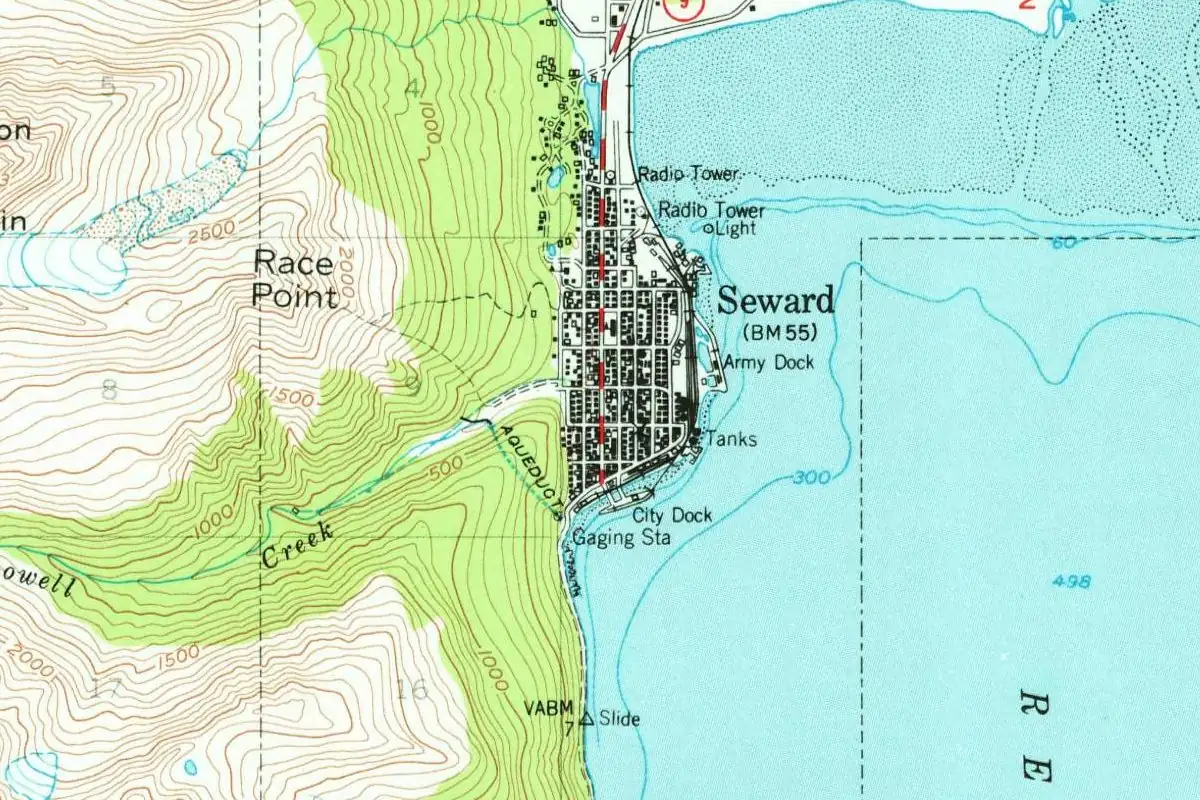
The same earthquake and its tsunami destroyed much of Seward, too. And Valdez isn’t the only town that picked itself up and moved: Worland, Wyoming, slid its buildings across the frozen Bighorn River in 1906 to meet the railroad.
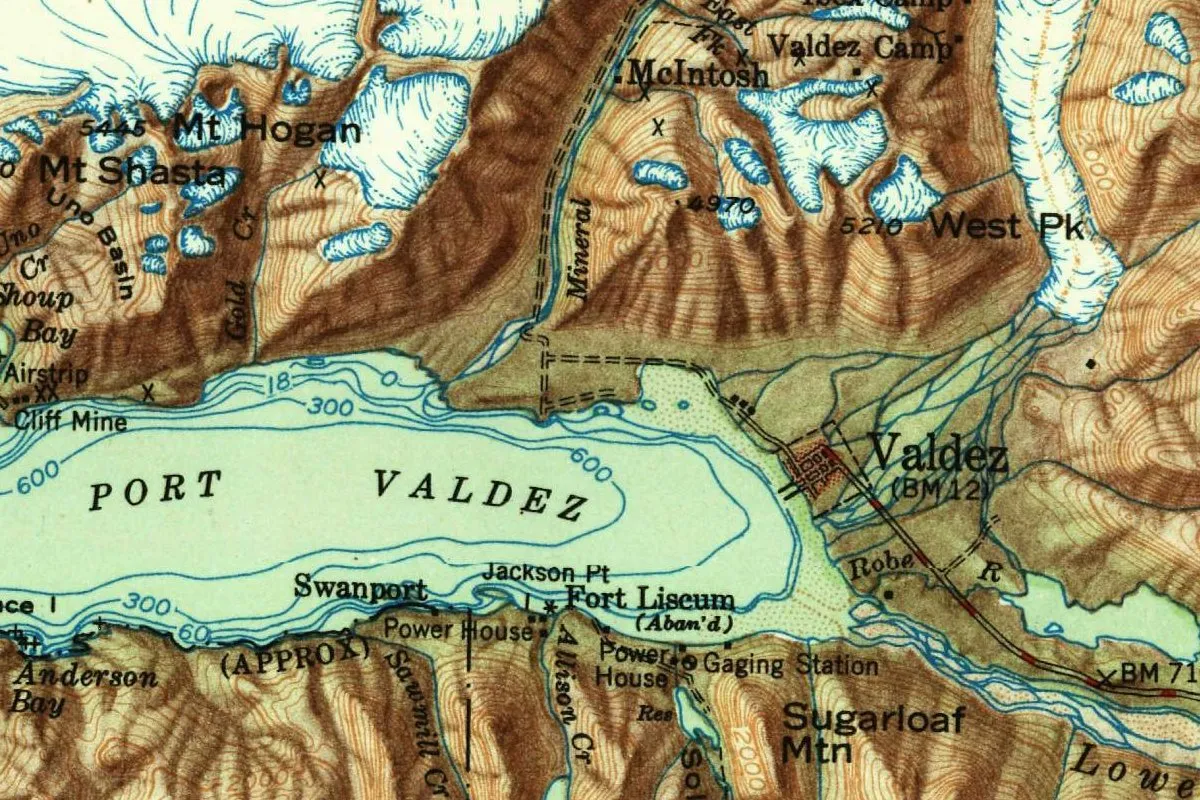
Valdez on the 1952 map
The map at the top shows Valdez before the move. It’s from the Geological Survey’s 1:250,000 Valdez sheet, in shaded relief, marked “Edition of 1952.” The margin says it was “Mapped, edited, and published by the Geological Survey,” with hydrography from Coast and Geodetic Survey charts, topography from surveys of 1900–1939, aerial photography of 1941–1942 and a 1945 compilation. The printer’s line reads “INTERIOR—GEOLOGICAL SURVEY, WASHINGTON, D. C.” with no later date, and this copy carries the Survey’s file-copy stamps.
You can see the old town, labeled “Valdez (BM 12),” at the head of the bay on the glacier’s outwash, with PORT VALDEZ lettered across the water. To the west, the creek labeled Mineral runs down to the north shore, near the spot where the new town would go up after 1964. Across the bay are Fort Liscum, marked abandoned, Jackson Pt and Swanport.
Quick answers
Who is Valdez, Alaska, named after?
Antonio Valdés, a Spanish naval officer and minister. Salvador Fidalgo named the bay for him on June 16, 1790, Orth says, and the town took the bay’s name.
How do you pronounce Valdez?
Val-DEEZ. The Valdez Museum says the town is “pronounced Valdeez.”
What was Valdez called before?
Copper City. Baker and Orth both say the name changed when the Valdez post office opened in 1899.
Why did Valdez move?
The 1964 earthquake set off an underwater slide that destroyed the waterfront, and the old town sat on unstable ground. Geologists recommended the Mineral Creek site, and the museum says the move was complete in 1967.
Key dates
- 1790On June 16, Salvador Fidalgo names the bay for the Spanish naval officer Antonio Valdés.
- 1792Jacinto Caamaño names Port Bazan, on Dall Island, for the same man, Orth says.
- 1898Gold seekers bound for the interior land at the head of the bay; the tent town is called Copper City.
- 1899A post office named Valdez opens in July.
- 1901The town is incorporated on July 1.
- 1964The Good Friday earthquake of March 27 sets off an underwater slide; 32 people on the dock drown.
- 1966Geologists Coulter and Migliaccio recommend moving the town to the Mineral Creek fan.
- 1967The move to the new townsite is complete, the Valdez Museum says.
Things to do in Valdez, Alaska
Valdez Museum on Egan
The museum's main building, with exhibits on exploration, Native culture, the gold rush, the founding of Valdez, the Richardson Highway, the pipeline and the Exxon Valdez oil spill, plus two restored fire engines and a lighthouse lens.
Valdez Museum on Hazelet
A second museum building four blocks from the first, built around a 1:20 scale model of Old Town Valdez as it looked just before the 1964 earthquake, with exhibits on the quake and on seismic activity.
Worthington Glacier
A small valley glacier, a National Natural Landmark since 1968, that the Park Service calls one of the most road-accessible glaciers in Alaska; you can park nearby and walk close to its face.
Valdez Glacier Lake
The lake at the foot of Valdez Glacier, reached by Airport Road; the town's visitor bureau notes the glacier has retreated out of sight of the parking area.
Getting there
Open Valdez in Google Maps
Opens in a new tab. The pin is the center of Valdez in the USGS place-name record.
The closest airports, Amtrak stations and intercity bus stops, measured in a straight line from the center of Valdez.
Airports
- Merle K (Mudhole) Smith (CDV) Cordova 53 mi 85 km
- Merrill Field (MRI) Anchorage 117 mi 188 km
- Ted Stevens Anchorage International (ANC) 122 mi 196 km
Distances are as the crow flies, not by road. We don't list schedules or fares because they change; check with the airline, Amtrak or the bus company before you go. Official data (FAA commercial service airports (2025), FAA airport locations, Amtrak stations and Intercity Bus Atlas) from the FAA and the U.S. Bureau of Transportation Statistics, checked Nov 18, 2026.
Sponsored
Staying in Valdez?
Compare hotels in Valdez, Alaska, on Expedia.
See hotels in ValdezWe may earn a commission if you buy through this link. It never changes what we write. Read our affiliate disclosure
Historical Sources & References
- Donald J. Orth, Dictionary of Alaska Place Names (1967), pp. 112, 1016. Port Valdez, “Named on June 16, 1790, by Don Salvador Fidalgo,” Puerto de Valdes; the town “established in 1898,” “Copper City,” the post office of 1899, the 1964 damage and the plan to move “three miles northwest”; Port Bazan, 1792.
- Marcus Baker, Geographic Dictionary of Alaska (1906), p. 657. “According to Vancouver it was called Puerto de Valdes by Fidalgo in 1790”; Captain Glenn’s Copper City; the post office of July 1899 and incorporation on July 1, 1901. Checked against the page image.
- Valdez Museum, “History of Valdez”. “Pronounced Valdeez,” Fidalgo’s 1790 voyage and the “Bay of Valdes,” Admiral Antonio Valdes, the All-American Route and 4,000 stampeders, the 1964 earthquake and the move completed in 1967.
- UAF Geophysical Institute, “When Valdez Moved”. Gillete’s warning of 1899, Coulter and Migliaccio, and the new town near the mouth of Mineral Creek.
- Coulter and Migliaccio, USGS Professional Paper 542-C (1966). The slide of about 98 million cubic yards and the Mineral Creek relocation site.
- Valdez Museum on Egan; Valdez Museum on Hazelet; NPS, Worthington Glacier; Visit Valdez, Glaciers. The details in the things-to-do list.
- U.S. Geological Survey, GNIS feature 1412465. Where the national names database puts the town, in the Chugach Census Area.
- Valdez, Alaska (1:250,000), edition of 1952. The sheet the map at the top was cropped from.
Spot something wrong, or know more? Tell us here. You can also email us or use our contact page. Corrections are noted here with their date, never made silently.