Skagway, Alaska: Windy Place or Place With Solid Core Trees?
Skagway comes from Shg̱agwei, the Lingít (Tlingit) name of the valley and river. Its meaning is debated. Older sources say "home of the north wind" or a windy place with whitecaps, but as of 2024 the Skagway Traditional Council, following Lingít linguists, supports "place with solid core trees."
Skagway, Alaska, was long said to mean windy place, but its Traditional Council now translates the Lingít name, Shg̱agwei, as place with solid core trees. Orth’s 1967 dictionary and the town’s own history give the windy meaning.
Shg̱agwei, in the Council’s words
The Skagway Traditional Council keeps a list of Lingít (Tlingit) place names for the area, with the English name in parentheses. The first line reads: “Shg̱agwei ~ Place with Solid Core Trees (Skagway).” Under it, the Council explains that Skagway “has been long recognized to mean the windy place or where the North wind blows,” but that researchers and linguists have questioned that, and that from the language’s roots it believes the name “means place with solid core trees.”
A one-page sheet from the Council tells how it got there. Shg̱agwei, it says, “has always been the land of Lḵoot Ḵwáan (Ancestral People of Chilkoot).” In the early 2000s, Dr. X̱ʼunei Lance Twitchell, then the Council’s president, went through printed sources and talked with visiting speakers of the language. An elder told him the name referred to “whitecaps on the water,” and the tribal building was named for that: Héen Agunatáani Hít, Whitecaps on the Water House.
Then, in the 2020s, language scholar Chalyee Will Geiger found a recording of Seinteen Mildred Sparks, a speaker, talking about the name. She explained that Shg̱agwei is a contraction of Wushig̱agu Yé. The sheet says that made “linguistic sense,” because g̱ákw refers to the heartwood of a tree and the “-i yé” ending is common in place names. As of 2024, the Council supports “the place with solid core trees,” as recommended by Lingít linguists, and says it’ll keep updating its place names as it learns more.
You’ll notice the spelling, too. The sheet asks readers to “note the underlined first g̱” and gives the pronunciation as “sh-gahg-way.”
The windy version, and where it came from
The wind story is much older than the Council’s research. Donald J. Orth’s Dictionary of Alaska Place Names, published by the U.S. Geological Survey in 1967, says the town’s name came from the Skagway River and calls the river’s name “A Tlingit Indian name said to mean ‘home of the north wind.’” That “said to mean” is Orth’s own hedge.
The municipality’s history of the town blends the two older ideas. It describes “Skaqua or Shgagwéi, as it is known by the Tlingit, a windy place with ‘white caps on the water,’” used by Chilkoots and Chilkats for hunting and fishing.
The Council’s sheet sorts these out its own way. It says that around the time of Twitchell’s research, elders and linguists settled on a translation by G. Emmons: “roughed up water” or “bunched up water.” The phrases “windy place,” “Home of the North Wind” and “valley of the wind” were adopted by Lingít and non-Lingít speakers alike, it says, “but there was no linguistic evidence to support these interpretations.”
So, depending on your source, Skagway is the home of the north wind, a windy place, rough water, or a place with solid core trees. The Council, which works with the language today, backs the last one.
How outsiders wrote it down
Orth also lists the ways the name was spelled before it settled: Cqagué, Schkagué, Shkagway, Skaguay and Skagwa. He says Aurel and Arthur Krause “recorded ‘Schkagué’” on an 1883 map, and that in 1891 “Lt. Comdr. H. E. Nichols, USN, wrote ‘Shkagway.’” A military post here, he adds, was called “Skaguay” by the U.S. Army.
From Mooresville to Skaguay
For a short while, the place had an English name. The municipality’s history says that in June 1887 Skookum Jim, “a Tlingit packer from Dyea and Tagish,” led Capt. William Moore, “a member of Canada’s Ogilvie survey party,” over a new pass up the valley, later named White Pass. That October, Moore came back with his son, Bernard. They staked 160 acres on the valley floor, started a cabin and a dock, and “call the place Mooresville.”
Then came the Klondike rush. On July 26, 1897, the steamer Queen landed at Moore’s wharf with the first of the gold seekers, and the Moores, the history says, were overrun: “Mooresville is re-platted by surveyor Frank Reid as Skaguay.” That fall the town got a post office and a newspaper, the Skaguay News. Orth’s entry tells it more briefly. He says the town was founded in 1897 by Capt. William Moore, “who had a cabin here,” and that the post office opened that year.
The spelling the post office picked
The last change was a single letter. In 1898, the municipal history says, the “Spelling changed to Skagway by post office, and most businesses reluctantly follow.”
What the map shows
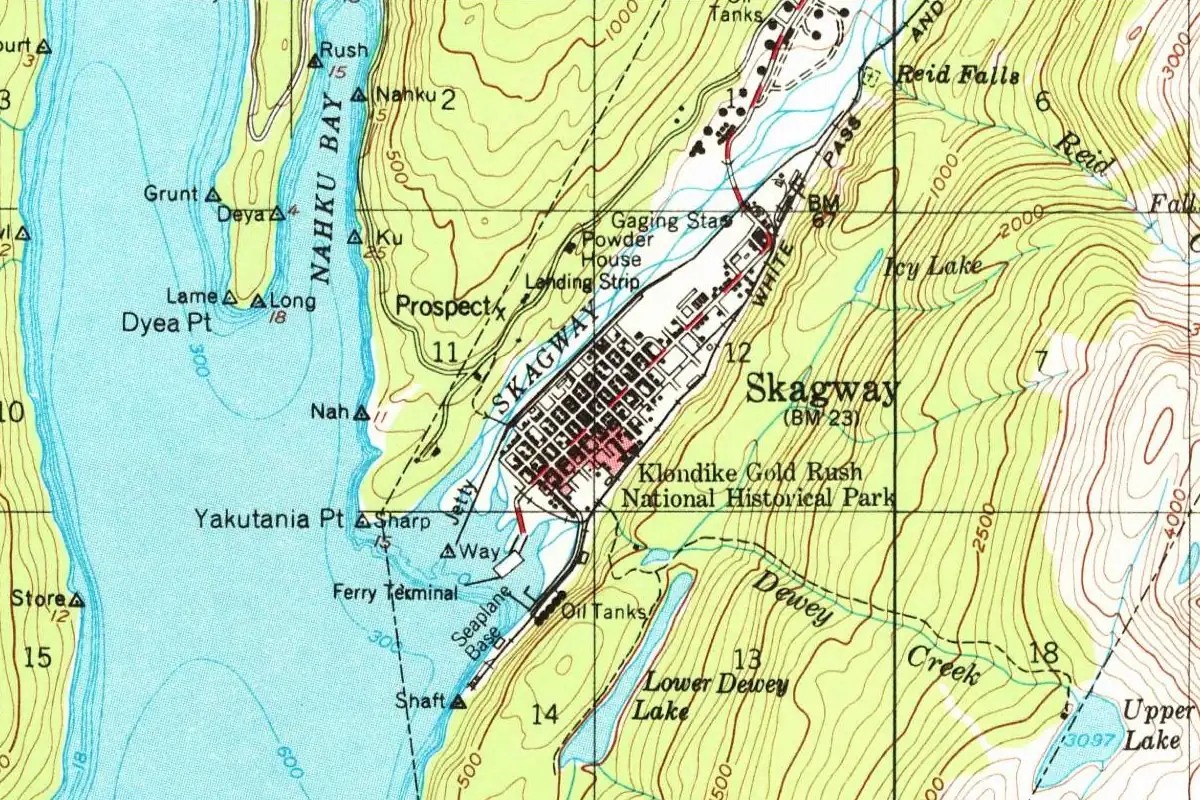
The map at the top of this page comes from the U.S. Geological Survey’s Skagway B-1 sheet, first published in 1949. This copy was clearly revised later. It labels Klondike Gold Rush National Historical Park, and the town’s history says Congress passed the law creating that park in 1976. You can see the town packed into the narrow valley floor where the Skagway River reaches the inlet, Nahku Bay and Dyea Point to the west, and the words White Pass running up the valley along the river.
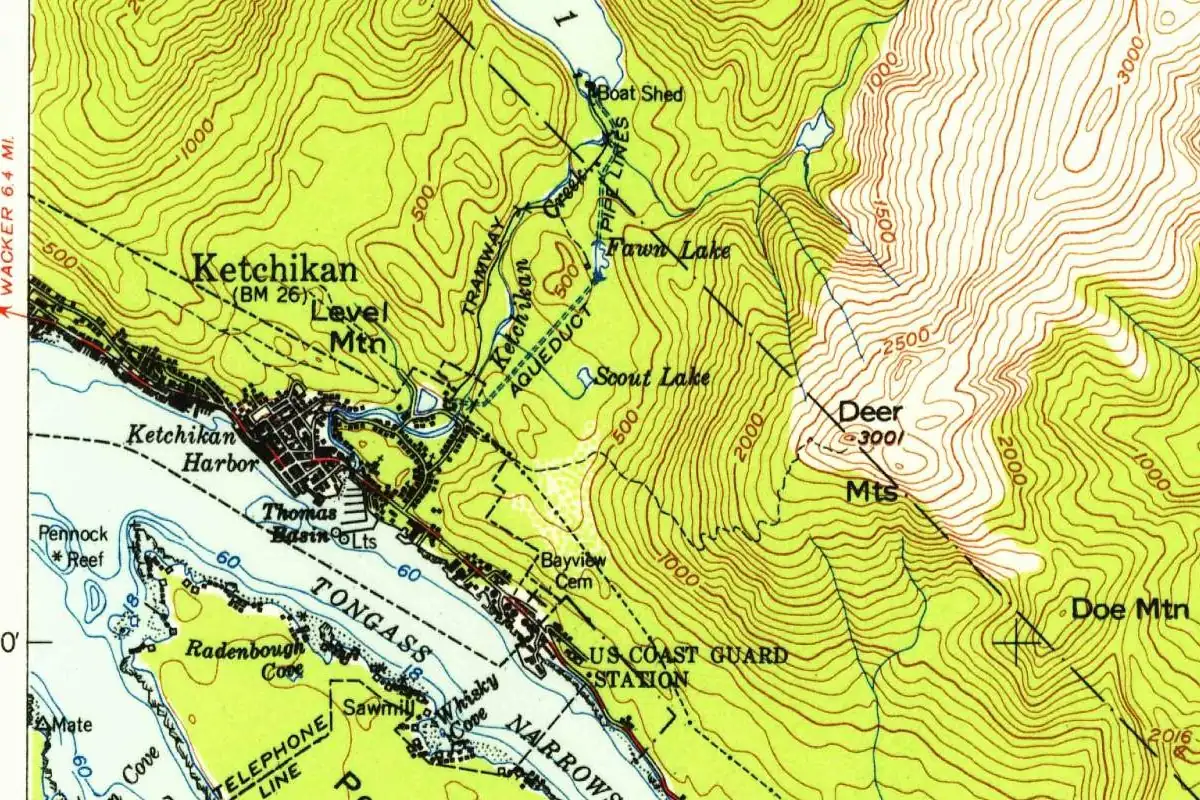
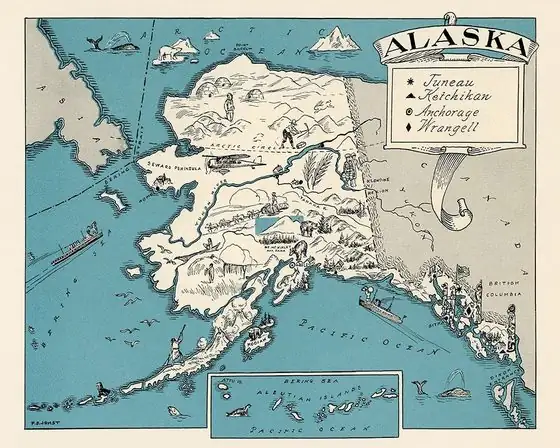
Two other Southeast Alaska towns carry Tlingit names with their own debates: Ketchikan, whose creek name has an eagle story attached, and Sitka. There’s more on the state’s names on our Alaska page.
Quick answers
What does Skagway mean?
It depends on the source. The Skagway Traditional Council translates Shg̱agwei as “place with solid core trees.” Orth’s 1967 dictionary says the Tlingit name is “said to mean ‘home of the north wind,’” and the town’s history calls it “a windy place with ‘white caps on the water.’”
Is Skagway a Tlingit word?
Yes. Orth calls it “A Tlingit Indian name,” and the Skagway Traditional Council writes it Shg̱agwei in Lingít, pronounced “sh-gahg-way.”
What was Skagway called before?
Mooresville. The town’s history says William Moore and his son Bernard gave the place that name in 1887, and that it was re-platted as Skaguay in 1897.
Why is Skagway spelled with a “y”?
The town’s history says the post office changed the spelling from Skaguay to Skagway in 1898, and “most businesses reluctantly follow.”
Key dates
- 1883Aurel and Arthur Krause record the river's name on a map as "Schkagué."
- 1887Skookum Jim guides Capt. William Moore over the pass; that fall Moore and his son Bernard stake 160 acres and call the place Mooresville.
- 1891Lt. Comdr. H. E. Nichols of the U.S. Navy writes the name "Shkagway."
- 1897Gold seekers arrive; Mooresville is re-platted as Skaguay and a post office opens.
- 1898The post office changes the spelling to Skagway, according to the town's history.
- 2024The Skagway Traditional Council supports "the place with solid core trees" as the meaning of Shg̱agwei.
Things to do in Skagway, Alaska
Klondike Gold Rush National Historical Park Visitor Center Museum
The park's museum lets you trace the gold rush from the beginning and choose your route to the gold fields, with artifacts from the park's collection, video clips, maps, photographs and dioramas.
Moore House Museum
The home of the first family to live in Skagway, built over several years starting in 1897. Two rooms show the Victorian era, and exhibits cover the family, frontier life and the marriage of Ben Moore and Klinget-sai-yet.
Chilkoot Trail
A Tlingit trade route turned gold rush highway from Dyea to Lake Bennett, British Columbia. Today it's a 33-mile (53 km) trail lined with artifacts left by gold seekers, designated the Chilkoot National Historic Trail in 2022.
White Pass & Yukon Route Railway
The railroad that climbs out of Skagway runs the White Pass Summit Excursion, a round trip of 40 miles (64 km) up to the pass.
Getting there
Open Skagway in Google Maps
Opens in a new tab. The pin is the center of Skagway in the USGS place-name record.
The closest airports, Amtrak stations and intercity bus stops, measured in a straight line from the center of Skagway.
Airports
- Gustavus (GST) 73 mi 117 km
- Juneau International (JNU) 81 mi 130 km
Distances are as the crow flies, not by road. We don't list schedules or fares because they change; check with the airline, Amtrak or the bus company before you go. Official data (FAA commercial service airports (2025), FAA airport locations, Amtrak stations and Intercity Bus Atlas) from the FAA and the U.S. Bureau of Transportation Statistics, checked Nov 14, 2026.
Sponsored
Staying in Skagway?
Compare hotels in Skagway, Alaska, on Expedia.
See hotels in SkagwayWe may earn a commission if you buy through this link. It never changes what we write. Read our affiliate disclosure
Historical Sources & References
- Skagway Traditional Council, “Lingít Place Names”. “Shg̱agwei ~ Place with Solid Core Trees (Skagway)” and the Council’s note on the older windy-place meaning.
- Skagway Traditional Council, “Shg̱agwei”. The spelling and pronunciation, Twitchell’s research and the “whitecaps on the water” account, the Emmons translation, the Sparks recording found by Geiger, Wushig̱agu Yé and g̱ákw, and the Council’s 2024 position.
- Donald J. Orth, Dictionary of Alaska Place Names (1967), p. 883. The town named from the Skagway River; the river’s Tlingit name “said to mean ‘home of the north wind’”; the spellings recorded by the Krauses (1883) and Nichols (1891); Moore and 1897; the Army’s “Skaguay.” Checked against the page image.
- Municipality of Skagway, “Skagway History”. “A windy place with ‘white caps on the water,’” Skookum Jim and Moore in 1887, Mooresville, the 1897 re-platting as Skaguay, the 1898 spelling change, and the 1976 park law.
- National Park Service, Klondike Gold Rush NHP, “Museums”. The Moore House and the park’s museums.
- GNIS feature 1414754 (U.S. Geological Survey). The Geographic Names Information System entry for Skagway, with its coordinates.
- U.S. Geological Survey, Skagway B-1 sheet (1949). The 1:63,360 map, in a later revised printing, that the image at the top of this page was cropped from.
Sponsored
Cruising to Alaska?
Compare Alaska cruises on CruiseDirect.
See Alaska cruisesWe may earn a commission if you buy through this link. It never changes what we write. Read our affiliate disclosure
Spot something wrong, or know more? Tell us here. You can also email us or use our contact page. Corrections are noted here with their date, never made silently.