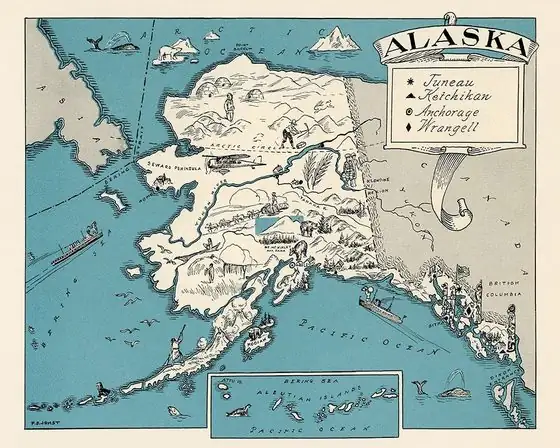
Ketchikan, Alaska: A Tlingit Creek Name and an Eagle Story
Ketchikan is named after Ketchikan Creek, whose Tlingit name was recorded as "Kitschk-hin" in 1881 and is written Kichxáan or Kichxháan today. Its meaning isn't settled. A NOAA profile offers "thundering wings of an eagle" or "the river belonging to Kitschk," and the USGS calls the eagle-wing idea unverified, possibly folklore.
Ketchikan, Alaska, takes its name from Ketchikan Creek, a Tlingit fish camp name first written down in 1881, and the word’s meaning is still unsettled. You’ll hear a lovely explanation about an eagle’s wings. The U.S. Geological Survey’s own dictionary of Alaska names says it may be folklore.
The creek came first
Start with the part everyone agrees on. Donald Orth’s Dictionary of Alaska Place Names, published by the USGS in 1967, sums it up in one line under the city’s entry: “The city was named after Ketchikan Creek.” The creek runs about 6 miles (10 km) from a chain of lakes down to Tongass Narrows, and the fish camp and later the town sat at its mouth.
The City of Ketchikan tells the older story in Tlingit terms. On its museums page it says that “Kichxháan (Ketchikan) was a Tlingit summer fish camp around the mouth of Kichxháan Héeni (Ketchikan Creek),” and that Ketchikan remains home to the Taant’a Khwáan, the Sea Lion Tribe of the Tongass Tlingit. A community profile from NOAA’s fisheries center adds that the area is ancestral territory of both the Tongass and the Cape Fox Tlingit, and that people of both groups used the creek as a fish camp. The sea lion in the tribe’s name has a story of its own: the Tongass people were once known as the Tanta Kwaan, NOAA says, and Tan, meaning sea lion, is the Tlingit name for Prince of Wales Island. “Tanyatak Kwaan” meant the people of the head part of the sea lion, the island’s southern tip.
The NOAA profile also passes along a story told by Tlingit elders Ester Shea, Emma Williams and Mickey Denney: the Cape Fox people used Ketchikan Creek for salmon until a marriage between a Cape Fox and a Tongass Tlingit, when use of the creek was given to the Tongass as a wedding gift. That’s a story about who fished the creek, not about the word. But it tells you how much the place mattered.
“Kitschk-hin” in 1881
The oldest spelling in these sources dates from 1881. Orth writes that the Tlingit name was “recorded as ‘Kitschk-hin’ by Arthur or Aurel Krause in 1881, and evolved in the present name ‘Ketchikan.’” (Orth doesn’t say which of the two Krauses wrote it down.) Marcus Baker’s 1906 Geographic Dictionary of Alaska shows the name still wobbling a little: it “has been written Kichikan and Kitch-i-kan.” Orth adds Kitchikan and Kitskan to the list of variants.
Then there’s the name the newcomers used. Orth notes that “Fish Creek” was reported as local usage in 1883 by the Coast and Geodetic Survey. Fish Creek didn’t stick. The Tlingit name did.
The eagle story, and the doubt
Here’s the explanation you’re most likely to run into. Orth gives it in full:
“It has been suggested that the name means ‘eagle wing river’ derived from the fact that ‘a boulder in the stream at the falls broke the water giving the appearance of the spread wings of an eagle.’”
And then, in the very next sentence, Orth pours cold water on it: “This suggested meaning has not been verified and may be a form of folklore.”
NOAA’s profile doesn’t settle it either. In one place it says the fish camp, “kitschk-hin,” means “creek of the thundering wings of an eagle.” Further on, it writes the Tlingit word as Kichxáan and says plainly that “the meaning of this name is not clear.” It offers two possibilities: “the river belonging to Kitschk,” or “thundering wings of an eagle.” So you’ve got an eagle in flight, a boulder that looks like one, and a person or thing called Kitschk, and no source on this page that picks a winner.
What does hold up is the chain of names: a Tlingit name for the creek, written down by an outsider in 1881, passed to the town that grew at its mouth.
From fish camp to cannery town
The town itself is young. Orth says it began as a fishing town when a cannery was built in 1887 and became a supply center during the gold rush years of the late 1890s. It had 40 people in 1890. Baker dates the post office to April 1892, and Orth’s entry carries a 1905 decision of the Board on Geographic Names on the name.
The NOAA profile fills in more, with care. By 1884 a saltery stood on Ketchikan Creek, and later a trading post went up at its mouth. “According to some accounts,” it says, an Irishman named Mike Martin is considered the first resident of Ketchikan and “is said to have purchased 160 acres from Chief Kyan of the Tanta Kwaan.” The city was incorporated in 1900.
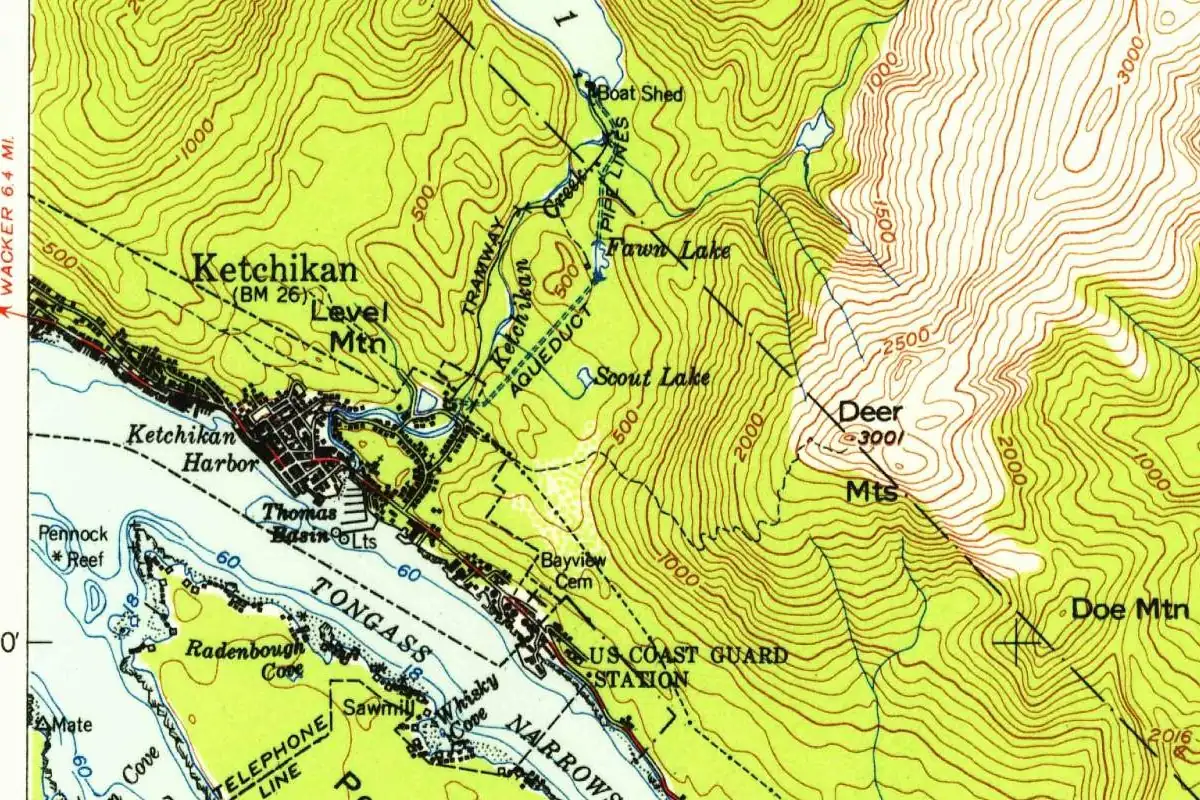
The 1954 map at the top of this page shows how much the town still leaned on that creek. “Ketchikan Creek” is lettered right along it, coming down from a lake with an aqueduct and pipelines beside it, straight into town at the waterfront. Look closely and you’ll see a tramway too.
Other Tlingit names in Alaska
Ketchikan isn’t the only Southeast Alaska town still carrying a Tlingit name: Sitka kept its own even after the Russians called the place New Archangel. Orth’s dictionary also explains the very different Russian and Native history of Kodiak. You’ll find the rest of the state’s name stories on our Alaska page.
Quick answers
What does Ketchikan mean?
It isn’t settled. NOAA’s community profile says the meaning “is not clear” and gives two possibilities, “the river belonging to Kitschk” or “thundering wings of an eagle.”
Is Ketchikan named after a creek?
Yes. Orth’s 1967 USGS dictionary says the city “was named after Ketchikan Creek,” whose Tlingit name was recorded as “Kitschk-hin” in 1881.
Does Ketchikan mean “eagle wing river”?
Maybe, but it’s unproven. Orth reports the suggestion, tied to a boulder at the falls that looked like an eagle’s spread wings, and adds that it “has not been verified and may be a form of folklore.”
How do you pronounce Ketchikan?
KETCH-ih-kan, according to the NOAA community profile.
Key dates
- 1881Arthur or Aurel Krause records the creek's Tlingit name as "Kitschk-hin."
- 1883The Coast and Geodetic Survey reports "Fish Creek" as the local name for the stream.
- 1887A cannery is built, and Ketchikan begins as a fishing town, according to Orth.
- 1892The Ketchikan post office opens in April.
- 1900Ketchikan is incorporated as a city.
Things to do in Ketchikan, Alaska
Totem Heritage Center and Tongass Historical Museum
The city's two museums: the Totem Heritage Center keeps original 19th-century totem poles and the living arts of the Tlingit, Haida and Tsimshian, and the downtown Tongass Historical Museum covers Ketchikan's own history.
Totem Bight State Historical Park
A park with totem poles and a model Native village that grew out of a 1938 Forest Service program, paid for with Civilian Conservation Corps funds, to save or copy old cedar poles left to rot in abandoned villages.
Southeast Alaska Discovery Center
A Forest Service visitor center with more than 20,000 square feet (1,858 square meters) of exhibits on the ecology and history of a nearly 17-million-acre temperate rainforest and the cultures of the region's Native peoples.
Misty Fjords National Monument
More than 2 million acres of wilderness in the Tongass National Forest, with deep fjords carved by ice and towering cliffs, reached by boat or floatplane through Behm Canal.
Getting there
Open Ketchikan in Google Maps
Opens in a new tab. The pin is the center of Ketchikan in the USGS place-name record.
The closest airports, Amtrak stations and intercity bus stops, measured in a straight line from the center of Ketchikan.
Airports
- Ketchikan International (KTN) 3 mi 4 km
- Klawock (AKW) 58 mi 94 km
Distances are as the crow flies, not by road. We don't list schedules or fares because they change; check with the airline, Amtrak or the bus company before you go. Official data (FAA commercial service airports (2025), FAA airport locations, Amtrak stations and Intercity Bus Atlas) from the FAA and the U.S. Bureau of Transportation Statistics, checked Nov 14, 2026.
Sponsored
Staying in Ketchikan?
Compare hotels in Ketchikan, Alaska, on Expedia.
See hotels in KetchikanWe may earn a commission if you buy through this link. It never changes what we write. Read our affiliate disclosure
Historical Sources & References
- Donald J. Orth, Dictionary of Alaska Place Names (USGS Professional Paper 567, 1967), p. 511. The city “named after Ketchikan Creek”; BGN 1905; the 1887 cannery, the gold rush supply center and 40 people in 1890; the 1892 post office; the creek’s length; “Kitschk-hin” recorded by Arthur or Aurel Krause in 1881; the quoted eagle-wing suggestion and “has not been verified and may be a form of folklore”; “Fish Creek” in 1883; the variants Kichikan, Kitchikan and Kitskan.
- Marcus Baker, Geographic Dictionary of Alaska (USGS Bulletin 299, 1906), p. 360. The post office established in April 1892; the name “has been written Kichikan and Kitch-i-kan.”
- NOAA, Community Profiles for North Pacific Fisheries – Alaska: Ketchikan. The pronunciation; Tongass and Cape Fox Tlingit territory; the Tanta Kwaan and Tan, sea lion, for Prince of Wales Island; the fish camp “kitschk-hin,” “creek of the thundering wings of an eagle”; Kichxáan, whose meaning “is not clear,” with its two possible meanings; the elders’ wedding-gift story; the 1884 saltery, the trading post, Mike Martin and Chief Kyan as told “according to some accounts”; incorporation in 1900.
- City of Ketchikan, Museums. Kichxháan as a Tlingit summer fish camp at the mouth of Kichxháan Héeni (Ketchikan Creek); the Taant’a Khwáan of the Tongass Tlingit.
- GNIS feature 1423039 (U.S. Geological Survey). The USGS place-name entry for Ketchikan, in the Ketchikan Gateway Borough.
- U.S. Geological Survey, Ketchikan B-5 sheet (1954). The 1:63,360 quadrangle the map at the top of this page was cropped from.
Sponsored
Cruising to Alaska?
Compare Alaska cruises on CruiseDirect.
See Alaska cruisesWe may earn a commission if you buy through this link. It never changes what we write. Read our affiliate disclosure
Spot something wrong, or know more? Tell us here. You can also email us or use our contact page. Corrections are noted here with their date, never made silently.