Kodiak or Kadiak? How Kodiak, Alaska Got Its Name
Kodiak takes its name from Kodiak Island. The Alutiiq Museum says the likely source is qik'rtaq, the Alutiiq word for island, which the Russian Stephen Glotov recorded as Kikhtak in 1763. Older writers also suggested a tribal name, Kaniag, or a Russian word for tub. The official spelling was Kadiak until local usage won in 1901.
Kodiak, Alaska, was officially spelled Kadiak until 1901, and the name itself most likely comes from qik’rtaq, the Alutiiq word for island. The town took the island’s name, and the island’s name has been argued over, misspelled and corrected for more than two centuries.
An island called “island”
The Alutiiq Museum in Kodiak puts it simply: “The Alutiiq word qik’rtaq, meaning island, is the likely source of the name Kodiak.” The museum says the Russian explorer Stephen Glotov recorded the Native term as Kikhtak in 1763.
Marcus Baker’s Geographic Dictionary of Alaska, published by the U.S. Geological Survey in 1906, tells the same scene from the old Russian records. Glotov, “a Russian fur hunter,” anchored in Alitak Bay on the southwest side of the island on September 8, 1763, and “learned from the natives that the island was by them called Kikhtak.” Baker then lines up the old authorities. Ivan Petrof said “Kikhtak or Kikhtowik” was the word for island. Martin Sauer, who wrote up the Billings expedition of 1785-1794, complained that the Russian trader Shelikof had mistaken a plain word for a name, since “Kichtak or Kightak is merely an island.”
So if the museum is right, the island Orth calls “the largest in Alaska” ended up named, in effect, “island.” The town, in turn, took its name from the island.
The other explanations
That’s the leading answer, not the only one, and the 1906 dictionary is honest about the clutter. Petrof thought the tribal name had been Kaniag, and that the Russian name “was probably derived from both.” William Dall agreed it was “more probably” a corruption of Kaniag, though he noted that “some authors” derived it from the Russian kadia, “a large tub.” And a writer named Martin, Baker adds, was told in 1904 by Russian Alaskans that the name came from the Aleut word for sea gull, “which it resembles closely.”
Even an early English account muddies things. Orth quotes William Coxe, writing in 1787, who said Glotov didn’t land until he reached the most easterly of the islands, “called by the inhabitants Kadyak.” Hubert Howe Bancroft, a century later, had the island “called Kikhtak by the natives, but now known as Kadiak.” And in 1788 it picked up yet another name: Baker and Orth both note that Martinez and Lopez de Haro named it Florida Blanca. That one didn’t last.
You can see why we’ve marked this one disputed. Island, tribe, tub or gull: the island word has the most support, including from the Alutiiq Museum itself, but the old books never fully agreed.
Kodiak, Kadiak and a lot of other spellings
Spelling was its own fight, and pronunciation came with it. By the time of the Alaska purchase, Baker writes, English speakers used the form Kodiak, “pronounced Ko-dy-ak,” while Russians wrote the same name and said “Kad-yak.” Baker says Captain James Cook got “Kodiak” from the Russian Ismailof in 1778, and that Dall insisted “Kadiak” was “the only correct spelling,” calling Kodiak, Codiac and the rest “similarly absurd.” In 1890 the U.S. Board on Geographic Names adopted Kadiak. Here’s what happened next, in Baker’s words:
“Local usage has, however, remained Kodiak, both in form and pronunciation, while the pronunciation Ka-dy-ak is often heard from the lips of those who have learned the name, not from hearing it, but from the printed page.”
The Board, he wrote, “has therefore receded from the position taken in 1890 and adopted Kodiak.” Orth’s 1967 Dictionary of Alaska Place Names dates the change to 1901 “because of popular local usage,” and the Alutiiq Museum agrees: in 1901, it says, “Kadiak became Kodiak to reflect the more common local pronunciation.” The people who lived there won.
Paul’s Harbor, St. Paul, and finally Kodiak
The town has had more names than the island. Orth says it was founded in 1792 by Alexander Baranov, manager of the Shelikov company, who moved the settlement from Three Saints Harbor to higher, drier ground with timber close by. Baranov named it “Pavlovsk Gavan,” or “Paul’s Harbor.” Kodiak is, in Orth’s words, a “Local name derived from Kodiak Island.”
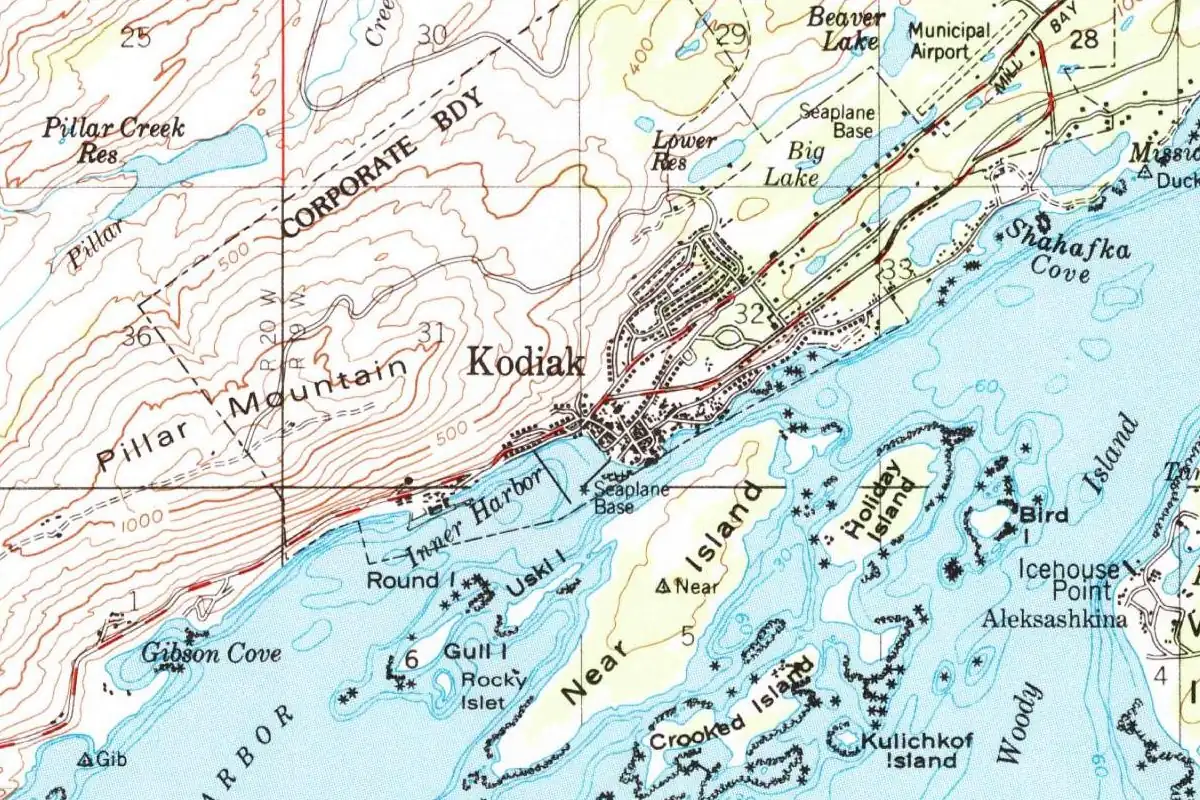
The 1890 census, quoted by Baker, said the local people called the town simply gavan, “the harbor,” and blamed American mapmakers’ “faulty translation” for turning it into St. Paul. Baker didn’t buy it. That claim, he wrote, “is not wholly borne out by the record,” since the Russian navigator Lisianski already had St. Paul on his map of 1805. The name survives on the water: Orth lists the bay southwest of town as Saint Paul Harbor, a name from Lisianski. Look at the bottom left of the 1949 map at the top of this page and you’ll see the word HARBOR spread across it.
The post office settled the town’s everyday name. Baker dates the Kodiak post office to August 1888. Orth says one first opened in 1869, closed in 1875 and reopened in 1888.
Russian headquarters before Sitka
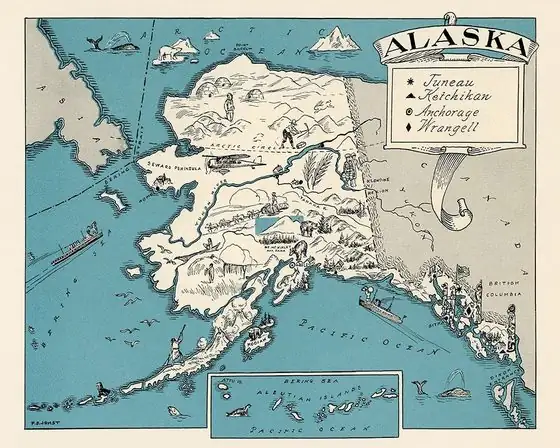
The 1890 census, as Baker and Orth both quote it, says Kodiak was picked as headquarters of the Russian fur-trading companies “on account of its good harbor” and nearby timber, and that before New Archangel, or Sitka, was founded on its present site, Kadiak was headquarters of the Russian-American Company too. You can compare its very different naming story with the Tlingit creek name behind Ketchikan, or browse the rest of the state on our Alaska page.
Quick answers
What does Kodiak mean?
Most likely “island.” The Alutiiq Museum says the Alutiiq word qik’rtaq, meaning island, is the likely source, though older writers also suggested the tribal name Kaniag, a Russian word for tub and an Aleut word for sea gull.
Why was Kodiak spelled Kadiak?
Because the U.S. Board on Geographic Names adopted Kadiak in 1890. Local people kept saying and writing Kodiak, and the spelling was changed back in 1901.
What was Kodiak’s Russian name?
Pavlovsk Gavan, or Paul’s Harbor, according to Orth. The Russians also called it St. Paul, a name Lisianski put on his 1805 map.
Is the town of Kodiak named after the island?
Yes. Orth’s 1967 USGS dictionary calls Kodiak a “Local name derived from Kodiak Island.”
Key dates
- 1763Russian fur hunter Stephen Glotov reaches the island and records its Native name as Kikhtak.
- 1778Captain Cook gets the name Kodiak from the Russian Ismailof.
- 1792Alexander Baranov moves the Russian settlement from Three Saints Harbor and names the new site Pavlovsk Gavan, Paul's Harbor.
- 1890The Board on Geographic Names adopts the spelling Kadiak.
- 1901Kadiak becomes Kodiak, following local usage.
Things to do in Kodiak, Alaska
Alutiiq Museum
The Alutiiq Museum and Archaeological Repository preserves and shares the heritage and living culture of the Alutiiq people, with ancestral artifacts from 7,800 years of Alutiiq/Sugpiaq history.
Kodiak History Museum
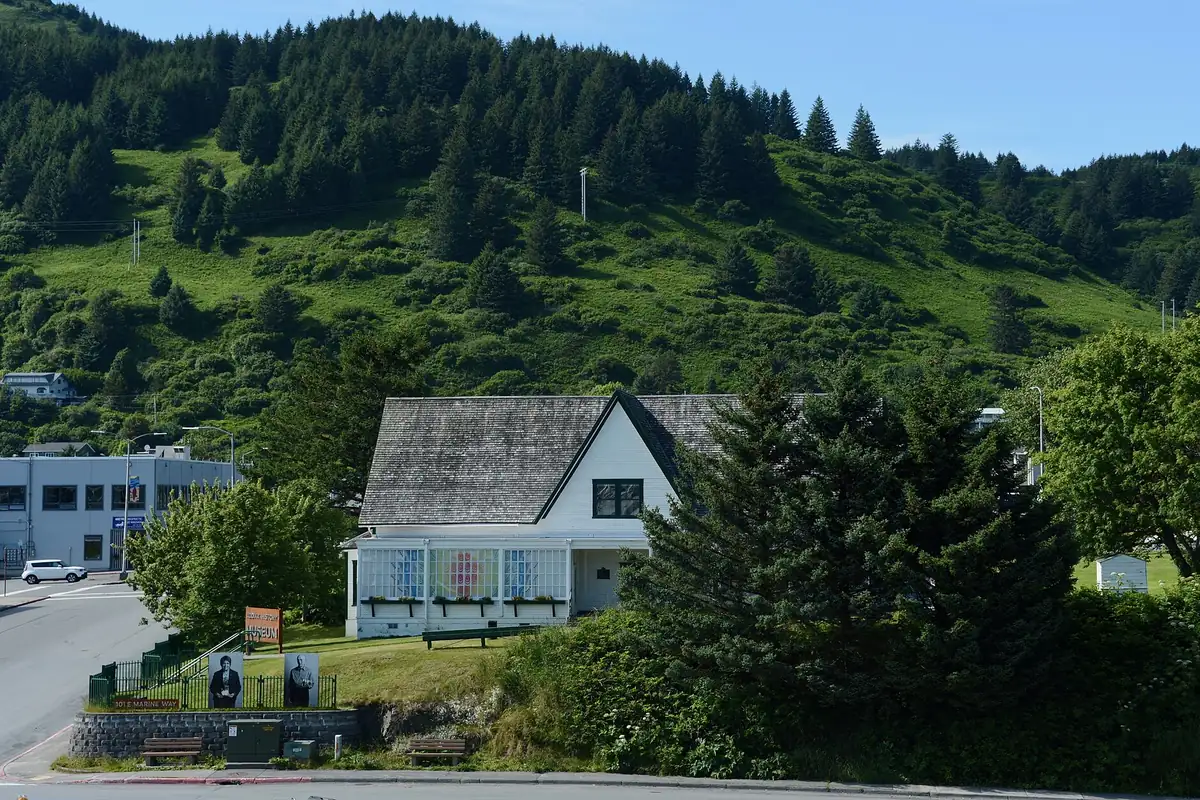
Formerly the Baranov Museum, it tells Kodiak's history in the Russian-American Magazin, a storehouse built around 1808 by Russian company craftsmen.
Fort Abercrombie State Historical Park
A 182-acre state park with the ruins of a World War II coastal defense post, surf-pounded cliffs, spruce forest, wildflower meadows and a trout lake.
Kodiak National Wildlife Refuge Visitor Center
The visitor center for a refuge of nearly two million acres across Kodiak, Afognak, Ban and Uganik islands, with an exhibit hall on Kodiak's wildlife and ecosystems.
Getting there
Open Kodiak in Google Maps
Opens in a new tab. The pin is the center of Kodiak in the USGS place-name record.
The closest airports, Amtrak stations and intercity bus stops, measured in a straight line from the center of Kodiak.
Airports
- Kodiak (ADQ) 4 mi 7 km
- Homer (HOM) 132 mi 213 km
Distances are as the crow flies, not by road. We don't list schedules or fares because they change; check with the airline, Amtrak or the bus company before you go. Official data (FAA commercial service airports (2025), FAA airport locations, Amtrak stations and Intercity Bus Atlas) from the FAA and the U.S. Bureau of Transportation Statistics, checked Nov 14, 2026.
Sponsored
Staying in Kodiak?
Compare hotels in Kodiak, Alaska, on Expedia.
See hotels in KodiakWe may earn a commission if you buy through this link. It never changes what we write. Read our affiliate disclosure
Historical Sources & References
- Marcus Baker, Geographic Dictionary of Alaska (USGS Bulletin 299, 1906), p. 374. Glotof at Alitak Bay on September 8, 1763, and Kikhtak; Petrof’s “Kikhtak or Kikhtowik” and “probably derived from both”; Sauer’s “merely an island”; Cook and Ismailof in 1778.
- Marcus Baker, Geographic Dictionary of Alaska (1906), p. 375. Ko-dy-ak and Kad-yak at the time of the purchase; Dall on Kaniag, kadia and “the only correct spelling”; Martin’s sea gull; the 1890 Kadiak decision, the quoted passage on local usage and the Board’s reversal; the town, St. Paul, gavan, “faulty translation” and “not wholly borne out by the record”; the post office in August 1888; the 1890 census on the harbor, the timber and the Russian-American Company.
- Donald J. Orth, Dictionary of Alaska Place Names (USGS Professional Paper 567, 1967), p. 535. Kodiak, “Local name derived from Kodiak Island”; the island as “the largest in Alaska”; the 1869 post office, closed in 1875 and reopened in 1888; Baranov, 1792, “Pavlovsk Gavan,” or “Paul’s Harbor,” and the move from Three Saints Harbor; the island’s spelling changed in 1901 “because of popular local usage”; Coxe’s “called by the inhabitants Kadyak” and Bancroft’s “called Kikhtak by the natives”; Florida Blanca, 1788.
- Donald J. Orth, Dictionary of Alaska Place Names (1967), p. 828. Saint Paul Harbor, southwest of Kodiak, named from Lisianski’s 1805 name for the village.
- Alutiiq Museum, “Island: Qik’rtaq”. “The Alutiiq word qik’rtaq, meaning island, is the likely source of the name Kodiak”; Glotov and Kikhtak in 1763; “In 1901, Kadiak became Kodiak to reflect the more common local pronunciation.”
- GNIS feature 1404875 (U.S. Geological Survey). The USGS place-name entry for Kodiak, in the Kodiak Island Borough.
- U.S. Geological Survey, Kodiak D-2 sheet (1949). The 1:63,360 quadrangle the map at the top of this page was cropped from.
Sponsored
Cruising to Alaska?
Compare Alaska cruises on CruiseDirect.
See Alaska cruisesWe may earn a commission if you buy through this link. It never changes what we write. Read our affiliate disclosure
Spot something wrong, or know more? Tell us here. You can also email us or use our contact page. Corrections are noted here with their date, never made silently.