Valentine, Arizona: The Indian Commissioner Behind the Name
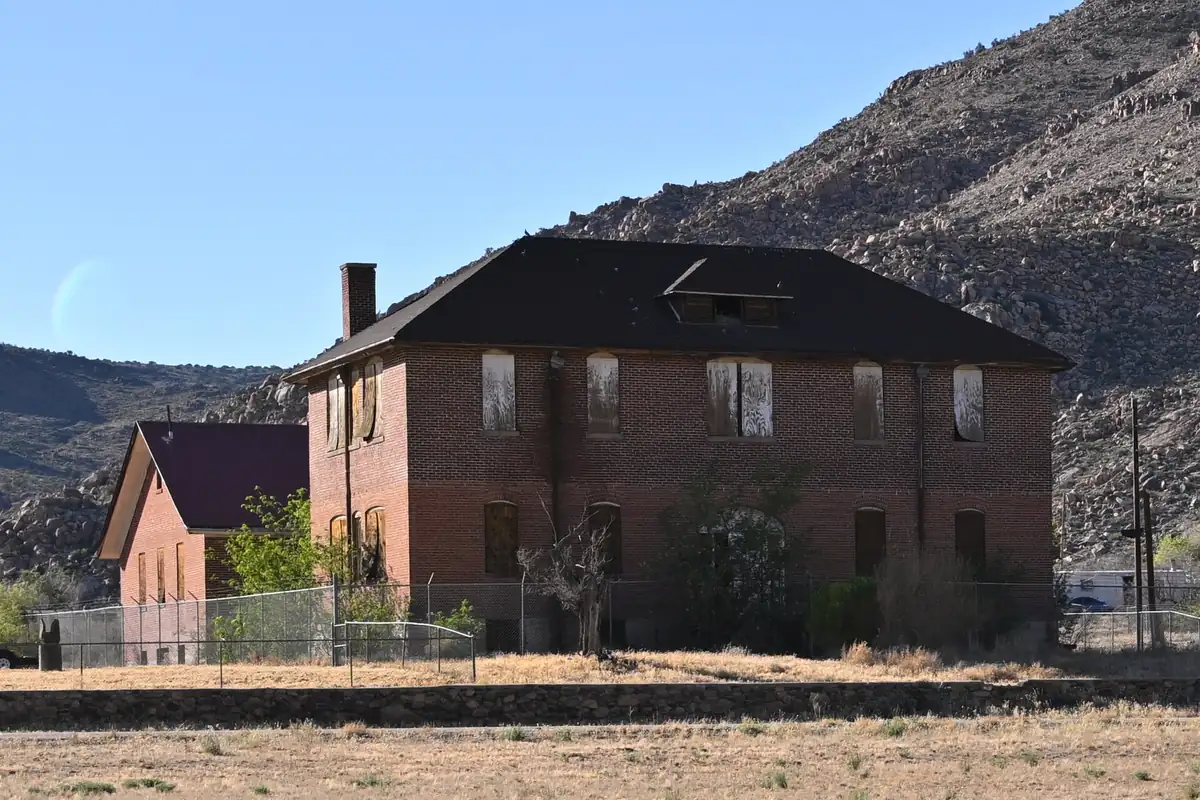
Valentine, Arizona, was Truxton until February 24, 1910, when its post office took the name of Robert G. Valentine, U.S. commissioner of Indian affairs. The office he ran was in charge of the Indian boarding school there, and that school’s 1903 schoolhouse is still standing.
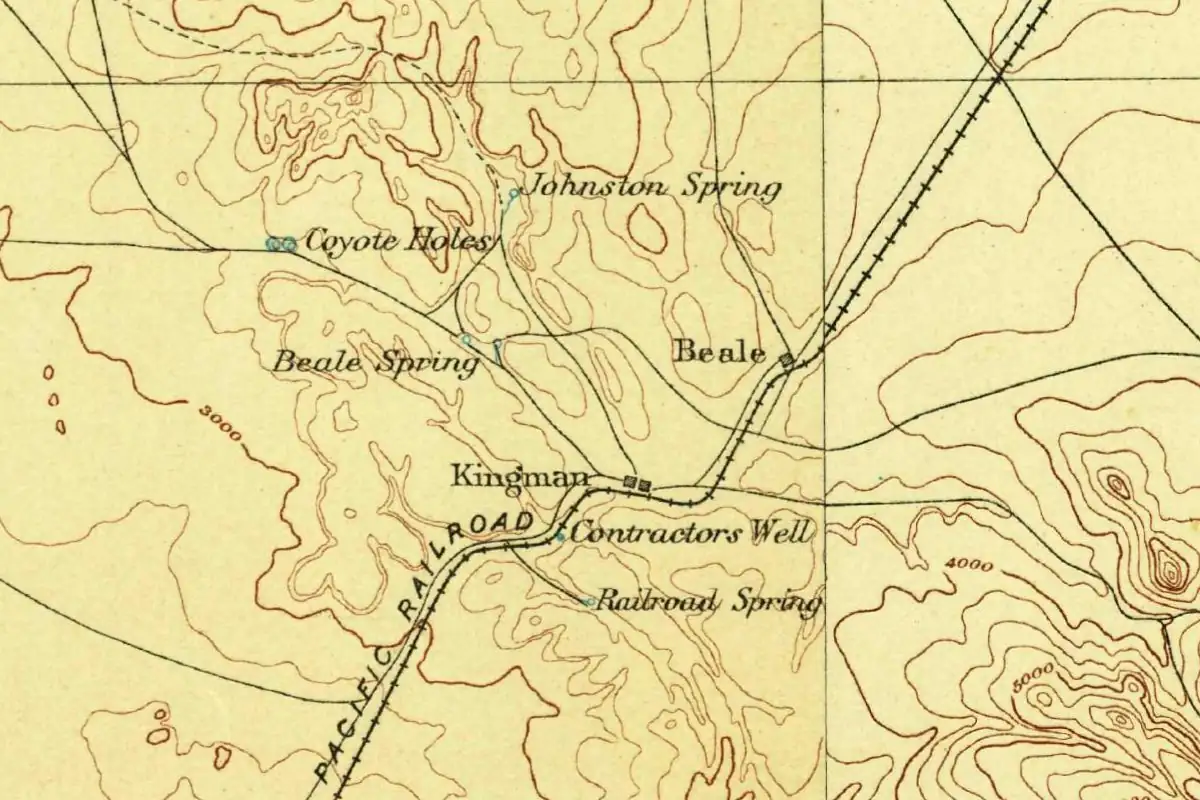
You’ll find Valentine on old Route 66 in Mohave County, Arizona, about 35 miles (56 km) northeast of Kingman and 15 miles (24 km) southwest of the Hualapai Tribe’s offices in Peach Springs, according to the schoolhouse’s National Register nomination.
A commissioner’s name in the place-name book
Will C. Barnes put the story in a few short lines in his Arizona Place Names in 1935. Valentine, he wrote, was a Santa Fe railroad station and an Indian agency “on a small outlying area of Hualpai Ind. Res.” It was “Named after Robert G. Valentine, U. S. Commissioner, Indian Affairs, 1908-10,” and “Formerly called Truxton.” He added that the post office was established on February 24, 1910, with Enos B. Atkinson as postmaster.
The WPA’s state guide said the same thing five years later, in its tour of US 66:
“In VALENTINE, 81.1 m. (3,800 alt., 110 pop.), formerly called Truxton but renamed for Robert G. Valentine, Commissioner of Indian Affairs (1908-10), is the Truxton Canyon Indian Subagency on a tract of 640 acres bisected by the Santa Fe Ry.”
Both books give Valentine’s term as 1908-10, and that’s a clue the guide was leaning on Barnes. The dates don’t quite match the record, either. Papers in a 1911 libel suit, Farr v. Valentine, say he was still assistant commissioner in March 1909 and “on the first day of June, A. D. 1909, appointed and became Commissioner of Indian Affairs, an officer of the United States at the head of the Indian Service.” So when the name changed in February 1910, the man it honored was the head of the federal office that ran the school there. None of these sources says who asked for the new name, or whether Valentine himself had anything to do with it.
Truxton, the name that came first
The post office didn’t start out as Valentine. The U.S. Postal Service’s Postmaster Finder lists it as “Originally established as TRUXTON,” opened on January 10, 1901, with Henry P. Ewing as the first postmaster. The National Register nomination for the schoolhouse names a Henry P. Ewing as the deputy sheriff who, along with the Hualapai people, urged the opening of a day school at Hackberry, and a Henry Ewing as that day school’s teacher in charge before the boarding school replaced it.
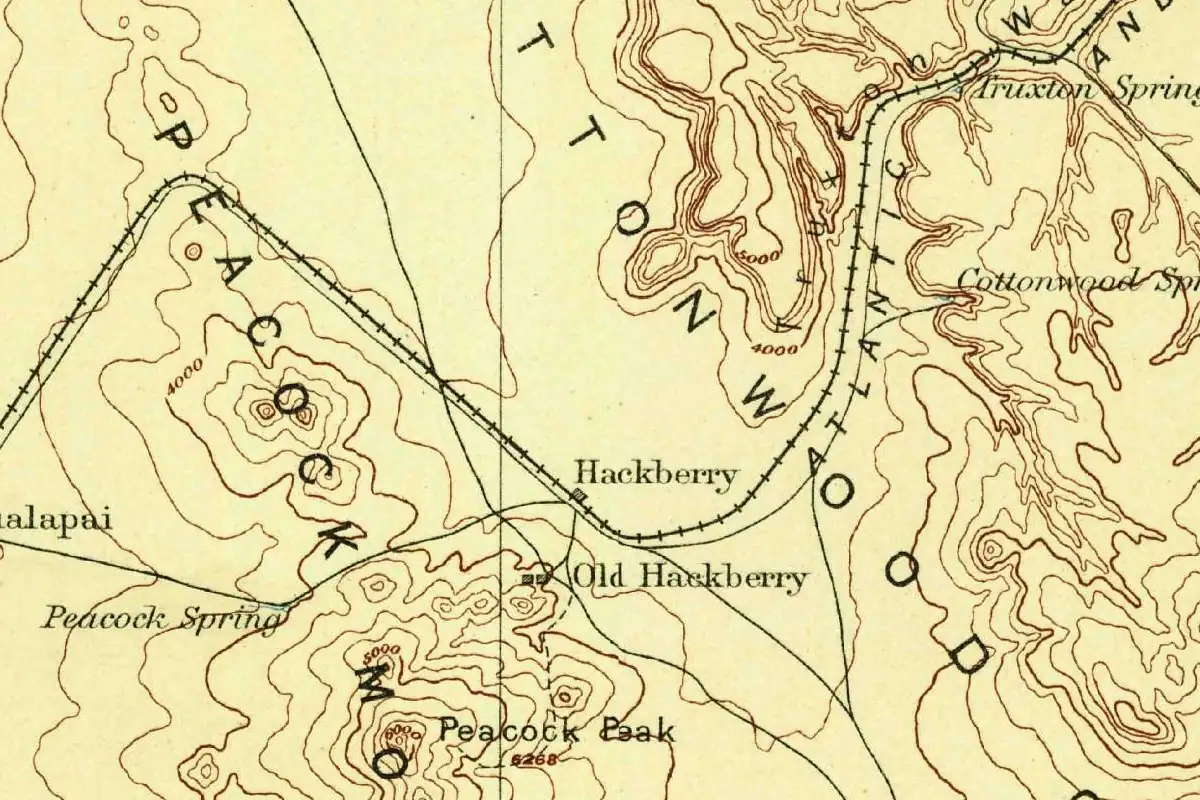
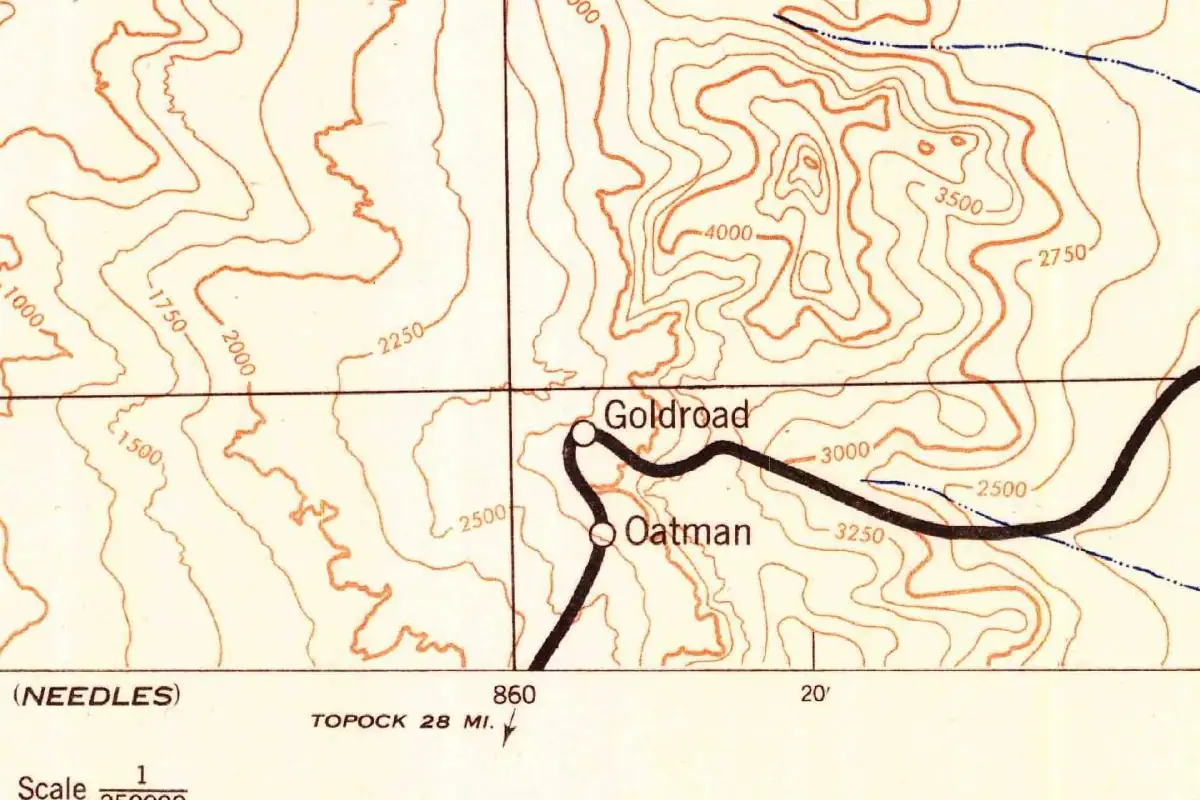
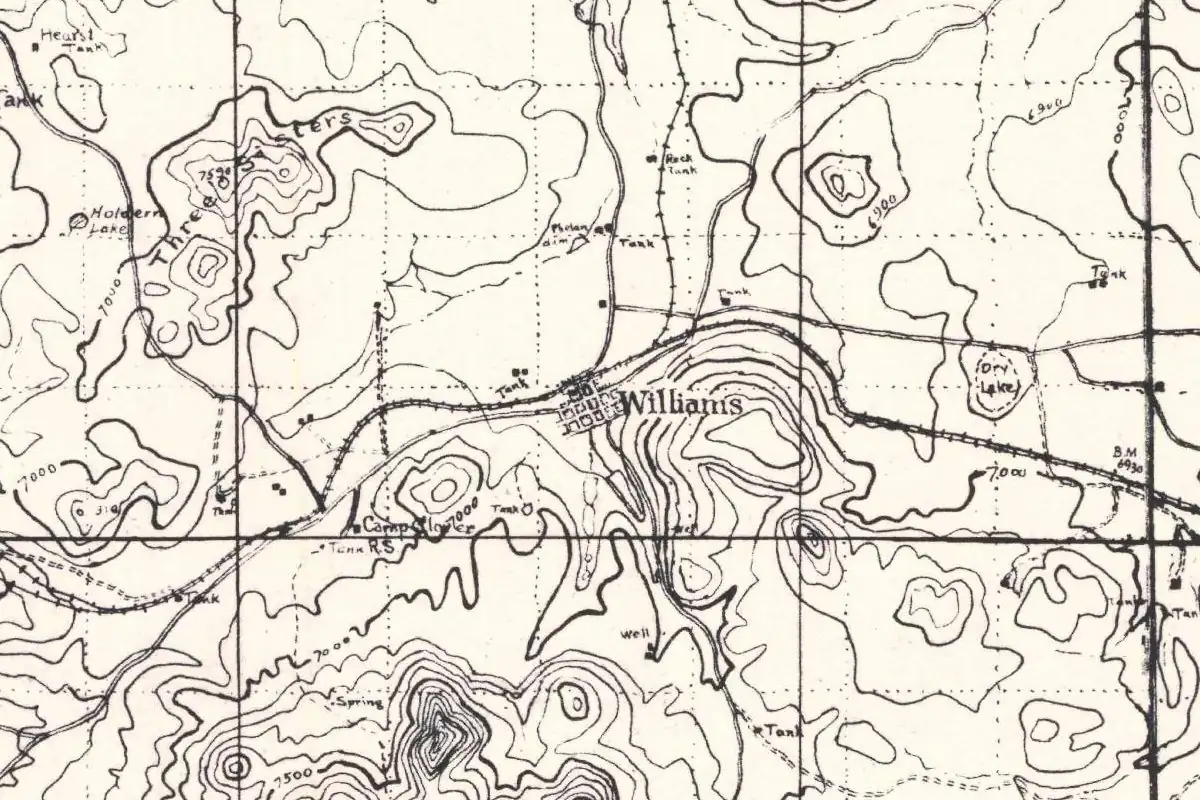
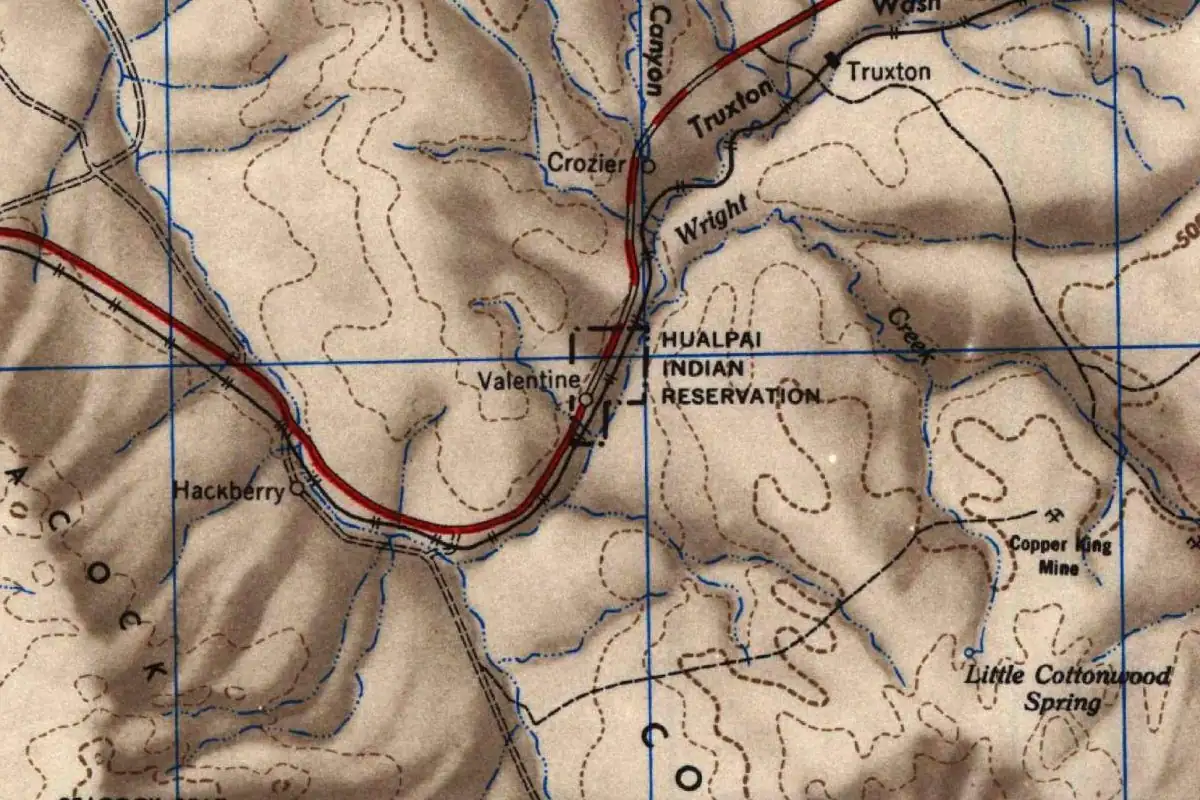
Truxton was already an old name in that canyon. Barnes says Lt. Edward F. Beale named Truxton Spring in 1857, “either for his grandfather, Commodore Thomas Truxton, or for one of his party by this same name.” The railroad used it too. Barnes lists a separate Santa Fe station called Truxton, “12 miles west Peach springs,” and tells you to “See Valentine.” On the U.S. Geological Survey’s Diamond Creek map, even in the printings of 1918 and 1927, the stop in the canyon is still labeled Truxton, and there’s no Valentine at all. The first USGS sheet we found with the name is the 1948 one at the top of this page, where Valentine sits in its little square of reservation land and Truxton is a separate station up the line.
February 24, 1910
The change itself is in the Postal Service’s own list of postmasters: “Changed to VALENTINE on February 24, 1910.” The same postmaster, Enos B. Atkinson, appears on both sides of that line, appointed at Truxton in June 1909 and again at Valentine on the day of the change. Four months later, the Arizona Republican in Phoenix ran a roundup of Arizona post office changes between June 1, 1909, and June 1, 1910. Under “Names Changed,” between McNeal and Wenden, it listed “Truxton, Mohave county, to Valentine.” The paper didn’t say why.
You may also run into a different explanation. Marshall Trimble’s Roadside History of Arizona (1986) says the post office was discontinued “when the school was closed” and that, “according to rules,” a new name had to be chosen when it was re-established in 1910. The records don’t back that up. The Postmaster Finder shows one office, renamed, with the same postmaster before and after, and the National Register nomination has the school open from 1901 to 1937. Trimble agrees on the namesake, though. We didn’t find any source that credits the Santa Fe railroad, or anyone else, with picking the name.
The school behind the post office
The school’s story starts earlier. According to the National Register nomination, Hualapai leaders asked for a school close to home after the government sent a dozen Hualapai children from Fort Mojave to the Albuquerque Indian School in 1891 without their parents’ knowledge, and two of them soon died. The Massachusetts Indian Association opened a day school at Hackberry in 1894. An executive order created the Hualapai Indian School Reserve next to it in 1898, and on April 1, 1901, teachers moved their classes into the new Truxton Canyon Training School. Its brick schoolhouse went up in 1903.
It was a boarding school built for assimilation. The nomination says its architecture “expressed the intent on the part of the federal government to separate a student from his or her family and culture,” and the National Park Service says many students “found life at Truxton Canyon traumatic.” Measles, influenza and tuberculosis were common. From 1925 on, enrollment stayed near 200, the nomination says, and in the school’s last decade Hualapai children were joined by Navajo, Apache, Havasupai, Hopi, Pima, Tohono O’odham and Yavapai students.
The school closed in 1937, after a day school opened for Hualapai children at Peach Springs. The WPA guide, published three years later, still described the agency building as housing “a boarding school for two hundred Indian boys and girls,” so its information was already behind the times. The dormitory and the teacher’s residence were torn down in the late 1950s, and the nomination says their bricks went into the Mohave County Historical Museum in Kingman.
What’s left on the old road
The road past the school became part of the National Old Trails Road in the 1910s and was designated Route 66 by 1926, according to the National Park Service. The WPA guide gave Valentine’s population as 110 in 1940. The post office lasted until October 10, 1975, when the Postal Service discontinued it and made it a community post office of Kingman.
Only the schoolhouse survives from the school. It was listed in the National Register of Historic Places in 2003, and the Hualapai Nation owns it. The Park Service says it’s closed to the public but can be seen from the road, and that opinions among the Hualapai about preserving it vary. For many, it brings back a time of forced assimilation. For others, it’s a reminder of a history that “should not be forgotten.”
Not the Nebraska Valentine, or the holiday
There’s an older Valentine in Nebraska. Henry Gannett’s 1905 list of American place names includes only that one, “named for Hon. E. K. Valentine,” and has no Valentine in Arizona, which didn’t have one yet. Our Nebraska story identifies him as Congressman Edward K. Valentine. And if you were wondering about Valentine’s Day, none of the sources we read connects it to the Arizona name. The post office changed names on February 24, ten days after the holiday.
So the name on the map isn’t about romance at all. It belongs to the man at the head of the Indian Service in 1910, the same office that ran the boarding school whose schoolhouse still stands beside the old road.
Quick answers
Who is Valentine, Arizona, named after?
Robert G. Valentine, the U.S. commissioner of Indian affairs, according to Will C. Barnes’s Arizona Place Names (1935) and the 1940 WPA guide. Neither says who chose the name.
What was Valentine, Arizona, called before?
Truxton. The post office opened as Truxton on January 10, 1901, and was changed to Valentine on February 24, 1910, according to the Postal Service’s records.
Is Valentine, Arizona, named after Valentine’s Day?
No. None of the sources we read connects the name to the holiday, and the post office took the name on February 24, not February 14.
What was the Truxton Canyon Training School?
A federal boarding school, mostly for Hualapai children, that opened in 1901 and closed in 1937. Its 1903 brick schoolhouse still stands in Valentine and belongs to the Hualapai Nation.
Key dates
- 1857Lt. Edward F. Beale names Truxton Spring, Barnes says, either for his grandfather, Commodore Thomas Truxton, or for a man in his party.
- 1898An executive order creates the Hualapai Indian School Reserve next to the Hackberry day school.
- 1901A post office called Truxton opens on January 10, and on April 1 classes move into the new Truxton Canyon Training School.
- 1903The school's brick schoolhouse goes up.
- 1909Robert G. Valentine becomes commissioner of Indian affairs on June 1, according to a 1911 court record.
- 1910On February 24, the Truxton post office is changed to Valentine.
- 1926The road past the school is designated U.S. Route 66, according to the National Park Service.
- 1937The Truxton Canyon Training School closes after a day school opens at Peach Springs.
- 1975The Valentine post office is discontinued on October 10 and becomes a community post office of Kingman.
- 2003The schoolhouse is listed in the National Register of Historic Places.
Getting there
Open Valentine in Google Maps
Opens in a new tab. The pin is the center of Valentine in the USGS place-name record.
The closest airports, Amtrak stations and intercity bus stops, measured in a straight line from the center of Valentine.
Airports
- Grand Canyon West (1G4) Peach Springs 42 mi 68 km
- Laughlin/Bullhead International (IFP) Bullhead City 53 mi 86 km
- Harry Reid International (LAS) Las Vegas 97 mi 155 km
Amtrak trains
- Kingman station (KNG) 26 mi 42 km
- Needles station (NDL) 66 mi 106 km
Intercity buses
- Greyhound Kingman McDonald's 23 mi 37 km
- Vegas Airporter Amtrak Connecting Service · Kingman 26 mi 42 km
- FlixBus Kingman N 27 mi 43 km
Distances are as the crow flies, not by road. We don't list schedules or fares because they change; check with the airline, Amtrak or the bus company before you go. Official data (FAA commercial service airports (2025), FAA airport locations, Amtrak stations and Intercity Bus Atlas) from the FAA and the U.S. Bureau of Transportation Statistics, checked Nov 11, 2026.
Sponsored
Staying in Valentine?
Compare hotels in Valentine, Arizona, on Expedia.
See hotels in ValentineWe may earn a commission if you buy through this link. It never changes what we write. Read our affiliate disclosure
Historical Sources & References
- Will C. Barnes, Arizona Place Names (1935). p. 466, entry “Valentine”: Santa Fe station and Indian agency “On a small outlying area of Hualpai Ind. Res.,” “Named after Robert G. Valentine, U. S. Commissioner, Indian Affairs, 1908-10,” “Formerly called Truxton,” post office established February 24, 1910, Enos B. Atkinson, postmaster. p. 452, entry “Truxton”: Santa Fe station “12 miles west Peach springs. See Valentine”; entry “Truxton Canyon and Spring”: named in 1857 by Lt. Edw. F. Beale “either for his grandfather, Commodore Thomas Truxton, or for one of his party by this same name.” University of Arizona Repository scan.
- U.S. Postal Service, Postmaster Finder. Search “Valentine,” Arizona: “Originally established as TRUXTON,” January 10, 1901, Henry P. Ewing; Enos B. Atkinson, June 5, 1909; “Changed to VALENTINE on February 24, 1910,” Atkinson again; discontinued October 10, 1975, and converted to a community post office of Kingman.
- The Arizona Republican, June 23, 1910, p. 7. “Postoffice News of Varied Kinds”: Arizona post office changes between June 1, 1909, and June 1, 1910, with “Truxton, Mohave county, to Valentine” under “Names Changed.”
- Writers’ Program, Arizona: A State Guide (1940). p. 323 (Tour 2): the quotation above, with 110 people, the Truxton Canyon Indian Subagency on 640 acres and “a boarding school for two hundred Indian boys and girls.”
- Farr v. Valentine (Court of Appeals of the District of Columbia, 1911). Record and briefs: Valentine was “still Assistant Commissioner of Indian Affairs” on March 16, 1909, and “on the first day of June, A. D. 1909, appointed and became Commissioner of Indian Affairs, an officer of the United States at the head of the Indian Service.”
- National Register of Historic Places Registration Form, Schoolhouse at Truxton Canyon Training School. Prepared by Pat Haigh Stein (1999, revised 2003). Section 7, pp. 6-9: location 35 miles from Kingman and 15 miles from Peach Springs, the 1898 reserve, the school from 1901 to 1937, the 1903 schoolhouse, and the dormitory and teacher’s residence razed in the late 1950s for the museum in Kingman. Section 8, pp. 10-14: the 1891 removal of Hualapai children, the Hackberry day school, Deputy Sheriff Henry P. Ewing and teacher Henry Ewing, the move on April 1, 1901, the 1903 schoolhouse, enrollment near 200 from 1925, the tribes in the last decade, the 1937 closing and the purpose of the architecture.
- National Park Service, “Arizona: Schoolhouse at Truxton Canyon Training School”. Life at the school “traumatic,” the diseases, the 1937 closing, the National Old Trails Road and Route 66 by 1926, the 2003 listing, Hualapai ownership and views, closed to the public but visible from the road.
- Marshall Trimble, Roadside History of Arizona (1986). p. 286: the version that the post office was discontinued when the school closed and renamed under postal “rules” in 1910, also for Robert G. Valentine. Read as search excerpts; the book is a restricted loan.
- Henry Gannett, The Origin of Certain Place Names in the United States (1905). p. 308: Valentine, Nebraska, “named for Hon. E. K. Valentine”; no Valentine in Arizona.
- U.S. Geological Survey, Diamond Creek sheet (1892; 1918 and 1927 printings). Truxton on the railroad in the canyon and no Valentine. Also online: the 1927 printing.
- U.S. Geological Survey, Williams sheet (1948). The map at the top of this page, the oldest USGS topographic sheet we found with Valentine on it.
- GNIS feature 13160, Valentine (U.S. Geological Survey). The Geological Survey’s place-name entry for Valentine, a populated place in Mohave County on the Valentine map sheet, with its coordinates.
Sponsored
Gear up for your next road trip
Explore rooftop tents, vehicle awnings and outdoor gear from TOPOAK Overland.
Shop TOPOAK overlanding gearWe may earn a commission if you buy through this link. It never changes what we write. Read our affiliate disclosure
Spot something wrong, or know more? Tell us here. You can also email us or use our contact page. Corrections are noted here with their date, never made silently.