Arlington National Cemetery History and Name Origin
Arlington National Cemetery took its name from the Custis estate on the hill, first called Mount Washington and renamed for an older family plantation. The cemetery came last. Before there were graves, there was a house, and before that house was Arlington, it was named for George Washington.
Arlington National Cemetery History: From Mount Washington to a National Cemetery
The name starts on Virginia’s Eastern Shore. Early in the 1670s, according to Encyclopedia Virginia, John Custis, founder of the family in Virginia, put up a brick house of three stories beside Old Plantation Creek in Northampton County and called it Arlington, probably after the family’s ancestral village in Gloucestershire, England. The encyclopedia’s entry calls it perhaps the finest house put up in the 17th-century Chesapeake.
More than a century later, the name moved across the state. George Washington Parke Custis, Martha Washington’s grandson, grew up at Mount Vernon in the care of Martha and George Washington. When his grandmother died in 1802, he came into the Custis lands, among them 1,100 acres (445 hectares) on the Potomac. The National Park Service says Custis “first christened the property Mount Washington,” then renamed it Arlington for an earlier plantation of the Custis family. Encyclopedia Virginia makes the link plain: the old Eastern Shore house was the namesake of the new one.
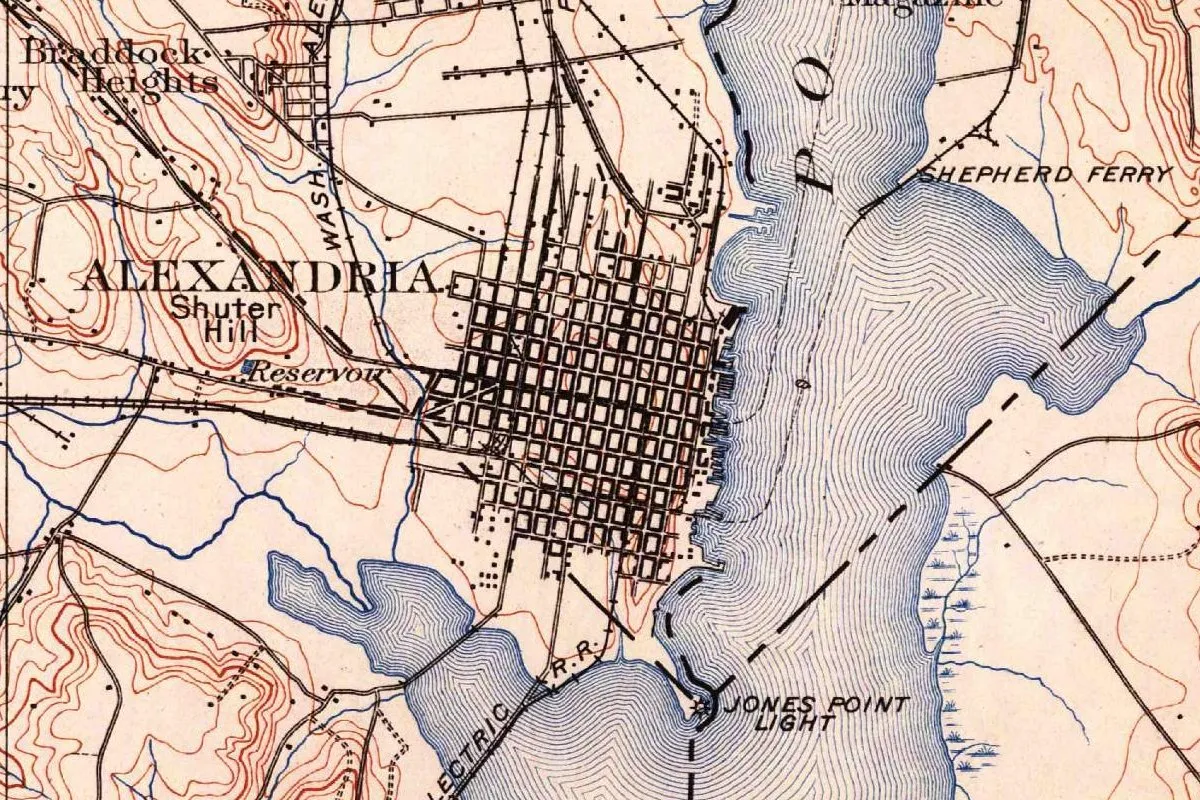
That land had its own earlier owner. The Park Service says John Alexander held 6,000 acres (2,428 hectares) here by 1669, and in 1778 John Parke Custis, the younger Custis’s father, bought 1,100 of them from Gerrard Alexander. The town that took Alexander’s name, as our Alexandria page explains, was laid out in 1749.
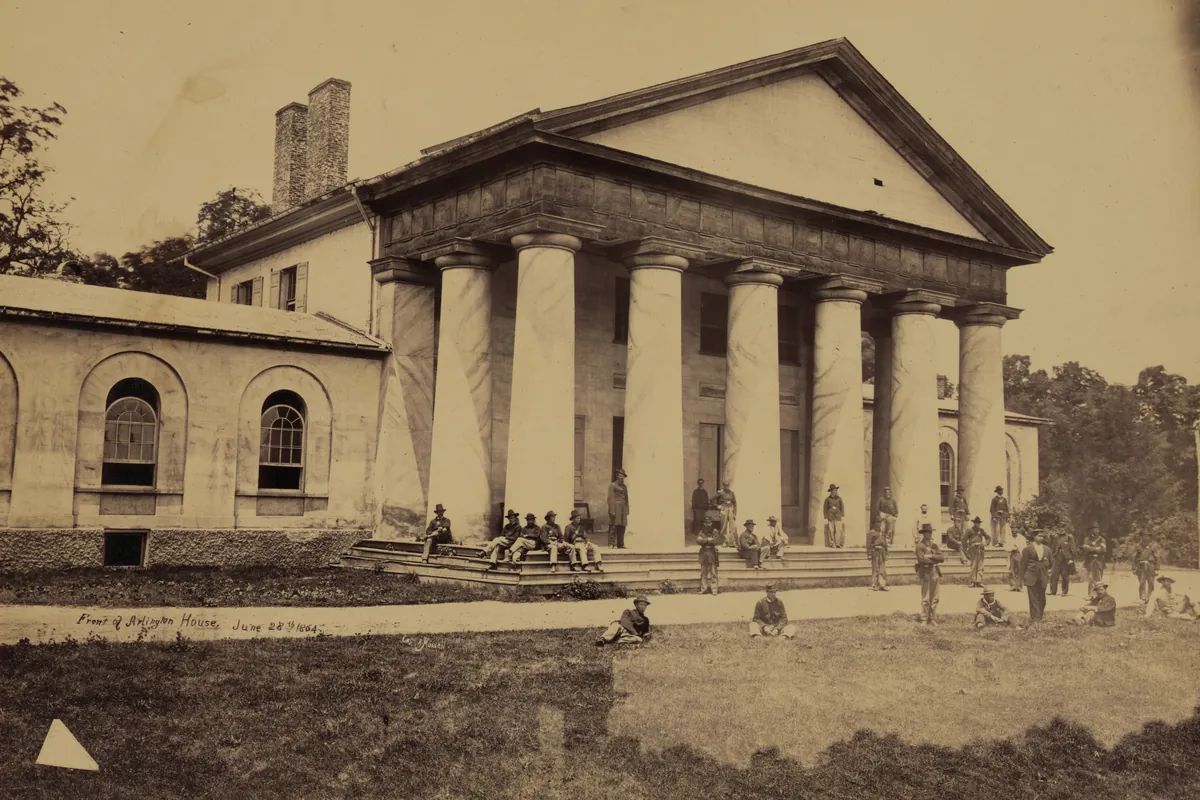
The mansion took from 1802 to 1818 to finish, and the Park Service says 57 enslaved workers were brought to the estate that summer to build it. Custis filled it with relics from Mount Vernon, including the bed Washington died in, and the Park Service calls the house the nation’s first memorial to Washington. In 1831 his daughter, Mary Anna Randolph Custis, married Lt. Robert E. Lee. When Custis died in 1857, he left the estate to Mary for her lifetime and then to her eldest son. The cemetery’s own history is careful on this point: Lee served as the will’s executor and never held title. The Lee connection also carried the name west: Arlington, Texas, as our page on it explains, chose the name in 1876 for Lee’s Virginia home.
The Civil War turned the estate into something else. After the Lees left, the Army seized it early on May 24, 1861, for its high ground over the capital; the cemetery’s history says it was taken for strategic value, not to punish the family. Forts went up on the property, and in June 1863 a Freedman’s Village, a camp for people freed from or escaping slavery, opened on ground that’s now part of the cemetery.
By 1864 the burial grounds around Washington were running out of space. Pvt. William Christman was buried at Arlington on May 13, the first military burial there. On June 15, Quartermaster General Montgomery Meigs proposed Arlington for a new national cemetery, and Secretary of War Edwin M. Stanton approved it the same day, ordering that no more than 200 acres (81 hectares) be laid out. The Park Service adds that Meigs wanted graves close to the mansion to make it uninhabitable if the Lees ever came back, and in August 1864, 26 soldiers were buried along the edge of Mrs. Lee’s rose garden.
The Lees never returned. The government had bought the property at a public auction in January 1864, but after the deaths of Robert E. Lee and his wife, their son Custis Lee sued, and in 1882 the Supreme Court ruled in his favor. He was paid $150,000, the Park Service says, ending the family’s claim.
So the name was already old when the cemetery got it, and the cemetery grew into it. The first Decoration Day, later called Memorial Day, was held there on May 30, 1868. The cemetery stayed segregated until 1948; Section 27 holds the graves of over 3,800 African Americans freed from slavery. The Tomb of the Unknown Soldier followed on November 11, 1921. Today, the cemetery says, nearly 430,000 veterans and family members are buried on 639 acres (259 hectares).
Visiting Arlington National Cemetery
Arlington is an active cemetery. On a weekday, the cemetery says, as many as 30 service members and eligible relatives are laid to rest, and its visitor rules ask you to keep in mind that it’s “a place of honor, grieving and reflection.” Speak quietly. Don’t run, climb, bike, play sports or picnic, and don’t sit on headstones or monuments. If a funeral procession comes by, step aside and wait, and keep your distance from a service. When Taps sounds or the flag is part of a ceremony, civilians place a right hand over the heart.
As of November 2026, the cemetery was open every day, 8 a.m. to 5 p.m. The grounds are hilly, and the cemetery warns that the walking takes moderate effort. An interpretive tram stops at sites such as John F. Kennedy’s grave and the Tomb of the Unknown Soldier, and visitors with a disability placard can ride the bus free with one companion. The cemetery’s ANC Explorer app can find a grave and offers self-guided tours. The cemetery also said that, starting around November 2, 2026, work on its Southern Expansion would close the U.S. Air Force Memorial and its surroundings, so check before you go.
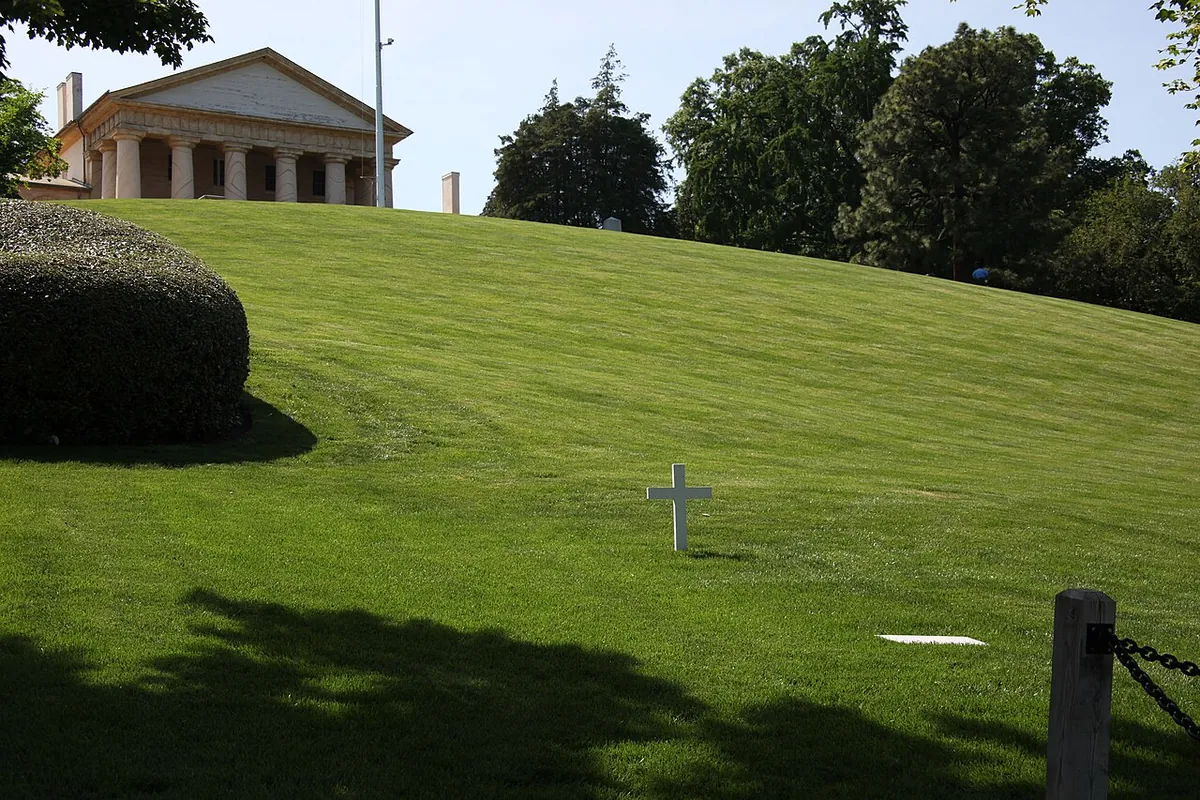
The Tomb has been guarded around the clock since 1937, the cemetery says, and by soldiers of the 3rd U.S. Infantry Regiment, The Old Guard, since 1948. Arlington House still stands at the top of the hill, above the graves. Across the river is the Lincoln Memorial, which, as our page on it explains, planners in 1902 meant to tie to the cemetery by a new bridge.
Quick answers
Why is it called Arlington National Cemetery?
It’s named for Arlington, the Custis estate it was built on. George Washington Parke Custis gave the estate that name after an older family plantation, a 1670s Custis mansion on Virginia’s Eastern Shore.
Was Arlington ever called Mount Washington?
The estate was. The Park Service says Custis first named it Mount Washington before changing it to Arlington. The cemetery didn’t exist until 1864.
Did Robert E. Lee own Arlington?
No. Custis’s will gave the estate to his daughter, Lee’s wife, for her lifetime and then to her eldest son. Lee was executor of the will, the cemetery’s history says.
When did Arlington become a national cemetery?
On June 15, 1864, when Secretary of War Edwin M. Stanton approved Meigs’s proposal, about a month after the first military burial.
Key dates
- 1670sJohn Custis builds a brick mansion on Virginia's Eastern Shore and calls it Arlington.
- 1802Work begins on George Washington Parke Custis's house above the Potomac, on an estate he first calls Mount Washington and later Arlington.
- 1861May 24: the U.S. Army seizes Arlington Estate to defend Washington.
- 1864May 13: first military burial, Pvt. William Christman; June 15: Secretary of War Edwin M. Stanton makes 200 acres a national cemetery.
- 1868May 30: the first official Decoration Day is held at Arlington.
- 1882The U.S. Supreme Court rules for Custis Lee, who is paid $150,000 for the estate.
- 1921November 11: the Tomb of the Unknown Soldier is dedicated.
Getting there
Open Arlington National Cemetery in Google Maps
Opens in a new tab. The pin is an approximate point for Arlington National Cemetery.
The closest airports, Amtrak stations and intercity bus stops, measured in a straight line from the center of Arlington National Cemetery.
Airports
- Ronald Reagan Washington Ntl (DCA) Arlington 2 mi 4 km
- Washington Dulles International (IAD) 22 mi 35 km
Amtrak trains
- Washington station (WAS) 4 mi 6 km
- Alexandria station (ALX) 5 mi 8 km
Intercity buses
- FlixBus Arlington Rosslyn 1 mi 2 km
- OurBus Arlington, VA (1101 Wilson Blvd, Rosslyn) 1 mi 2 km
- Amtrak Chartered Vehicle Amtrak Connecting Service · Washington Union Station 4 mi 6 km
Distances are as the crow flies, not by road. We don't list schedules or fares because they change; check with the airline, Amtrak or the bus company before you go. Official data (FAA commercial service airports (2025), FAA airport locations, Amtrak stations and Intercity Bus Atlas) from the FAA and the U.S. Bureau of Transportation Statistics, checked Nov 21, 2026.
Sponsored
Planning a visit?
Compare hotels near Arlington National Cemetery on Expedia.
See hotels nearbyWe may earn a commission if you buy through this link. It never changes what we write. Read our affiliate disclosure
Historical Sources & References
- Arlington National Cemetery, “History of Arlington National Cemetery”: Custis’s will and Lee as executor, the seizure of May 24, 1861, Freedman’s Village, the first military burial, the order of June 15, 1864, segregation until 1948 and Section 27, Decoration Day 1868, the Tomb in 1921 and the number of burials.
- Arlington National Cemetery, “Historical Expansion”: Meigs, the 200 acres of the original 1,100, the growth to 639 acres and the weekday burials.
- National Park Service, “The Washington Treasury”: Custis’s upbringing at Mount Vernon, his inheritance in 1802, the house built from 1802 to 1818, the name Mount Washington and the rename to Arlington, and the marriage of 1831.
- National Park Service, “Arlington National Cemetery”: the auction of January 1864, Meigs’s proposal and Stanton’s approval on June 15, 1864, the rose-garden burials and the Supreme Court ruling of 1882.
- National Park Service, “Whose Land? Claims at Arlington Estate”: John Alexander’s 6,000 acres, the purchase of 1778 and the 57 enslaved workers of 1802.
- Encyclopedia Virginia, “John Custis (ca. 1629-1696)”: the Arlington mansion of the 1670s in Northampton County, its probable Gloucestershire name and its link to Arlington House.
- Arlington National Cemetery, “Tomb of the Unknown Soldier”: the round-the-clock guard since 1937 and The Old Guard since 1948.
- Arlington National Cemetery, “Plan Your Visit” and “Visitor Rules”: hours, the tram, the ANC Explorer app, the Air Force Memorial closure and the rules of conduct (as of November 2026).
- “Arlington House, east front, June 28, 1864,” Library of Congress: the photo at the bottom of this page, by Andrew J. Russell.
Spot something wrong, or know more? Tell us here. You can also email us or use our contact page. Corrections are noted here with their date, never made silently.