Lincoln Memorial: Its Name, History, and What to See
The Lincoln Memorial wasn’t always going to be a memorial: Congress first chartered a Lincoln Monument Association in 1867, and that plan never got built. Whose name it carries was never in doubt. It’s Abraham Lincoln, the 16th president. What took 57 years after his death to settle was what kind of tribute it would be, and where it would stand.
Lincoln Memorial History: From the First Plans to the Civil Rights Era
The first try came two years after the assassination. Congress set up a Lincoln Monument Association in 1867, the National Park Service says, and brought in sculptor Clark Mills, whose design was an enormous bronze piece with 36 figures and Lincoln sitting at the top. The Law Library of Congress quotes the purpose Congress gave the association: a “monument in the city of Washington, commemorative of the great charter of emancipation and universal liberty in America.” It also had to raise at least $100,000. It never did, and nothing was built.
The word that won came later. When Congress tried again, the law President William Howard Taft signed on February 9, 1911, didn’t choose. It set up “a commission, to be known as the Lincoln Memorial Commission,” to choose a site, a plan and a design for “a monument or memorial” in Washington “to the memory of Abraham Lincoln,” with a budget capped at two million dollars. The commission’s name used one word, the law kept both, and the finished building went by the commission’s. No source we opened says why memorial won out.
The place had been picked years before the law. The Senate Park Commission, which Senator James McMillan put together in 1901 to redraw Washington, proposed in 1902 to put a Lincoln Memorial on the edge of the Potomac, where it would close off the Mall on the west, according to the Park Service. A new bridge, the future Arlington Memorial Bridge, would tie it to Arlington National Cemetery across the river, linking the old Union and Confederate sides. The Law Library adds that the Lincoln commission still had rival plans drawn for two other sites, at the Old Soldiers’ Home and on a rise along Sixteenth Street, before it settled on Potomac Park.
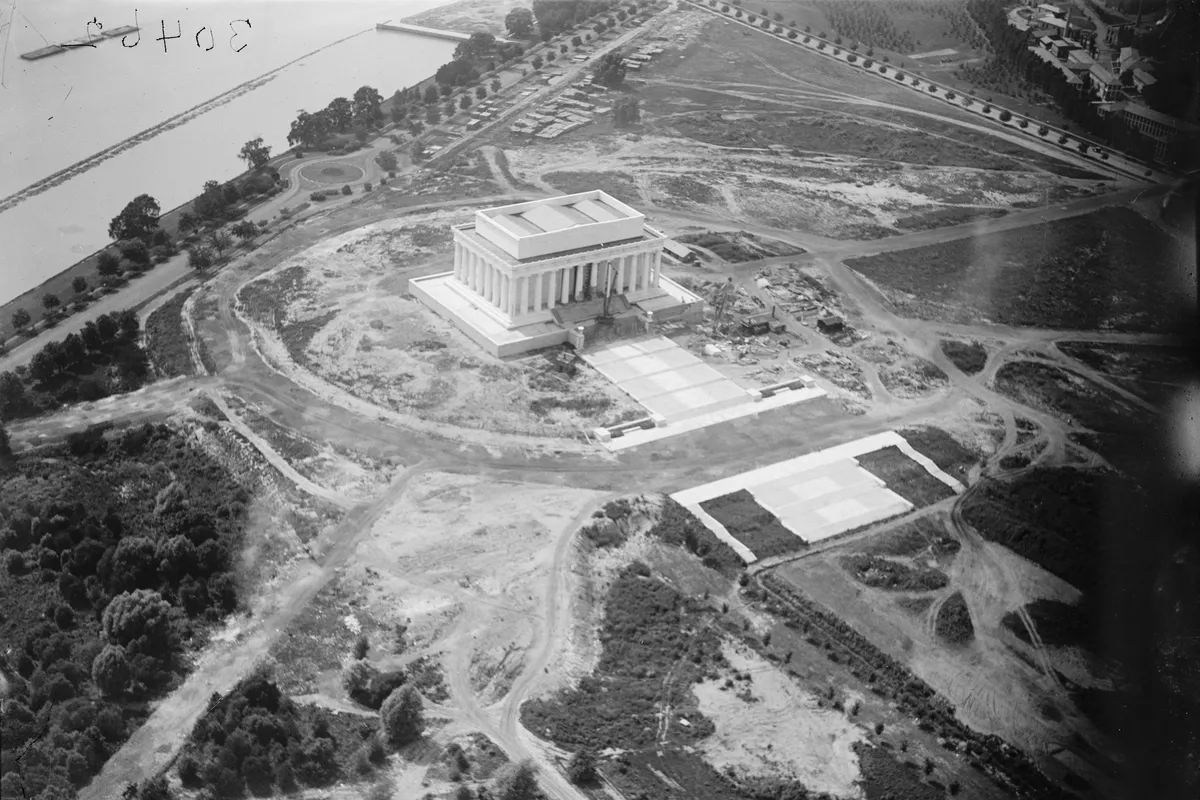
Taft chaired the commission while he was president. Architect Henry Bacon modeled the building on the Parthenon, and construction began on February 12, 1914, Lincoln’s birthday. The ground was filled land, so the Park Service says workers sank 122 concrete piers into bedrock before any marble went up. In 1918, with World War I slowing the work, the designers doubled the size of Daniel Chester French’s planned statue so it wouldn’t look small in the chamber. The Piccirilli brothers carved it out of 28 pieces of Georgia marble, and crews assembled it around the turn of 1920. The aerial photo at the bottom of this page shows the building about then, standing on bare, rutted ground.
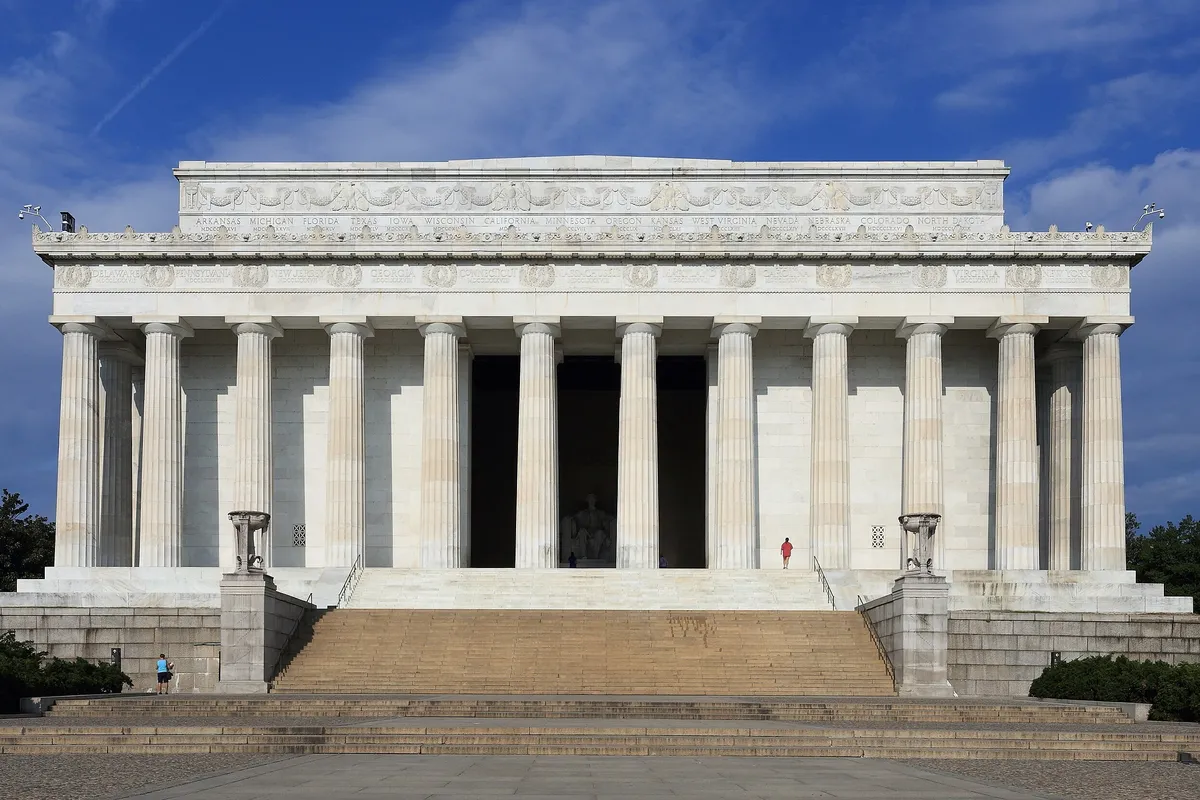
The building keeps two counts of the Union at once. The Park Service’s exterior page says the 36 fluted Doric columns stand for the 36 states that made up the Union when Lincoln died, and those states’ names are carved above them. Higher up, on the attic, you’ll find all 48 states that existed on dedication day. Alaska and Hawaii get a plaque on the plaza instead.
The dedication came on May 30, 1922. Taft, by then Chief Justice and still head of the commission, handed the memorial to President Warren G. Harding, with Lincoln’s son Robert Todd Lincoln there, before a crowd of over 50,000 and a national radio audience. One speaker was Dr. Robert Moton, president of Tuskegee Institute. The Park Service’s account of the day says Black members of the audience were seated in a separate section, and that Moton spoke about the discrimination they faced that very day, comparing the Mayflower with a slave ship bound for America.
The steps became a stage for that unfinished business. In 1939, the Daughters of the American Revolution refused to let Marian Anderson sing at Constitution Hall, which banned Black performers, and the NAACP and her manager, Sol Hurok, set up a performance at the memorial instead. On Easter Sunday, April 9, 1939, she opened with “My Country, ’Tis of Thee” before what the Park Service calls “an integrated crowd of 75,000 people.” On August 28, 1963, Martin Luther King Jr. spoke from the same steps during the March on Washington, heard by an estimated 250,000 marchers, according to the Library of Congress.
The name traveled long before the memorial was finished. In 1867, the same year Congress chartered the monument association, Nebraska’s legislature named its new capital, until then called Lancaster, after him: Lincoln. And the senator who’d debated Lincoln got a town too: Douglas, Wyoming, is named for Stephen A. Douglas.
Visiting the Lincoln Memorial: What to See and How to Get There
The chamber and the outside of the memorial cost nothing to visit, the Park Service says. Inside you’ll find French’s 19-foot (5.8 m) statue, the Gettysburg Address and the Second Inaugural Address carved into the walls, and two murals by Jules Guerin, each 60 feet (18 m) long. Above the statue is the line Royal Cortissoz wrote for it, which the Park Service says he counted as his proudest work: “In this temple, as in the hearts of the people for whom he saved the Union, the memory of Abraham Lincoln is enshrined forever.”
Partway up the steps, look for the engraved stone that marks where King gave his speech in 1963. If stairs are a problem, the Park Service says there’s an elevator up to the chamber, on the left side of the steps.
Under the memorial is a newer space, the undercroft, a 15,000-square-foot (1,400 m²) exhibit area that shows the concrete columns holding the building up and tells how it was built. It’s run separately from the chamber. When we checked in November 2026, the Park Service said the undercroft required timed-entry tickets, which are free except for a small service fee on advance reservations, and that its entrance is across the stairs from that elevator.
For the trip itself, the Park Service puts the Foggy Bottom-GWU Metro station about 0.8 miles (1.3 km) from the memorial and Smithsonian station about 1.2 miles (1.9 km) away. It warns that parking nearby is limited, with most spots along Ohio Drive SW limited to two hours.
Quick answers
Who is the Lincoln Memorial named for?
Abraham Lincoln, the 16th president. The 1911 law that started the project created the Lincoln Memorial Commission to plan a tribute “to the memory of Abraham Lincoln.”
When was the Lincoln Memorial built?
Between 1914 and 1922. Work began on February 12, 1914, Lincoln’s birthday, and the memorial was dedicated on May 30, 1922, more than 55 years after Congress’s first attempt in 1867.
Is visiting the Lincoln Memorial free?
Yes, for the chamber and the outside. The undercroft exhibit below it needs a timed-entry ticket, which the Park Service says is free apart from a small fee for reserving ahead.
Was the Lincoln Memorial dedication segregated?
Yes. The Park Service says Black guests at the May 30, 1922, ceremony sat in a separate section, and speaker Robert Moton of Tuskegee Institute talked about that discrimination in his address.
Key dates
- 1867Congress creates the Lincoln Monument Association and hires Clark Mills to design a bronze monument, which is never built.
- 1902The Senate Park Commission proposes a Lincoln Memorial on the Potomac at the west end of the Mall.
- 1911February 9: Congress creates the Lincoln Memorial Commission to plan "a monument or memorial" to Lincoln.
- 1914Construction begins on February 12, Lincoln's birthday.
- 1922May 30: the memorial is dedicated before a crowd of more than 50,000, with Black guests seated in a separate section.
- 1939April 9: Marian Anderson sings on the steps before 75,000 people, Black and white.
- 1963August 28: Martin Luther King Jr. gives his "I Have a Dream" speech from the steps.
Getting there
Open Lincoln Memorial in Google Maps
Opens in a new tab. The pin is an approximate point for Lincoln Memorial.
The closest airports, Amtrak stations and intercity bus stops, measured in a straight line from the center of Lincoln Memorial.
Airports
- Ronald Reagan Washington Ntl (DCA) Arlington 3 mi 4 km
- Washington Dulles International (IAD) 22 mi 36 km
Amtrak trains
- Washington station (WAS) 2 mi 4 km
- Alexandria station (ALX) 6 mi 9 km
Intercity buses
- FlixBus Arlington Rosslyn 1 mi 2 km
- OurBus Arlington, VA (1101 Wilson Blvd, 1 block from Rosslyn Metro station) 1 mi 2 km
- Amtrak Chartered Vehicle Amtrak Connecting Service · Washington Union Station 2 mi 4 km
Distances are as the crow flies, not by road. We don't list schedules or fares because they change; check with the airline, Amtrak or the bus company before you go. Official data (FAA commercial service airports (2025), FAA airport locations, Amtrak stations and Intercity Bus Atlas) from the FAA and the U.S. Bureau of Transportation Statistics, checked Nov 21, 2026.
Sponsored
Planning a visit?
Compare hotels near Lincoln Memorial on Expedia.
See hotels nearbyWe may earn a commission if you buy through this link. It never changes what we write. Read our affiliate disclosure
Historical Sources & References
- Act of February 9, 1911 (36 Stat. 898): creates “a commission, to be known as the Lincoln Memorial Commission,” to plan “a monument or memorial” in Washington “to the memory of Abraham Lincoln,” with a limit of two million dollars.
- Library of Congress, “The Lincoln Memorial: Pic of the Week”: the 1867 Lincoln Monument Association and its stated purpose; the $100,000 it had to raise; Taft as chairman; the rival sites at the Old Soldiers’ Home and Sixteenth Street; Potomac Park.
- National Park Service, “The Making of the Lincoln Memorial”: Clark Mills’s 1867 design; McMillan and the Senate Park Commission of 1901-1902; the bridge to Arlington; the commissions of 1910 and 1911; February 12, 1914; the 122 piers; the statue enlarged in 1918; the Piccirilli brothers and 28 blocks of Georgia marble; Cortissoz’s inscription; the dedication of May 30, 1922.
- National Park Service, “The Dedication of the Lincoln Memorial”: Moton, Taft, Harding and Robert Todd Lincoln; more than 50,000 people and a radio broadcast; the separate seating and Moton’s speech.
- National Park Service, “Exterior Features”: the 36 columns for the 36 states of 1865; the 48 state names on the attic; the plaque for Alaska and Hawaii.
- National Park Service, “Marian Anderson and Constitution Hall”: the DAR’s refusal, the NAACP and Sol Hurok, April 9, 1939, and the integrated crowd of 75,000.
- Library of Congress, “Memorializing Lincoln”: Bacon and the Parthenon; the estimated 250,000 participants in the 1963 March on Washington.
- National Park Service, “Visit the Lincoln Memorial Chamber” and park home page: free entry to the chamber and the exterior; the “I Have a Dream” stone on the steps.
- National Park Service, “Explore the Lincoln Memorial Undercroft”: the 15,000-square-foot exhibit space and its timed-entry tickets (as of November 2026).
- National Park Service, “Directions” and “Accessibility”: Metro distances, parking, and the elevator up to the chamber.
- Harris & Ewing, “Lincoln Memorial. Under construction. View from air” (1919): the photo at the bottom of this page.
- GNIS feature 531835, Lincoln Memorial: the federal identifier for the memorial.
Spot something wrong, or know more? Tell us here. You can also email us or use our contact page. Corrections are noted here with their date, never made silently.