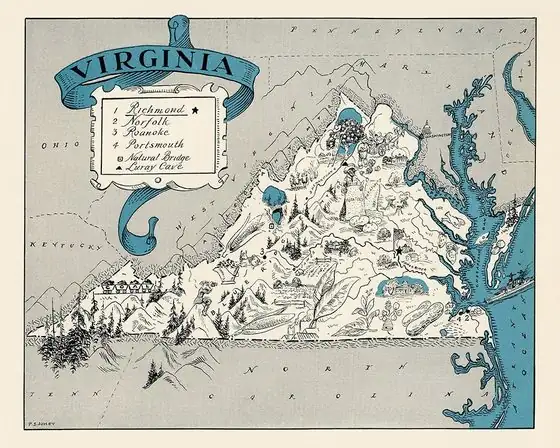
Fredericksburg, Virginia: Named for a Prince of Wales
Frederick, Prince of Wales, eldest son of King George II, is the Frederick in Fredericksburg. A Virginia act from the session dated February 1727 laid out 50 acres on the Rappahannock and ordered that the town be called Fredericksburg. Local histories from 1908 and 1922, Gannett's 1905 bulletin and Virginia's legislature all name the prince.
Section IX of a law about tobacco and trade
A Virginia law of 1727 ordered that a new trading town at the falls of the Rappahannock be called Fredericksburg, after Frederick, Prince of Wales. The law itself never says who Frederick was. For that you have to go to the histories, and they all point to the same royal: the eldest son of King George II.
The act, as William Waller Hening printed it in his Statutes at Large, is headed “An Act for erecting a Town, in each of the Counties of Spotsylvania and King George,” and his volume dates the session to February 1727. Its opening explains the problem. Settlers had moved “above the falls” of the river, tobacco and other goods came down every year to the upper landings, and there was no “convenient place, where traders may cohabit.” So the assembly ordered 50 acres of a tract owned by John Royston and Robert Buckner, “commonly called or known by the name of the Lease-Land,” to be surveyed, split into half-acre lots and sold, no more than two to a buyer. Then, in Section IX, it named the place. Here’s the line as S. J. Quinn reprinted it in his 1908 history of the city:
“AND be it further enacted, that the Town aforesaid shall be called by the Name of Fredericksburg.”
Quinn adds that the act “elevated the Lease Land into the town of Fredericksburg” and was signed by William Gooch, the governor, and John Holliday, the speaker.
The Frederick in Fredericksburg
On the namesake, the sources line up. Quinn writes that Fredericksburg “was founded by law in 1727 and named for Frederick, Prince of Wales, son of George the Second.” John T. Goolrick’s Historic Fredericksburg, from 1922, says the town “was named in honor of Frederick, Prince of Wales, son of George II.” Henry Gannett’s 1905 bulletin on American place names has the same prince, and today the Virginia General Assembly’s charter history calls him “Frederick Louis, Prince of Wales, eldest son of George II.”
Goolrick also gives the story its twist. Frederick “died before ascending the throne, but his son became George III.” So the town’s namesake was the father of the king its people later rebelled against. Gannett credits Frederick’s wife with a couple of places, too: Augusta, Maine, and Augusta County, Virginia, “named for Augusta of Saxe-Gotha, wife of Frederick, Prince of Wales.” For Augusta, Maine, that’s one of several versions.
Falmouth, the twin across the river
The same law made a second town. Since Fredericksburg wouldn’t be handy for people on the north side of the river, it set aside 50 more acres, owned by William Todd, “about two miles above the said lease-land,” in King George County. Those lots got their own trustees and the same building rules, and Section XII ends: “the said last mentioned town, shall be called by the name of Falmouth.”
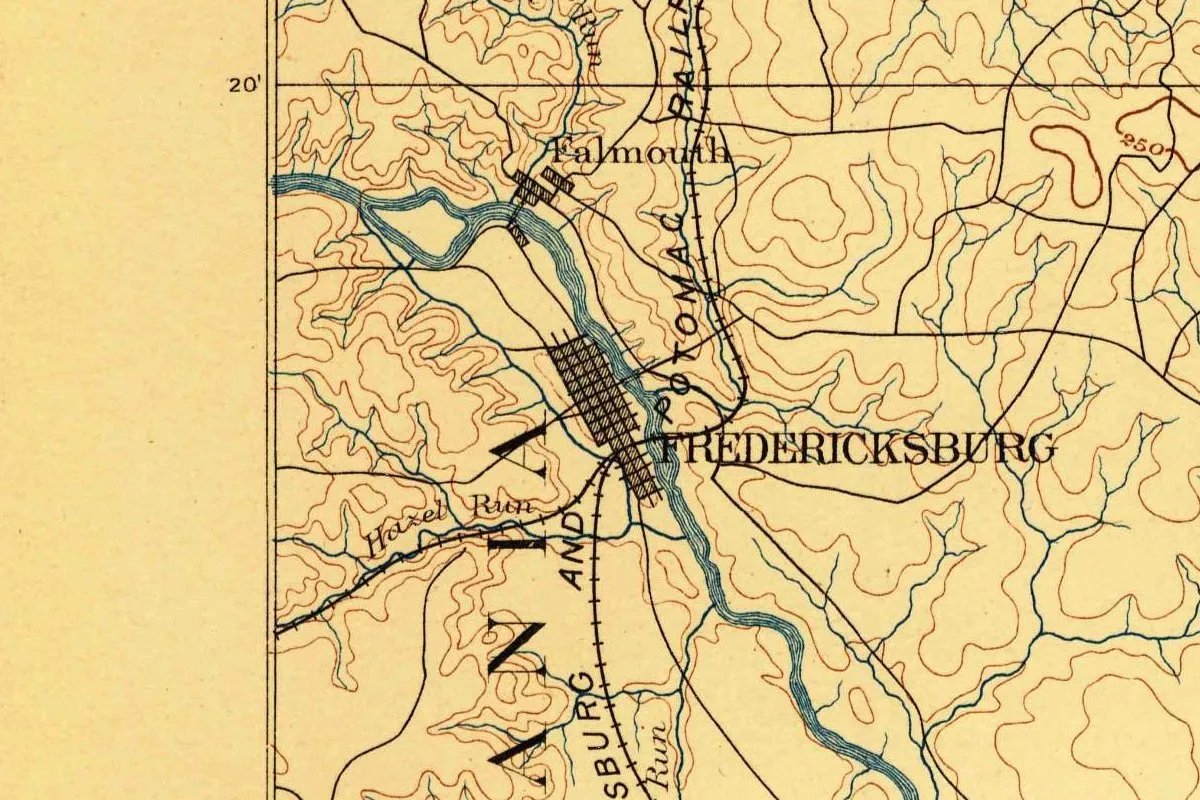
So Falmouth isn’t an old name for Fredericksburg, though you may see it described that way. It’s a sibling, born in the same act. Both show up on the 1889 survey map, Fredericksburg on the south bank and Falmouth upstream on the north.
A royal family on the street signs
Quinn says the townspeople showed their “attachment to the royal family of England” in the streets, too. He lists Sophia Street for George II’s sister, Caroline for his wife, Princess Anne and Princess Elizabeth for daughters, Prince Edward for a grandson, Frederick and William for sons, George for the king himself, Hanover for the royal house and Prussia for the country. Charles and Wolfe were the odd ones out. Quinn didn’t know whom they honored and thought they weren’t laid out as streets in the first survey at all. Goolrick, writing in 1922, was glad the royal names had survived an attempt to swap them for numbers and letters.
Colonel Willis’s new town
The act’s trustees included a Henry Willis, and five years later a Colonel Willis was running the place. In 1732, Quinn writes, Colonel Byrd, who lived on the James River where Richmond now stands, stopped in on a trip to Germanna and wrote a friend about what he saw. “Colonel Willis walked me about his new town of Fredericksburg,” Quinn’s excerpt begins. It wasn’t much yet:
“Besides Colonel Willis, who is the top man of the place, there are only one merchant, a tailor, a smith, an ordinary-keeper, and a lady, Mrs. Livingston, who acts here in the double capacity of a doctress and a coffee-woman.”
Ten years later the trustees filled an empty seat on their board. Quinn prints the paper of April 1742 naming Augustine Washington, “the father of General George Washington,” as a trustee of Fredericksburg.
1727 or 1728?
You’ll find both years. Hening’s heading puts the act in the February 1727 session, and Quinn and Goolrick both say 1727. Today the state of Virginia keeps a charter history that says the town was “Established in 1728.” Neither source explains the gap, and neither changes the name. The same charter history lists the later steps: Fredericksburg was incorporated as a town in 1781 and became a city in 1879. The prince’s name, though, was on the law from the start, decades before the town’s people, in Goolrick’s words, “plotted to free themselves” from his son.
Quick answers
Who was Fredericksburg, Virginia, named after?
Frederick Louis, Prince of Wales, eldest son of King George II. Quinn (1908), Goolrick (1922), Gannett (1905) and the Virginia General Assembly’s charter history all name him.
Does the 1727 law say Frederick was the Prince of Wales?
No. Section IX only says the town “shall be called by the Name of Fredericksburg.” The identification of the prince comes from the later histories and the state’s charter record.
Was Fredericksburg ever called Falmouth?
No. Falmouth was a separate town on the north bank of the Rappahannock, created by the same act about two miles (3 km) upriver from the Lease Land.
When was Fredericksburg founded?
By the act of the session Hening dates February 1727. Virginia’s charter history gives 1728 as the founding year, 1781 for its incorporation as a town and 1879 for city status.
Key dates
- 1727February session: Virginia's assembly orders 50 acres of the Lease Land laid out as a town "called by the name of Fredericksburg."
- 1728The founding year Virginia's legislature gives for Fredericksburg in its charter history.
- 1732Colonel Byrd visits, and Colonel Willis walks him around "his new town of Fredericksburg."
- 1742April: the town's trustees choose Augustine Washington, father of George Washington, as one of their number.
- 1781Fredericksburg is incorporated as a town.
- 1879Fredericksburg becomes a city.
Getting there
Open Fredericksburg in Google Maps
Opens in a new tab. The pin is the center of Fredericksburg in the USGS place-name record.
The closest airports, Amtrak stations and intercity bus stops, measured in a straight line from the center of Fredericksburg.
Airports
- Ronald Reagan Washington Ntl (DCA) Arlington 44 mi 71 km
- Washington Dulles International (IAD) 45 mi 72 km
Amtrak trains
- Fredericksburg station (FBG) under 1 mi 0.6 km
- Quantico station (QAN) 18 mi 28 km
Intercity buses
- Greyhound Fredericksburg Bus Stop 1 mi 2 km
- OurBus Fredericksburg, VA (Warrenton Road Commuter Lot (Free overnight parking, at owner's own risk)) 4 mi 6 km
- FlixBus Fredericksburg (Old Salem Church Rd Park & Ride Lot) 4 mi 7 km
Distances are as the crow flies, not by road. We don't list schedules or fares because they change; check with the airline, Amtrak or the bus company before you go. Official data (FAA commercial service airports (2025), FAA airport locations, Amtrak stations and Intercity Bus Atlas) from the FAA and the U.S. Bureau of Transportation Statistics, checked Nov 13, 2026.
Sponsored
Staying in Fredericksburg?
Compare hotels in Fredericksburg, Virginia, on Expedia.
See hotels in FredericksburgWe may earn a commission if you buy through this link. It never changes what we write. Read our affiliate disclosure
Sponsored
Want the spooky side of Fredericksburg?
The name has its story above. For the ghost stories, US Ghost Adventures runs walking ghost tours in Fredericksburg.
See ghost tours in FredericksburgWe may earn a commission if you book through this link. It never changes what we write. Read our affiliate disclosure
Historical Sources & References
- S. J. Quinn, The History of the City of Fredericksburg, Virginia (1908), pp. 37-43. The town “founded by law in 1727 and named for Frederick, Prince of Wales, son of George the Second” and the royal street names (p. 37); Charles and Wolfe Streets (p. 38); the reprinted act, ending “the Town aforesaid shall be called by the Name of Fredericksburg,” the Lease Land, Gooch and Holliday, and Augustine Washington as trustee in 1742 (p. 42); Byrd’s 1732 description of “his new town of Fredericksburg” (p. 43).
- William Waller Hening, The Statutes at Large, vol. 4, chap. XIV, pp. 234-239. Online transcription of the act of the February 1727 session: the title, the preamble about the falls and the traders, the 50 acres of the Lease-Land of John Royston and Robert Buckner, the trustees including Henry Willis, the naming clause (p. 237) and Falmouth on William Todd’s land (pp. 238-239).
- John T. Goolrick, Historic Fredericksburg (1922), p. 20. The 1727 charter, the town “named in honor of Frederick, Prince of Wales, son of George II,” the prince who “died before ascending the throne” and the royal street names that outlasted a renaming attempt.
- Henry Gannett, The Origin of Certain Place Names in the United States (USGS, 1905), pp. 33 and 131. Fredericksburg “Named for Frederick, Prince of Wales” (p. 131), and Augusta, Maine, and Augusta County, Virginia, “named for Augusta of Saxe-Gotha, wife of Frederick, Prince of Wales” (p. 33).
- Virginia General Assembly, “Charter: Fredericksburg, City of”. “Established in 1728 in County of Spotsylvania. Named for Frederick Louis, Prince of Wales, eldest son of George II,” a town in 1781 and a city in 1879.
- GNIS feature 1494947 (U.S. Geological Survey). The record for the independent city on the Rappahannock, a separate entry from the Fredericksburg in Rockbridge County.
- U.S. Geological Survey, Fredericksburg sheet (1889). A 1:125,000 survey from 1889 that labels Fredericksburg and Falmouth on opposite banks.
Spot something wrong, or know more? Tell us here. You can also email us or use our contact page. Corrections are noted here with their date, never made silently.