The Franklin Institute: Why It's Named for Ben Franklin
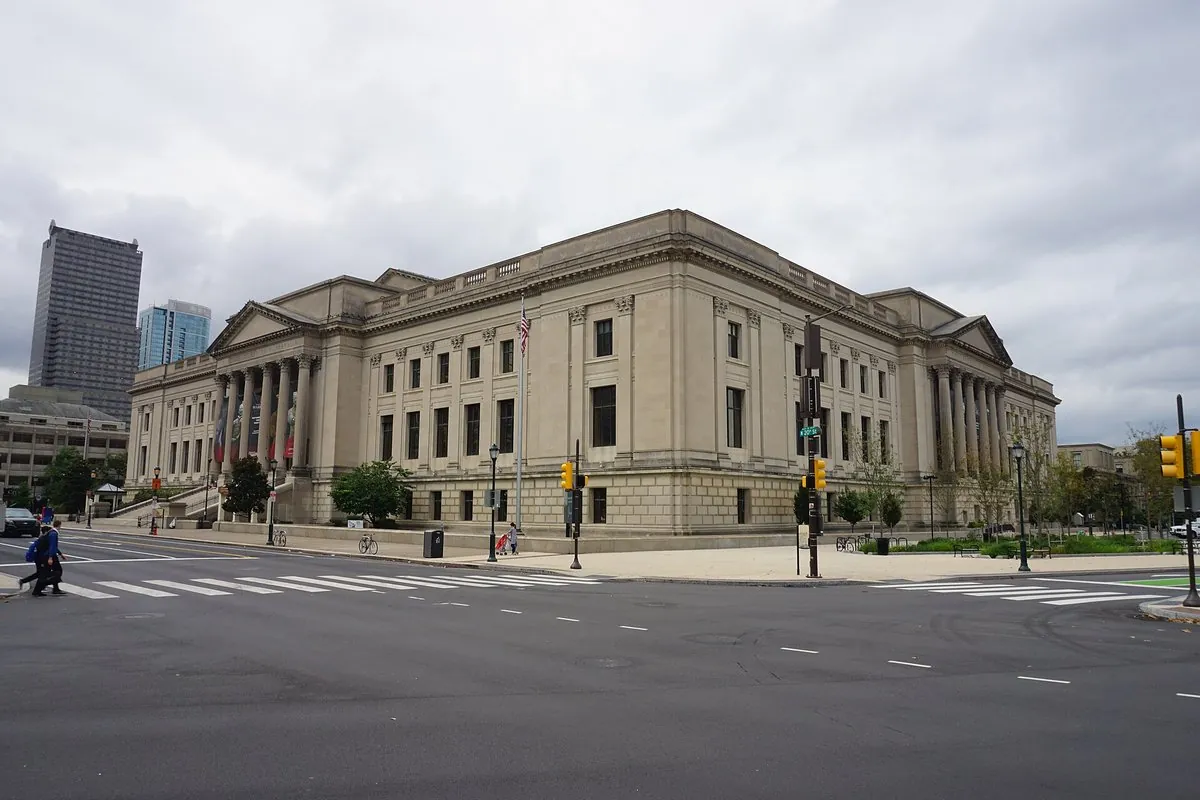
The Franklin Institute in Philadelphia is named for Benjamin Franklin, whose name its 1895 history calls “of all names, the most fitting.” They organized the institute in 1824, almost 34 years after Franklin died in 1790, and more than a century later it built him a marble hall that Congress made a national memorial.
A young man a mechanics’ club turned away
The institute’s own history, compiled in 1895 by its secretary, William H. Wahl, starts with an awkward moment. Wahl worked from a letter by Samuel V. Merrick, who at 21 had found himself “the owner of a workshop, without a mechanical education, with scarcely a mechanical idea.”
Merrick tried to join a local association of mechanics. He didn’t have the qualifications, and the members black-balled him. That small setback, Wahl writes, “appears to have caused” Merrick to take up a friend’s suggestion, from William Kneass, to start an organization of his own. After a few more discouraging failures, Merrick went to see William H. Keating, a young chemistry professor at the University of Pennsylvania who’d had his own bad luck getting a science society off the ground.
“Of all names, the most fitting”
In Wahl’s telling, the name was the founders’ choice as a group, and he explains it in one sentence:
“The founders chose for it, of all names, the most fitting—that of the illustrious printer, statesman, philosopher—the synonym of broad utilitarianism.”
You can see why Franklin fit. Wahl describes a place meant to hold “professor and layman, master and workman, side by side,” and he sums up the idea with a phrase the founders wanted, figuratively, “inscribed on its corner-stone”: “Science with Practice; Practice with Science.”
You don’t have to take the institute’s word for the Franklin connection, either. Scharf and Westcott’s History of Philadelphia, published in 1884 with no tie to the institute, mentions that the engraver Christian Gobrecht made a “medal for the Franklin Institute, with the head of Franklin.” And the Encyclopedia of Greater Philadelphia, published by Rutgers University, says the institute’s members were “seeking to emulate a passion for useful science, in the spirit of Benjamin Franklin.”
A courthouse full of strangers
Instead of a small club, the founders went big. They pulled names out of the city directory and mailed invitations: some 1,500 of them, by Wahl’s count, or “some twelve hundred to sixteen hundred citizens,” as Scharf and Westcott put it. The meeting was held at the County Court-house, at Sixth and Chestnut streets, on the evening of February 5, 1824, and Scharf and Westcott say the courthouse was “filled to overflowing.”
Merrick later wrote that “the meeting was a perfect success; and the novel mode of throwing the association open to the world, without the intervention of cliques, made it universally popular.”
A few weeks later, the legislature of Pennsylvania chartered it under a much longer name: “the Franklin Institute of the State of Pennsylvania for the Promotion of the Mechanic Arts.” Wahl gives the date of the act as March 30, 1824, on one page and March 3, 1824, on another, so you’ll see both.
From Seventh Street to the Parkway
The institute filled up fast. Construction on its first long-term home, designed by John Haviland at 15 South Seventh Street, began on June 8, 1825, according to the Encyclopedia of Greater Philadelphia.
A century later it was time to move. In 1930, in the early years of the Great Depression, the institute and the Poor Richard Club raised $5.1 million in less than two weeks for a science museum, and by 1934 it had opened on the Benjamin Franklin Parkway, in a Beaux-Arts building by architect John T. Windrim. That’s about 1.2 miles (1.9 km) in a straight line from the old hall on Seventh Street, which Atwater Kent bought and gave to the city for a history museum.
So the institute that took Franklin’s name in 1824 ended up on a boulevard that carries his name too.
Franklin’s memorial, inside the museum
The new building gave Franklin more than a name over the door. The National Park Service says the sculptor James Earle Fraser worked on a seated statue of him from 1932 to 1938: 20 feet (6 m) tall, 30 tons, on a pedestal of white Seravezza marble. It was dedicated in 1938 in the domed Memorial Hall, also designed by Windrim, which measures 82 feet (25 m) in length, width and height.
In 1972 Congress passed a joint resolution that made the hall the Benjamin Franklin National Memorial. Its reasons spell out the naming in plain words:
“Whereas the said Franklin Institute named the Benjamin Franklin Memorial Hall in honor of Benjamin Franklin over thirty years ago;”
The resolution also called Philadelphia “a most appropriate location for a national memorial to Benjamin Franklin since Philadelphia was his home for many years.” Back in 1824, the institute’s founders had reached the same conclusion and put it in a single word: Franklin.
If you’re in the city for history, another Philadelphia name story from the 1820s is Eastern State Penitentiary, a prison whose name comes from the half of the state it was built to serve.
Quick answers
Who is the Franklin Institute named after?
Benjamin Franklin. The institute’s 1895 history says its founders chose “of all names, the most fitting,” that of the “illustrious printer, statesman, philosopher.”
Who founded the Franklin Institute?
Samuel V. Merrick and Professor William H. Keating led the effort, according to both the institute’s 1895 history and Scharf and Westcott’s 1884 History of Philadelphia. A public meeting organized it on February 5, 1824.
Is the Franklin Institute a national memorial?
Partly. In 1972 Congress designated its Benjamin Franklin Memorial Hall, with James Earle Fraser’s 20-foot (6 m) seated statue of Franklin, as the Benjamin Franklin National Memorial.
What is the Franklin Institute’s full name?
Its 1824 charter calls it the Franklin Institute of the State of Pennsylvania for the Promotion of the Mechanic Arts.
Key dates
- 1824February 5: a public meeting at the County Court-house, Sixth and Chestnut streets, organizes the Franklin Institute.
- 1824March: Pennsylvania's legislature charters the Franklin Institute of the State of Pennsylvania for the Promotion of the Mechanic Arts.
- 1825Construction begins on the institute's first long-term home, on South Seventh Street.
- 1930With the Poor Richard Club, the institute raises $5.1 million in less than two weeks for a new science museum.
- 1934The new museum opens on the Benjamin Franklin Parkway.
- 1938James Earle Fraser's seated statue of Franklin is dedicated in the building's Memorial Hall.
- 1972Congress designates Memorial Hall as the Benjamin Franklin National Memorial.
Getting there
Open The Franklin Institute in Google Maps
Opens in a new tab. The pin is an approximate point for The Franklin Institute.
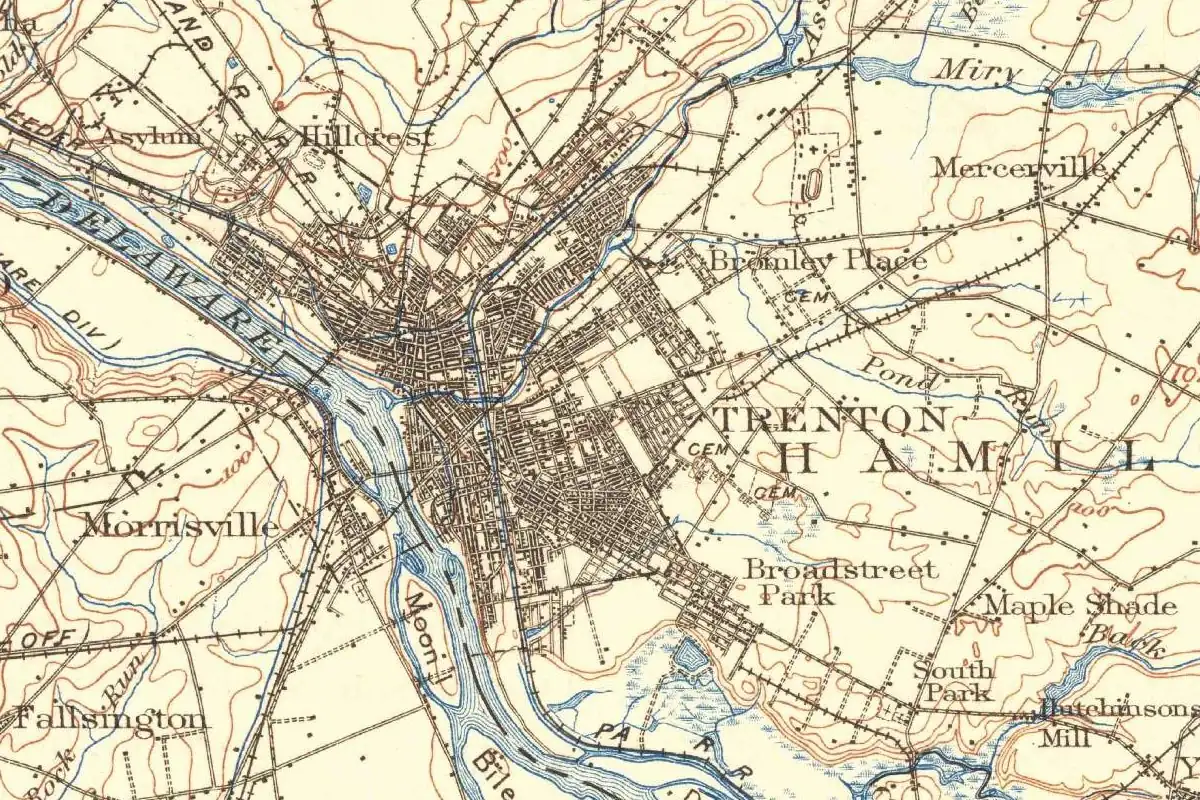
The closest airports, Amtrak stations and intercity bus stops, measured in a straight line from the center of The Franklin Institute.
Airports
- Philadelphia International (PHL) 7 mi 11 km
- Trenton Mercer (TTN) 29 mi 47 km
Amtrak trains
- Philadelphia station (PHL) under 1 mi 0.8 km
- North Philadelphia station (PHN) 3 mi 5 km
Intercity buses
- OurBus Philadelphia, PA (1200 Market Street Center City 19102 By Loews Hotel. (Service is provided with a Van)) under 1 mi 1 km
- Peter Pan Bus Lines Philadelphia (Bus Terminal) under 1 mi 1 km
- Fullington Trailways Philadelphia (Bus Terminal) under 1 mi 1 km
Distances are as the crow flies, not by road. We don't list schedules or fares because they change; check with the airline, Amtrak or the bus company before you go. Official data (FAA commercial service airports (2025), FAA airport locations, Amtrak stations and Intercity Bus Atlas) from the FAA and the U.S. Bureau of Transportation Statistics, checked Nov 13, 2026.
Sponsored
Planning a visit?
Compare hotels near The Franklin Institute on Expedia.
See hotels nearbyWe may earn a commission if you buy through this link. It never changes what we write. Read our affiliate disclosure
Sponsored
Want the spooky side of Philadelphia?
The museum's name has its story above. For ghost stories, US Ghost Adventures runs walking ghost tours in Philadelphia.
See ghost tours in PhiladelphiaWe may earn a commission if you book through this link. It never changes what we write. Read our affiliate disclosure
Historical Sources & References
- William H. Wahl, The Franklin Institute of the State of Pennsylvania for the Promotion of the Mechanic Arts: A Sketch of Its Organization and History (1895), printed pp. 3-7. Published by the institute and compiled by its secretary. The founders’ choice of Franklin’s name and Merrick’s black-balling (p. 4), “Science with Practice; Practice with Science” (p. 3), the meeting of February 5, 1824, and Merrick’s letter (p. 5), and the two dates for the act of incorporation (pp. 3 and 7).
- J. Thomas Scharf and Thompson Westcott, History of Philadelphia, 1609-1884, vol. 2 (1884), pp. 1214-1215. An independent city history: the institute’s full name, its organization on February 5, 1824, Merrick and Keating, the names picked from the “Philadelphia Directory,” and the courthouse “filled to overflowing.” Also online: p. 1064, on Christian Gobrecht’s “medal for the Franklin Institute, with the head of Franklin.”
- Jessica Linker, “Franklin Institute,” The Encyclopedia of Greater Philadelphia (Rutgers University, 2016). The founders’ aim “in the spirit of Benjamin Franklin,” the Seventh Street building begun June 8, 1825, the 1930 fund drive with the Poor Richard Club, the 1934 move to the Benjamin Franklin Parkway, architect John T. Windrim, and Atwater Kent’s purchase of the old building.
- Public Law 92-551 (October 25, 1972), 86 Stat. 1164. The joint resolution that designated Benjamin Franklin Memorial Hall as the Benjamin Franklin National Memorial, and its statement that the institute named the hall “in honor of Benjamin Franklin.”
- National Park Service, “Benjamin Franklin National Memorial”. James Earle Fraser’s statue (1932-1938, dedicated 1938), its size and pedestal, and the measurements of Windrim’s Memorial Hall.
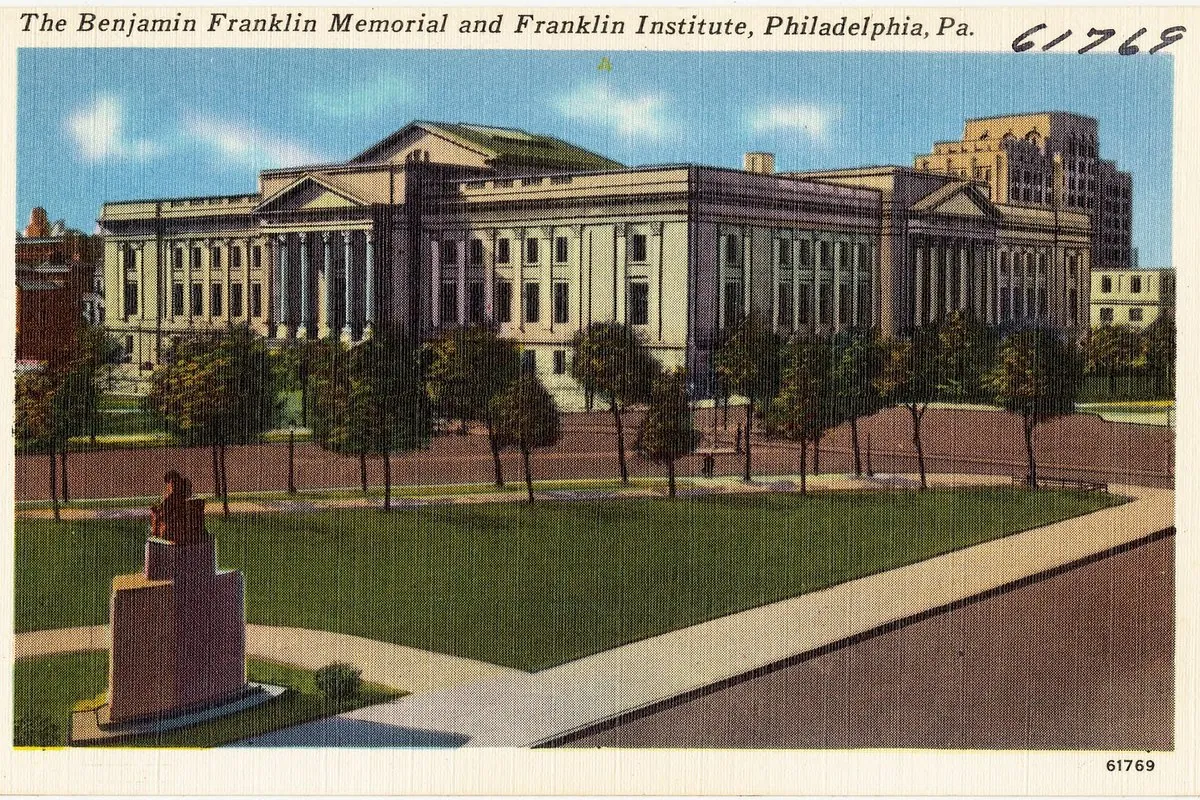
- Tichnor Brothers postcard 61769, Boston Public Library, via Wikimedia Commons. The postcard on this page, from about 1930 to 1945, titled “The Benjamin Franklin Memorial and Franklin Institute, Philadelphia, Pa.”
Spot something wrong, or know more? Tell us here. You can also email us or use our contact page. Corrections are noted here with their date, never made silently.