Independence Hall History: How the State House Got Its Name
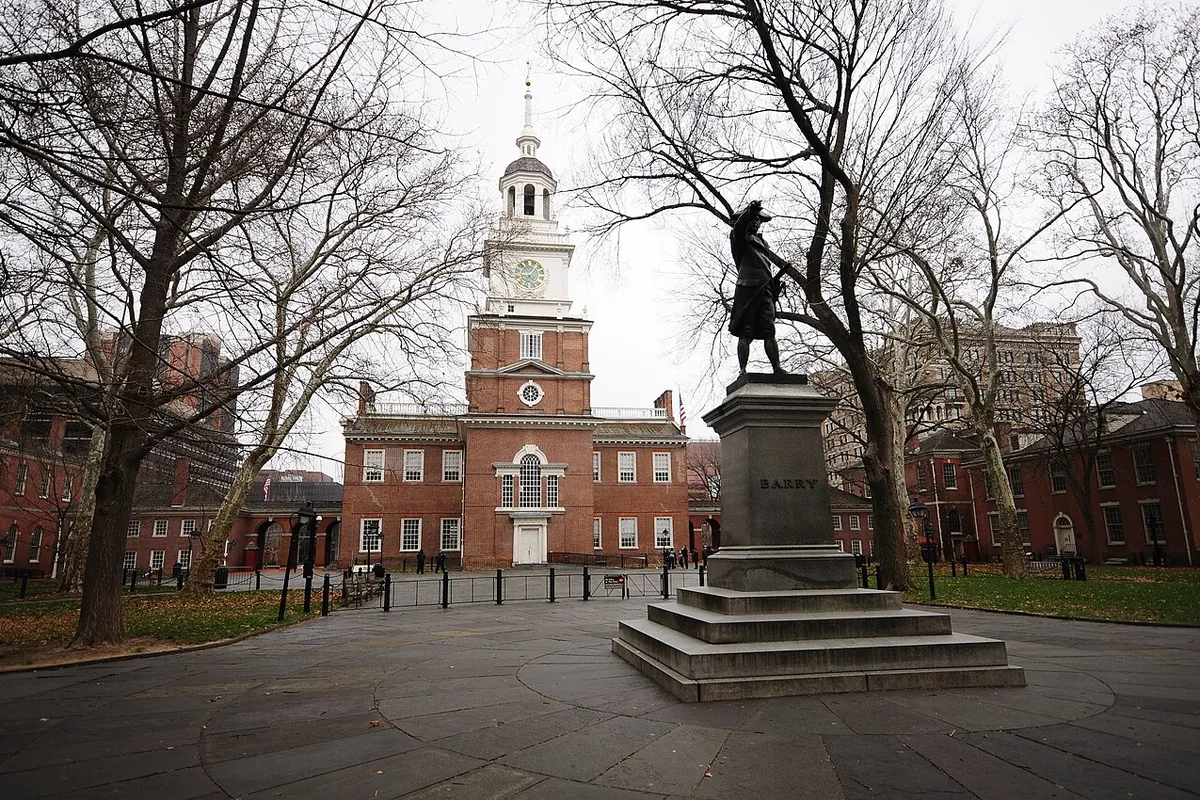
Independence Hall was built as the Pennsylvania State House. Its new name began in 1824 with one room, readied as the Hall of Independence for Lafayette. Nobody voted to rename the building. The name spread from that room to the rest of it, slowly, over the next few decades.
Independence Hall History: From State House to Hall of Independence
It started as an office building for a colony. In 1729, Charlene Mires writes in the Encyclopedia of Greater Philadelphia, the Pennsylvania Assembly approved “a House for the Assembly of this Province to meet in,” on a Chestnut Street lot between Fifth and Sixth, at the time the edge of town. Speaker Andrew Hamilton is credited with the design, and the master carpenter Edmund Woolley oversaw the work. Construction began in 1732, the Assembly was meeting there by 1736, and in 1749 Woolley was called back to build a tower and steeple. The Park Service says the State House housed the legislative, executive and judicial arms of colonial Pennsylvania.
Its fame came from guests. The Assembly lent its room to the Second Continental Congress, which began meeting there in May 1775, voted for independence on July 2, 1776, and adopted the Declaration on July 4. Washington was named commander of the Continental Army there in 1775, the Park Service notes. In the summer of 1787 the Constitutional Convention met in the same room and finished on September 17.
None of that changed what Philadelphians called the place. It stayed the State House, and then the old State House. Pennsylvania’s capital went to Lancaster in 1799 and then on to Harrisburg; as our Harrisburg page explains, a law of 1810 sent the government there in 1812. The federal government left for Washington in 1800. Charles Willson Peale ran his museum upstairs, the wooden steeple had been taken down in 1781, and in 1812 the old wings and arcades were replaced by rows of city offices. Mires says the state proposed selling the square in 1813 and 1816, and the city agreed in 1816 to buy the building and grounds. Edward M. Riley’s 1954 handbook for the Park Service puts the purchase in 1818, at $70,000.
The new name came with a party. When the Marquis de Lafayette toured the United States in 1824, Philadelphia welcomed him at the old State House. According to Riley, the former Assembly Room was redecorated for the visit and called the “Hall of Independence” for the first time, and Lafayette was formally received there by the mayor on September 28. Mires says that while planning the event, Philadelphians began calling the east room both “the Hall of Independence” and “Independence Hall,” and that the name gradually came to cover the whole building.
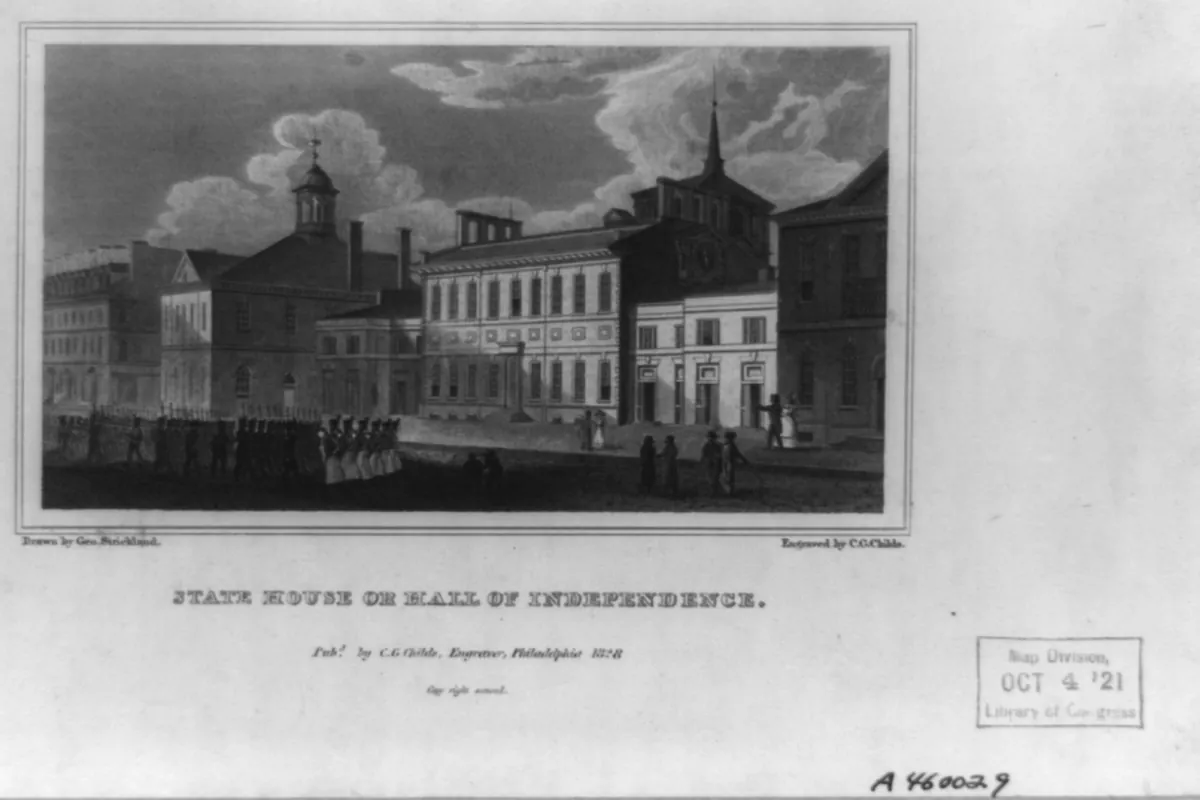
It took a while. The city named the yard behind it Independence Square in 1825, along with Washington, Franklin, Rittenhouse and Logan squares. In 1828 the City Councils ordered a new steeple, designed by William Strickland, to stand in for the one lost decades earlier. That same year C. G. Childs published the engraving at the bottom of this page under the title “State House or Hall of Independence,” putting both names on one print. Riley writes that the “State House” didn’t become “Independence Hall” until the second half of the 1800s.
The bell in its tower went through a similar change around the same years. As our Liberty Bell page explains, it went by the State House Bell, and its famous name first turns up in print in an 1835 abolitionist monthly. After that, Mires writes, the building turned from a workplace into a shrine: the Declaration room became a memorial to the founders in 1854, the first floor became a “National Museum” for the 1876 Centennial, and in 1979 UNESCO named Independence Hall a World Heritage Site. It stands in Philadelphia, whose own name, as our page explains, is Greek for brotherly love and came from William Penn.
Visiting Independence Hall
The building faces Chestnut Street in the block from 5th to 6th, but you go in from the south side. As of November 2026, everyone passed through a security screening area reached by stairs or a ramp off 5th Street, south of Chestnut, the Park Service said. No weapons are allowed, open food and drink containers aren’t permitted, and capped bottles are fine.
Mornings from 9 to 10:30 a.m. were an open house with no tickets needed. From 10:40 a.m. to 4:40 p.m., guided tours left every 20 minutes and needed timed tickets. The tickets themselves are free, but reserving them on Recreation.gov costs $1 apiece, a fee federal passes don’t cover, and there are no refunds. You can reserve up to 30 days ahead; more tickets for the next day open at 5 p.m. the day before. The Park Service asks you to get there half an hour before your tour to clear screening.
The tour takes you to the Assembly Room, where delegates signed the Declaration and, 11 years later, the Constitution. The first floor is accessible, an audio description tour is offered on request, and an American Sign Language interpreter can be arranged if you call at least 14 days ahead. On the same square, the Park Service also lists Congress Hall, Old City Hall and the Great Essentials exhibit in the building’s West Wing.
Quick answers
What was Independence Hall originally called?
The Pennsylvania State House. It was built from 1732 for the colony’s Assembly and housed its government.
When did the State House become Independence Hall?
The name first went on one room. For Lafayette’s visit in 1824, the old Assembly Room was called the “Hall of Independence,” and the name spread to the building over the following decades. Riley’s Park Service handbook says the switch wasn’t complete until the second half of the 19th century.
Why is it called Independence Hall?
For the Declaration of Independence, which the Second Continental Congress approved there on July 4, 1776.
Do you need tickets for Independence Hall?
For tours from 10:40 a.m. to 4:40 p.m., yes, as of November 2026. The tickets are free apart from a $1 reservation fee each; the 9 to 10:30 a.m. open house needed none.
Key dates
- 1732Work begins on a house for the Pennsylvania Assembly on Chestnut Street; the Assembly is using it by 1736.
- 1776July 4: the Second Continental Congress approves the Declaration of Independence in the State House.
- 1787September 17: the Constitutional Convention finishes its work in the same building.
- 1816The City of Philadelphia agrees to buy the State House and its square from the state.
- 1824September 28: Lafayette is received in the old Assembly Room, newly called the Hall of Independence.
- 1825The square behind the building is named Independence Square.
- 1828A new steeple goes up, and an engraving is published as "State House or Hall of Independence."
- 1979Independence Hall is named a UNESCO World Heritage Site.
Getting there
Open Independence Hall in Google Maps
Opens in a new tab. The pin is an approximate point for Independence Hall.
The closest airports, Amtrak stations and intercity bus stops, measured in a straight line from the center of Independence Hall.
Airports
- Philadelphia International (PHL) 7 mi 12 km
- Trenton Mercer (TTN) 29 mi 46 km
Amtrak trains
- Philadelphia station (PHL) 2 mi 3 km
- North Philadelphia station (PHN) 3 mi 5 km
Intercity buses
- OurBus Philadelphia, PA (1001 Filbert Street) under 1 mi 0.7 km
- FlixBus Philadelphia under 1 mi 0.8 km
- Fullington Trailways Philadelphia (Bus Terminal) under 1 mi 0.8 km
Distances are as the crow flies, not by road. We don't list schedules or fares because they change; check with the airline, Amtrak or the bus company before you go. Official data (FAA commercial service airports (2025), FAA airport locations, Amtrak stations and Intercity Bus Atlas) from the FAA and the U.S. Bureau of Transportation Statistics, checked Nov 21, 2026.
Sponsored
Planning a visit?
Compare hotels near Independence Hall on Expedia.
See hotels nearbyWe may earn a commission if you buy through this link. It never changes what we write. Read our affiliate disclosure
Historical Sources & References
- Charlene Mires, “Independence Hall,” Encyclopedia of Greater Philadelphia (2012): the 1729 order, Hamilton and Woolley, the dates of 1732, 1736 and 1749, the Congress of 1775-1776 and the Convention of 1787, the moves of the capital, Peale’s museum, the 1812 offices, the city purchase of 1816, Lafayette’s welcome and the “Hall of Independence” and “Independence Hall,” the squares named in 1825, the 1828 steeple, the shrine of 1854, the 1876 museum and UNESCO in 1979.
- Edward M. Riley, “Two Centuries of Independence Hall” (NPS Historical Handbook No. 17, 1954, revised 1956): the purchase of 1818 for $70,000 and Strickland’s steeple of 1828.
- Edward M. Riley, “Evolution of a Shrine” (same handbook): the “Hall of Independence” named for the first time in 1824, the reception of September 28, and the name change completed in the second half of the 1800s.
- National Park Service, “Independence Hall”: the start of construction in 1732, the three branches of colonial government and Washington’s appointment in 1775.
- National Park Service, “Independence Hall: International Symbol of Freedom”: the State House as the building now known as Independence Hall, and the Congress and Convention in its Assembly Room.
- National Park Service, “Visiting Independence Hall” and “Independence Hall Tickets”: the entrance, screening, open house, tour times, ticket fee, reservations and accessibility (as of November 2026).
- “State House or Hall of Independence,” Library of Congress: the 1828 engraving at the bottom of this page.
Spot something wrong, or know more? Tell us here. You can also email us or use our contact page. Corrections are noted here with their date, never made silently.