Liberty Bell: History, Its Name, Crack and Visiting
The Liberty Bell was cast in 1753 as Pennsylvania’s State House bell, and the earliest known use of its famous name is in an abolitionist monthly in 1835. The crack most people picture first played no part in the name. The words on the bell did.
Liberty Bell History: From State House Bell to a Symbol of Liberty
The bell was a piece of government equipment. Isaac Norris, the Speaker of the Pennsylvania Assembly, ordered it from London’s Whitechapel Foundry in 1751 for the tower of the State House, the building now called Independence Hall, according to the National Park Service. It cracked the first time it was tested. Two local craftsmen, John Pass and John Stow, then melted it down and recast it in Philadelphia, and their names, the city and the year 1753 are on its face. The Park Service says it called lawmakers to sessions and townspeople to hear the news.
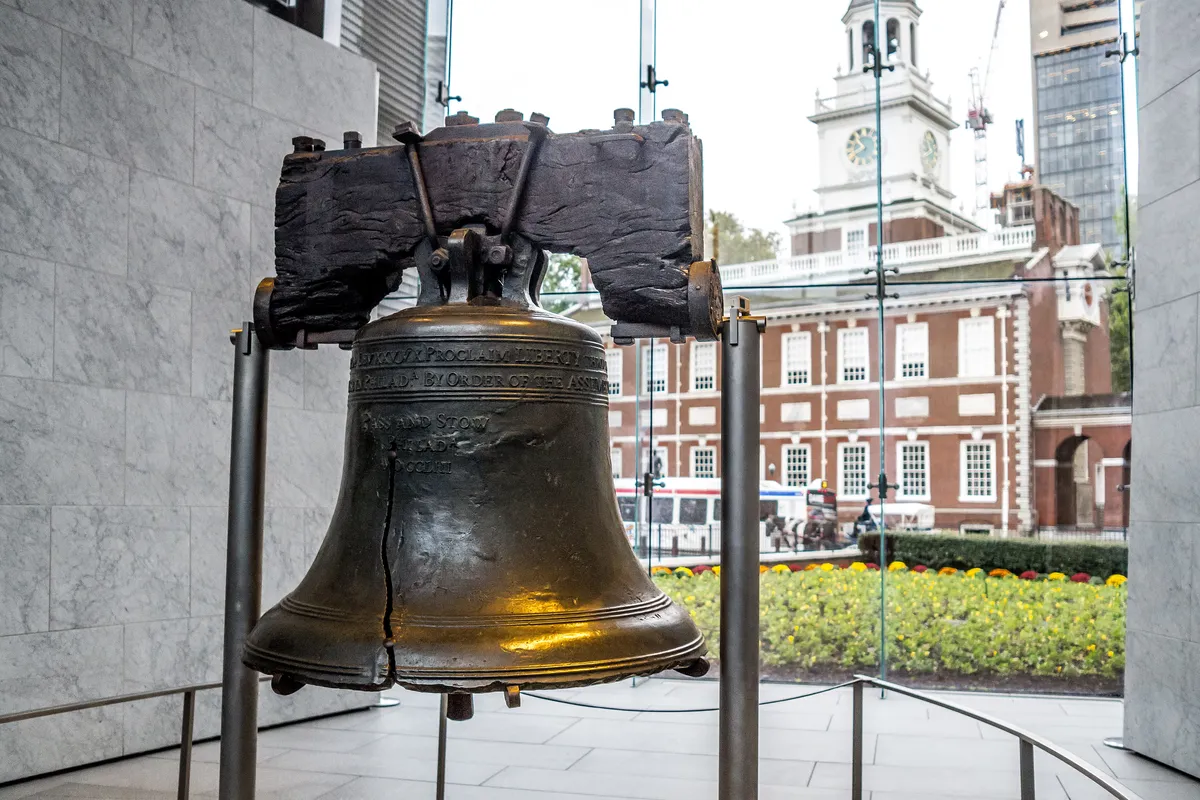
Norris also picked the inscription in 1751, a verse from Leviticus: “Proclaim Liberty Throughout All the Land Unto All the Inhabitants thereof.” The Park Service says he may have chosen it because 50 years had passed since the Charter of Privileges William Penn granted in 1701. Under it, a second line says who ordered the bell and why: “By Order of the ASSEMBLY of the Province of PENSYLVANIA for the State House in Philada.” That spelling of Pennsylvania is on the bronze.
So for its first 80 years it had no grand name. The Park Service’s history of where it has been displayed says it was commonly called the State House Bell. Historian Gary B. Nash, in the Encyclopedia of Greater Philadelphia, writes that Philadelphians knew it as the “old bell.”
The new name came from people who read the inscription literally. In February 1835 someone writing in The Anti-Slavery Record, a monthly put out by abolitionists in New York, climbed the State House tower and looked at the bell. The piece ran under the heading “THE LIBERTY BELL.” The Park Service says no earlier recorded use of the name is known. Its transcript has the writer asking whether “the emancipationists in Philadelphia” might “hope to live to hear the same bell rung, when liberty shall in fact be proclaimed to all the inhabitants of this favored land?” The next lines are the sharpest: “Hitherto, the bell has not obeyed the inscription; and its peals have been a mockery, while one sixth of ‘all the inhabitants’ are in abject slavery.”
Neither the Park Service nor Nash names the author, and an earliest known printed use isn’t proof that nobody said it first. The two sources don’t agree on the publisher, either. The Park Service names the American Anti-Slavery Society, and Nash names the New York Anti-Slavery Society. Nash adds that abolitionists in New York and Boston took up the bell as an emblem, and that an abolitionist poem reprinted in The Liberator called it “the tocsin of freedom and slavery’s knell.”
The new name spread slowly. The Park Service says it wasn’t widely used until years later. What made the bell famous to most Americans was a piece of fiction: George Lippard’s 1847 story “Ring, Grandfather, Ring,” in which an old bellman rings it to announce independence. Nash says the tale, though made up, was retold as fact and tied the bell to the Declaration from then on.
Even the 1835 writer, a dozen years before Lippard, took it for granted that the bell had rung when the Declaration was signed. The Park Service finds no evidence of the bell ringing on either July 4 or July 8, 1776, though there is evidence it rang over the Stamp Act and its repeal. Nash is less flat about it: he says the bell “is believed to have pealed” on July 8, when the sheriff read the Declaration aloud in the State House yard.
Liberty Bell Crack History
Nobody wrote down when the bell first cracked or why. The Park Service’s best guess is a thin split in the early 1840s, after almost 90 years of ringing. Nash, writing for the encyclopedia, puts it in 1843, almost certainly while the bell rang for Washington’s birthday. He also mentions the old story that it cracked tolling for Chief Justice John Marshall’s funeral in July 1835, and calls it a legend.
The wide gap you see is a repair. In 1846, the Park Service says, the city wanted the bell working again for the Washington’s birthday holiday, so metalworkers drilled out the thin crack to keep it from spreading and to get the tone back, a method called “stop drilling.” You can count more than 40 drill marks along it. It didn’t work. The Public Ledger reported that another fissure opened, and that second crack, which climbs from the shortened “Philada” through the word “Liberty,” ended the bell’s ringing for good. The Park Service’s display history dates that last crack to February 1846.
The name was already 11 years old in print when that happened, so the crack can’t explain it.
Liberty Bell Original Location
From 1753 to 1777, the Park Service says, the bell hung in the State House steeple. In 1777, with the British about to occupy Philadelphia, it was hidden away with the city’s other bells. Nash writes that it was carried by wagon to Allentown. Our Allentown page says it was hidden in the church now called Zion’s Reformed United Church of Christ, in a town that was officially still Northampton then, since the name Allentown wasn’t made official until 1838.
It came back in 1778 and hung in the brick part of the tower for the rest of its working life. After the last crack it came down and was shown in Independence Hall’s Assembly Room, the room where both the Declaration and the Constitution were signed.
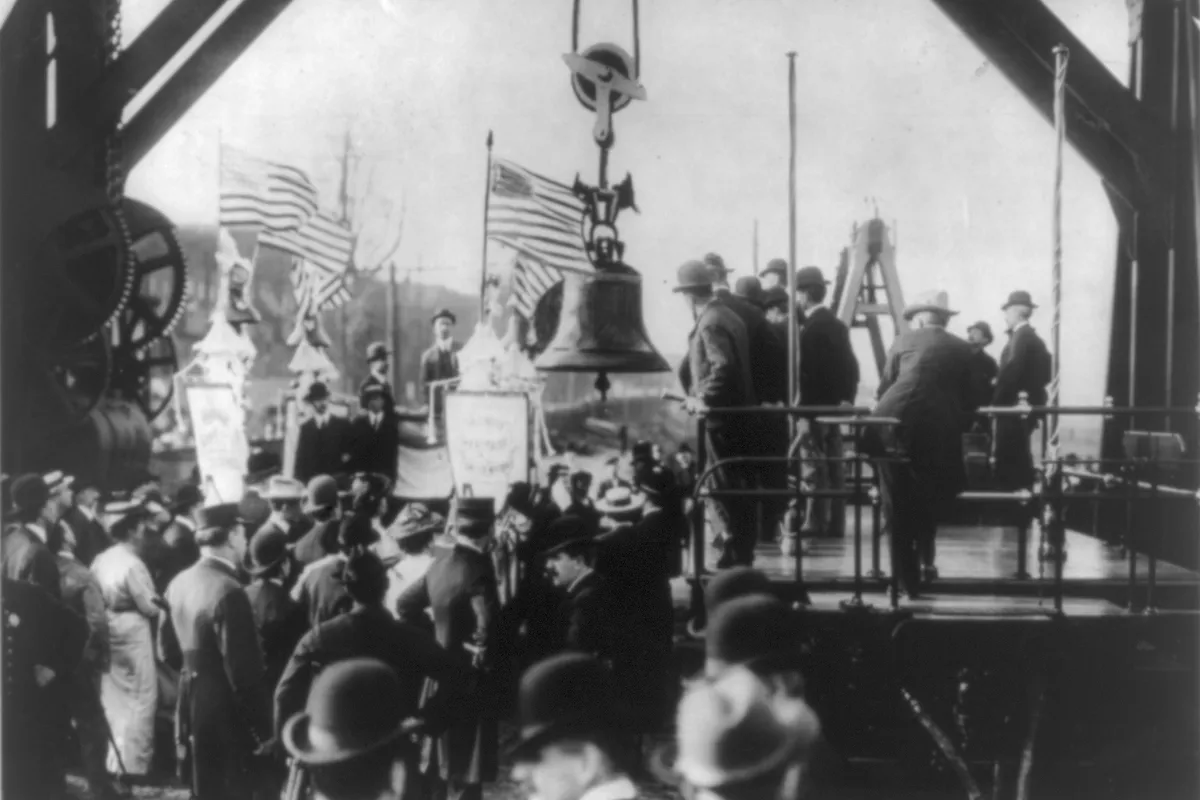
From 1885 to 1915 the bell went out on the rails now and then, to fairs and expositions around the country. Nash counts seven trips, starting with New Orleans in 1885 and ending with a 1915 run to San Francisco and then San Diego. The photo at the bottom of this page shows it being moved from a truck to a train at St. Louis after the 1904 exposition. After 1915 it never left Philadelphia again, and it stood in Independence Hall’s stair hall.
Then came the moves across the street. At midnight on January 1, 1976, ahead of the Bicentennial, it went to a new glass Liberty Bell Pavilion on Market Street, and on October 9, 2003, it went to the Liberty Bell Center, its home today. The Park Service points out that the bell chamber looks straight across at its first home.
Visiting Liberty Bell
The Liberty Bell Center is at 526 Market Street in Independence National Historical Park, in the same city whose Greek name, as our Philadelphia page explains, William Penn chose for brotherly love. When we checked the Park Service’s pages in November 2026, the center was open daily from 9 a.m. to 5 p.m. and admission was free. No tickets are needed, and entry is first come, first served, after a security check. Screening closes at least five minutes before the building does.
The hallway to the bell has exhibits on its whole story, from the State House years to the abolitionists and the civil rights movement that later took it up. On the bell itself, look for the Leviticus line, the Assembly’s order and “Pass and Stow.” There are no restrooms in the center. The Park Service points visitors to the Independence Visitor Center, at the corner of 6th and Market.
The bell you hear in the neighborhood isn’t the Liberty Bell. According to the Park Service, the Centennial Bell, a bell from the 1876 centennial, rings every hour in the Independence Hall tower.
Quick answers
What Was the Liberty Bell Originally Called?
The State House Bell, after the Pennsylvania State House, now Independence Hall, whose tower it hung in. Nash adds that people in Philadelphia called it the “old bell.”
Who Gave the Liberty Bell Its Name?
No single person is known. The earliest known printed use is an unsigned piece titled “The Liberty Bell” in The Anti-Slavery Record of February 1835, and the Park Service says years passed before the name caught on widely.
Why Is the Liberty Bell Cracked?
Most likely from long use, the Park Service says. A narrow crack appeared sometime in the 1840s, and a repair in 1846 widened it on purpose. Then a second crack opened, and the bell hasn’t rung freely since.
Can You Visit the Liberty Bell for Free?
Yes. As of November 2026, the Park Service says admission to the Liberty Bell Center is free and you don’t need a ticket, though everyone goes through security.
Key dates
- 1751Isaac Norris, Speaker of the Pennsylvania Assembly, orders a bell for the State House from the Whitechapel Foundry in London.
- 1753John Pass and John Stow recast the London bell, which cracked when first tested, in Philadelphia.
- 1777The bell is taken out of Philadelphia and hidden during the British occupation; it comes back in 1778.
- 1835February: The Anti-Slavery Record runs a piece titled "The Liberty Bell," the earliest known use of the name.
- 1846A repair before Washington's birthday fails when a new crack opens, and the bell never rings freely again.
- 1885The bell's first rail trip, to New Orleans; trips continue now and then until 1915.
- 1976January 1: the bell moves from Independence Hall to the new Liberty Bell Pavilion.
- 2003October 9: the bell moves to the Liberty Bell Center on Market Street.
Getting there
Open Liberty Bell in Google Maps
Opens in a new tab. The pin is an approximate point for Liberty Bell.
The closest airports, Amtrak stations and intercity bus stops, measured in a straight line from the center of Liberty Bell.
Airports
- Philadelphia International (PHL) 7 mi 12 km
- Trenton Mercer (TTN) 29 mi 46 km
Amtrak trains
- Philadelphia station (PHL) 2 mi 3 km
- North Philadelphia station (PHN) 3 mi 5 km
Intercity buses
- OurBus Philadelphia, PA (Center City, 1001 Filbert Street, Gate 4) under 1 mi 0.7 km
- FlixBus Philadelphia under 1 mi 0.7 km
- Fullington Trailways Philadelphia (Bus Terminal) under 1 mi 0.7 km
Distances are as the crow flies, not by road. We don't list schedules or fares because they change; check with the airline, Amtrak or the bus company before you go. Official data (FAA commercial service airports (2025), FAA airport locations, Amtrak stations and Intercity Bus Atlas) from the FAA and the U.S. Bureau of Transportation Statistics, checked Nov 21, 2026.
Sponsored
Planning a visit?
Compare hotels near Liberty Bell on Expedia.
See hotels nearbyWe may earn a commission if you buy through this link. It never changes what we write. Read our affiliate disclosure
Historical Sources & References
- National Park Service, “‘The Liberty Bell.’ in The Anti-Slavery Record – February 1835”: the visit to the State House tower, the heading “THE LIBERTY BELL,” the quotations from the transcript, the American Anti-Slavery Society as publisher and the note that this is the earliest known recorded use of the name.
- National Park Service, “The Liberty Bell”: Norris’s 1751 order, the first bell’s crack and the recasting by Pass and Stow, the inscription and the possible link to the 1701 charter, the lettering, the name not widely used until later, Lippard’s 1847 story, the 1846 repair, stop drilling and the second crack, no evidence of ringing on July 4 or July 8 of 1776, and the Centennial Bell.
- National Park Service, “Displaying the Liberty Bell”: the name State House Bell, the bell in the steeple, 1753-1777, hiding the bell in 1777 and its return in 1778, the last crack in February 1846, the move to the Assembly Room, the trips from 1885 to 1915, the stair hall, January 1, 1976, and October 9, 2003.
- Gary B. Nash, “Liberty Bell,” The Encyclopedia of Greater Philadelphia: the “old bell,” the New York and Boston abolitionists, the New York Anti-Slavery Society as publisher, the poem in The Liberator, July 8, 1776, the trip to Allentown, the 1843 crack and the John Marshall legend, Lippard’s tale retold as fact, and the seven trips.
- National Park Service, “Visiting the Liberty Bell Center”: the address, free admission, no tickets, security screening, the exhibits and the restrooms (as of November 2026).
- National Park Service, “Operating Hours & Seasons”: the Liberty Bell Center’s daily hours, 9 a.m. to 5 p.m. (as of November 2026).
- “Transferring the Liberty Bell from truck to train at St. Louis after the Exposition,” Library of Congress: the photo at the bottom of this page, from the George Grantham Bain Collection.
Spot something wrong, or know more? Tell us here. You can also email us or use our contact page. Corrections are noted here with their date, never made silently.