Fremont, California: Five Towns and a Name for the Map
Fremont, California, is named for John C. Frémont, the explorer known as the Great Pathfinder, who mapped a trail through Mission Pass. The name was chosen in 1956, when Mission San Jose, Centerville, Niles, Irvington and Warm Springs incorporated as one city. Every town but Mission San Jose preferred Fremont.
Five towns, one new name
Fremont, California, is named for the explorer John Frémont, called the Pathfinder, and the name came when five small towns became one city in 1956. None of those towns was called Fremont. The name came in with the city.
Go back to 1939 and you’d find five separate places in southern Alameda County. The Federal Writers’ Project guide to California listed them one by one. Niles had 1,525 people and had been “known as Vallejo Mills in the 1850’s.” Mission San Jose, with 525, clustered around the fourteenth of California’s missions, founded in 1797. Centerville was a farm town of 1,700 “in the midst of vegetable gardens and orange groves.” Irvington had 1,000 and had once been “Washington Corners.” Warm Springs had 75.
All five sat inside Washington Township. The city’s history page names them, Mission San Jose, Centerville, Niles, Irvington and Warm Springs, as the towns that “came together to form our beloved City of Fremont.” The police department’s history gives the date: the city was “first incorporated on January 23rd 1956.” The Pond profile puts the deciding vote on June 10, 1956, so the two city sources don’t agree on the day.
“No name, no map”
So how did a merger of five towns end up with a name none of them had? The city has published a profile of the man it calls “The Man Who Named Fremont,” Wally Pond, based on an interview from mid-1997, a few months before he died. Pond was an Irvington pharmacist who had taken over his father’s drugstore in 1950. He was named chairman of a committee to study the pros and cons of incorporating.
The name had its own committee, chaired by Maurice Marks. According to the profile, a straw vote in Mission San Jose put “Mission Valley” on top, but every other town preferred Fremont. Then an engineer named Bill Dutra, who was drawing up the map for the incorporation, pressed the point: “We’ve got to have a name.” And: “No name, no map.” Pond’s answer, in his own words:
“So finally I said, ‘Well, put down Fremont.’”
Even after the city was formed, Pond remembered, there was some move to change the name, “but it never got anywhere at all because the majority of the people liked ‘Fremont.’”
That’s a 41-year-old memory, told by the man who said the words, and it’s the closest thing to an eyewitness account of the choice. It also leaves things out. Pond doesn’t say why people liked Fremont, and the profile never mentions the explorer at all.
Why the Pathfinder?
The link to the explorer comes from the city and the county. The City of Fremont’s history calls John C. Frémont “our City’s namesake” and says he “mapped a trail through Mission Pass, providing American settlers access to the southeastern San Francisco Bay Area.” It adds that historians call him “The Great Pathfinder.” The Alameda County Assessor’s city profile from 2021 says the same thing more plainly: Fremont was “named after John C. Fremont, an American explorer and former U.S. Senator.”
He was hardly a new name on the map in 1956. Back in 1905, Henry Gannett’s survey of American place names for the U.S. Geological Survey listed a Fremont county and pass in Colorado, counties in Idaho and Iowa, towns in New Hampshire and New York, a city in Ohio, a peak in Wyoming, “and many other places,” all “Named for Gen. John C. Fremont.” One of those many other places is Fremont, Nebraska, named for him exactly 100 years before the California city.
The Bay Area’s Fremont, then, was a latecomer to a long list. What made it different is that it was picked by a committee and a straw vote, not by a railroad or a town founder, and the man who finally said the word was a pharmacist trying to get a map finished.
Eighty street names too many
Putting five towns under one name came with a practical headache. The police department’s history says that “since Fremont was formed from five towns of Washington Township there were many duplicate street names,” and on January 10, 1959, the city changed the names of more than 80 streets.
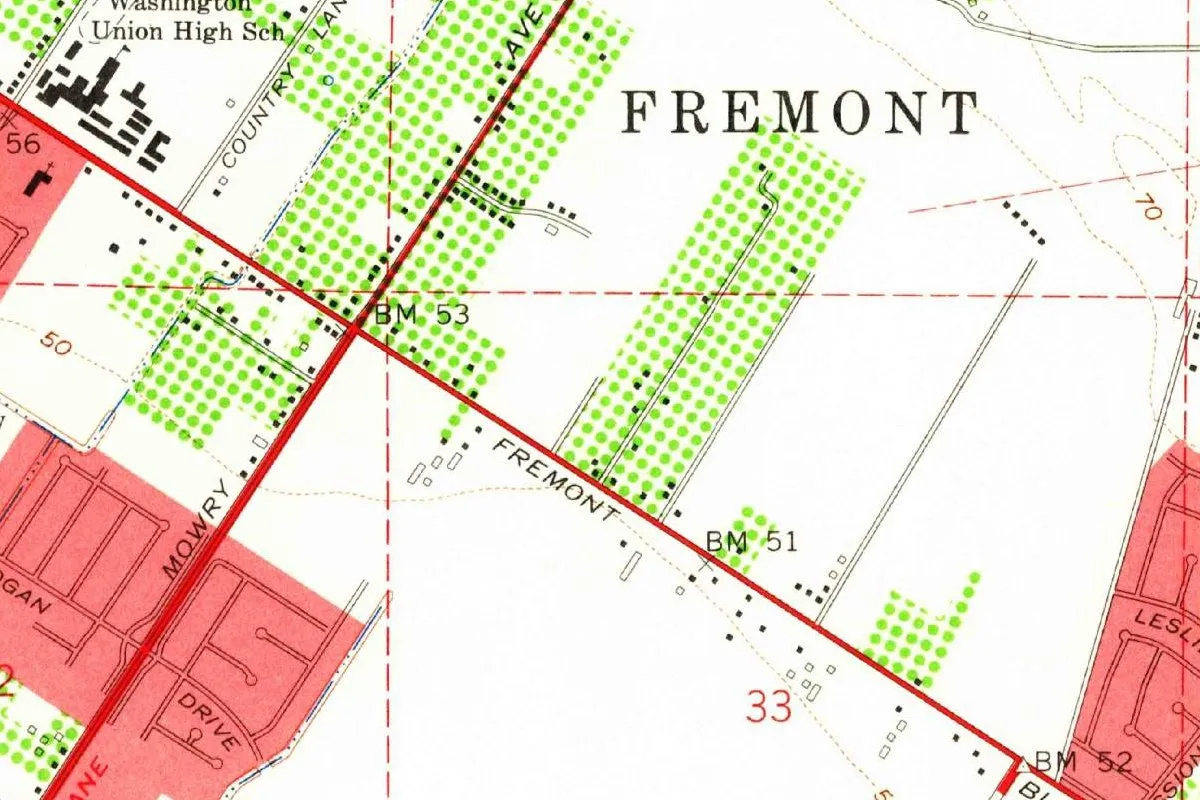
The old town names didn’t vanish, though. The county assessor’s profile says that “even today, each town retains its own unique identity.” The 1961 map at the top of this page catches the new city early, with FREMONT printed in big letters over orchards and fresh subdivisions, five years after the vote.
Quick answers
Who is Fremont, California, named after?
John C. Frémont, the explorer known as the Great Pathfinder and later a U.S. senator, according to the City of Fremont and the Alameda County Assessor.
What towns make up Fremont?
Mission San Jose, Centerville, Niles, Irvington and Warm Springs, the five Washington Township towns that incorporated together, as the city’s history lists them.
When did Fremont become a city?
January 23, 1956, according to the Fremont Police Department’s history of the city. The city’s profile of Wally Pond dates the vote to June 10, 1956.
Was Fremont almost called something else?
A straw vote in Mission San Jose favored “Mission Valley,” the city’s profile of Wally Pond says, but the other towns preferred Fremont.
Key dates
- 1797Mission San Jose, the oldest of the five towns, is founded, the 1939 state guide says.
- 1939The state guide still lists Niles, Mission San Jose, Centerville, Irvington and Warm Springs as separate towns.
- 1956January 23: the five towns incorporate as the City of Fremont, by the police department's history.
- 1959January 10: Fremont renames more than 80 streets that the five towns had duplicated.
Getting there
Open Fremont in Google Maps
Opens in a new tab. The pin is the center of Fremont in the USGS place-name record.
The closest airports, Amtrak stations and intercity bus stops, measured in a straight line from the center of Fremont.
Airports
- Mineta San Jose International (SJC) 13 mi 21 km
- Oakland San Francisco Bay (OAK) 17 mi 28 km
Amtrak trains
- Fremont station (FMT) 1 mi 2 km
- Pleasanton station (PLS) 10 mi 15 km
Intercity buses
- Amtrak Chartered Vehicle Amtrak Connecting Service · Fremont Amtrak Bus Stop 4 mi 6 km
- Gold Runner Fremont 4 mi 6 km
- Greyhound Hayward Bus Station 10 mi 16 km
Distances are as the crow flies, not by road. We don't list schedules or fares because they change; check with the airline, Amtrak or the bus company before you go. Official data (FAA commercial service airports (2025), FAA airport locations, Amtrak stations and Intercity Bus Atlas) from the FAA and the U.S. Bureau of Transportation Statistics, checked Nov 13, 2026.
Sponsored
Staying in Fremont?
Compare hotels in Fremont, California, on Expedia.
See hotels in FremontWe may earn a commission if you buy through this link. It never changes what we write. Read our affiliate disclosure
Historical Sources & References
- City of Fremont, “The Man Who Named Fremont”. Wally Pond’s account from a 1997 interview: the incorporation committee, Maurice Marks’s name committee, the “Mission Valley” straw vote, Bill Dutra’s “No name, no map,” and “Well, put down Fremont.”
- City of Fremont, History. John C. Frémont as “our City’s namesake,” his trail through Mission Pass, “The Great Pathfinder,” and the five townships that formed the city.
- Fremont Police Department, History. Incorporation on January 23, 1956, the duplicate street names, and the renaming of more than 80 streets on January 10, 1959.
- Alameda County Assessor, February 2021 newsletter. Fremont “named after John C. Fremont, an American explorer and former U.S. Senator,” and the five towns that formed it.
- Henry Gannett, The Origin of Certain Place Names in the United States (USGS, 1905), p. 132. The list of earlier Fremonts, “and many other places,” all “Named for Gen. John C. Fremont.”
- Federal Writers’ Project, California: A Guide to the Golden State (1939), pp. 598-600. Niles, Mission San Jose, Centerville, Irvington and Warm Springs as separate towns, with their populations and older names.
- GNIS feature 277521 (U.S. Geological Survey). Fremont’s populated-place record in the Geographic Names Information System, in Alameda County, with its coordinates.
- U.S. Geological Survey, Niles sheet (1961). The source of the map at the top of this page.
Spot something wrong, or know more? Tell us here. You can also email us or use our contact page. Corrections are noted here with their date, never made silently.