How Sunnyvale, California Got Its Name in 1901
Sunnyvale got its name in 1901 from its postmaster, Fred E. Cornell. The town's post office was then called Encinal and its train stop Murphy's Station, but the railroad already had another Encinal. After three other names were turned down, Cornell proposed Sunnyvale as the name that best described the place, a 1922 county history says.
One stop, two names
Until 1901, Sunnyvale, California, went by two names at once: Encinal at its post office and Murphy’s Station at its railroad stop. Because the railroad already had another station called Encinal, the postmaster came up with a third name, and that’s the one that stuck.
Most of what we know about the switch comes from a 1922 biography of the man who made it. It’s part of Eugene T. Sawyer’s History of Santa Clara County, and its subject is Fred E. Cornell, a Wisconsin farm boy who came out to “Murphy’s Station (now Sunnyvale)” in 1897 and opened a general store that October. The Southern Pacific, Sawyer explains, had kept the name Murphy’s Station because this was the home of Martin Murphy, Jr., whose ranch once took in all the land the town later stood on. As more settlers came in, they started calling the place Encinal instead, “on account of the many beautiful live oak trees which flourished at this place.”
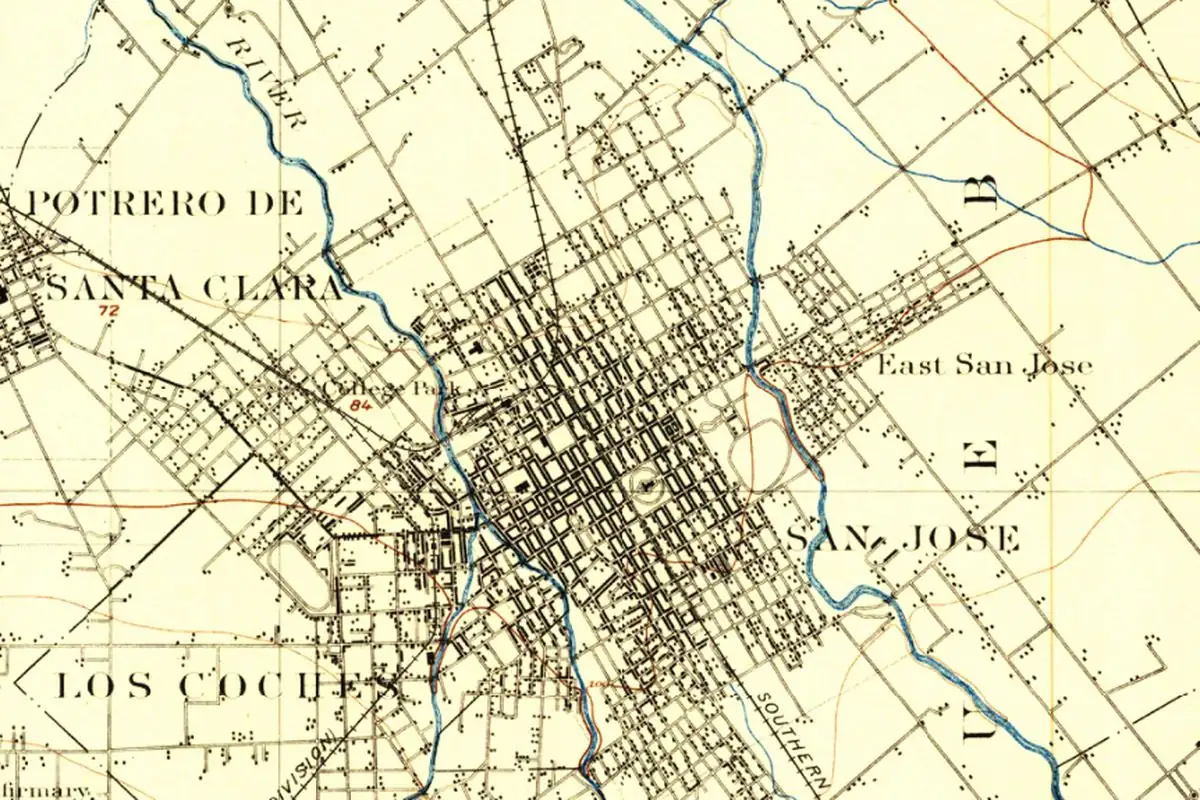
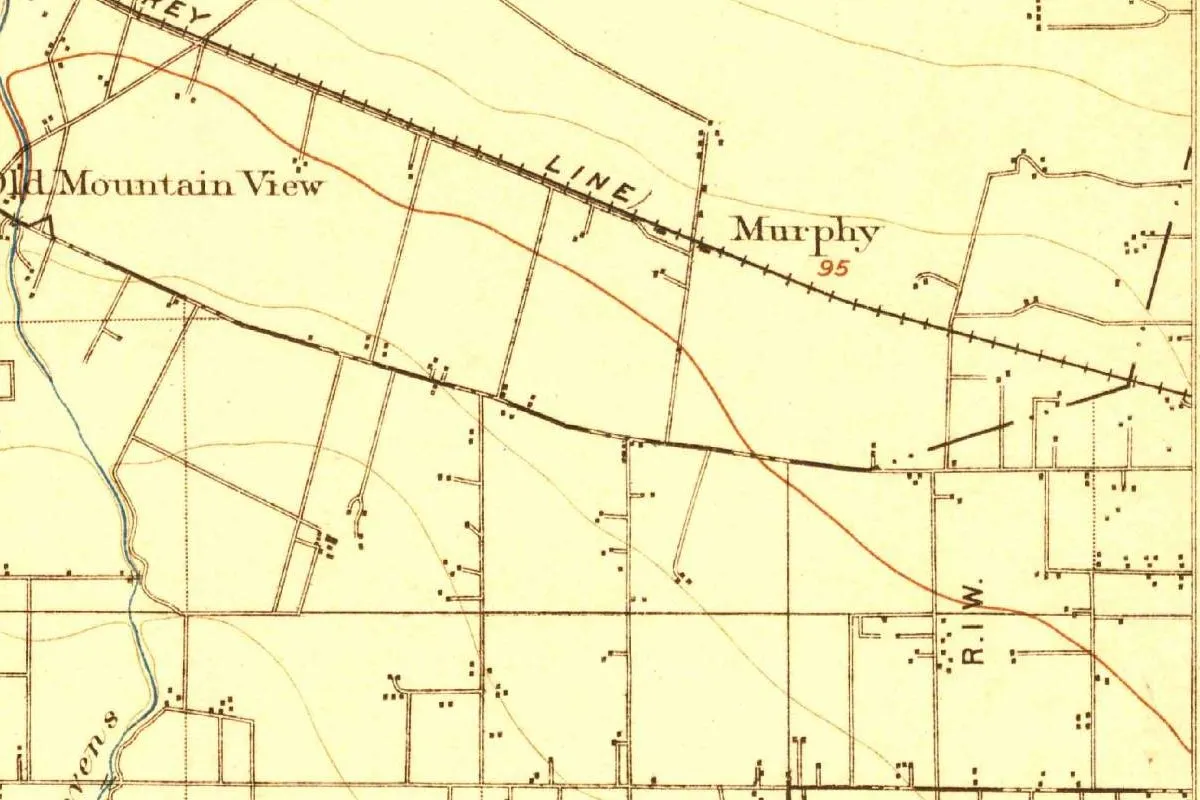
The 1897 survey map still shows the railroad’s version. Look along the tracks and you’ll find a stop lettered simply “Murphy.”
Why Encinal didn’t stick
Cornell was appointed postmaster on March 18, 1898. From then on the community had a post office called Encinal and a train stop called Murphy’s Station.
Sawyer says Encinal “might have proven satisfactory enough” and might have been taken up by the Southern Pacific too, except the railroad “had already given that name to another station on their line.” So Cornell and other early settlers were asked to suggest something new. Cornell and Horace E. Smeld sent in three names, and all three were “rejected for various reasons.” Sawyer doesn’t say what they were.
Then came what he calls “a happy thought.” The postmaster and his neighbors settled on Sunnyvale, convinced “that such a name would best describe the locality,” and Cornell proposed it in his official capacity. According to Sawyer, both the government and the railroad “hastened to accept it.”
The change in the newspaper
You don’t have to rely on a biography written two decades later. The San Francisco Call of February 6, 1901, ran a short column of news from Washington under the headline “Interests the Coast.” Datelined February 5, it reads:
“Postoffice name changed: California—Encinal, Santa Clara County, to Sunnyvale. Postmasters commissioned: California—Fred E. Cornell, Sunnyvale…”
That’s the whole story in two lines: the old name, the new one, and the postmaster who’d suggested it, according to Sawyer, now holding the job under a new name. Cornell stayed on as Sunnyvale’s postmaster until April 1915, Sawyer says.
Encinal lingered in print
Old names don’t vanish overnight. Henry Gannett’s 1905 bulletin on American place names, published four years after the change, still lists “Encinal; village in Santa Clara County, California,” and explains it as “A Spanish word meaning ‘forest of evergreen oak.’” There’s no entry for Sunnyvale at all. Gannett’s meaning and Sawyer’s story about the live oaks point the same way: Encinal was a name about trees, and Sunnyvale was a name about the setting.
The town grew quickly after that. In a chapter on the county’s growing towns, Sawyer describes Sunnyvale as built on what had been a grain field, eight miles (13 km) west of San Jose on the Southern Pacific main line, with factories, canneries and a bank. It was incorporated on December 24, 1912. The Murphy name didn’t vanish either: by 1922 the Cornells lived on Murphy Avenue. So a California town that once answered to two names ended up with a third one of its own, picked by the man who sorted its mail.
Quick answers
What was Sunnyvale called before 1901?
Two things. The post office was Encinal, and the Southern Pacific stop was Murphy’s Station, after rancher Martin Murphy, Jr. An 1897 survey map labels the stop “Murphy.”
Who named Sunnyvale?
Fred E. Cornell, the local postmaster, according to Sawyer’s 1922 county history. He and Horace E. Smeld had first sent in three other names that were all rejected.
Why was Encinal renamed Sunnyvale?
Because the Southern Pacific already had another station called Encinal, Sawyer says. The post office change was reported from Washington on February 5, 1901.
What does Encinal mean?
Gannett’s 1905 bulletin calls it “A Spanish word meaning ‘forest of evergreen oak.’” Sawyer says settlers chose it for the many live oaks there.
Key dates
- 1897Fred E. Cornell comes to Murphy's Station and opens a general store there in October.
- 1898March 18: Cornell becomes postmaster. The post office is called Encinal, while the railroad stop keeps the name Murphy's Station.
- 1901February 5: a dispatch from Washington reports the post office name changed from Encinal to Sunnyvale, with Cornell as postmaster.
- 1905Gannett's place-name bulletin still lists Encinal as a village in Santa Clara County.
- 1912December 24: Sunnyvale is incorporated.
Getting there
Open Sunnyvale in Google Maps
Opens in a new tab. The pin is the center of Sunnyvale in the USGS place-name record.
The closest airports, Amtrak stations and intercity bus stops, measured in a straight line from the center of Sunnyvale.
Airports
- Mineta San Jose International (SJC) 6 mi 10 km
- San Francisco International (SFO) San Francisco International Airport 25 mi 41 km
Amtrak trains
- Santa Clara station (GAC) 5 mi 7 km
- Santa Clara station (SCC) 6 mi 9 km
Intercity buses
- Gold Runner San Jose 8 mi 13 km
- Amtrak Chartered Vehicle Amtrak Connecting Service · San Jose 8 mi 13 km
- FlixBus San Jose Diridon Station 8 mi 13 km
Distances are as the crow flies, not by road. We don't list schedules or fares because they change; check with the airline, Amtrak or the bus company before you go. Official data (FAA commercial service airports (2025), FAA airport locations, Amtrak stations and Intercity Bus Atlas) from the FAA and the U.S. Bureau of Transportation Statistics, checked Nov 13, 2026.
Sponsored
Staying in Sunnyvale?
Compare hotels in Sunnyvale, California, on Expedia.
See hotels in SunnyvaleWe may earn a commission if you buy through this link. It never changes what we write. Read our affiliate disclosure
Historical Sources & References
- Eugene T. Sawyer, History of Santa Clara County, California (1922), pp. 294 and 486. Cornell’s arrival at Murphy’s Station in 1897, Martin Murphy, Jr.‘s ranch, Encinal for the live oaks, Cornell as postmaster from March 18, 1898 to April 1915, the railroad’s other Encinal station, the three rejected names, Sunnyvale as the name that “would best describe the locality,” and the Cornells’ home on Murphy Avenue (p. 486); Sunnyvale on a former grain field eight miles west of San Jose, incorporated December 24, 1912 (p. 294, the unnumbered first page of chapter 34).
- The San Francisco Call, February 6, 1901, p. 10. The Washington dispatch of February 5 with the post office name changed from Encinal to Sunnyvale and Fred E. Cornell commissioned as postmaster.
- Henry Gannett, The Origin of Certain Place Names in the United States (USGS, 1905), p. 119. Encinal as a village in Santa Clara County, “A Spanish word meaning ‘forest of evergreen oak,’” and no entry for Sunnyvale.
- GNIS feature 1656344 (U.S. Geological Survey). Sunnyvale as a Santa Clara County populated place, indexed to the Cupertino quadrangle when its entry was created in 1981.
- U.S. Geological Survey, Palo Alto sheet (1897). The 1897 edition of the Palo Alto sheet, printed before the 1901 change, where the stop on the rail line is lettered Murphy.
Spot something wrong, or know more? Tell us here. You can also email us or use our contact page. Corrections are noted here with their date, never made silently.