Santa Cruz, California: Holy Cross, by Way of a Creek
Santa Cruz is Spanish for "holy cross." On October 18, 1769, the Portolá expedition crossed a creek just past the San Lorenzo River, and Fray Juan Crespí wrote that it "was named Santa Cruz." A mission opened there in 1791, and an 1879 county history says the little stream gave its name to the city.
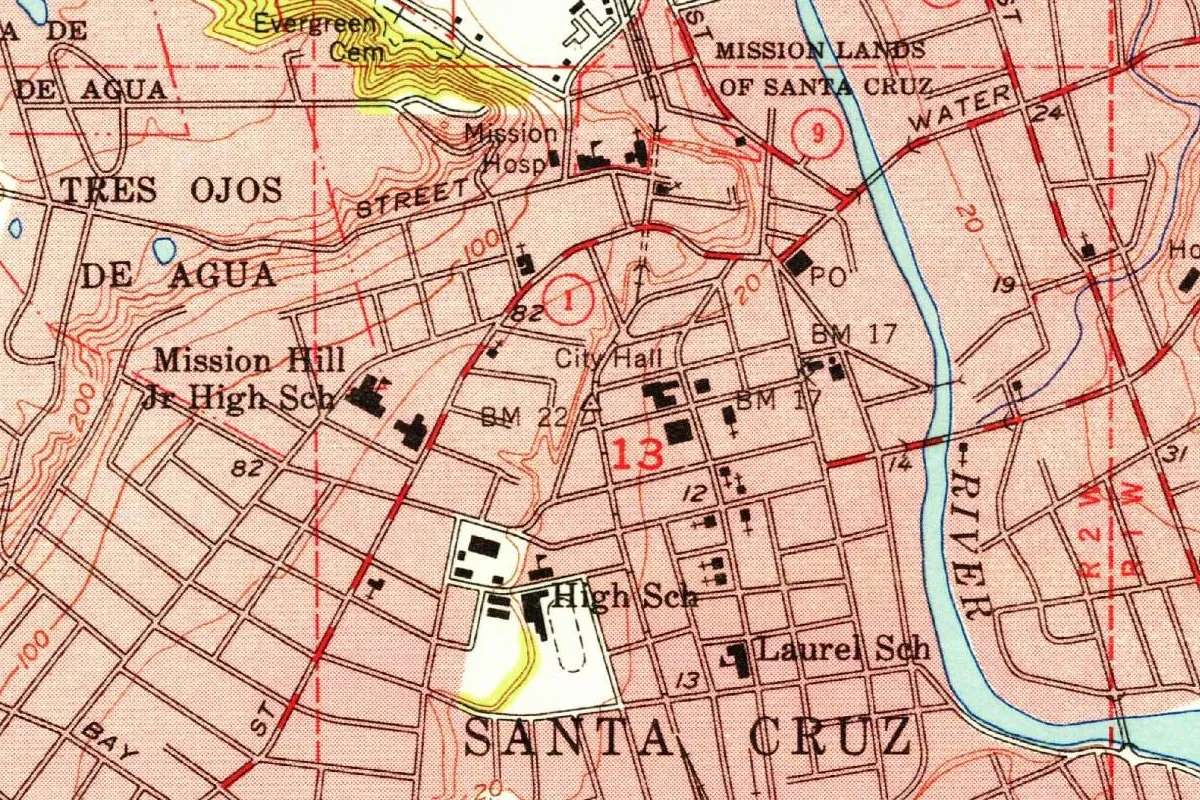
The first thing in Santa Cruz, California, to be called Santa Cruz was a creek, named by a Spanish expedition on October 18, 1769. The words mean “holy cross,” and an 1879 county history says the city took them from that little stream.
The day after the San Lorenzo
The expedition was Gaspar de Portolá’s overland march from San Diego, sent north in 1769 to find Monterey Bay. One of its two Franciscans, Fray Juan Crespí, kept the diary at Father Junípero Serra’s request, and Palóu later copied the whole thing into his history of the missions.
On October 17 the party came to a river “not far from the sea,” about eighteen varas wide, with water up to the bellies of the animals. Crespí called it one of the largest they’d met on the whole journey. They had to clear a way down one bank and up the other, made camp on the far side, and named the river San Lorenzo. They didn’t see a single Indian all day, he noted.
The next morning they set off along the coast, and almost at once they hit another stream. Crespí’s entry, in the English of Herbert Bolton’s 1926 edition, has the naming in one short line:
“Five hundred steps after we started we crossed a good arroyo of running water which descends from some high hills where it rises. It was named Santa Cruz.”
That’s the whole ceremony. He doesn’t say who picked the name or why, and the rest of the entry moves straight on to mesas, burned grass and the next four gullies. Bolton’s footnote to the line is just as brief: “At Santa Cruz.”
You may have read that the explorers raised a cross by the river that day. Crespí’s entries for October 17 and 18 don’t mention one. The cross is in the name, not in the diary.
Costansó didn’t write it down
The expedition’s engineer, Miguel Costansó, kept his own diary, and it’s a useful check. For October 17 he has the ford and the “river which was named San Lorenzo.” For October 18 he describes three bad crossings, log bridges covered with earth and brush, and a camp the men called Las Puentes. There’s no Santa Cruz in his entry at all.
So the name hangs on Crespí’s diary alone. That’s not a weak thread, since he was the man Serra had asked to keep the record, but it means you won’t find a second eyewitness who heard the name spoken.
Which creek, exactly?
Here the local historians don’t agree. The 1879 History of Santa Cruz County retold the march and decided the stream “appears to be that which we know as Major’s Mill creek.” Thirteen years later, E. S. Harrison’s county history printed a fresh translation of the diary with notes by the translator, who put it somewhere else: “The creek which they named ‘Santa Cruz’ is the one which flows through Kirby’s Tannery.”
Bolton’s note, written decades later, doesn’t name a creek at all. What they all agree on is the order of events: the San Lorenzo first, then a creek a few hundred steps on, and the creek got the name.
From a creek to a mission to a town
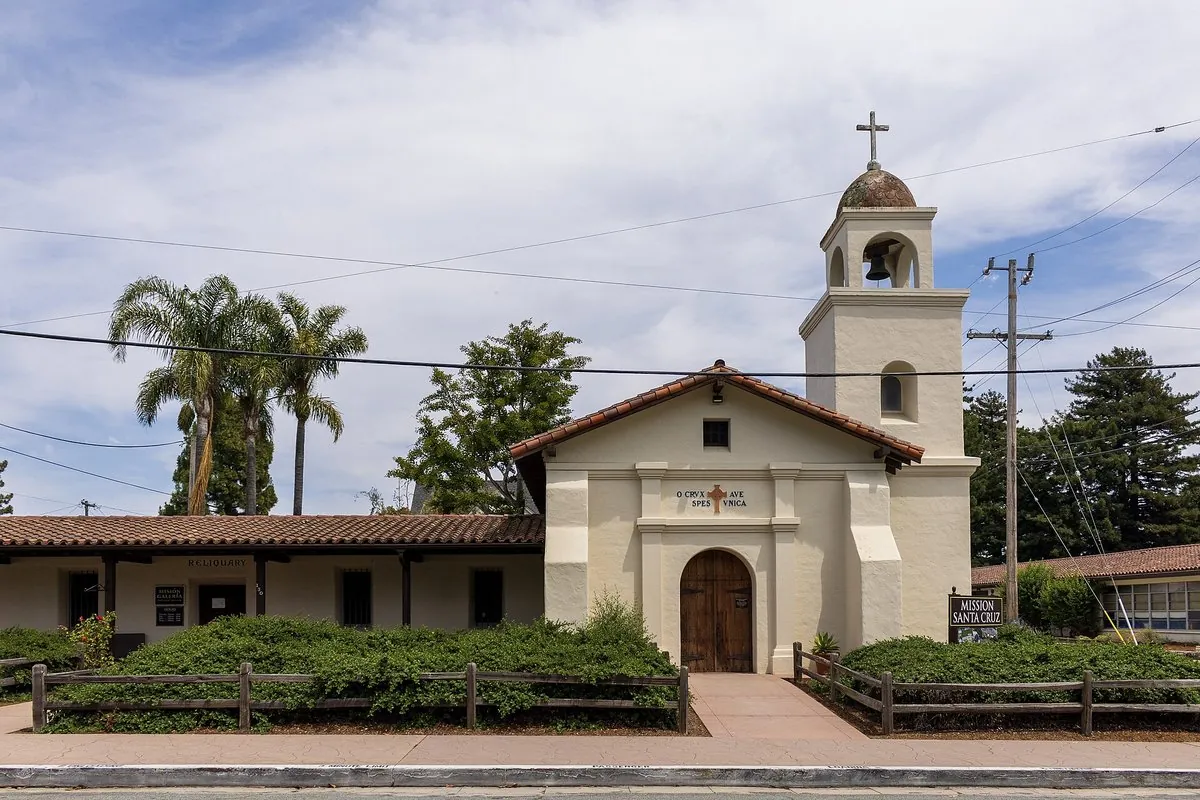
For twenty-two years, as far as these sources show, the name belonged to a stream. Then, Harrison writes, on September 25, 1791, Fathers Alonzo Salazar and Baldomero López arrived and pitched their tents “on the hill where the Catholic Church now stands.” A report written at the mission that December calls it the “mission at Santa Cruz, founded on the twenty-fifth day of September of this year (1791).” Its adobe church was dedicated on March 10, 1794.
The 1879 history draws the line from one to the other without fuss: “And so the little stream gave its name to the city.”
By 1905, when Henry Gannett compiled his federal list of American place names, the creek had dropped out of the story. His entry covers a county and a city in California, a county in Arizona and an island off the California coast, and gives the meaning and nothing else: “A Spanish phrase meaning ‘holy cross.’” That’s still the plain answer if you want one line. The longer one is that two and a half months after the same diary named the river at Los Angeles the Porciúncula, the expedition waded a creek on an October morning, and the name it got there is now on a city, a county and a mission.
Quick answers
What does Santa Cruz mean?
Holy cross. Gannett’s 1905 list of place names gives it as “a Spanish phrase meaning ‘holy cross.’”
Who named Santa Cruz, California?
The Portolá expedition. Fray Juan Crespí’s diary says a creek the party crossed on October 18, 1769, “was named Santa Cruz,” without saying which man chose it.
Did Spanish explorers put up a cross at Santa Cruz in 1769?
Not according to the diaries. Neither Crespí’s nor Costansó’s entries for October 17 and 18, 1769, mention a cross there.
When was Mission Santa Cruz founded?
September 25, 1791, when Fathers Alonzo Salazar and Baldomero López arrived, according to Harrison’s 1892 history and the mission report it quotes.
Key dates
- 1769October 17: the Portolá expedition fords a large river and names it San Lorenzo. October 18: Crespí writes that a creek just beyond it was named Santa Cruz.
- 1791September 25: Fathers Alonzo Salazar and Baldomero López arrive and pitch their tents for Mission Santa Cruz.
- 1794March 10: the mission's adobe church is dedicated, according to an 1892 county history.
- 1879A county history says the creek Crespí described is Major's Mill Creek and that "the little stream gave its name to the city."
- 1892A second county history puts the Santa Cruz creek at Kirby's Tannery instead.
Getting there
Open Santa Cruz in Google Maps
Opens in a new tab. The pin is the center of Santa Cruz in the USGS place-name record.
The closest airports, Amtrak stations and intercity bus stops, measured in a straight line from the center of Santa Cruz.
Airports
- Mineta San Jose International (SJC) 27 mi 44 km
- Monterey Regional (MRY) 29 mi 46 km
Amtrak trains
- Seaside-Marina station (MYU) 26 mi 41 km
- San Jose station (SJC) 26 mi 41 km
Intercity buses
- International Bus Lines Gilroy 25 mi 41 km
- Limousine Express Gilroy 25 mi 41 km
- Amtrak Chartered Vehicle Amtrak Connecting Service · Seaside-Marina 26 mi 41 km
Distances are as the crow flies, not by road. We don't list schedules or fares because they change; check with the airline, Amtrak or the bus company before you go. Official data (FAA commercial service airports (2025), FAA airport locations, Amtrak stations and Intercity Bus Atlas) from the FAA and the U.S. Bureau of Transportation Statistics, checked Nov 13, 2026.
Sponsored
Staying in Santa Cruz?
Compare hotels in Santa Cruz, California, on Expedia.
See hotels in Santa CruzWe may earn a commission if you buy through this link. It never changes what we write. Read our affiliate disclosure
Sponsored
Want the spooky side of Santa Cruz?
The name has its story above. For the ghost stories, US Ghost Adventures runs walking ghost tours in Santa Cruz.
See ghost tours in Santa CruzWe may earn a commission if you book through this link. It never changes what we write. Read our affiliate disclosure
Historical Sources & References
- Francisco Palóu, Historical Memoirs of New California, ed. Herbert E. Bolton, vol. 2 (1926), pp. 108, 134, 202-203. Crespí’s diary as Palóu copied it: the San Lorenzo River on October 17, 1769, the creek that “was named Santa Cruz” on October 18, and Bolton’s note “At Santa Cruz.” Also p. 108, where Palóu says Serra charged Crespí with keeping the diary, and p. 134, where the same diary names the river at Los Angeles the Porciúncula.
- The Portolá Expedition of 1769-1770: Diary of Miguel Costansó (1911), pp. 92-93. The engineer’s entries for October 17 and 18, 1769: the “river which was named San Lorenzo,” the log bridges and Las Puentes, with no mention of Santa Cruz.
- History of Santa Cruz County, California (Wallace W. Elliott & Co., 1879), p. 2. “How Santa Cruz Was Named”: the creek identified as Major’s Mill creek and “the little stream gave its name to the city.”
- E. S. Harrison, History of Santa Cruz County, California (1892), pp. 20-23, 37-38. The arrival of Fathers Salazar and López on September 25, 1791, the mission report of December 1791 and the church dedication of March 10, 1794 (pp. 20-23); a translation of Crespí’s diary with the note placing the Santa Cruz creek at Kirby’s Tannery (pp. 37-38).
- Henry Gannett, The Origin of Certain Place Names in the United States (USGS, 1905), p. 275. Santa Cruz as “a Spanish phrase meaning ‘holy cross,’” for the California county, city and island and the Arizona county.
- GNIS feature 1659596 (U.S. Geological Survey). Santa Cruz’s entry in the Geographic Names Information System, filed under Santa Cruz County.
- U.S. Geological Survey, Santa Cruz sheet (1:24,000), 1954, 1955 printing. Downtown streets beside the San Lorenzo River, with “Mission Lands of Santa Cruz” printed across the hill to the north.
Spot something wrong, or know more? Tell us here. You can also email us or use our contact page. Corrections are noted here with their date, never made silently.