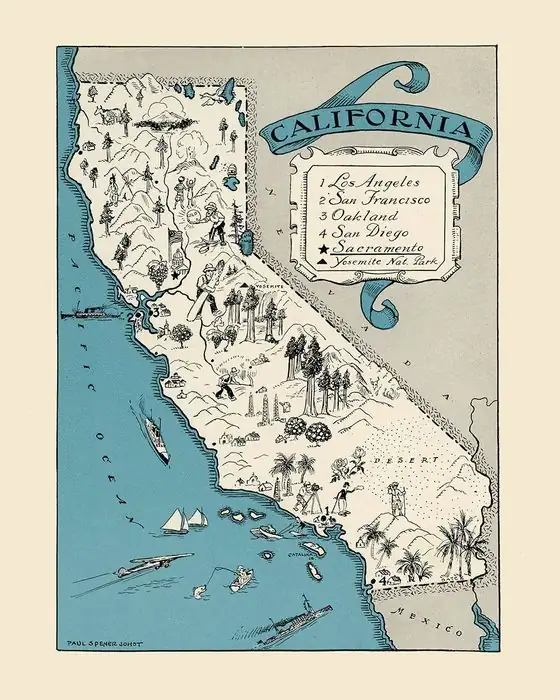
How Salinas, California Got Its Salty Name
Salinas is Spanish for salt marshes. A 1914 book on California place names says the Salinas River was named for the salt-water ponds along its course, and an 1881 county history already talks of the Salinas plain in 1846. The town laid out there in 1867 was called Salinas City. The handful-of-salt story comes from a 1930 memoir.
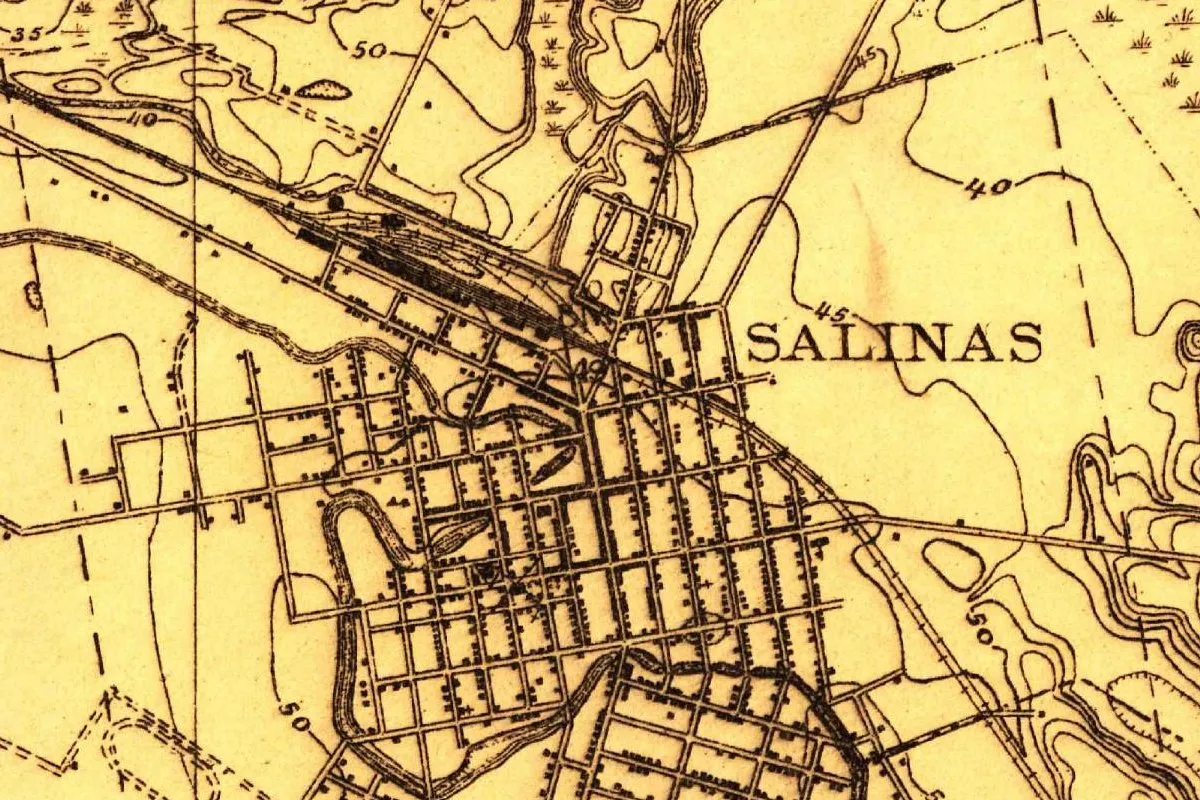
A Spanish word for salt marshes was on the river and the plain around Salinas, California, before the town was laid out as Salinas City in 1867. The folksy story of a man walking into a meeting with a handful of salt came much later, from a pioneer’s memoir written in 1930.
Salt ponds along a river
Salinas is a Spanish word, and in this valley it described something you could actually see. Nellie Van de Grift Sanchez, who wrote a 1914 book on the Spanish and Indian place names of California, gave the river’s name a short gloss: “The Salinas (salt marshes).” She said the river was called that for the chain of salt-water ponds along its course, and that before the name stuck it had shown up as El Rio Elzeario, Santa Delfina and El Rio de Monterey.
The city tells it the same way. Its budget profile says “The name Salinas means ‘salt marsh’ in Spanish” and that the city got the name “because at that time there was a large slough that ran through the area.”
Nine years before Sanchez, Henry Gannett’s federal list of place names put Salinas in one bracket with Salina, New York, and the Saline rivers and counties of the Midwest, under a single explanation: “So named from the presence of salt springs or salt deposits within their limits.” He didn’t add anything local, but he didn’t need to. The salt was the point.
A town to be called Salinas City
The word was in use around here well before there was a town. The History of Monterey County, published in 1881, describes a fight of November 1846 in which horses were about to be “driven across the Salinas plain toward Monterey,” and it calls the clash the battle of the Salinas.
The same book tells how the town itself started. It says the first building was the Half-way House, put up in 1856 by Deacon Elias Howe and used as an inn, a store and a meeting place for county conventions and elections. Then, on the next page:
“…in the year 1867, he and his partner, Jackson, on one side of the fence, and Eugene Sherwood on the other, laid out plans for a town to be called Salinas City, upon portions of the Sausal and Nacional Ranchos.”
The “he” is A. Ricker, who had bought out the Half-way House’s “doubting” owner named Tresony “at a low figure.” So by the book’s account, the developers didn’t invent a name for their town. They borrowed the one already on the plain and the river, and stuck “City” on the end. The Legislature incorporated the city of Salinas on March 4, 1874, and by the 1881 history’s count it had 1,865 people by the census of 1880.
The man with the handful of salt
If you ask around Salinas, though, you may hear a livelier story. The Monterey County Historical Society keeps a manuscript called “Looking Back Down an Old Trail Through the Eyes of a Pioneer,” written in 1930 by John McDougall. He remembered a meeting of settlers at the old Halfway house to talk about building a town. Eugene Sherwood offered the land and a survey, and then the name came up. In McDougall’s words, “a man came in with a handful of stuff that looked like salt,” gathered from one of the salt ponds nearby. A man named Soto looked at it and said, in Spanish, “Es Salina.” Captain El Graves picked up on that and suggested they move the “Es” to the end of the word and “call it ‘Salinas.’”
It’s a great story. The trouble is that it’s the memory of an old man, written down long after the meeting it describes, and we couldn’t find any minutes of that meeting. The historical society itself warns that the essays in that section of its website “have not been revised or updated.” The Monterey County Weekly, retelling it in 2024, opened with “Legend has it” and dated the meeting only “roughly around 1854, according to historical texts.” That date doesn’t sit well with the 1881 history, which says the Half-way House wasn’t built until 1856.
There’s a bigger reason to hold the story loosely, and this part is our reading of the sources, not something any of them says. Even if the meeting happened just as McDougall recalled, the word wasn’t new. The river, the plain and the battle already went by Salinas. At most, a handful of salt helped a room full of settlers pick a name that was already all around them.
A salty name in the Salad Bowl
The town grew quickly, and the 1881 history says the Southern Pacific gave it “a fresh impetus.” The book puts it about 18 miles (29 km) by rail from the harbor at Monterey, on a plain that had been an “immense mustard patch” and cattle pasture. Today it’s Monterey County’s largest city, as the Weekly notes, and the valley it sits in calls itself “The Salad Bowl of the World,” as the city’s profile puts it.
So the next time you drive through the lettuce fields of the Salinas Valley in California, remember what the name is describing. Not the farms, and not a person. Salt water standing in low ground beside a river, which somebody, long before there was a town, thought worth a Spanish word.
Quick answers
What does Salinas mean in Spanish?
Salt marshes. Sanchez’s 1914 book glosses the river’s name as “salt marshes,” and the City of Salinas says the name means “salt marsh” in Spanish.
Did a man with a handful of salt name Salinas?
Probably not. The only firsthand source for it is John McDougall’s 1930 memoir, which credits Captain El Graves after a man brought salt into a settlers’ meeting. Older records already used Salinas for the river and the plain.
What was Salinas called when it was founded?
Salinas City. The 1881 county history says the town was laid out in 1867 as “a town to be called Salinas City.”
When did Salinas become a city?
On March 4, 1874, when the Legislature passed the act incorporating the city of Salinas.
Key dates
- 1846In November, horses are driven across the Salinas plain toward Monterey, in the words of an 1881 county history.
- 1856Deacon Elias Howe builds the Half-way House, the first building in what is now Salinas, the 1881 history says.
- 1867A. Ricker, his partner Jackson and Eugene Sherwood lay out plans for a town to be called Salinas City.
- 1874March 4: the Legislature incorporates the city of Salinas.
- 1930Pioneer John McDougall writes down the story of a handful of salt and a town meeting that chose the name.
Getting there
Open Salinas in Google Maps
Opens in a new tab. The pin is the center of Salinas in the USGS place-name record.
The closest airports, Amtrak stations and intercity bus stops, measured in a straight line from the center of Salinas.
Airports
- Monterey Regional (MRY) 12 mi 20 km
- Mineta San Jose International (SJC) 50 mi 80 km
Amtrak trains
- Salinas station (SNS) under 1 mi 0.2 km
- Seaside-Marina station (MYU) 8 mi 13 km
Intercity buses
- Amtrak Chartered Vehicle Amtrak Connecting Service · Salinas under 1 mi 0.2 km
- Gold Runner Gilroy 23 mi 37 km
- Limousine Express Gilroy 24 mi 38 km
Distances are as the crow flies, not by road. We don't list schedules or fares because they change; check with the airline, Amtrak or the bus company before you go. Official data (FAA commercial service airports (2025), FAA airport locations, Amtrak stations and Intercity Bus Atlas) from the FAA and the U.S. Bureau of Transportation Statistics, checked Nov 13, 2026.
Sponsored
Staying in Salinas?
Compare hotels in Salinas, California, on Expedia.
See hotels in SalinasWe may earn a commission if you buy through this link. It never changes what we write. Read our affiliate disclosure
Historical Sources & References
- History of Monterey County, California (Elliott & Moore, 1881), pp. 45, 108 and 109. The horses “driven across the Salinas plain” in November 1846 and the battle of the Salinas (p. 45); the Half-way House of 1856, the “immense mustard patch,” the 1880 population and the distance by rail to Monterey (p. 108); the 1867 plans “for a town to be called Salinas City,” the railroad’s “fresh impetus” and the incorporation of March 4, 1874 (p. 109).
- Nellie Van de Grift Sanchez, Spanish and Indian Place Names of California (1914), pp. 148 and 151. “The Salinas (salt marshes),” the salt-water ponds along the river, its earlier names, and the town about eighteen miles east of Monterey.
- Henry Gannett, The Origin of Certain Place Names in the United States (1905), p. 272. Salinas grouped with Salina and Saline: “So named from the presence of salt springs or salt deposits within their limits.”
- Monterey County Historical Society, “Origin of the Name ‘Salinas’”. John McDougall’s 1930 account of the meeting, the handful of salt, Soto’s “Es Salina” and Captain El Graves’s suggestion, plus the society’s note that the essays “have not been revised or updated.”
- Erik Chalhoub, Monterey County Weekly (2024). The salt story told as “Legend has it,” the meeting dated “roughly around 1854,” and Salinas as Monterey County’s largest city.
- City of Salinas, Community Profile, FY 2025-26 Budget. “The name Salinas means ‘salt marsh’ in Spanish,” the large slough, and “The Salad Bowl of the World.”
- GNIS feature 277589 (U.S. Geological Survey). Salinas’s permanent ID in the place-name files, kept under Monterey County.
- U.S. Geological Survey, Salinas sheet (1910). A 1910 survey at 1:31,680 with the rail yard, the street grid and SALINAS printed in capitals.
Spot something wrong, or know more? Tell us here. You can also email us or use our contact page. Corrections are noted here with their date, never made silently.