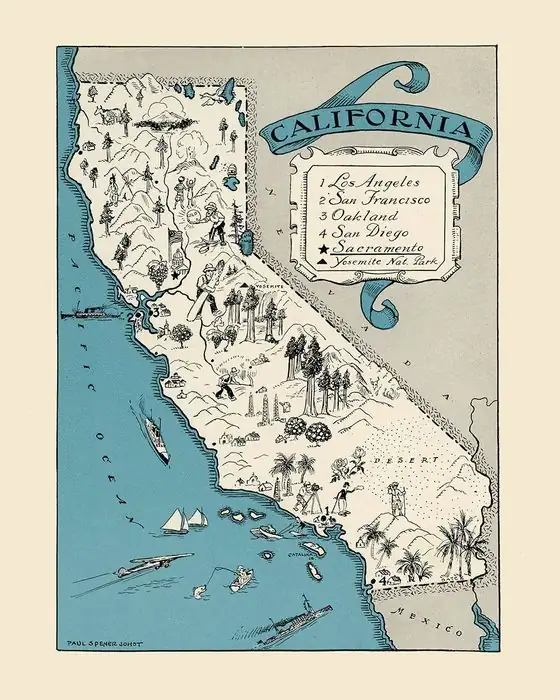
Carmel-by-the-Sea, California: A River Name From 1602
Carmel-by-the-Sea is named for the Carmel River, which Sebastián Vizcaíno's expedition called the Carmelo during its 1602-1603 stop at Monterey, after the three Carmelite friars who sailed with it. The town began as Carmel City in 1888. The city's own historic study credits developer Abbie Jane Hunter with coining the longer name.
Three friars on Vizcaíno’s ships
Carmel-by-the-Sea takes the first half of its name from a river that Spanish sailors called the Carmelo in 1602-03, after the Carmelite friars on board. The second half came almost three centuries later, from the real estate business. In between, the name sat on a river, a bay and a mission long before there was a town to wear it.
The sailors belonged to Sebastián Vizcaíno’s expedition up the California coast. Herbert Eugene Bolton’s 1916 collection of early Spanish narratives explains that its spiritual care was “intrusted to three Carmelites,” and that one of them, Father Antonio de la Ascensión, had been a pilot on voyages to the Indies before he took the habit. Ascensión wrote his own report of the trip, and he introduces the friars like this:
“…three religious, priests of the Discalced Order of Carmelites, were appointed; they were Father Andres de la Asumpcion, who went as commissary, Father Tomas de Aquino, and I, Father Antonio de Ascension, who writes this report.”
So the man who later wrote down the river’s name was himself a Carmelite. Keep that in mind when you get to the river.
A river named the Carmelo
The ships reached Monterey in December 1602 and stayed until January 3, 1603, according to the City of Carmel-by-the-Sea’s historic context statement. Vizcaíno’s diary, as Bolton prints it, describes the general heading inland on January 3 with the commissary and ten arquebusiers. Some three leagues out he found “a copious river” coming down from high, snow-covered mountains, lined with pines, poplars and willows. Bolton’s footnote identifies it as the Carmel River and adds that “it was given this name by the Vizcaino expedition.”
Ascensión’s report says the same thing in fewer words. After praising Monterey’s harbor, timber and water, he mentions a river nearby that “was named the Carmelo,” the same line our Monterey story quotes for the bay next door. The city’s study puts it plainly: Vizcaíno named the Rio del Carmelo “after the Carmelite friars who accompanied his voyage.” It also says the crew had chosen Our Lady of Mount Carmel as its patroness for the voyage.
That’s a longer road to the name than some other Carmels took. In his 1905 list of place-name origins, Henry Gannett traced Carmel, Maine, “and several other small places” straight to “the mountain in Palestine.” California’s Carmel got there secondhand, through an order of friars named for that mountain and a river named for them. The same voyage, by the way, is behind the names of San Diego and Monterey, too.
A mission, then Carmel City
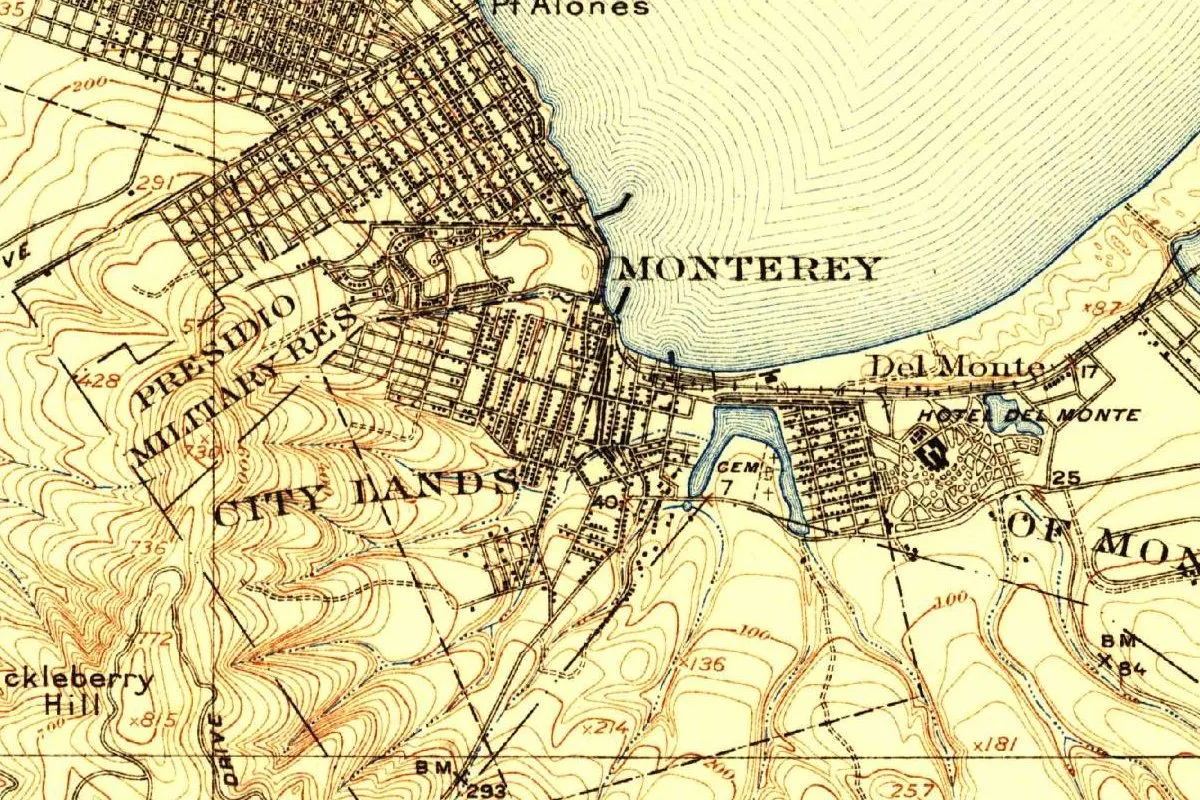
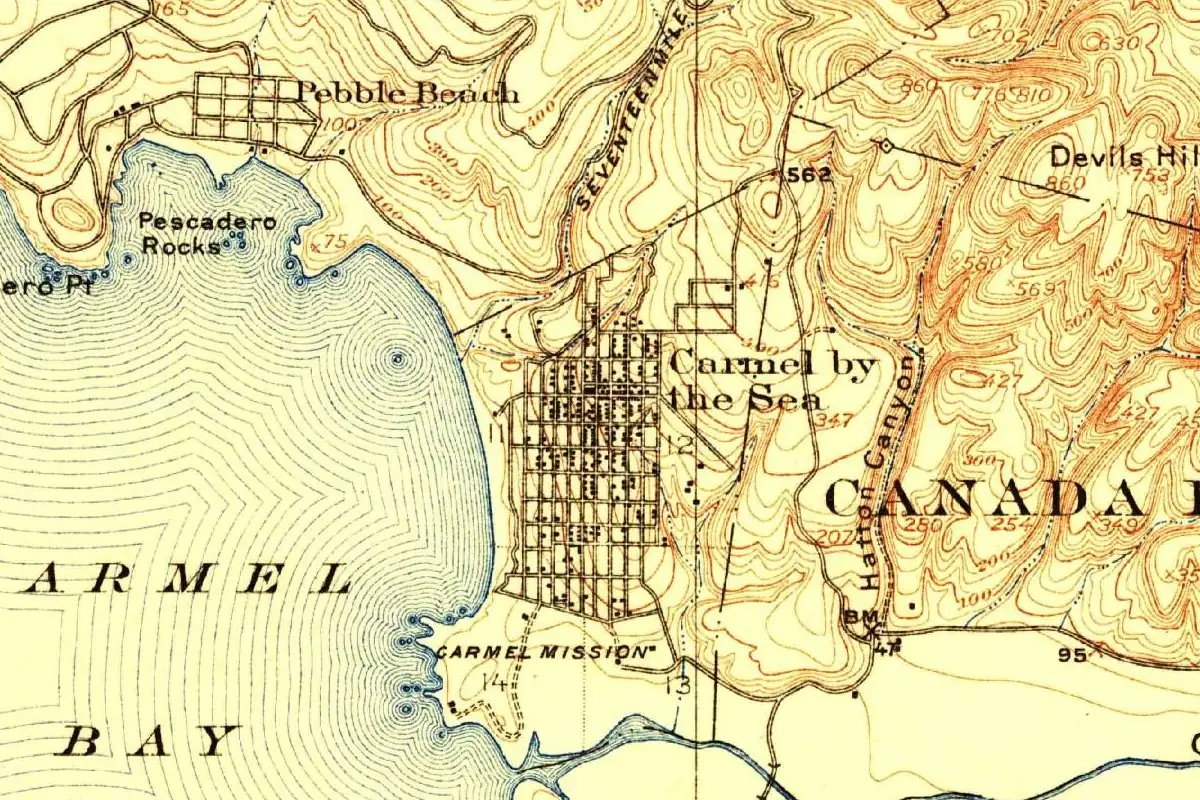
Nobody built a town by the river for a long time. In 1770 the Portolá expedition founded a presidio and Mission San Carlos Borromeo at Monterey, and the next year Father Junípero Serra got permission to move the mission to the Carmel River. The city’s study says he wanted his converts farther from the soldiers and closer to good farmland. The mission’s full name, San Carlos Borromeo del Rio Carmelo, kept the river in it, and you’ll see “Carmel Mission” printed near the shore on the 1913 map at the top of this page.
The first plan for a town came in 1888. Santiago and Belisario Duckworth, brothers with a real estate firm in Monterey, signed an agreement with landowner Honore Escolle on February 8, 1888, to lay out lots in the pine forest above the beach. Their subdivision was recorded with Monterey County as Carmel City, pitched as a Catholic retreat along the lines of the Methodist one in Pacific Grove. The study says more than two hundred lots sold by 1890, mostly to buyers from San Francisco, before the hard times of the 1890s stalled everything.
Who added “by-the-Sea”?
Here the record gets thinner. By 1892, Abbie Jane Hunter’s Woman’s Real Estate Investment Company of San Francisco had bought about 300 Carmel City lots from the Duckworths. Hunter sold mostly to San Francisco teachers, professors and writers, and the study says she called the place a “Haven of Rest.” Her brother, carpenter Delos Goldsmith, put up the first houses and a bathhouse on the beach.
In its list of notable people, the same city study says of Hunter: “She is credited with coining the name Carmel-by-the-Sea.” Notice the word “credited.” The study doesn’t give a date, a brochure or a quote from Hunter herself, so treat it as the town’s accepted attribution rather than something you can check against a document. Hunter’s company didn’t last, either. She was arrested in San Francisco in 1895 after a lawsuit against the firm.
Whoever thought of it, the longer name stuck. Map makers weren’t fussy about the hyphens, though. The 1913 survey sheet just prints “Carmel by the Sea” in two lines next to the grid of streets.
The best little city in California
The town that grew into that name was mostly the work of two men named Frank. San Francisco attorney Frank Powers and real estate broker James Franklin “Frank” Devendorf founded the Carmel Development Company in 1902 and went after buyers the study describes as “School Teachers and Brain Workers.” Devendorf, it says, curved streets around big trees rather than cut them down.
On November 1, 1916, the Carmel Pine Cone reported that voters had chosen to incorporate, calling the result “the best little city in California.” The city was incorporated as Carmel-by-the-Sea, which is still its official name, though plenty of people just say Carmel. Either way, you’re saying the name a Carmelite friar wrote down for a river more than four hundred years ago. More stories from around the state are on our California page.
Quick answers
Why is it called Carmel-by-the-Sea?
Carmel comes from the Carmel River, which Sebastián Vizcaíno’s expedition named the Carmelo in 1602-1603 after the Carmelite friars aboard. The city’s historic study credits Abbie Jane Hunter with adding “by-the-Sea.”
Who named Carmel-by-the-Sea?
The credit is split, centuries apart. Vizcaíno’s expedition named the river during its 1602-1603 stop at Monterey, and the city’s historic study credits developer Abbie Jane Hunter, who was selling lots in the 1890s, with coining the full town name.
What was Carmel-by-the-Sea called before?
Carmel City. That was the name of the Duckworth brothers’ subdivision, recorded with Monterey County in 1888.
When did Carmel-by-the-Sea become a city?
In 1916. The Carmel Pine Cone announced the incorporation vote on November 1, 1916.
Key dates
- 1602Sebastián Vizcaíno's ships reach Monterey on December 17, with three Discalced Carmelite friars aboard.
- 1603On January 3, Vizcaíno goes overland to a river the expedition names the Carmelo.
- 1771Father Junípero Serra moves Mission San Carlos Borromeo from Monterey to the Carmel River.
- 1888The Duckworth brothers' subdivision, Carmel City, is recorded with Monterey County.
- 1902Frank Powers and Frank Devendorf found the Carmel Development Company.
- 1916Voters incorporate Carmel-by-the-Sea.
Things to do in Carmel-by-the-Sea, California
Carmel Mission Basilica
Mission San Carlos Borromeo del Rio Carmelo, moved here from Monterey in 1771, still carries the river's name. It's an active parish, with a museum, a mission store and grounds that visitors can explore.
Carmel Beach
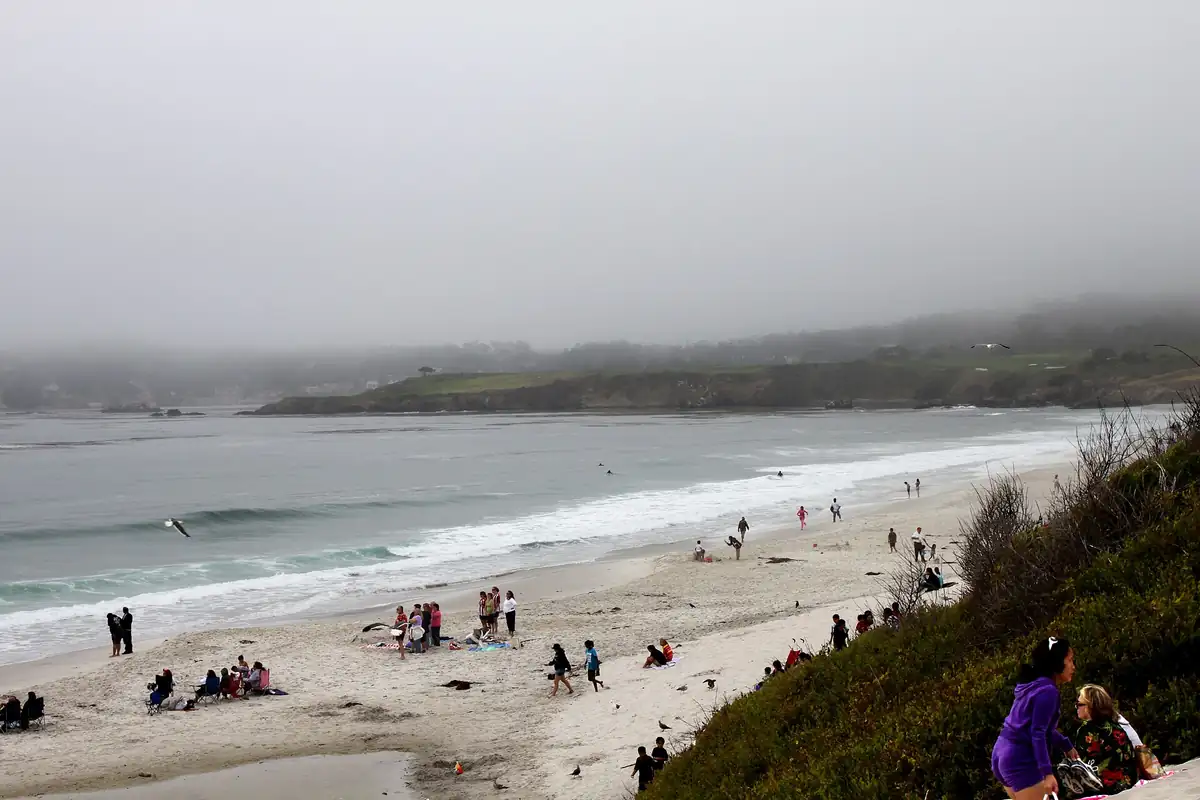
The town's own beach lies at the bottom of Ocean Avenue, reached by a sand ramp and a row of stairways down the bluff. Dogs are allowed on the sand off leash as long as they stay under voice control.
Carmel River State Beach
A mile-long beach on Carmel Bay where the Carmel River forms a lagoon before it reaches the Pacific. The lagoon is a bird sanctuary for waterfowl and songbirds.
Point Lobos State Natural Reserve
Often called the crown jewel of the California State Park System, with headlands, coves and rolling meadows, plus an offshore area that forms one of the richest underwater habitats in the world.
Tor House
The granite house poet Robinson Jeffers built on Carmel Point with builder Michael J. Murphy. A volunteer foundation keeps Tor House, Hawk Tower and the gardens open to the public through guided tours.
Getting there
Open Carmel-by-the-Sea in Google Maps
Opens in a new tab. The pin is the center of Carmel-by-the-Sea in the USGS place-name record.
The closest airports, Amtrak stations and intercity bus stops, measured in a straight line from the center of Carmel-by-the-Sea.
Airports
- Monterey Regional (MRY) 5 mi 8 km
- Mineta San Jose International (SJC) 56 mi 90 km
Amtrak trains
- Seaside-Marina station (MYU) 10 mi 15 km
- Salinas station (SNS) 17 mi 27 km
Intercity buses
- Amtrak Chartered Vehicle Amtrak Connecting Service · Carmel Amtrak Bus Stop 1 mi 2 km
- Gold Runner Gilroy 37 mi 59 km
- Limousine Express Gilroy 37 mi 60 km
Distances are as the crow flies, not by road. We don't list schedules or fares because they change; check with the airline, Amtrak or the bus company before you go. Official data (FAA commercial service airports (2025), FAA airport locations, Amtrak stations and Intercity Bus Atlas) from the FAA and the U.S. Bureau of Transportation Statistics, checked Nov 14, 2026.
Sponsored
Staying in Carmel-by-the-Sea?
Compare hotels in Carmel-by-the-Sea, California, on Expedia.
See hotels in Carmel-by-the-SeaWe may earn a commission if you buy through this link. It never changes what we write. Read our affiliate disclosure
Historical Sources & References
- Herbert Eugene Bolton, ed., Spanish Exploration in the Southwest (1916), Report of Father Ascensión, p. 119. Ascensión’s description of the harbor at Monterey and of a river nearby that “was named the Carmelo.”
- Bolton, Spanish Exploration in the Southwest, Report of Father Ascensión, p. 106. The passage quoted above, naming the three Discalced Carmelite priests and Ascensión as the report’s author.
- Bolton, Spanish Exploration in the Southwest, Diary of Vizcaíno, p. 94. The ride inland on January 3, 1603, to a copious river from snow-covered mountains, and Bolton’s note that it’s the Carmel River, “given this name by the Vizcaino expedition.” His introduction (p. 46) says spiritual care was entrusted to three Carmelites and that Ascensión had been a pilot. Also online: p. 46.
- City of Carmel-by-the-Sea, Historic Context Statement (adopted January 2025). Vizcaíno naming the Rio del Carmelo after the Carmelite friars and the mission’s move in 1771 (p. 29); the stay at Monterey from December 17, 1602, to January 3, 1603, and Our Lady of Mount Carmel (p. 36); the Duckworths, Escolle and Carmel City in 1888 (p. 38); the lots sold by 1890 (p. 39); Abbie Jane Hunter, the “Haven of Rest” and her arrest in 1895 (p. 40); the Carmel Development Company of 1902, its “School Teachers and Brain Workers” and Devendorf’s trees (pp. 47-49); the 1916 incorporation (p. 51); Hunter “credited with coining the name Carmel-by-the-Sea” and Jeffers’s Tor House (p. 195).
- Henry Gannett, The Origin of Certain Place Names in the United States (USGS, 1905), p. 69. Carmel, Maine, “and several other small places, named from the mountain in Palestine.”
- GNIS feature 1658224 (U.S. Geological Survey). The federal names register files Carmel-by-the-Sea as a populated place in Monterey County, record 1658224.
- U.S. Geological Survey, Monterey sheet (1913). The 1:62,500 sheet the map at the top of this page comes from, with “Carmel by the Sea” and “Carmel Mission” on Carmel Bay.
Spot something wrong, or know more? Tell us here. You can also email us or use our contact page. Corrections are noted here with their date, never made silently.