West Covina, California: A Name Borrowed From Next Door
West Covina takes its name from Covina, the older town just to the east. Residents west of Covina incorporated on February 17, 1923, to stop Covina from building a sewage farm on their land. Covina's own name is disputed: it's credited to surveyor Frederick Eaton in 1885, or to local settlers, as a blend of cove and vine.
A city formed to say no
West Covina, California, became a city in 1923 to keep its neighbor Covina from putting a sewage farm there, and then kept that neighbor’s name. The “West” just means it’s the land to the west of Covina. The hard part is Covina itself, a made-up word whose origin local historians are still arguing about.
The city tells its own beginning in a couple of lines. It was incorporated on February 17, 1923, “to prevent the City of Covina from establishing a sewage farm” inside what are now its boundaries, and “the 507 residents of the area banded together to maintain local control of their land.” Its first mayor was Benjamin F. Maxson, who served from February 1923 to April 1928.
You can see how small the new city was in the state’s 1924 Blue Book. It lists the City of West Covina as a city of the sixth class, with B. F. Maxson as president of the trustees, meetings every Wednesday at 7 p.m., and a clerk whose post office address was Covina. So the city that formed to get out from under Covina’s plans still got its official mail through Covina.
Covina, the word underneath
Covina is the older town, and its name is where the arguing starts. The Pomona Valley Historical Collection at Cal Poly Pomona’s library gives the version most people know: Joseph Swift Phillips bought 2,000 acres of Hollenbeck land in 1882, and in 1885 the name Covina came as a blend of “cove” and “vine” from Frederick Eaton, the engineer Phillips hired to survey it.
A pioneer who was already living there told it differently. In February 1926 the Covina Argus printed notes on early families, and one of them was about the Eckles family, who moved to the area in 1881:
“Mrs. Eckles states that the community was without a name and a number of ladies decided upon the word Covina as typical of the cove or valley and the vineyards that covered a large portion of the cultivated area.”
Same two ideas, cove and vines. Different people get the credit, depending on which account you read.
A third version
Covina’s local historians have turned up more. On his Covina Past history blog, J. Scott Shannon quotes the memoir of Clara Eckles, a daughter of that same family, who said members of a German Baptist Brethren colony wanted to call their section “Los Covinas,” thinking it was Spanish for “the little cove,” and that “Covina” was a compromise. He also cites a Brethren circular of 1885 that spelled it “Covena.” We haven’t seen those documents ourselves, so take them as the case Covina’s historians are making, not a settled answer.
What nobody disputes is that Covina came first and was a coined name, not a person’s. West Covina simply put a direction in front of it.
Groves, then a boom
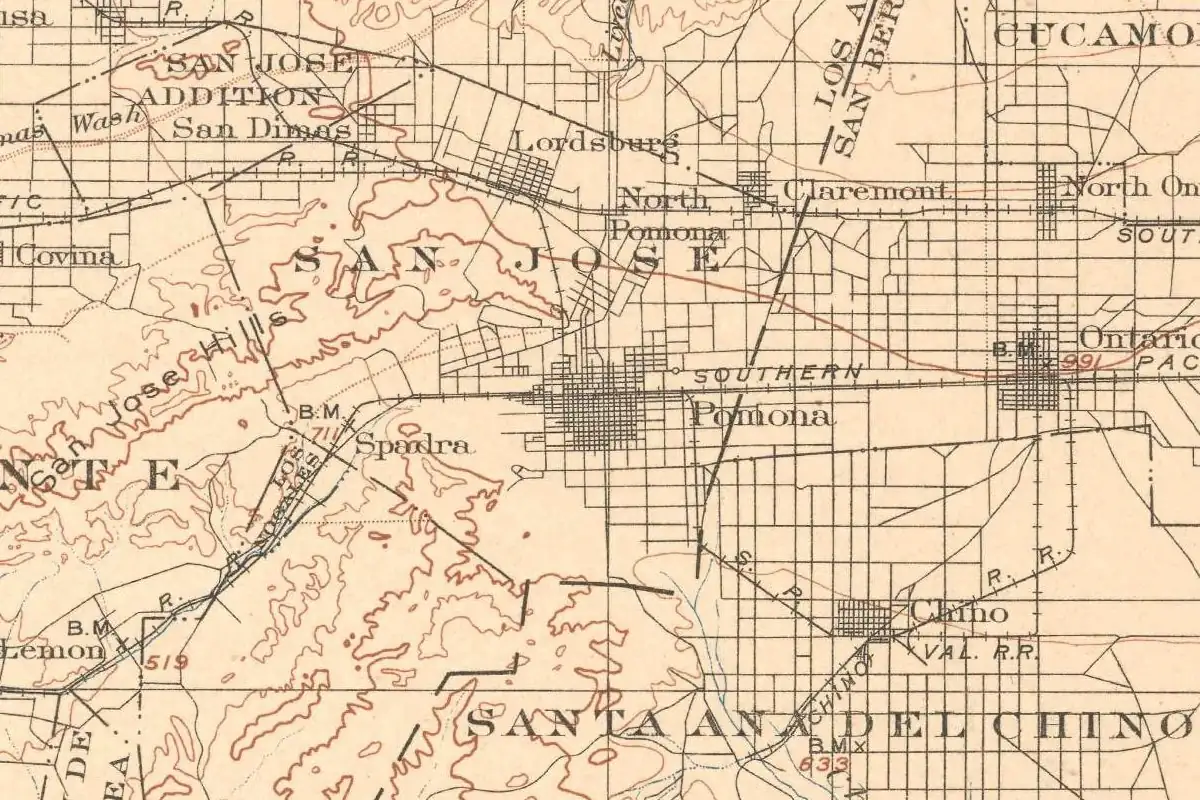
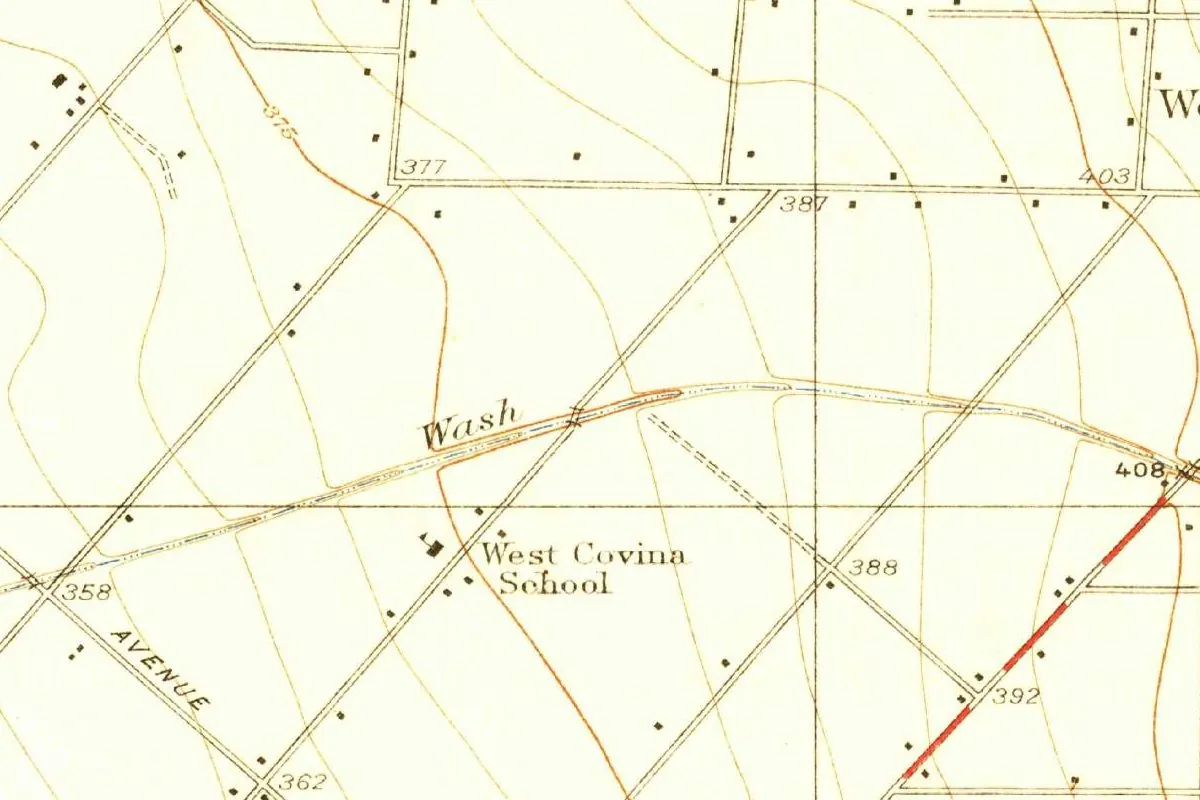
The new city stayed small for a long time. West Covina says walnut and orange groves kept flourishing in the decades after 1923, and that it had 769 people in 1930 and 1,549 in 1940. The government’s 1927 map at the top of this page shows mostly farm roads, a wash and a building marked West Covina School.
Then it took off. The city says it was America’s fastest-growing city between 1950 and 1960, going from fewer than 5,000 people to more than 50,000. That’s a lot of new residents in this stretch of California living in a city that began as a protest against a sewage farm, and that still carries the name of the town it was protesting.
Quick answers
Why is it called West Covina?
Because it’s the area west of Covina. Residents there incorporated in 1923 as their own city, and the name kept the neighbor’s.
Why did West Covina become a city?
To stop the City of Covina from putting a sewage farm on its land. The city says 507 residents banded together and incorporated on February 17, 1923.
Who named Covina?
It isn’t settled. Cal Poly Pomona’s library credits the surveyor Frederick Eaton in 1885, while a 1926 Covina Argus account says a number of local ladies chose it.
Was West Covina ever part of Covina?
No source we found says so. The city’s history says residents formed their own city so that Covina couldn’t decide how their land was used.
Key dates
- 1882Joseph Swift Phillips buys 2,000 acres of Hollenbeck land, the tract that becomes Covina.
- 1885Covina gets its name, credited by Cal Poly Pomona's library to the surveyor Frederick Eaton.
- 1923February 17: West Covina incorporates to stop Covina from putting a sewage farm inside its boundaries.
- 1924The state's Blue Book lists West Covina as a city of the sixth class, with B. F. Maxson as president of the trustees.
- 1926The Covina Argus prints pioneer Mrs. Eckles's account that a number of ladies chose the name Covina.
- 1950-1960West Covina grows from fewer than 5,000 people to more than 50,000, the city says.
Getting there
Open West Covina in Google Maps
Opens in a new tab. The pin is the center of West Covina in the USGS place-name record.
The closest airports, Amtrak stations and intercity bus stops, measured in a straight line from the center of West Covina.
Airports
- Ontario International (ONT) 19 mi 31 km
- Long Beach (Daugherty Field) (LGB) 21 mi 34 km
Amtrak trains
- Pomona station (POS) 11 mi 17 km
- Fullerton station (FUL) 14 mi 22 km
Intercity buses
- Mexicoach Baldwin Park (Executive Lines Terminal) 2 mi 4 km
- Limousine Express El Monte 5 mi 8 km
- International Bus Lines El Monte (Limo Express) 5 mi 8 km
Distances are as the crow flies, not by road. We don't list schedules or fares because they change; check with the airline, Amtrak or the bus company before you go. Official data (FAA commercial service airports (2025), FAA airport locations, Amtrak stations and Intercity Bus Atlas) from the FAA and the U.S. Bureau of Transportation Statistics, checked Nov 13, 2026.
Sponsored
Staying in West Covina?
Compare hotels in West Covina, California, on Expedia.
See hotels in West CovinaWe may earn a commission if you buy through this link. It never changes what we write. Read our affiliate disclosure
Historical Sources & References
- City of West Covina, “About the City”. Incorporation on February 17, 1923, to stop Covina’s sewage farm, the 507 residents, and Benjamin F. Maxson as first mayor, February 1923 to April 1928.
- City of West Covina, “History”. Walnut and orange groves, 769 people in 1930 and 1,549 in 1940, and growth from fewer than 5,000 to more than 50,000 between 1950 and 1960.
- California Blue Book, or State Roster (1924), p. 250. The City of West Covina as a city of the sixth class, its trustees under B. F. Maxson, and the clerk’s post office at Covina.
- Covina Argus, February 12, 1926, p. 2. The quoted account from Mrs. Eckles that a number of ladies chose the name Covina for the cove and the vineyards.
- Cal Poly Pomona University Library, “Covina,” Pomona Valley Historical Collection. Phillips’s purchase of 2,000 acres in 1882 and Covina as a blend of “cove” and “vine” from the surveyor Frederick Eaton in 1885.
- J. Scott Shannon, “Who Really Named Covina?” (Covina Past, 2023). Clara Eckles’s memoir about the Brethren colony and “Los Covinas,” and the 1885 circular that spelled the name “Covena.”
- GNIS feature 1652809 (U.S. Geological Survey). West Covina’s feature ID, its county (Los Angeles) and the coordinates the map follows.
- U.S. Geological Survey, Puente sheet (1927). The source of the map at the top of this page.
Spot something wrong, or know more? Tell us here. You can also email us or use our contact page. Corrections are noted here with their date, never made silently.