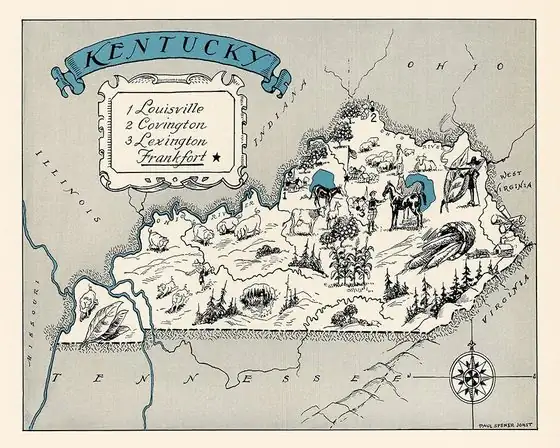
Bardstown, Kentucky: The Town Virginia Called Baird's Town
Bardstown is named for the Bard family. William Bard laid off the town around 1780 for his brother David, one of the landowners. The settlement was first called Salem, then Baird's Town, and a 1788 Virginia law established it as Baird's town. The modern spelling, Bardstown, drops the i.
Baird’s town, by act of Virginia
The 1788 Virginia law that created Bardstown, Kentucky, never used that spelling: it set up a town “by the name of Baird’s town,” after David Baird. The name comes from the Bard family, two brothers who owned and laid out the land, and it took a few tries before anyone settled on how to write it.
Virginia, not Kentucky, passed that law, because there wasn’t a state of Kentucky yet. Nelson County had been formed in 1784 by Virginia’s general assembly, as the fourth county in what Lewis and Richard Collins, in their 1874 History of Kentucky, called “the district (now state) of Kentucky.” So the paperwork for this town sits in the laws of Virginia, and that’s where the spelling problem starts.
The county had a namesake too. Collins says Nelson County was “named in honor of ex-Gov. Thomas Nelson of Va.” So the county honors a Virginia governor, and the town inside it honors a family of landowners whose name the lawmakers spelled their own way.
William Bard, agent for his brother
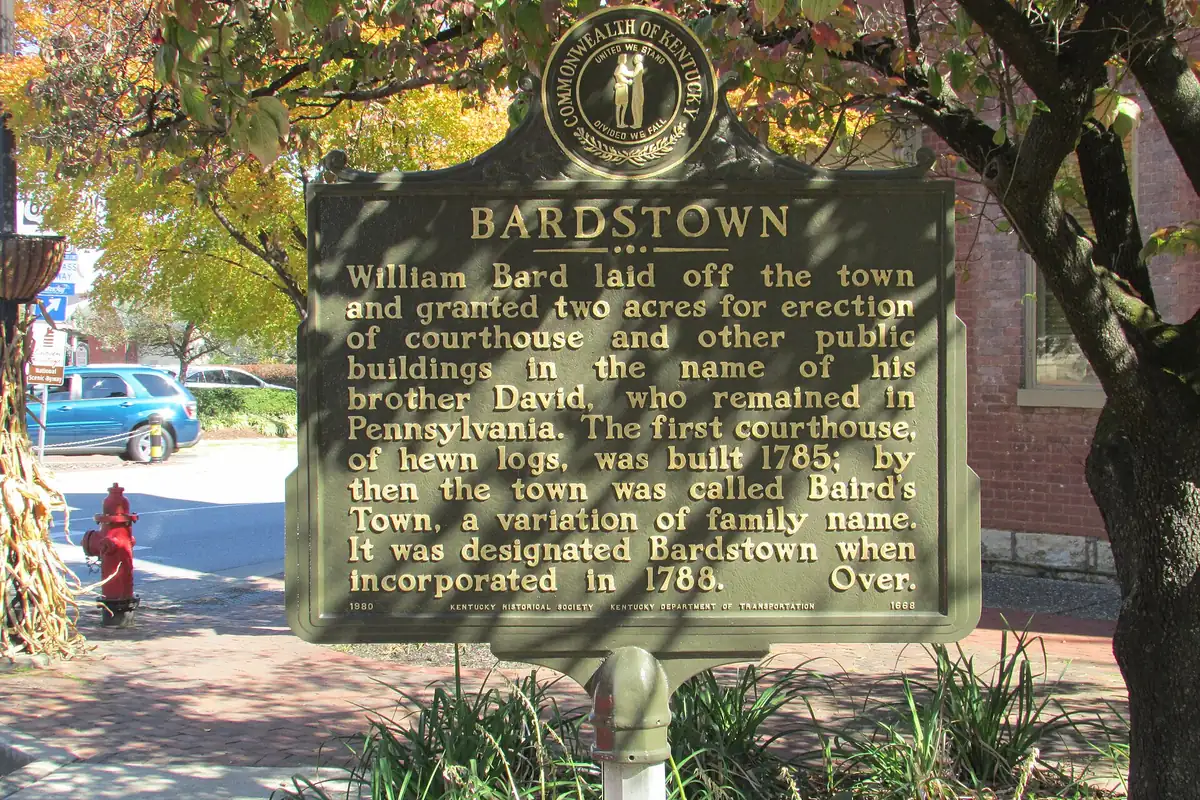
The Kentucky Historical Society’s marker on the courthouse square tells the family side. William Bard came in 1780 “as agent for his brother David and John C. Owings, and laid off the town.” The settlement, the marker says, “was first called Salem.”
In 1785 the Virginia General Assembly issued a land grant of 1,000 acres, and 100 of those acres, Salem included, were set aside for a county seat. William Bard granted two acres for a courthouse and other public buildings “in the name of his brother David, who remained in Pennsylvania.” The first courthouse, made of hewn logs, went up in 1785. By then, the marker says, the town was called Baird’s Town, “a variation of family name.”
The marker doesn’t say why the spelling drifted, only that the new form was a variation on the family’s own.
So you’ve got a town laid out by one brother, held in the name of another who never moved there, and called by a spelling that wasn’t quite theirs. That last part ended up in the law books.
What the 1788 law says
William Waller Hening’s collection of Virginia statutes prints the act, Chapter 60 of the October 1788 session, passed on December 2, 1788. It starts with the land itself:
“…one hundred acres of land, lying at a place called Baird’s town, in the county of Nelson, the property of David Baird, and John C. Owing…”
The act handed that land to a board of trustees, among them Andrew Hynes. That’s the name of the colonel who laid out Elizabethtown, in Hardin County, which Collins says was carved out of Nelson in 1792. The trustees were to divide it into half-acre lots “with convenient streets” and establish “a town by the name of Baird’s town.” Buyers had three years to build a house at least sixteen feet (5 m) square, “with a brick or stone chimney,” and the money from the lot sales went to Baird and Owing. The sale had to be advertised for two months at the courthouse doors of Jefferson and Nelson counties, and the trustees got the power to settle any arguments over lot lines.
That’s the founding document, and it spells the name with an i every time. Even the partner’s name wobbles: the marker calls him John C. Owings, while the act writes John C. Owing. Virginia was doing this a lot in those years. It had established Frankfort, the future capital, just two years earlier.
Salem didn’t vanish
The first name hung around in a different form. Seventeen days before the town act, on November 15, 1788, the same legislature passed a law about “the seminary of learning at the place called Baird’s town.” From then on, it said, that school “shall obtain the name of Salem Academy.”
Hening’s volume doesn’t explain the choice, and neither does the marker. But it’s hard to miss: the year the town got a law with the Baird name, its school got the Salem name.
Bard, Baird or Bardstown?
Here’s where the sources part ways. The historical society’s marker says the town “was designated Bardstown when incorporated in 1788.” The 1788 act, as Hening prints it, says Baird’s town.
The older histories lean toward the i as well. Collins wrote in 1874 that Bardstown “was established by the legislature of Virginia in 1788, as Bairdstown, after David Baird, one of the original proprietors of the 100 acres on which it was laid off.” He put it 40 miles (64 km) from Louisville and 50 (80 km) from Frankfort, with a stone courthouse, four or five churches and 1,835 people in 1870, which he noted was a gain of only 200 in 40 years. Henry Gannett’s 1905 dictionary of place names for the U.S. Geological Survey kept the same spelling: “named for David Baird, one of the original proprietors.”
None of these sources says when the i dropped out, or who dropped it. By the time Collins wrote, the town’s name was printed Bardstown, while the man was still spelled Baird. You can read that as a correction or as a slip that stuck.
Either way, the family name on the marker today is Bard. In a roundabout way, the town ended up closer to that spelling than the law that founded it ever was. For more Kentucky name stories, head to our Kentucky page.
Quick answers
Who is Bardstown, Kentucky, named after?
The Bard family. The Kentucky Historical Society says William Bard laid off the town for his brother David and John C. Owings; Collins (1874) and Gannett (1905) name David Baird, “one of the original proprietors.”
What was Bardstown’s first name?
Salem. The state historical marker says the settlement “was first called Salem,” and that by 1785 it was called Baird’s Town.
Was Bardstown always spelled that way?
No. The 1788 Virginia act established “a town by the name of Baird’s town,” and Collins says it was established as Bairdstown. The sources here don’t say when the spelling changed.
Key dates
- 1780William Bard arrives as agent for his brother David and John C. Owings and lays off the town. The settlement is first called Salem.
- 1785Virginia grants 1,000 acres, 100 of them set aside for the county seat. The first log courthouse goes up, and by then the town is called Baird's Town.
- 1788On November 15, Virginia incorporates Salem Academy at Baird's town. On December 2, it passes the act establishing a town "by the name of Baird's town."
Things to do in Bardstown, Kentucky
My Old Kentucky Home State Park
The park centers on Federal Hill, the house Judge John Rowan built in two stages, in 1795 and 1818. The Kentucky Historical Society calls it the inspiration for Stephen Collins Foster's song, now Kentucky's state song.
Basilica of St. Joseph Proto-Cathedral
Bishop Benedict Joseph Flaget, the first bishop of the Diocese of Bardstown, began this cathedral in 1816, and it was dedicated in 1819. When the see moved to Louisville in 1841 it became the proto-cathedral, the first cathedral.
Wickland
A Georgian mansion built around 1815 by Charles A. Wickliffe and known as the home of three governors: Wickliffe himself, his son Robert in Louisiana, and his grandson J. C. W. Beckham.
Spalding Hall
Built in 1826 as part of St. Joseph College, a military hospital during the Civil War, it later served as a seminary, orphanage and school. Today it houses the Oscar Getz Museum of Whiskey History.
Getting there
Open Bardstown in Google Maps
Opens in a new tab. The pin is the center of Bardstown in the USGS place-name record.
The closest airports, Amtrak stations and intercity bus stops, measured in a straight line from the center of Bardstown.
Airports
- Louisville Muhammad Ali International (SDF) 29 mi 47 km
- Blue Grass (LEX) Lexington 49 mi 79 km
- Cincinnati/Northern Kentucky International (CVG) Hebron 96 mi 154 km
Intercity buses
- Greyhound Upton Weldon Loop Rd 33 mi 53 km
- Miller Transportation Louisville 35 mi 56 km
- Barons Bus Lines Louisville 35 mi 56 km
Distances are as the crow flies, not by road. We don't list schedules or fares because they change; check with the airline, Amtrak or the bus company before you go. Official data (FAA commercial service airports (2025), FAA airport locations, Amtrak stations and Intercity Bus Atlas) from the FAA and the U.S. Bureau of Transportation Statistics, checked Nov 13, 2026.
Sponsored
Staying in Bardstown?
Compare hotels in Bardstown, Kentucky, on Expedia.
See hotels in BardstownWe may earn a commission if you buy through this link. It never changes what we write. Read our affiliate disclosure
Historical Sources & References
- Kentucky Historical Society, “Bardstown,” Kentucky Historical Marker 1668. William Bard’s arrival in 1780 as agent for his brother David and John C. Owings, the first name Salem, the 1785 land grant and county seat, the log courthouse of 1785, “Baird’s Town, a variation of family name,” and the line that the town was designated Bardstown in 1788.
- William Waller Hening, The Statutes at Large (Laws of Virginia), vol. 12, pp. 676 and 718-719. Chapter 60, passed December 2, 1788, establishing “a town by the name of Baird’s town” on 100 acres owned by David Baird and John C. Owing, with its trustees, building rules and the two-month notice of the lot sale (pp. 718-719). Also online: Chapter 18, passed November 15, 1788, naming the seminary at Baird’s town Salem Academy (p. 676).
- Lewis Collins and Richard H. Collins, History of Kentucky (1874), vol. 2, pp. 212, 307-308 and 643-644. Nelson County’s formation in 1784 and its namesake, ex-Gov. Thomas Nelson of Virginia, Hardin County’s split from it in 1792, and Bardstown “established by the legislature of Virginia in 1788, as Bairdstown, after David Baird,” with its distances from Frankfort and Louisville and its 1870 courthouse, churches and population. Also used: Col. Andrew Hynes laying out land at Elizabethtown (Hardin County, pp. 307-308) and Frankfort “established” by the Virginia legislature in 1786 (p. 212).
- Henry Gannett, The Origin of Certain Place Names in the United States (USGS, 1905), p. 36. Bardstown “named for David Baird, one of the original proprietors.”
- GNIS feature 486333 (U.S. Geological Survey). Where the Geographic Names Information System puts Bardstown: a populated place in Nelson County, at the coordinates used here.
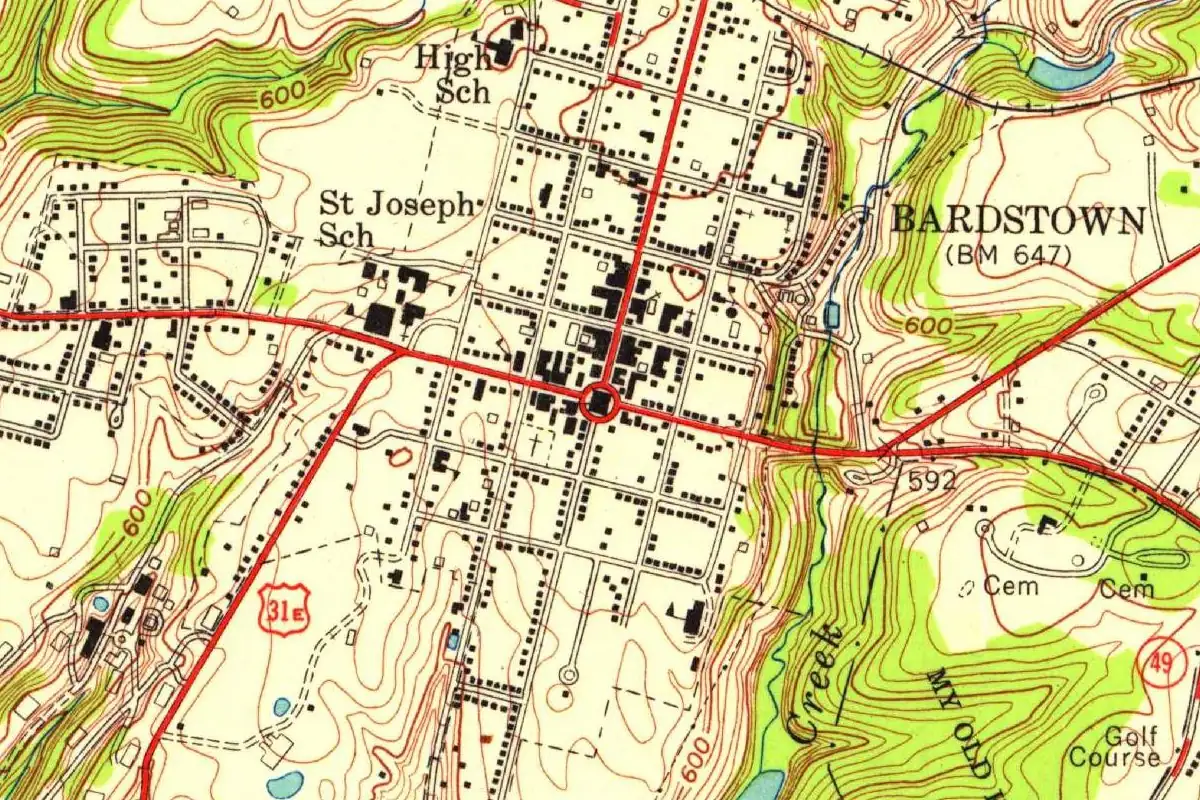
- U.S. Geological Survey, Bardstown sheet (1953). The 1:24,000 quadrangle the old map at the top of this page comes from.
Spot something wrong, or know more? Tell us here. You can also email us or use our contact page. Corrections are noted here with their date, never made silently.