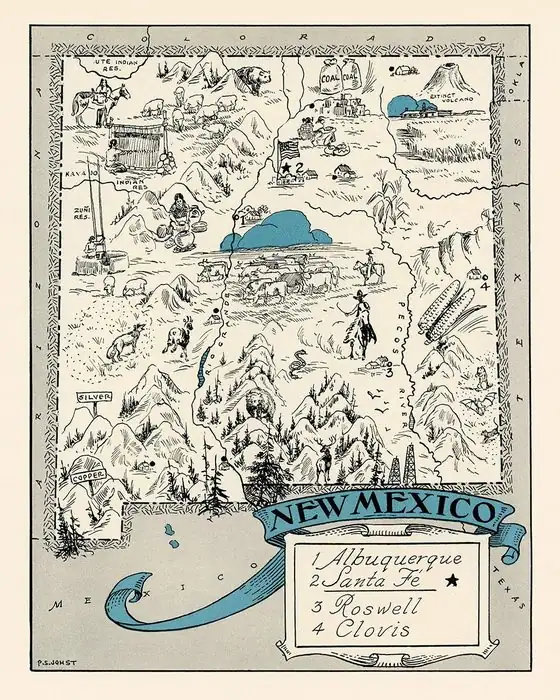
Alamogordo, New Mexico: The Big Cottonwood Behind the Name
Alamogordo comes from the Spanish álamo gordo, a big or "fat" cottonwood. The city says John Eddy, brother of railroad man Charles Eddy, named it in 1898 for cottonwoods he remembered from the Pecos River country. A 1995 study by William McPhee and Harry Parsons concludes that he joined the two words on purpose.
Alamogordo, New Mexico, carries a Spanish name you won’t find in a Spanish dictionary: it’s álamo gordo, a big or “fat” cottonwood, run into one word. The man who joined the two words was John Eddy, who named the railroad’s stations in 1898 and remembered a cottonwood campsite in New Mexico’s Pecos River country.
Álamo plus gordo
Take the name apart and it’s two ordinary Spanish words. The City of Alamogordo spells it out on its history page: “Gordo = fat; alamo = poplar or cottonwood.” Henry Gannett had it down as Spanish by 1905, too, in the second edition of his Origin of Certain Place Names in the United States, where Alamogordo is “A Spanish word meaning ‘large poplar’ or ‘large cottonwood.’”
There’s a catch, though. A 1995 article in the New Mexico Historical Review, by William N. McPhee and Harry R. Parsons, opens by pointing out that “Alamogordo” doesn’t occur in Spanish dictionaries “either as a word or a name.” It’s two words that someone decided to write as one. So the question isn’t really what it means. It’s who glued it together, and why.
The Eddy brothers and a railroad
The town was a railroad project from the start. Michael Welsh’s 1995 history of White Sands for the National Park Service says two New York brothers, Charles and John Eddy, came to the Pecos River valley in the 1880s to run a cattle ranch. Charles promoted towns there, including Roswell and Carlsbad, “which he first named for himself.”
Then the brothers looked west, toward the Tularosa Basin. Charles Eddy pitched a rail line to investors in El Paso, Welsh writes, and by 1897 he had enough backing for the El Paso and Northeastern Railroad. The railroad created a new townsite about 15 miles (24 km) east of the dunes, “named Alamogordo (‘fat cottonwood’ in Spanish), where for $5,000 the EPNE had purchased Oliver Lee’s Alamo ranch and its precious water rights.” A company subsidiary platted the village, and within twelve months it had a thousand people.
The city’s own history dates the founding to 1898 and says Charles Bishop Eddy shaped the plan, with wide streets and tree-lined irrigation canals. The east-west streets got numbers and the north-south streets got the names of states. Today’s White Sands Boulevard was Pennsylvania Avenue.
John Eddy’s cottonwood
Welsh doesn’t say who picked the name. The city does: “Charles Eddy’s brother, John Eddy, named the new city Alamogordo after a grove of fat cottonwoods he remembered from the Pecos River area.”
You can also read it in Eddy’s own words, more or less. McPhee and Parsons found a typed manuscript in the Eddy scrapbook, “The Twenty-Fifth Anniversary of the Founding of Alamagordo,” dated May 28, 1923. In it, John Arthur Eddy writes that “It devolved on me to name the stations on the [rail]road.” He didn’t want plain “Alamo,” which he found “so common.” Instead he thought of a favorite campsite that “was on a little stream running into the east side of the Pecos,” a stream called Alamo Gordo, and of what he’d learned the name meant: “a big or ‘Rotund’ cottonwood.” Then, as he tells it:
“upon seeing such a tree, at the mouth of the Alamo Canon, the name came back impressively to me.”
“And that is how Alamogordo got its name,” he wrote. The name, in other words, came from a stream he remembered, and one tree brought it back.
The authors also point to newspaper notices dated May 26, 1898, that offered lots in “Alamogordo,” each signed “J.A. Eddy, President.” So the one-word spelling was in print from the town’s first weeks.
An old name, written as one word
Eddy didn’t invent the phrase. McPhee and Parsons trace “Alamo Gordo,” often with arroyo in front of it, back to 1838, when a man named Sutton received a land grant centered on a spring along the Pecos River. The name shows up again on an 1851 U.S. Army map, they write, and in reports from Fort Sumner in the 1860s.
Their first guess was that some government office, maybe the post office or a mapmaker, had squeezed the two words together over time. They ended up rejecting that. In their view, the joined spelling “was a deliberate action by John Arthur Eddy,” and it was “intended as a name right from the start.” They compare it to Yellowstone, another name made by running two words together.
That’s the reason the dictionary comes up empty. In their reading, the words are Spanish, but the single word is Eddy’s.
The 1950 map
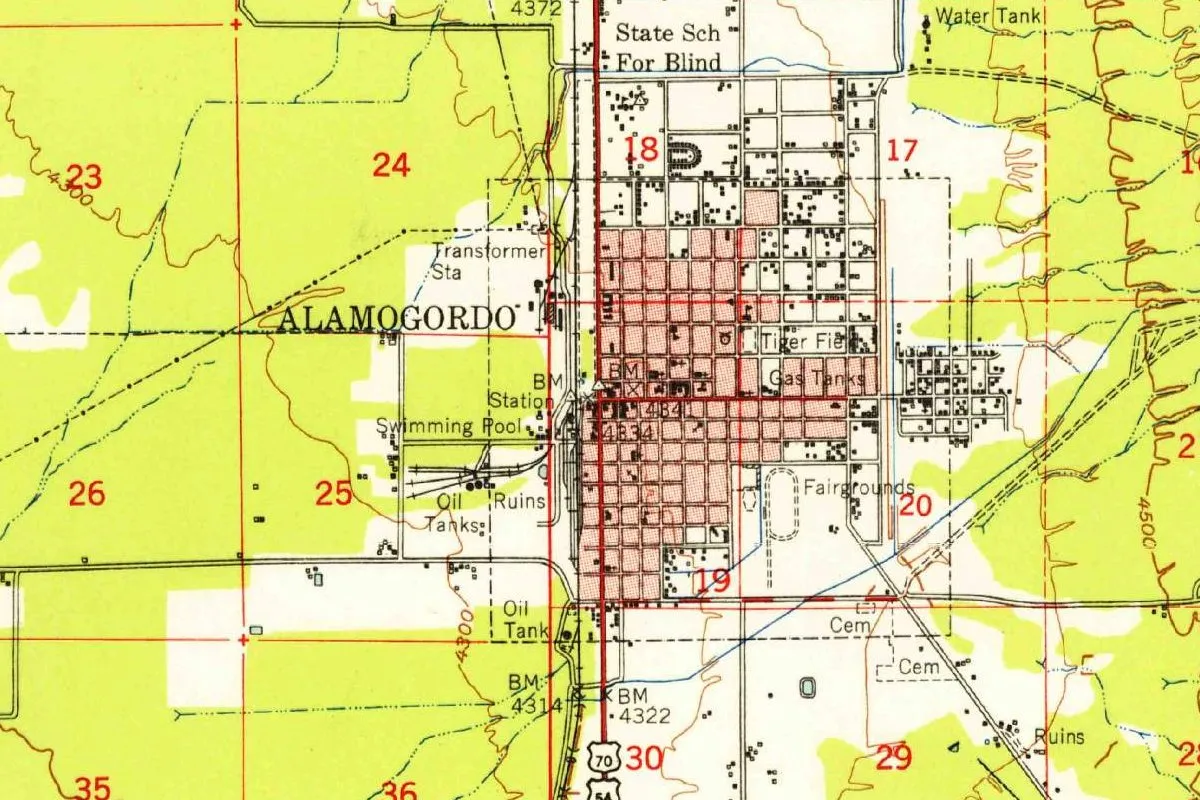
The map at the top of this page comes from the U.S. Geological Survey’s Alamogordo sheet of 1950, about half a century after the railroad came through. The label ALAMOGORDO sits west of the tracks, next to a station, oil tanks and a swimming pool, while the shaded street grid spreads east toward the fairgrounds. At the top edge you can make out the State School for the Blind.
If you’re hunting for the town’s cottonwoods on that map, you won’t find them labeled. What you will find is the grid the railroad company laid out, with the shields of US 70 and US 54 near the bottom and, beside the tracks, the one word John Eddy chose in 1898.
Quick answers
What does Alamogordo mean in English?
Big or “fat” cottonwood. Gannett (1905) gives “large poplar” or “large cottonwood,” the city says “fat cottonwood,” and John Eddy wrote that he’d learned it meant “a big or ‘Rotund’ cottonwood.”
Who named Alamogordo?
John Arthur Eddy, according to the City of Alamogordo and his own 1923 account, which McPhee and Parsons quote. He was the brother of Charles B. Eddy, who headed the El Paso and Northeastern Railroad.
Is Alamogordo a real Spanish word?
Not as one word. McPhee and Parsons note it isn’t in Spanish dictionaries; it joins álamo and gordo, and they conclude Eddy wrote it as one word on purpose.
When was Alamogordo founded?
In 1898, when the El Paso and Northeastern Railroad reached the townsite, according to the city’s history page.
Key dates
- 1838The name "Alamo Gordo" is already in use for a stream near the Pecos, according to McPhee and Parsons.
- 1851"Alamo Gordo" appears on a U.S. Army map, McPhee and Parsons write.
- 1898The El Paso and Northeastern reaches the new townsite; lots in "Alamogordo" are advertised on May 26.
- 1905Henry Gannett lists Alamogordo as a Spanish word meaning "large poplar" or "large cottonwood."
- 1923On May 28, John Arthur Eddy writes down how he named Alamogordo, for the town's 25th anniversary.
Things to do in Alamogordo, New Mexico
White Sands National Park
Wave-like dunes of gypsum sand cover 275 square miles (712 sq km) of the Tularosa Basin here. The Park Service calls it the world's largest gypsum dunefield.
New Mexico Museum of Space History
Dedicated on October 5, 1976, as the International Space Hall of Fame. The campus also takes in the New Horizons Dome Theater and Planetarium, the John P. Stapp Air & Space Park and the Astronaut Memorial Garden.
Alameda Park Zoo
The city's zoo dates to 1898, the year Alamogordo was founded, and the city calls it the oldest zoo in the Southwest. It keeps nearly 170 animals of 70 species on 12 acres (about 5 ha).
Oliver Lee Memorial State Park
A historic ranch house and year-round springs under the cottonwoods of Dog Canyon. Oliver Lee settled at the canyon's mouth in 1893, and the park says he was instrumental in establishing the town of Alamogordo.
Getting there
Open Alamogordo in Google Maps
Opens in a new tab. The pin is the center of Alamogordo in the USGS place-name record.
The closest airports, Amtrak stations and intercity bus stops, measured in a straight line from the center of Alamogordo.
Airports
- El Paso International (ELP) 79 mi 128 km
- Roswell Air Center (ROW) 87 mi 141 km
Amtrak trains
- El Paso station (ELP) 85 mi 137 km
Intercity buses
- Greyhound Alamogordo Bus Station 3 mi 4 km
Distances are as the crow flies, not by road. We don't list schedules or fares because they change; check with the airline, Amtrak or the bus company before you go. Official data (FAA commercial service airports (2025), FAA airport locations, Amtrak stations and Intercity Bus Atlas) from the FAA and the U.S. Bureau of Transportation Statistics, checked Nov 15, 2026.
Sponsored
Staying in Alamogordo?
Compare hotels in Alamogordo, New Mexico, on Expedia.
See hotels in AlamogordoWe may earn a commission if you buy through this link. It never changes what we write. Read our affiliate disclosure
Historical Sources & References
- William N. McPhee and Harry R. Parsons, “Origins of the Name ‘Alamogordo’,” New Mexico Historical Review 70, no. 4 (1995). The point that “Alamogordo” isn’t in Spanish dictionaries (p. 417); John Arthur Eddy’s 1923 manuscript, with the quoted lines about naming the stations, the Pecos campsite and the tree at the mouth of Alamo Canyon (p. 418, note 3 on p. 420); the 1898 notices, and “Alamo Gordo” in 1838, on an 1851 Army map and in Fort Sumner reports (p. 419); the authors’ conclusion (p. 420).
- City of Alamogordo, “History of Alamogordo”. The 1898 founding, Charles Bishop Eddy and the railroad, John Eddy naming the city for cottonwoods “he remembered from the Pecos River area,” the street names, the meaning “fat cottonwood,” and the zoo’s 1898 start.
- Michael Welsh, Dunes and Dreams, chapter 2 (National Park Service, 1995). The Eddy brothers in the Pecos valley, Carlsbad and Roswell, the El Paso and Northeastern, and the townsite 15 miles (24 km) east of the dunes on Oliver Lee’s former Alamo ranch.
- Henry Gannett, The Origin of Certain Place Names in the United States, 2nd ed. (1905), p. 19. “A Spanish word meaning ‘large poplar’ or ‘large cottonwood.’” Checked against the page image.
- National Park Service, White Sands National Park; New Mexico Museum of Space History; Alameda Park Zoo; Oliver Lee Memorial State Park. The details in the things-to-do list.
- GNIS feature 903054 (U.S. Geological Survey). The national gazetteer’s entry for Alamogordo, Otero County, with its coordinates.
- U.S. Geological Survey, Alamogordo sheet (1950). The 1:62,500 map, printed in 1955, that the image at the top of this page was cropped from.
Spot something wrong, or know more? Tell us here. You can also email us or use our contact page. Corrections are noted here with their date, never made silently.